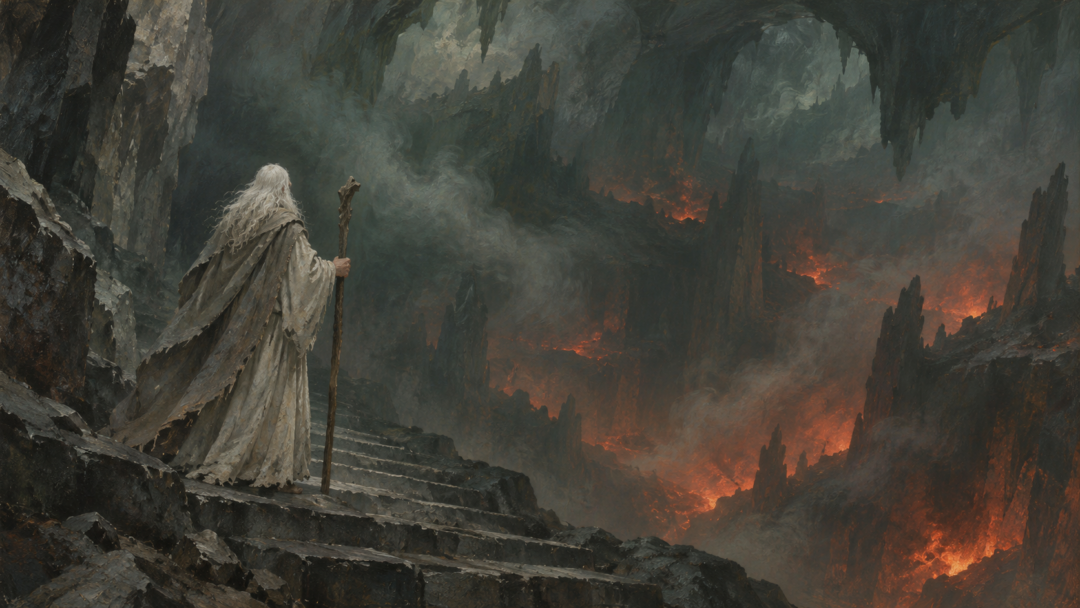
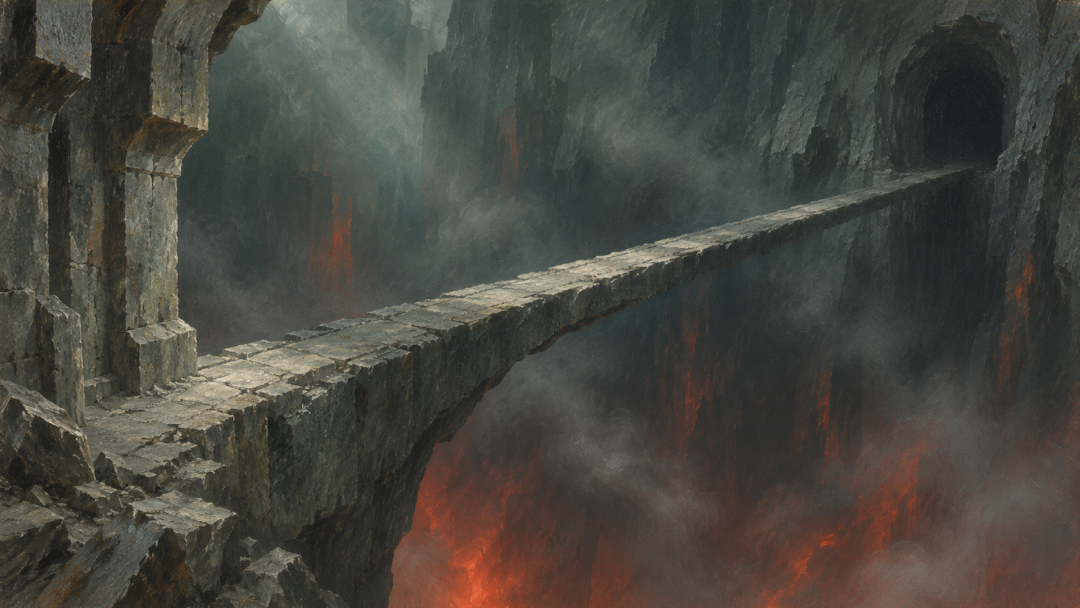
The bridge of Khazad-dûm is scarcely wide enough for a single traveller. Behind Gandalf, the Fellowship scrambles towards safety; ahead, a shadow wrapped in fire advances with a sword and a many-thonged whip. Gandalf names it a “flame of Udûn” and holds his ground. Now imagine that the white-robed figure on the bridge is not Gandalf but Saruman, the chief of the Wizards. Would the creature have met its match?
Probably not decisively, and certainly not cheaply. Saruman was no ordinary sorcerer: he was a Maia, a spirit of the same broad order as the Balrog. But the Wizards lived under special limits, and Saruman's title did not make him the strongest fighter among them. No book describes him meeting a Balrog. The best evidence comes from what Saruman really was, what he could do, and what Gandalf had to endure to destroy Durin's Bane.
A Maia, but a Wizard first
In The Silmarillion, the Ainulindalë places the Ainur before the making of the world, while the Valaquenta describes the Maiar as spirits of the same order as the Valar, though lesser in degree. Saruman belonged to this order. His elderly face and white robes were not his original nature; they were the form in which he was sent to Middle-earth. That puts him far beyond a human scholar who happened to master a few spells.
Unfinished Tales, in its account of the Istari, associates Saruman with Aulë, the Vala of making and craft. That background suits the Curunír we encounter in the story: a figure drawn to knowledge, devices, and the secrets of power. Sauron had also been associated with Aulë before his fall. The connection helps explain a shared interest in making and control, but it supplies no evidence that Saruman and Sauron—or Saruman and a Balrog—had equal strength.
Saruman came as the first and most prominent of the Wizards and was regarded as their chief. At the Council of Elrond, Gandalf himself calls him the greatest of his order, remembering the wisdom and knowledge that once made his advice valuable. Yet neither “chief” nor “greatest” is a measurement of ability in a duel. Rank, learning, and the authority to lead a council are different things from surviving a whip of fire on a stone bridge.
More importantly, the Istari were not Maiar walking freely in their full spiritual majesty. They took real, aged bodies, subject to weariness, pain, fear and death. Their task was to oppose Sauron by advising and encouraging the peoples of Middle-earth, not by unveiling their power and ruling others through force. They were forbidden to match Sauron openly with power or dominate Elves and Men through terror. Letters discussing Gandalf's return reinforce how seriously this mission and its limitations matter.
Those restrictions did not mean a Wizard was helpless in a fight. Gandalf uses fire, light, command and protective spells, and ultimately stands against the Balrog. Defending companions from immediate destruction is not the same as setting himself up as a new Dark Lord. Saruman likewise had genuine powers. But imagining him simply dropping his mortal appearance and fighting as an unrestricted ancient spirit changes the question: that would no longer be the Saruman whose deeds the books let us assess.
What Gandalf's victory actually cost
The Balrog was not a large animal with a supernatural coat of flame. The Valaquenta identifies the Balrogs, or Valaraukar, as spirits drawn into Morgoth's service, creatures of shadow, terror and fire. They were among his most dangerous servants in the First Age. In later conceptions of the legendarium they are fewer and more formidable than some early versions suggest, not disposable monsters.
Durin's Bane had survived that ancient world, hidden beneath the Misty Mountains. When the Dwarves disturbed it, the creature killed their kings and helped drive them from Khazad-dûm. Its concealment was no sign of weakness. When it appears before the Fellowship, even the Orcs recoil. Gandalf understands that Aragorn, Boromir and the others cannot face this enemy, however brave they are.
Even before the bridge, Gandalf meets an unseen will contesting his spell upon a door in the Chamber of Mazarbul. The counterspell nearly breaks him, and the door is shattered. He has not yet identified his opponent. This is a magical contest, not a physical one: the Balrog can challenge a Wizard's working directly. Saruman's learning would not prevent such a collision of wills.
At the bridge Gandalf faces a weapon of fire, withstands its attack, and breaks the stone span beneath the creature. The Fellowship escapes and the Balrog falls. But its whip catches Gandalf and pulls him down. Destroying the crossing saves the others without ending the creature. A Saruman who achieved only that much would still face a terrible problem below.
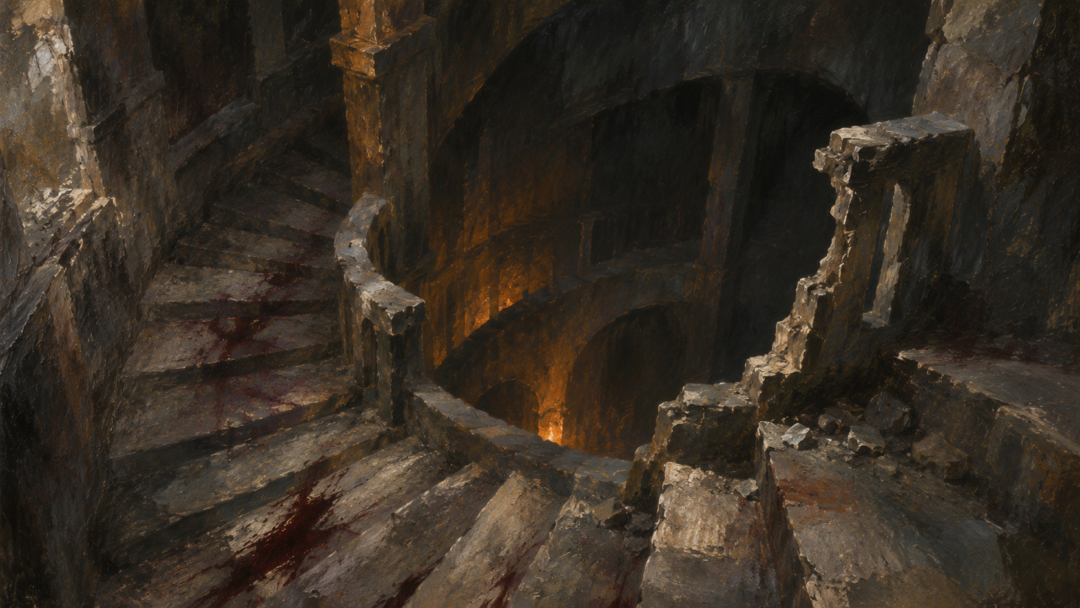
In The Two Towers, “The White Rider” tells the rest. Gandalf and the Balrog fall into deep water and fight in darkness. The Balrog's fires are quenched, but it is not killed; it flees through the depths, and Gandalf pursues it up the Endless Stair. On the summit of Zirakzigil it bursts into flame again. Their struggle brings thunder, lightning, steam and falling ice, before Gandalf finally casts it down and dies himself.
Gandalf's return as the White Rider is therefore not the normal reward for winning a difficult duel. He is sent back after death to complete his task; he does not revive himself with a spell learned from the Wizards' order. That distinction makes any comparison with Saruman uncomfortable. The one clear Third Age example of a Wizard defeating a Balrog required everything Gandalf could give, followed by an intervention outside his own ordinary power.
Could Saruman's voice or knowledge have changed the fight?
Saruman's most remarkable weapon in the books is not a sword or a blast of flame. It is his voice. In “The Voice of Saruman,” the company gathered below Orthanc hears speech that seems wonderfully reasonable, even when the words themselves ought to raise suspicion. Listeners feel drawn to agree, and those who resist must work against the spell. Gandalf warns his companions to be wary precisely because Saruman remains dangerous even after his armies and fortifications have failed him.
That power is formidable against people who can be tempted, flattered, divided or made doubtful. Théoden has to reject a voice inviting him to reconsider the conflict with Isengard. But a Balrog is no anxious king or wavering counsellor. Nothing in the books establishes that Saruman could charm one into retreat or obedience. Gandalf confronts Durin's Bane with words of authority, including the command to return to the shadow, and the creature attacks anyway.
Saruman also knew much about the Enemy's arts, especially the Rings of Power. At Orthanc he even names himself a ring-maker, though the story never establishes what his own ring can accomplish. His research might have suggested wards, traps or ways to delay a servant of ancient darkness. Yet studying Sauron's devices does not amount to possessing a secret weapon against Balrogs. No passage credits him with one, and there is no reason to turn his expertise into an automatic victory.
His machinery offers another tempting possibility. Saruman equips Isengard for war, with furnaces, underground works and fire that burns some of the Ents during their assault. He is capable of making the landscape itself hostile. Given preparation and a defensible passage, he might try to collapse stone, cut off pursuit or contain an enemy rather than meet it blade to blade. That is a plausible hypothetical tactic, not a documented ability to imprison or destroy a Balrog. Nor can we assume an ancient fire-spirit would be vulnerable to Isengard's flames.
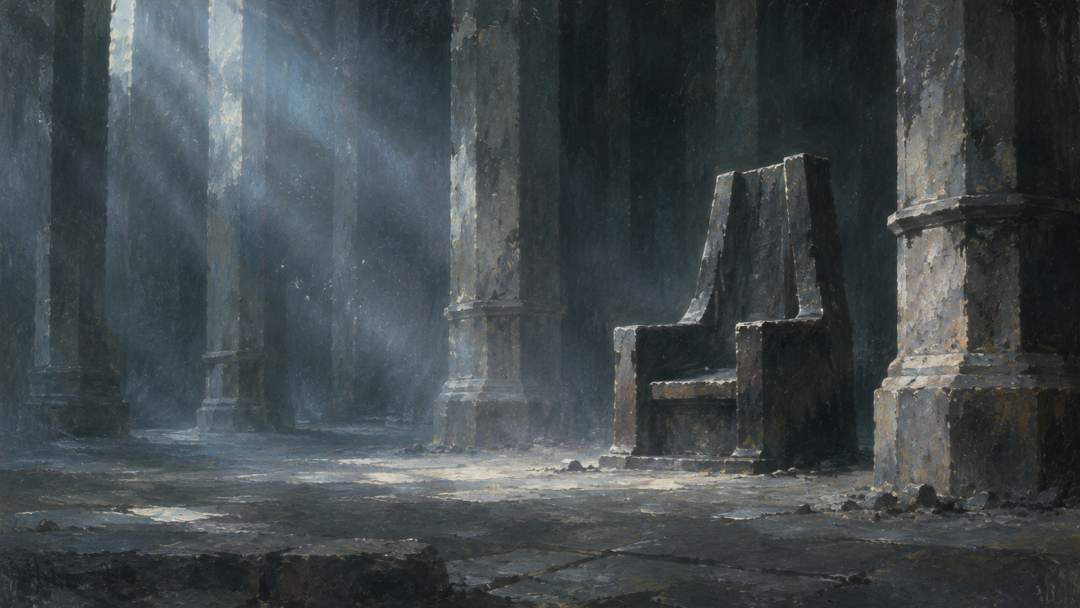
If Saruman had stood on the bridge
Suppose Saruman took Gandalf's place in Moria with the Fellowship behind him. A temporary success is entirely possible: he could resist, obstruct, buy time, perhaps even bring down the bridge. His standing as a Maia makes that more credible than it would be for an ordinary warrior. But if the Balrog survived the fall, as it did against Gandalf, Saruman would still face an enemy able to fight in darkness and renew its fire above the mountain.
An outright victory is harder to justify. We never see Saruman endure anything comparable to Gandalf's pursuit through the depths or the Battle of the Peak. We do see his power fail in other circumstances: the Ents ruin Isengard, Gandalf the White breaks his staff and casts him from the order, and, at Bag End, Wormtongue kills him with a knife. That final scene proves his embodied vulnerability, not that a Balrog could dispatch him just as easily at the height of his power.
The films can distort the comparison. Peter Jackson shows Saruman using force against Gandalf at Orthanc, a physical magical confrontation the book does not stage in that form. In the extended film ending, Saruman dies at Orthanc rather than in the Shire. Neither version gives him a meeting with Durin's Bane, and a cinematic display of magic cannot settle a duel that never happens in the written story.
The last trace of Saruman in the book is not a storm upon a mountain. It is a wisp of grey mist above the Hill, turning towards the West before a cold wind scatters it. Against the fire beneath Moria, that is no proof he would lose. It is a reminder how little even a Maia's title can promise when a body must stand and fight.
Sources & Notes
This article is based on close reading and interpretation of Tolkien's published works and related source material where relevant.