On Weathertop, Frodo slips the One Ring onto his finger and the Black Riders change before his eyes. Beneath their cloaks he sees pale faces, grey hair, silver helms, and a crowned figure carrying a dreadful knife. The Riders have not changed; Frodo can now see what was hidden.
That glimpse raises a question about the men who first received the Nine Rings. Did they acquire power over an invisible realm, as well as their earthly kingdoms? Yes, but only in a dangerous and limited sense. The Nine allowed their bearers to become unseen and perceive things hidden from mortal sight. They prolonged life and magnified worldly power, yet gradually drew their owners out of the visible world and into Sauron’s control.
What the Nine actually gave their bearers
The most direct answer comes in The Silmarillion, in “Of the Rings of Power and the Third Age.” After Sauron recovered Rings of Power and distributed them among Dwarves and Men, the recipients of the Nine rose to remarkable stature. The account describes kings, sorcerers, and warriors who gained glory and wealth. The Rings granted far more than an ability to vanish: their bearers wielded formidable worldly influence.
Yet we should not imagine nine established monarchs each receiving a Ring on his throne. Some recipients were powerful already; others became mighty through their Rings. “Akallabêth” tells us that three of those ensnared were great lords of Númenórean race, but it does not supply nine biographies. Most of their identities and careers remain unknown.
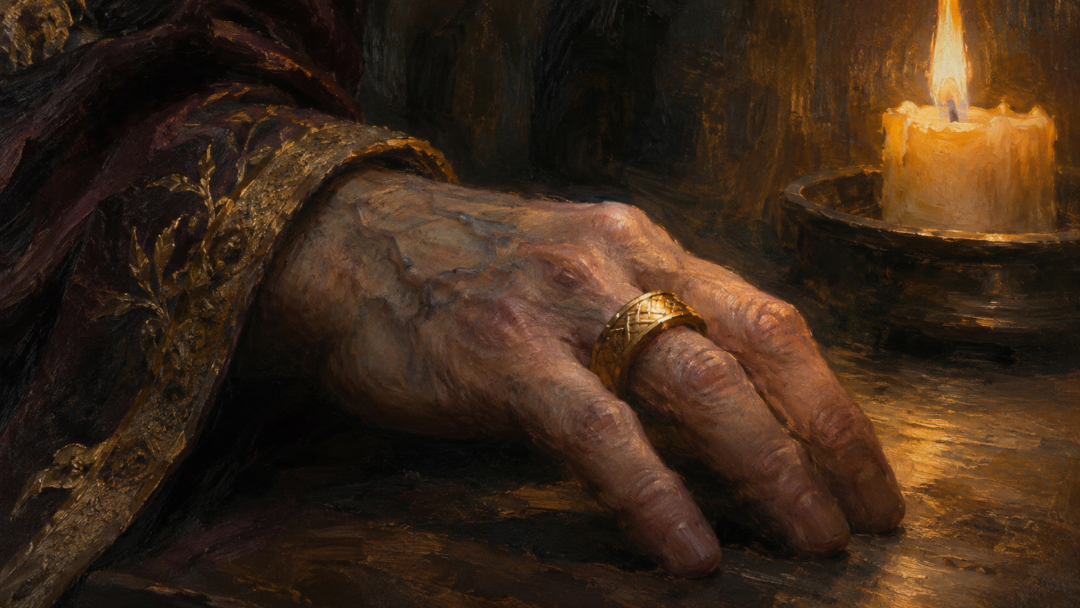
Their stranger abilities are described just as plainly. The bearers could choose to move without being seen by ordinary eyes, and they could perceive things that mortal Men could not. At first, then, the relationship with the unseen seems to involve a choice: a man might remain visible among his subjects, then pass beyond their sight. The Ring thus offers a condition most mortals cannot voluntarily enter, but not authority over everything encountered there.
Even the knowledge gained through this new sight was suspect. The same passage warns that the bearers often perceived Sauron’s phantoms and delusions. A king might believe himself privy to secret realities while receiving a view corrupted by the Dark Lord. We are not told what specific visions any of the Nine experienced, so there is no reason to invent consultations with spirits or secret councils of the dead.
The gift of lengthened life could look more desirable than either invisibility or mysterious sight. In “Akallabêth,” Númenor’s history is increasingly haunted by the fear of dying. Its people lived longer than other Men, but even their kings died. The longing to keep life and power from slipping away provides a powerful context for Sauron’s offers. It does not prove that each Ring-bearer accepted for the same reason; their individual hopes are not recorded.
Yet prolonged life was precisely where the promise began to betray them. The Nine did not turn mortal Men into Elves or give them a greater share of living. They kept existence going past its natural limit, until endurance itself became torment. The longer a bearer enjoyed his advantages, the longer the Ring worked upon him.
The unseen is not simply the land of the dead
Middle-earth has more than one way of being present in the world. Some things lie open to ordinary sight; others belong to an unseen aspect of reality. That distinction is especially vivid in The Fellowship of the Ring. At Weathertop, wearing the One Ring brings Frodo into a clearer perception of the Nazgûl. He sees beneath their black coverings, but this is hardly a safe unveiling. The Riders can now perceive him with terrifying directness, and their leader wounds him with a Morgul-knife.
Invisibility is an incomplete description of a Great Ring’s effects. To other people, Frodo disappears. To the Ringwraiths, he becomes more exposed. He has crossed toward their mode of existence, not slipped into a protected hiding place. The One Ring need not work exactly like the Nine to reveal the danger: seeing the unseen can also mean being seen by it.
There is another illuminating moment at the Ford of Bruinen. As Frodo weakens from his wound, the Riders grow clearer to him, while Glorfindel appears as a shining figure. Later, in “Many Meetings,” Gandalf explains that those who have dwelt in the Blessed Realm live in both the Seen and the Unseen and possess power against both. Glorfindel’s radiance is not the result of being consumed by a Ring. It belongs to an entirely different kind of being and history.
That comparison prevents a common mistake. The unseen is not a single gloomy kingdom in which all its inhabitants have the same status. The Nazgûl are drawn there through enslavement; an Elf such as Glorfindel can act in both aspects of the world without suffering their fate. Nor is this wraith-world the Halls of Mandos, associated with departed spirits in the larger mythology. The ultimate fate of Men lies beyond the world, not under the authority of the Nine.
Their unusual senses also have practical limits. Before the attack on Weathertop, Aragorn explains that the Black Riders do not perceive daylight as ordinary people do. Living shapes impress themselves upon their minds, and at night they can discern signs hidden from others. Yet their horses see normally, and the Riders employ spies. Even beings with such senses need animals and informants to hunt a hobbit.
How a king becomes a Ringwraith
The transformation was neither instantaneous nor uniform. The Silmarillion says the Nine fell one by one, sooner or later, according to their original strength and the moral direction of their wills. Their resistance differed, but none mastered his Ring or escaped its claim. What began as something a man could use became the power that used him.
Gandalf gives Frodo a closely related warning in “The Shadow of the Past.” A mortal who possesses a Great Ring may continue without truly gaining more life; frequent use of invisibility hastens a fading that can become permanent. Read beside the history of the Nine, this explains the dreadful progression. First the bearer can move out of ordinary sight. In time he can no longer return to it. Choice gives way to wraithdom.
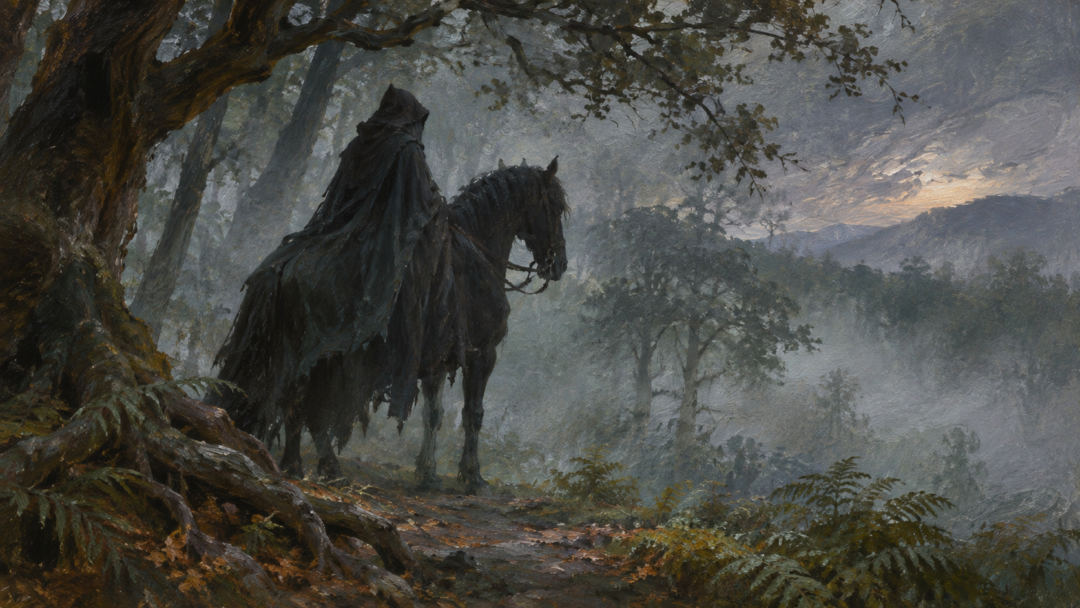
By the end, the Nazgûl are not independent kings ruling from invisible palaces. Black robes give their invisible bodies recognizable shapes. They still ride horses, carry weapons, inspire terror, and act in the physical world. But their existence rests upon a power outside themselves. In “The Council of Elrond,” the Nine remain inseparable from Sauron’s designs; elsewhere Gandalf makes clear that the Ringwraiths stand or fall with their master.
The Witch-king, their chief, shows how formidable such a servant could become. He had ruled Angmar, helped bring ruin upon the northern Dúnedain, and later led Sauron’s forces against Minas Tirith. Yet his defeat by Éowyn and Merry on the Pelennor Fields is not the downfall of a sovereign commanding death itself. An old blade strikes his unseen sinews, and Éowyn’s blow brings his apparent invincibility to an end.
His assertion that no living man can hinder him is often mistaken for an absolute law protecting him against ordinary opponents. In the story it belongs to a prophecy that his defeat would not come by the hand of man. The encounter exposes his mistake in relying upon that assurance. A crown falls, but no head is visible beneath it. The royal emblem survives the figure it once proclaimed.
Who really held power in the shadows?
One final complication makes the answer sharper. In “The Council of Elrond,” Gandalf says that the Nazgûl keep the Nine; in “The Shadow of the Past,” he says Sauron has gathered the Nine to himself. The accounts differ about physical custody, but not about domination. The Ringwraiths are not free because they once received gifts. They are bound to the maker of the One Ring and to the domination for which he designed it.
Nothing in that relationship requires the Nine to command dead souls. They wield fear, sorcery, strange perception, and force against living enemies. The Witch-king can threaten Éowyn with horrors beyond darkness, but the threat is not evidence that he governs the fate of the dead. Calling him a lord of the unseen may capture how he appears to his enemies; taken literally, it gives him a realm the books never grant him.
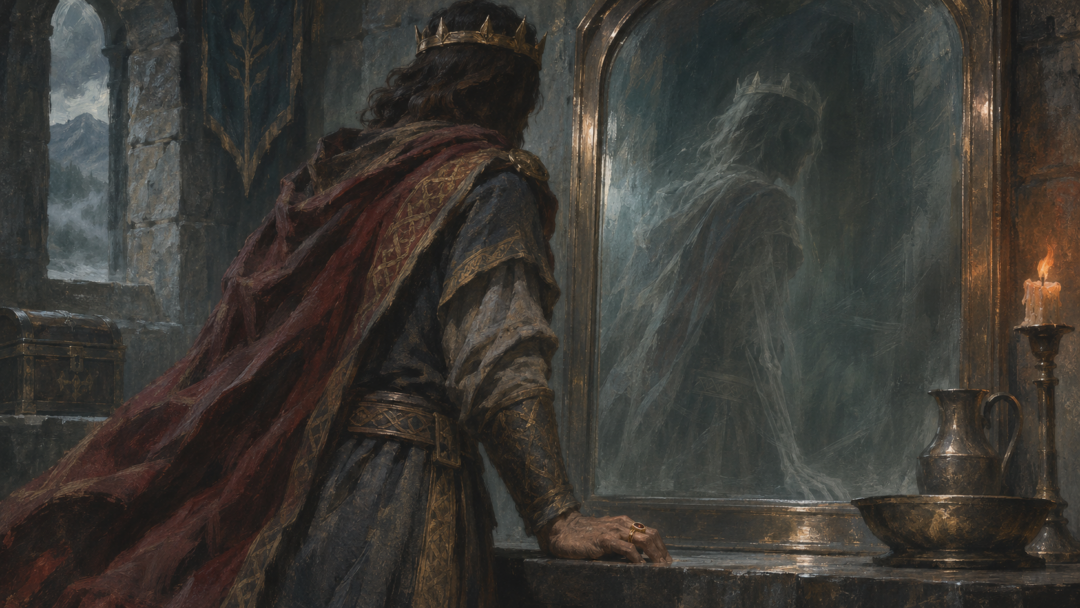
This is the cruel reversal at the heart of the Nine. A mortal ruler could gain wealth, years, and a glimpse of hidden things, all while believing that the boundaries of his kingdom were expanding. But the boundary that finally moved was the one around himself. At first he could choose to vanish from his people's sight. At the end, only the robes and the crown could tell the world where its king had gone.
Sources & Notes
- Nine Rings - Tolkien Gateway — https://tolkiengateway.net/wiki/Nine_Rings
- Unseen - Tolkien Gateway — https://tolkiengateway.net/wiki/Unseen
- Nazgûl - Tolkien Gateway — https://tolkiengateway.net/wiki/Nazg%C3%BBl
The Silmarillion, ‘Of the Rings of Power and the Third Age’, describes the Nine’s gifts, delusions and enslavement. The Fellowship of the Ring, ‘A Knife in the Dark’ and ‘Many Meetings’, illuminates unseen perception. None grants the Nine sovereignty over departed souls.