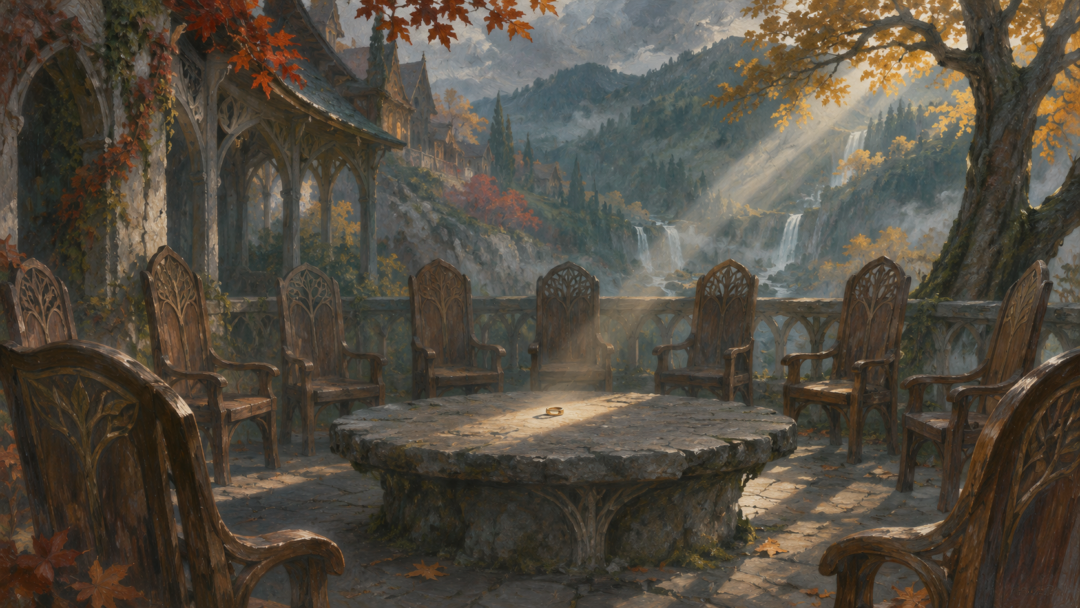
When Frodo lifts the gold Ring in Rivendell, he feels ashamed and reluctant, and Boromir stares at it with brightening eyes. Such a small object has brought elves, dwarves, men and hobbits into grave discussion. Yet the question is not whether it is Sauron's Ring. It is what anyone holding it could actually do.
The Council knows far more than the Ring's owner and origin. Elrond and Gandalf understand its design for domination, its treachery toward its bearers, and the danger of claiming it for a good cause. But no one present offers a complete account of its capabilities. Knowledge is uneven, some consequences remain uncertain, and Boromir's hopes expose the difference between recognizing a terrible power and understanding how it works.
What the Council could actually establish
The meeting is partly an investigation. Boromir arrives because a dream has spoken of Isildur's Bane and a halfling, but he does not yet know what those words mean. When Frodo displays the Ring, Boromir asks how the Wise can be certain it belonged to Isildur. Galdor of the Grey Havens wants the proofs too. A plain gold band cannot establish its history merely by being displayed.
So Gandalf supplies a chain of evidence, not a demonstration of spectacular magic. Bilbo recounts how he found the Ring beneath the Misty Mountains; Frodo explains its passage into his keeping and his flight from the Black Riders. Aragorn has hunted down Gollum, another bearer, while Gandalf has examined an ancient record left by Isildur in Minas Tirith. The Ring's markings, revealed by heat and read by Gandalf, confirm what these accounts have led him to suspect.
Elrond adds something no written record could replace: memory. He was present when Sauron fell before the Last Alliance, and he remembers Isildur refusing counsel to destroy the Ring. Isildur kept the object cut from Sauron's hand after his defeat, and it eventually betrayed him. That history makes the name Isildur's Bane more than a riddle. Possession had already proved perilous to a victorious king.
The larger design is also understood, at least by the most learned. In Of the Rings of Power and the Third Age, Sauron places much of his strength and will into the One so it can master the lesser Rings, perceive what their wearers do, and govern their thoughts. The Council knows that the Three Elven-rings are endangered if Sauron recovers the One. Elrond says their works would be turned against them and their minds exposed. This is a system of control, not simply a source of extra strength in battle.
Even ordinary experience gives warnings. Bilbo becomes strangely possessive; Gollum's long ownership deforms his life; Frodo's reluctance to show the Ring is visible before the assembled company. Gandalf has already explained in The Shadow of the Past that a Great Ring can unnaturally prolong a mortal's existence, while repeated use for invisibility can eventually make its wearer fade. The Council has observed enough to suspect that the Ring does not passively serve whoever slips it on.
Boromir's weapon, and Elrond's answer
Boromir sees a different problem. Gondor is fighting a desperate defensive war, and the Council appears ready to throw away something immensely powerful. He proposes that the Free Peoples use the Ring against its maker. His argument has an understandable military shape: if valour alone cannot stop Mordor, perhaps a captured weapon can. But he speaks conditionally about its power. He does not explain a technique for commanding armies with it, because he has no such knowledge to offer.
His proposal also reveals a gap between the experience of Gondor and that of the Wise. Boromir knows the terror of Mordor's forces, the damage done at Osgiliath, and the price his people pay to hold the crossings of Anduin. He has come seeking counsel, not a lesson in Ring-lore. When he suggests that Saruman's desire to wield the Ring might contain some wisdom, he is reasoning from urgency and apparent opportunity, not from tested knowledge of what happens to a bearer who tries.
The film compresses the answer into the claim that the Ring answers to Sauron alone. In the book Elrond is more precise: only someone already possessing great power might wield it, and for such a person the danger is greater. A mighty bearer might indeed overthrow Sauron, but would then become another Dark Lord. The fatal effect is not that the Ring lacks power for other hands. It is that exercising that power means entering Sauron's kind of rule.
Saruman makes the warning painfully immediate. Once head of the White Council and deeply learned in Ring-lore, he has turned toward the prospect of ordering the world through superior power. Gandalf recounts how Saruman proposed obtaining the One to direct events. The speaker who most resembles Boromir's imagined successful wielder is already corrupted by the wish to possess the Ring, without ever having held it.
Aragorn provides a quieter contrast. As Isildur's heir, he is connected to the Ring's history and could be imagined as its rightful claimant. Instead, he tells Frodo it belongs to neither of them. He promises to aid Gondor without acquiring his ancestor's fatal prize. Boromir and Aragorn therefore represent two possible responses to an inherited crisis: reach for the enemy's power, or fight without adopting it.
What even the Wise did not know
Gandalf's authority is hard won, and the book does not make him infallible. In The Shadow of the Past, he admits that he underestimated the Ring's danger for years. He knew Bilbo had a remarkable object, yet only later assembled the evidence that identified it as the One. Saruman, supposedly the foremost expert, had long argued that the Ring was lost beyond recovery. Expert opinion can be mistaken or deliberately misleading.
The Ring's own behaviour is particularly difficult to reduce to rules. Gandalf describes how it slipped from Isildur and eventually abandoned Gollum, trying to return to Sauron. This is not the same as saying it can foresee every event or arrange every meeting. Bilbo's discovery involved another power at work, Gandalf tells Frodo, and the Ring did not succeed in choosing a servant who would carry it straight home. It has a tendency and a purpose, but not unlimited control over circumstance.
There are uncertainties even among the Rings' makers and guardians. Glóin wonders whether other Rings might aid the war, mentioning the lost Seven and asking about the Three. Elrond corrects his belief that Sauron made the Three, explains that they were intended for preservation rather than conquest, and refuses to disclose more about them. Asked what their fate would be if the One were destroyed, he answers that no one knows for certain. He believes their power may fail, but it is a forecast, not a demonstrated fact.
Later writings clarify the limits, without granting the Council that knowledge. In Letter 131, Tolkien explains that Rings can enhance their bearers' native abilities and that the One's chief design is mastery. Letter 246 considers whether a sufficiently powerful challenger, perhaps Gandalf, could truly wrest the Ring from Sauron. It treats that outcome as conceivable, but disastrous: a different ruler might take Sauron's place while the Ring's dominating principle survived. The Council's warning is not a technical impossibility claim.
At Mount Doom the story reveals another limit, this time in a humble bearer. Frodo reaches the place where the Ring can be unmade but cannot surrender it voluntarily; he claims it instead. Letter 246 explicitly treats the pressure upon him there as overwhelming, not a simple failure of courage. The Council does not foresee the manner of its destruction. They know that carrying it is dangerous. They cannot calculate how near destruction its demand for possession will become strongest.

Why the choice falls to Frodo
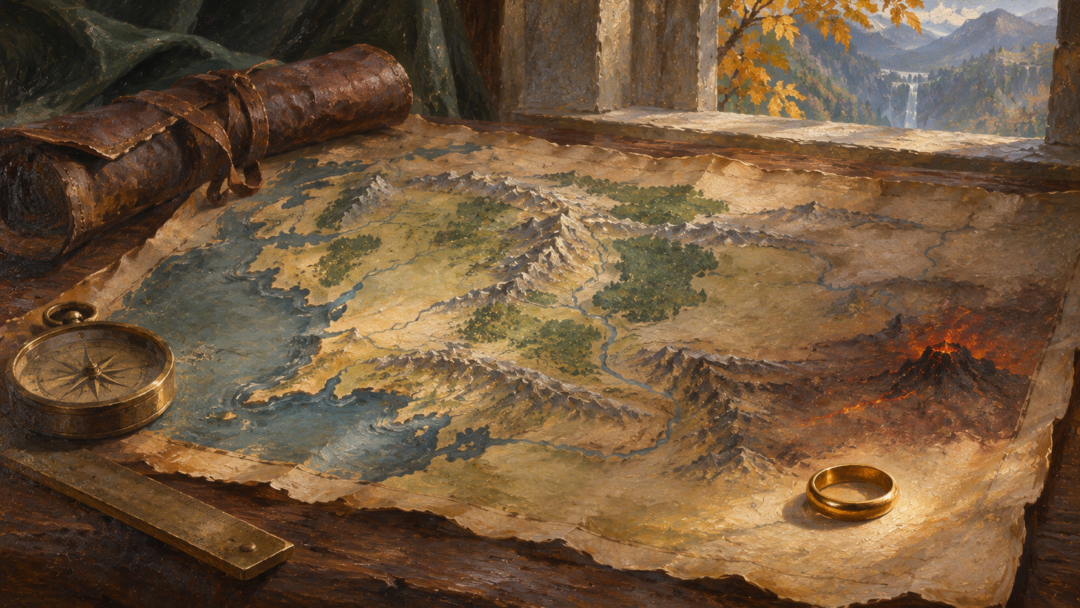
Once the Council rejects using the Ring and finds no safe place to hide it indefinitely, the question changes. Who can carry it toward the Fire? They consider keeping it in Rivendell, entrusting it to Tom Bombadil, sending it across the Sea, or casting it into deep water. Each leaves the Ring at risk of discovery or still dangerous. Destroying it in the place of its making is the only final answer they can attempt.
Gandalf points out an advantage hidden in that desperate plan. Sauron judges others by their appetite for power; he will expect a rival to seize the Ring, not destroy it. Elrond adds that strength is no guarantee of success, and that the weak may have as much hope as the strong. This does not make a hobbit immune to temptation. It makes the quest something different from a contest for supremacy, where the most formidable champion would automatically be the best choice.
Frodo volunteers without knowing the way. Elrond does not command him or claim to see the whole path ahead; he accepts the offer as freely made. The Council's most important conclusion is therefore an act of restraint. It can name the Ring, reconstruct its history, and recognize the ruin promised by its power, yet it cannot master every consequence of carrying it.
Beyond Rivendell lie roads its wisest counsellors cannot see to the end. The Ring was forged to bend other wills, and its maker imagines a world in which everyone seeks to command. Yet beneath the trees of Elrond's valley, its fate passes to a hobbit whose first great act is not to claim power, but to accept a burden.
Sources & Notes
- The Council of Elrond - Tolkien Gateway — https://tolkiengateway.net/wiki/The_Council_of_Elrond
- The One Ring - Tolkien Gateway — https://tolkiengateway.net/wiki/One_Ring
- Letter 131 - Tolkien Gateway — https://tolkiengateway.net/wiki/Letter_131
The Fellowship of the Ring, ‘The Shadow of the Past’ and ‘The Council of Elrond’, distinguish identification, domination, and uncertainty about the Three. Letter 131 explains the Rings’ design; it should not be read as knowledge possessed equally by every councillor.