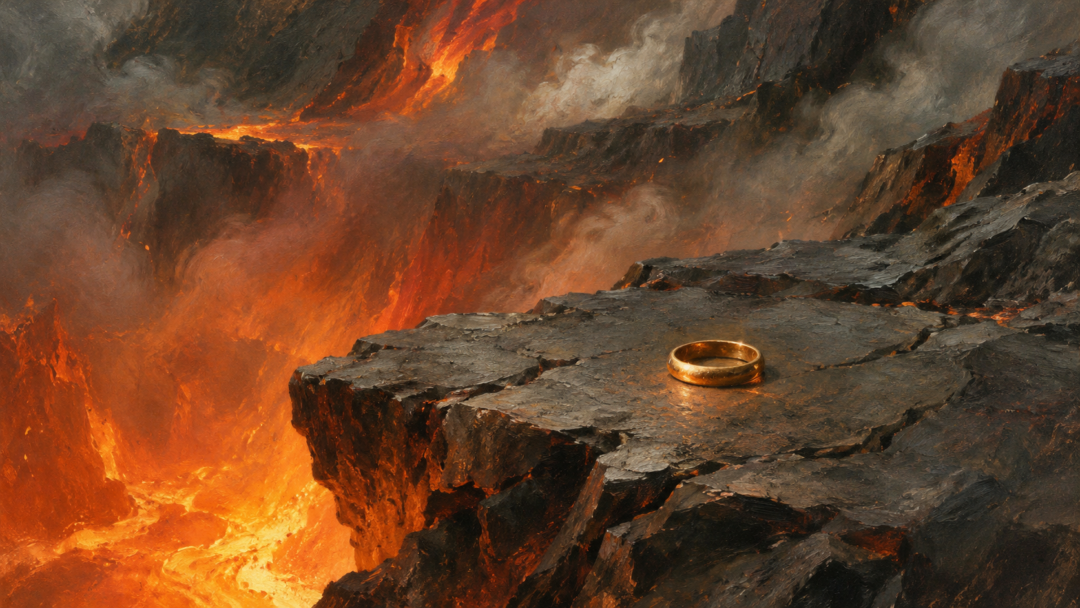
At the edge of the fire inside Mount Doom, Gollum holds up a golden ring with Frodo’s severed finger still inside it. He has finally recovered the thing he spent years hunting, and his joy lasts only a few heartbeats. He steps beyond the brink and falls. The creature who wants the Ring most desperately carries it to destruction.
But suppose that final struggle had gone a little differently. Would Gollum still have taken it from Frodo? Almost certainly he would have tried, and under the circumstances of the book he probably would have succeeded. The more interesting question is why his theft becomes the Quest’s last chance. His oath, Frodo’s failing strength, and the Ring’s own treachery have been drawing together long before the two hobbits reach the fire.
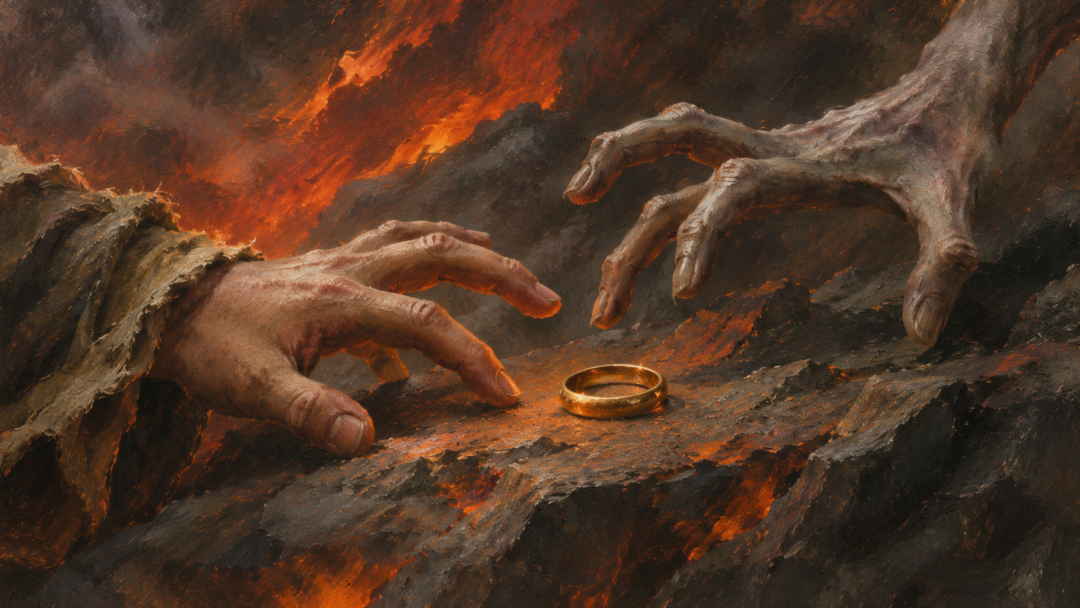
The promise that followed Gollum to Mordor
Back in the Emyn Muil, Frodo does not win Gollum’s cooperation through trust alone. Sam has bound their captive with an Elven rope that Gollum finds unbearable, and Frodo offers to remove it if Gollum makes a promise. Gollum wants to swear on the Precious. Frodo insists that he swear by it, not on it: the Ring already holds Gollum.
The promise has two parts that do not sit comfortably together. Gollum will serve the master of the Precious, meaning Frodo, and he will prevent the Ring from returning to Sauron. Yet neither requires him to accept the Ring’s destruction. That gap leaves room for the idea that taking the Ring for himself could be a way of saving it from its maker, even while betraying the hobbit who has shown him mercy.
Frodo warns that the Ring will bind Gollum to his words and may twist their meaning. This is no ordinary promise resting on Gollum’s conscience. He invokes a thing whose power is domination, while believing he can use its hold to restrain a creature already dominated by it. The oath sustains their partnership while planting a conflict for the moment Frodo tries to destroy the Ring.
In “The Passage of the Marshes,” Sam overhears Gollum arguing with himself while Frodo sleeps. One side remembers his promise and Frodo’s kindness; the other searches for a loophole. If Gollum were the Ring’s master, he reasons, he could satisfy himself and still claim to be keeping his word. The idea of taking the Ring predates the final cavern. Gollum has already imagined possession as the answer to an oath he cannot simply ignore.
Why he could not leave the Ring alone
The story of Sméagol begins with another violent taking. In “The Shadow of the Past,” Gandalf tells Frodo how Déagol found the Ring in the river and Sméagol strangled him when he refused to hand it over. Sméagol later fashioned a story in which the Ring was rightfully his birthday present. He builds his identity around the claim that it was owed to him.
Centuries under the Misty Mountains deepen that possessiveness. Gandalf explains that Gollum both loves and hates the Ring, and that the Ring eventually abandons him when he is no longer useful to its movement toward Sauron. Yet losing it does not free him. He follows Bilbo’s trail, fears his enemies, and eventually follows Frodo across the wild and into Mordor. Danger cannot drive away his need to recover it.
Still, Gollum is not a machine whose every choice is fixed. Frodo’s pity briefly reaches Sméagol, and there are moments when he seems capable of affection and service. The scene outside Shelob’s lair, when he finds Frodo asleep and touches him gently, makes the possibility particularly painful. Sam’s suspicion interrupts it. That does not prove enduring loyalty was possible, but it leaves us with a divided creature, not an uncomplicated villain.
At the Cracks, Frodo could no longer let go
By the time Frodo reaches Orodruin, the Ring has become an overwhelming weight. Food and water have nearly run out; Sam has carried Frodo himself up part of the mountain. In Mordor the Ring is no distant object of temptation. Even memories of life outside its pull are slipping away. He has reached the place where it was made, after exhausting almost everything he possessed.
The warning comes before the final chamber. Gollum attacks on the mountain path, and Frodo, seen by Sam in a strange vision as a figure with fire at his breast, commands him to go away. He says that if Gollum touches him again, he will be cast into the Fire of Doom. It echoes Frodo’s earlier warning that he could command Gollum to throw himself into fire. The book invites us to hear the oath behind this threat, without explaining exactly how the command will operate.
Sam then has a decision of his own. He could kill the defeated Gollum, who is still dangerous and still pursuing the Ring. Instead he feels pity, partly because he has briefly borne the Ring himself and now understands something of its torment. He lets Gollum live and hurries after Frodo. Mercy leaves Gollum alive and close enough to follow them into the mountain.
Inside the Sammath Naur, Frodo does what he came all that way to prevent: he claims the Ring and puts it on. His declaration, “The Ring is mine!”, is not a private thought but an act that reveals him to Sauron. The Dark Lord finally understands the danger and sends the Nazgûl racing toward the mountain. Frodo cannot cast it away, and Sam has no realistic chance of taking it from an invisible bearer.
How the Ring betrayed its final possessor
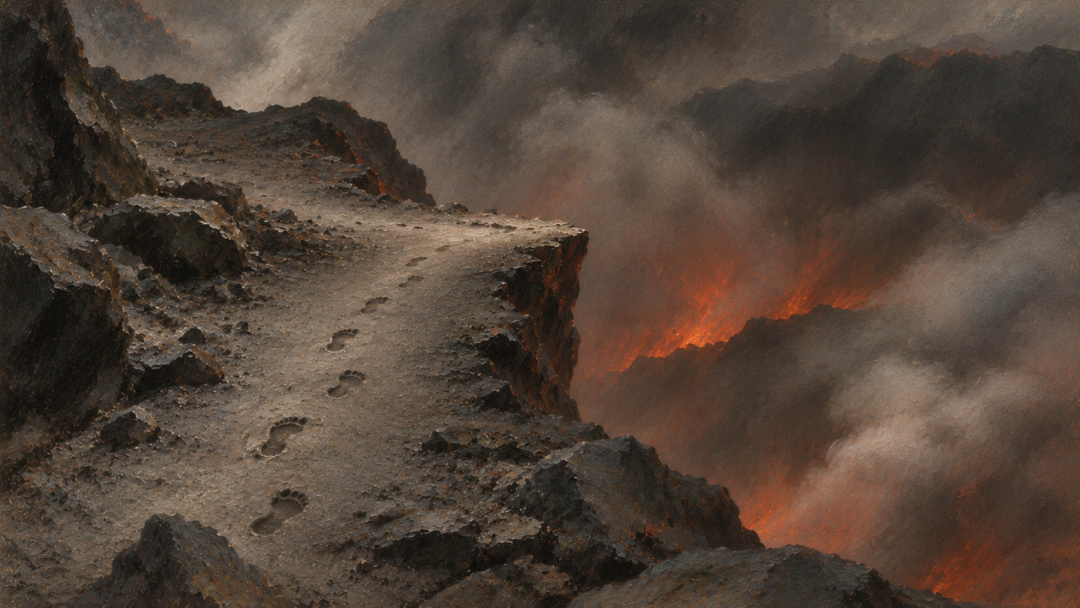
Gollum attacks the invisible Frodo. Sam, recovering from a blow, sees a struggle at the brink, and then Gollum bites off Frodo’s finger to seize the Ring. Gollum has taken it despite the oath and Frodo’s warning. What it does not prove is that the oath magically forced his teeth to close or his feet to slip. The narrative describes his joy, his raised gaze, his step too far, and his fall.
That sequence looks accidental from Gollum’s point of view. He has no intention of destroying his prize, and the book does not say he chooses to die. Yet the accident is prepared by everything that precedes it. The promise to serve the Ring’s master has been broken; Frodo has pronounced a fearful consequence; Gollum’s appetite blinds him to the edge at his feet. The object whose power has ruined his judgement is carried into the fire by the very triumph it offers him.
There is a further irony in what Gandalf says in “The Shadow of the Past.” The Ring had once betrayed Isildur and later abandoned Gollum, apparently seeking a route back to Sauron. It is treacherous, but is not shown to foresee its own destruction. If we describe its destruction as the Ring betraying its newest possessor, that is a reading of the pattern, not a statement that the Ring consciously planned to burn. Its victory over Gollum ends in a defeat it could not have wanted.
Peter Jackson’s film makes the climax more of a physical contest: Frodo and Gollum tumble over the edge together, and Frodo is pulled to safety. The book gives Gollum the fatal misstep while Frodo remains behind, wounded and suddenly freed of his burden. On the page, no last shove from Frodo finishes the Quest. What finally disappears into the fire is Gollum’s own grasp on the thing he cannot stop claiming.
Counterfactual: if Gollum had changed, would he still have taken it?
In Letter 246, Tolkien considers a different course for Gollum after the moment of tenderness outside Shelob’s lair. Had Sam responded differently, Gollum’s growing love for Frodo might have entered a deeper struggle with his desire for the Ring. Remarkably, Tolkien still imagines him stealing it or taking it by force near the end. Even a better Sméagol would not easily have escaped that compulsion. The change would have come after he possessed it.
In that imagined version, Gollum might have recognized that he could neither master the Ring nor keep it safely from Sauron, and might have thrown himself into the fire to save Frodo. That is speculation, not the novel’s ending. It also makes the answer to our question sharper: even in a scenario where kindness had transformed Gollum more deeply, Tolkien thought he would probably take the Ring first.
The letter also explains why Frodo’s refusal is not simply a failure of character. Starved, exhausted and subject to the Ring’s maximum pressure, he had reached the limits of what anyone could reasonably endure. He had nonetheless brought it to the one place where its destruction was possible. Tolkien describes him as an instrument of Providence, whose earlier patience and mercy toward Gollum are answered by mercy in turn. Grace does not require us to imagine an unseen hand physically pushing Gollum over the edge.
Frodo himself recognizes what Gollum accomplished and asks Sam to forgive him as the mountain breaks apart. In “The Field of Cormallen,” Frodo and Sam are honoured as Ring-bearers; in “The Grey Havens,” Frodo’s lasting wounds show that victory has not erased the cost. Mercy allowed the Quest to succeed, but did not make its survivors untouched.
So the answer is yes, as far as the book allows us to judge: Gollum would almost certainly have reached for the Ring, and the final struggle shows how well placed he was to take it. The greater surprise is not his theft. It is the tiny distance between possession and loss: one delighted step on a narrow ledge, where the Precious is lifted toward the light of the fire and vanishes forever.
Sources & Notes
- Mount Doom (chapter) - Tolkien Gateway — https://tolkiengateway.net/wiki/Mount_Doom_(chapter)
- Gollum - Tolkien Gateway — https://tolkiengateway.net/wiki/Gollum
- Letter 246 - Tolkien Gateway — https://tolkiengateway.net/wiki/Letter_246
The Two Towers, ‘The Taming of Sméagol’ and ‘The Passage of the Marshes’, establish the oath and divided intent. The Return of the King, ‘Mount Doom’, gives the actual fall; Letter 246 discusses a repentant-Gollum alternative. An oath mechanically forcing the fall is not explicitly stated.