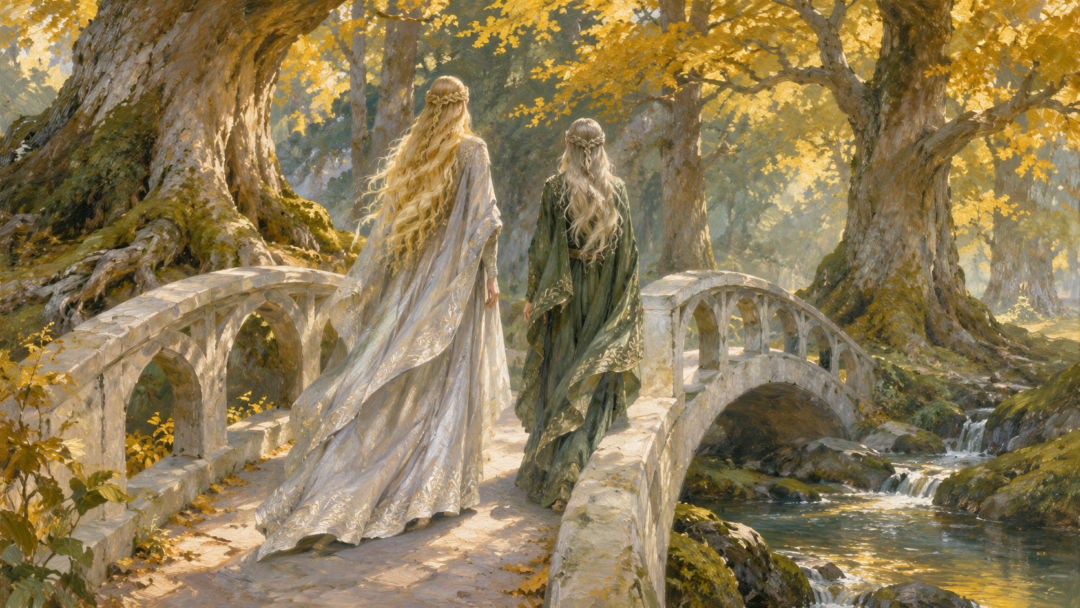
When Frodo meets Galadriel in Lothlórien, he encounters someone who remembers a world older than the Sun. The Lady of the Golden Wood was born in the Blessed Realm, where the Two Trees once gave their light. Her daughter, Celebrían, belonged to a later age and grew up in Middle-earth. Does the mother's extraordinary heritage make the daughter a High Elf too?
Celebrían was certainly an Elf: both her parents were Elves, and nothing in her story suggests a different fate. But "High Elf" is not simply a hereditary rank. In its strict ancient sense, it concerns the Elves who reached Aman and saw the light of the Trees; in broader usage, it can describe their peoples and descendants. Celebrían belongs to that heritage without having shared her mother's experience. Her own children introduce a different question altogether.
What made an Elf a High Elf?
The distinction began long before Lórien had golden leaves. The Elves first awoke at Cuiviénen under the stars, and the Valar later summoned them westward to Aman. Some refused the summons. These were the Avari, the Unwilling. Those who accepted were called the Eldar, but even among them the journey did not end in the same place. Forests and seas divided them.
The great travelling kindreds were the Vanyar, the Noldor and the Teleri. The Vanyar and Noldor reached Aman, as did some of the Teleri, while other Teleri remained in Middle-earth. The Sindar, or Grey-elves, belonged to this latter history; so did other groups with their own paths through the wilderness. These names mark migrations and relationships, not a ladder of worth.
The Silmarillion, in "Of the Coming of the Elves," calls those who reached the West in the days of the Trees the Calaquendi, or Elves of the Light. Those who never saw that light were called Moriquendi, Elves of the Darkness. The second name sounds sinister, but it does not imply evil. The Sindar built the kingdom of Doriath, and their king Thingol ruled beneath the protection of Melian. They had not crossed the Sea, yet their history was anything but obscure or ignoble.
Even this ancient division has an illuminating exception. Thingol had visited Aman as one of the first Elven ambassadors, then returned to Middle-earth and never completed the later migration. He had seen the Trees, however, and is counted among the Calaquendi. His people had not. Their king's experience differed from theirs. The term tracked an encounter with the Blessed Realm, not merely where someone happened to live.
In "Of the Noldor in Beleriand," the returning Noldor and the Sindar are also separated by language and memory. The Noldor bring knowledge learned in the West, but they enter lands where Elves have already formed kingdoms and loyalties. Thingol's eventual prohibition of Quenya in his realm makes those differences politically real. In the Third Age, "High-elven" could also describe Noldorin tradition and descendants born after the Trees were destroyed. It should not be mistaken for a claim that every such descendant personally saw their light.
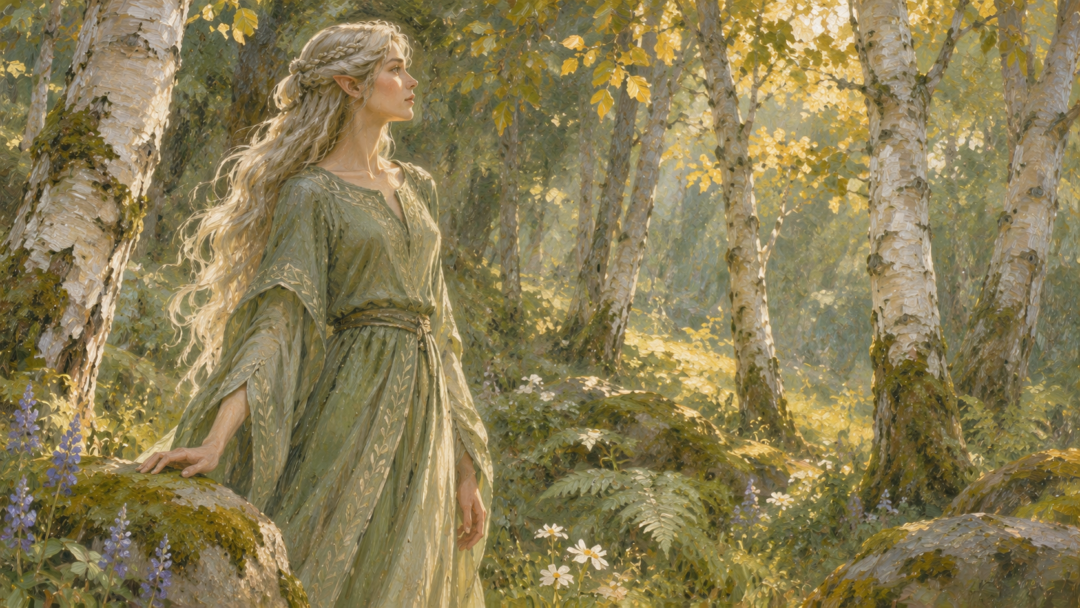
Celebrían inherited two Elven histories
Galadriel provides the clearest example of the older meaning. She was a Noldorin princess who lived in Aman before the destruction of the Trees, then crossed into Middle-earth with the exiled Noldor. In Lórien, the power and memory she carries are ancient even by Elvish measures. Her departure from Middle-earth is that of someone who remembered the light that gave the Calaquendi their name.
Celebrían's father, Celeborn, has a more complicated textual history. In the account familiar from The Silmarillion, he is a Sinda of Doriath, a kinsman of Thingol. In a later version preserved in Unfinished Tales, he is instead a Telerin Elf from Aman. The versions conflict, but both make Celebrían's parents Elves. On the Doriath account, Celebrían unites Noldorin and Sindarin ancestry in one family.
Her birth falls in the Second Age, long after Morgoth destroyed the Trees and the Sun first rose. She could not have witnessed their radiance. If we use Calaquendi narrowly for those who actually beheld it, Galadriel fits and Celebrían does not. Calling her a High Elf by ancestry is understandable; saying she shared her mother's experience is not. The books do not supply a formal ruling assigning Celebrían that label.
Her life gives a better picture of who she was than an imagined category ever could. Accounts in Unfinished Tales place her with her parents in the changing Elven settlements of the Second Age, including Lórien in one version. She later married Elrond of Rivendell, and their children were the twins Elladan and Elrohir and their sister Arwen. The marriage joined Lórien to a household whose lineage also reached the ancient houses of Men.
Celebrían's own fate is equally revealing. Travelling across the Misty Mountains to visit her parents, she was captured by Orcs in the Redhorn Pass. Her sons rescued her, and Elrond healed her poisoned wound, but she could no longer find peace in Middle-earth. In the following year, she sailed west. This happened centuries before the War of the Ring. Her experience recalls the account of Elvish life in "Laws and Customs among the Eldar": being bound to the life of the world does not make an Elf immune to injury, grief or weariness.
Why Elrond's children could choose another fate
Elrond complicates the family tree for a reason that has nothing to do with Celeborn being Sindarin or Galadriel being Noldorin. He is called Half-elven because his ancestry includes both Elves and Men. At the Council of Elrond, he tells Frodo that his father was Eärendil and his mother was Elwing, descended from Lúthien. This reaches back to the unions of Beren and Lúthien, and of Tuor and Idril. Unlike differences among Elven peoples, these unions have consequences for mortality itself.
The central episode occurs in "Of the Voyage of Eärendil and the War of Wrath" in The Silmarillion. Eärendil sails to the Undying Lands carrying a Silmaril and pleads for aid against Morgoth. Elwing joins him. Manwë then pronounces a special judgment: the couple and their sons may choose whether to share the fate of Elves or Men. Elwing chooses the Elves, and Eärendil follows her choice, although his heart inclines toward Men. The permission was exceptional.
Their sons take different paths. Elrond chooses to be counted among Elves, while his twin Elros accepts mortality and becomes the first king of Númenor. His descendants remain mortal, though long-lived; Aragorn belongs to that line. Thus two brothers with the same parents become ancestors of families with different destinies. Their ancestry remains true in both cases; it is the fate assigned to each line that differs.
The judgment extends to Elrond's children, despite their mother Celebrían being wholly Elvish. Appendix A of The Return of the King makes the terms plain: they may depart with Elrond into the West or, if they remain, become mortal in Middle-earth. Arwen's fate cannot be settled by adding up Elven ancestors. She can live for ages with the youth of the Eldar, yet the decision still lies before her. Her brothers are subject to the same exceptional choice.
Arwen chooses mortality when she pledges herself to Aragorn in Lórien. Their marriage brings together the lines of Elrond and Elros after long separation, but it also means that Arwen and her father will be parted beyond the Sea. After Aragorn's death, she returns to the now-silent woods of Lórien and dies on Cerin Amroth. Elladan and Elrohir have no recorded final choice. In a letter, Tolkien says they delay it and remain for a time.
Why bloodlines cannot provide one simple rule
Kindred, experience of Aman and ultimate fate are distinct questions. A family tree can tell us that Celebrían is descended from the Noldor and, in the familiar account, the Sindar. It cannot give her a personal memory of the Two Trees. Nor can a rich Elven ancestry override the special judgment that applies to Elrond's household. Treating all these questions as one inheritance test erases the differences the stories carefully preserve.
The later writings make those differences especially visible. "Laws and Customs among the Eldar," published in Morgoth's Ring in The History of Middle-earth, considers Elven marriage, children, embodied life and the fate of their spirits. Elves are bound to the life of Arda, whereas Men pass beyond its circles at death. This is more than a difference in longevity. The Half-elven case therefore required a decision concerning which destiny would govern them, not a calculation of how much of each ancestry they possessed.
There is no comprehensive rulebook describing what to call every child of different Elven branches. In everyday discussion, calling Celebrían a High Elf can reasonably signal her Noldorin heritage and her place among the great Elven houses of the West. If the question means whether she herself was one of the Elves who saw the Trees, the answer is no. If it means whether she was fully an Elf despite her parents' different kindreds, the answer is yes. Both statements can stand without contradiction.
What remains is the striking distance between mother, daughter and granddaughter. Galadriel remembered the light of the Trees; Celebrían knew the woods and roads of a later Middle-earth; Arwen stood on Cerin Amroth and chose a mortal future. Their family carried the same ancient stories through three different lives. In the end, the light of the West was something a descendant might inherit as memory and tradition, even when her own road led elsewhere.
Sources & Notes
- Calaquendi - Tolkien Gateway — https://tolkiengateway.net/wiki/Calaquendi
- Celebrían - Tolkien Gateway — https://tolkiengateway.net/wiki/Celebr%C3%ADan
- Half-elven - Tolkien Gateway — https://tolkiengateway.net/wiki/Half-elven
The Silmarillion, ‘Of the Coming of the Elves’, distinguishes the Calaquendi; Appendix A records Celebrían’s family and Elrond’s children’s exceptional choice. Unfinished Tales preserves variant histories of Galadriel and Celeborn. Ancestry, seeing the Trees, and ultimate fate are different questions.