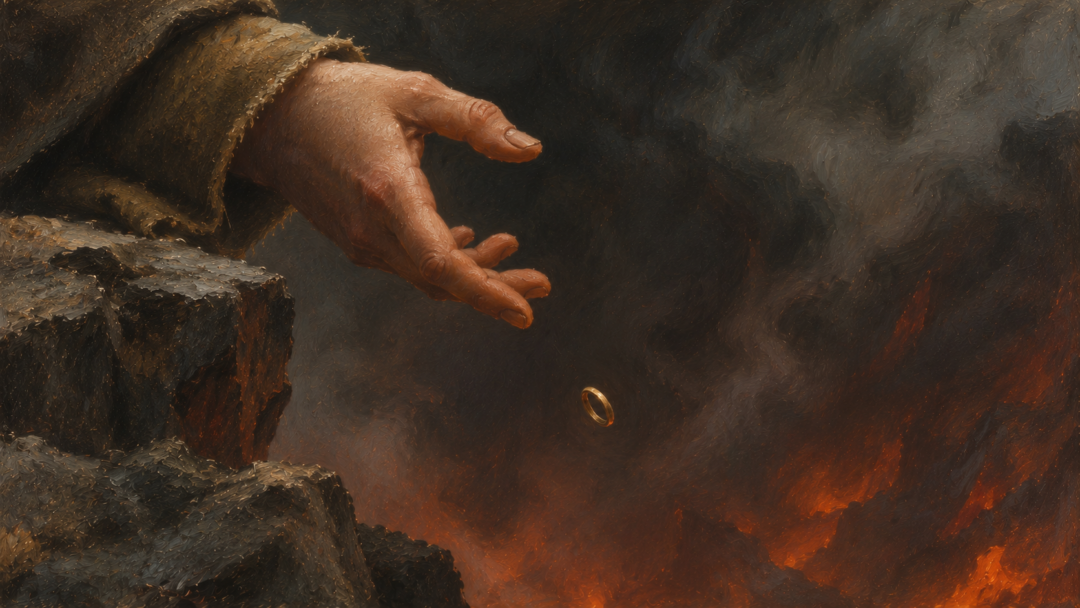
At the Crack of Doom, Frodo stands exactly where every mile of his journey was meant to take him. The fire is below. The Ring is in his possession. And instead of throwing it away, he claims it. Gollum attacks, bites the Ring from Frodo's hand, and falls into the chasm while celebrating his treasure. Middle-earth is saved by an ending no one in the chamber intended.
That is why "the Other Power then took over" invites a sharp question. Gravity and heat have been operating throughout the story; neither suddenly arrives to finish Frodo's work. The stronger reading is providence: an agency beyond Frodo, Gollum, and Sauron brings their actions to an outcome they could not achieve by design. This does not make Frodo's failure imaginary or Gollum's fall a visible miracle.
What the letters actually say
First, a correction makes the evidence clearer. The exact phrase appears in Letter 192, written to Amy Ronald in July 1956, not Letter 246. The later letter, drafted for Eileen Elgar in 1963, considers the same ending more extensively and calls Frodo an "instrument of Providence." Read together, the letters leave little room to equate Other Power with a physical principle.
In Letter 192, the sentence follows a judgment of Frodo's limits. He has used every reserve of body and will to reach the appointed place, but has nothing left to complete the final act. Only then does the Other Power take over, identified as "the Writer of the Story (by which I do not mean myself)." That qualification rules out the ordinary novelist as the intended referent. It points toward an ultimate authorial presence within the story's moral universe.
The letter refuses a comforting version in which a good hero always proves stronger than temptation. A brave, generous creature can meet an evil beyond what an embodied will can resist. Frodo's achievement is bringing the Ring to its place of destruction, not voluntarily destroying it. The cause succeeds where its bearer cannot. The word "then" marks the end of what Frodo can accomplish, rather than an instant when physical rules begin to function.
Letter 246 presses the moral argument further. The Ring's pressure is greatest at the Mountain, while Frodo is starving, exhausted, and worn down by prolonged possession. A failure to perform an act, it argues, need not be a blameworthy failure when the act exceeds a person's limits. Frodo offered all he had; his earlier patience and mercy created a situation in which deliverance became possible. Letter 181, to Michael Straight, adds that Gollum's final betrayal becomes beneficial at exactly the right juncture, without earning him any credit. His motive remains possessiveness.
A fall prepared across the whole journey
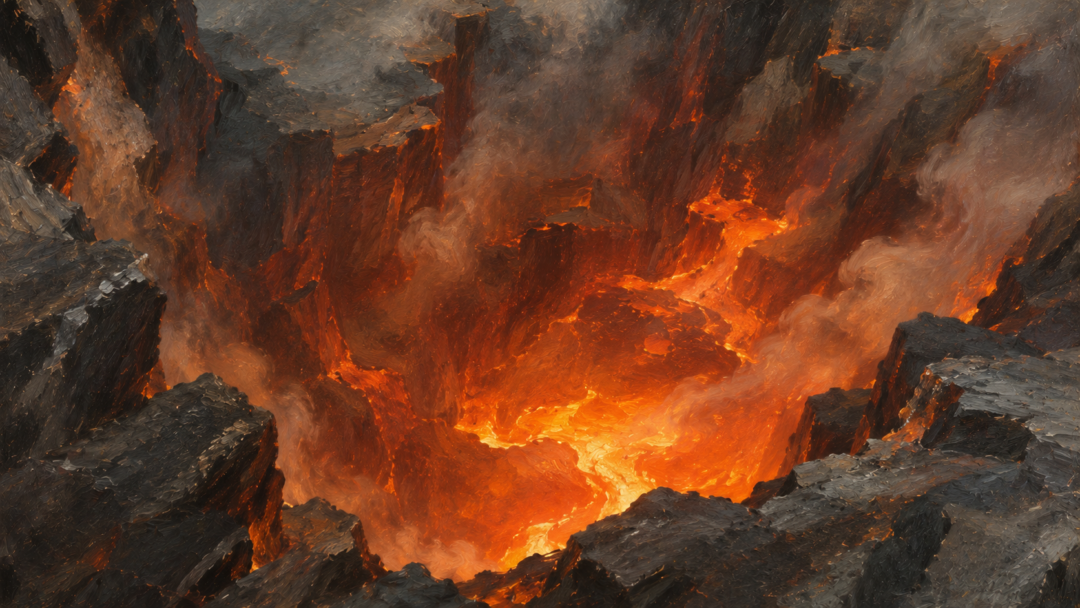
The book's scene in "Mount Doom" is strikingly spare. Frodo refuses his task and puts on the Ring. Sauron perceives the danger and turns his attention toward the Mountain. Gollum struggles with the invisible Frodo, bites off his finger, and seizes the Ring. In ecstasy he steps too far and falls. No invisible hand is described pushing him. The narrative gives us a chasm, a distracted creature, and an accident whose consequences are extraordinary.
The film stages this differently: Frodo grapples with Gollum for the Ring at the edge, both tumble over, and Sam helps Frodo back to safety. In the book, Frodo's final struggle does not cause Gollum's fall. Yet the accident has a disturbing preparation. Outside the chamber, Sam sees Frodo in an almost visionary aspect, warning Gollum that another touch will bring him to the Fire of Doom. Earlier, Frodo had said the Ring could bind Gollum to commands. Whether the warning operates as curse, prophecy, or threatened use of power is not settled by the narration.
The chain reaches back to Bilbo sparing Gollum beneath the Misty Mountains. Frodo later declines to kill him, despite knowing he is dangerous. Near the Mountain, Sam too cannot strike the wretched creature, partly because bearing the Ring has made Gollum's suffering more comprehensible. These acts guarantee nothing: Gollum betrays the hobbits and still wants the Ring. But without his survival, there is nobody at the brink to seize it when Frodo cannot let it go. The earlier mercy is consequential without being a clever plan.
Why physics cannot be the whole answer
A physical account is easy to give. Teeth can sever a finger; excitement can spoil someone's balance; a fall into the volcanic fire destroys the Ring in the place where it was forged. The scene requires no suspension of ordinary motion. But that explains how Gollum falls, not why mercy, betrayal, exhaustion, and temptation converge at the one instant when his theft saves the world.
Natural laws were just as present when Isildur kept the Ring, when Déagol found it, and when Frodo staggered across Mordor. They do not wait until someone's moral endurance is exhausted. Calling gravity the Other Power would drain the sentence's timing of significance. A law tells us what happens in given conditions; it does not by itself explain why those particular conditions arrive together after a history of meaningful choices.
There is a stronger naturalistic argument: the ending follows the built-in logic of the Ring and its hold on Gollum. His delight makes the misstep credible, while the Mountain makes it final. The letters themselves insist that the solution emerged from established characters and circumstances, not a convenient twist imposed on them. But narrative coherence and providence can explain different levels of the same event. One shows why the ending fits the story; the other asks what its fittingness means.
Nor must providence mean that Eru physically shoves Gollum. The book describes no such intervention. It can mean that freely chosen acts come together in an outcome beyond their makers' foresight. In that sense, "took over" names decisive completion, not the start of divine attention. The pattern can be present throughout the journey and become visible at the moment its human plan collapses. Otherwise the sentence would describe an omnipresent rule as though it had just entered the room.
Providence without puppets
The opening "Ainulindalë" of The Silmarillion offers a larger imaginative frame. Eru Ilúvatar gives the Ainur themes for a great Music. They add their own voices, while Melkor introduces discord in pursuit of glory. Ilúvatar does not make the discord unreal; he reveals that rebellion itself cannot escape the larger design. Creation contains genuine conflict and the contributions of distinct beings, yet its ultimate meaning exceeds any single participant's intentions.
That is not a precise explanation of every later accident. It does make the language of a providential Writer intelligible. Letter 131, summarizing the mythology for Milton Waldman, describes the Valar as governors with delegated authority rather than rival creators, and stresses the limits of their knowledge. Even the most powerful beings cannot see the whole design. Frodo and Gollum know far less still. Acting from their own desires, they participate in a story whose ending none of them can oversee.
The Lord of the Rings prepares readers for this long before Mordor. Gandalf suggests Bilbo was meant to discover the Ring through a purpose beyond Sauron's. At the Council of Elrond, strangers arrive from different lands at the needed hour; Elrond insists their meeting is not merely chance, but does not identify the one who arranged it. These are hints from characters, not an omniscient explanation. They establish a habit of looking beyond visible causes while admitting that the full reason remains hidden.
Choices are essential to that pattern. Gollum nearly responds to Frodo's kindness near Cirith Ungol, before Sam's suspicion helps end the moment. Letter 246 imagines a different, explicitly hypothetical ending in which a repentant Gollum might sacrifice himself with the Ring for Frodo. That is not the published story, but the alternative matters. It recognizes the importance of Gollum's possible change instead of treating him as machinery locked to a prearranged track. Providence need not erase the terrible weight of what he chooses.
Why Frodo is still honoured
If Frodo had mastered the Ring at the last second, the quest could end by suggesting that sufficient courage conquers every temptation. Instead, victory depends on mercy he cannot command. He deserves honour because he accepted the burden and went as far as his strength allowed. The letters reject the harsh judgment that his collapse makes him a traitor unworthy of gratitude. His failure as an agent of destruction is not the measure of his worth.
Gollum, meanwhile, is not transformed into a secret hero. His greed destroys him; the fortunate consequence does not turn the act into goodness. Mercy belongs to those who spared him for reasons deeper than usefulness. To spare him only because he might someday help would be calculation, not the vulnerable compassion these choices demand. The ending does not vindicate Gollum's desires. It shows that good may arise through them without approving them.
Nor does victory restore Frodo to his old life. In "The Grey Havens," he tells Sam that the Shire has been saved, but not for him. Letter 246 links his continuing pain to remembered injuries, self-reproach, and lingering longing for the Ring. The world receives deliverance without its bearer escaping unmarked. His departure across the Sea remains a hope of healing, not proof that the ordeal never wounded him.
There is no hand visible over the Crack of Doom, and the book gives no inventory of hidden causes. There is a ruined creature exulting too near the edge, a Ring falling into fire, and a hobbit who has reached as far as courage can carry him. "Then took over" gives that narrow instant its depth: the point where a failed final act opens, through undeserved mercy, onto a victory no one there could make happen.
Sources & Notes
This article is based on close reading and interpretation of Tolkien's published works and related source material where relevant.