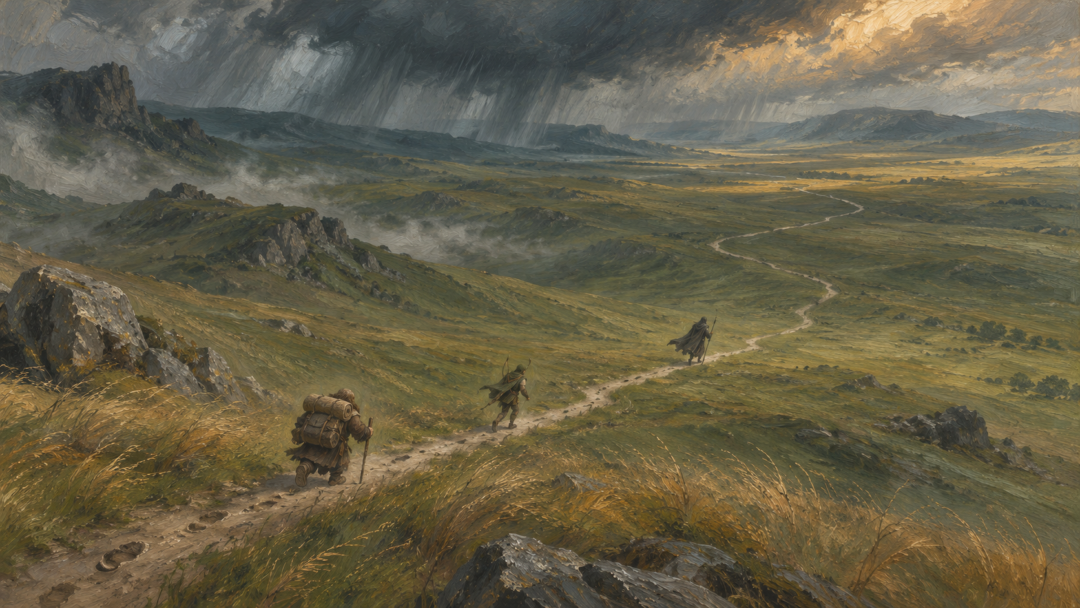
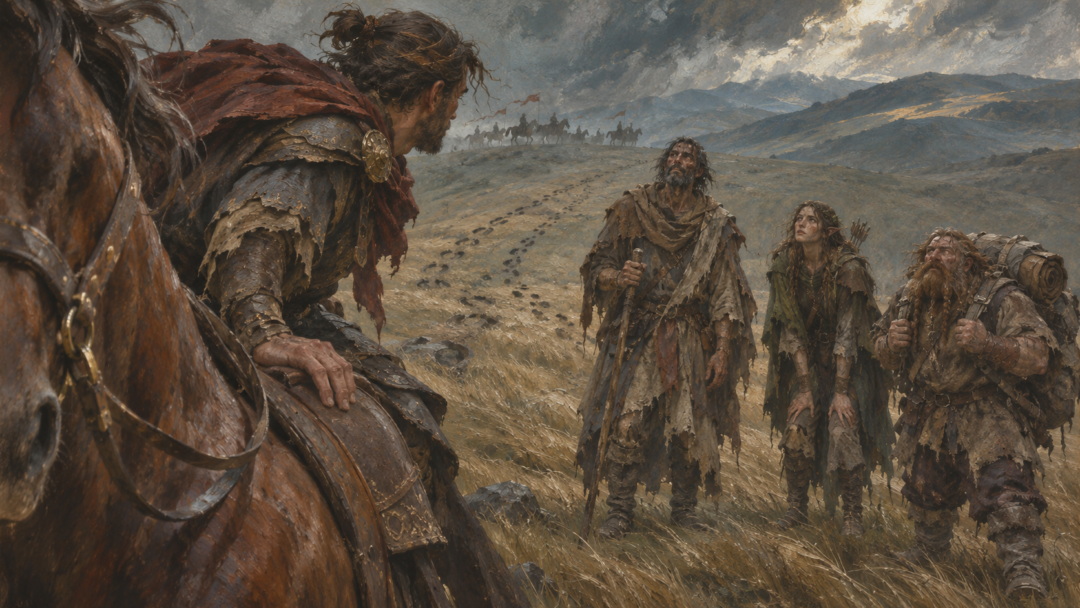
Across the plains of Rohan, three figures follow the Orcs who have carried off Merry and Pippin. Aragorn searches for signs of their passage; Legolas and Gimli keep pace as the trail stretches toward Fangorn. When they meet Éomer, the Rider is astonished to learn that the strangers have covered forty-five leagues in three days. He calls Aragorn Wingfoot. The compliment feels deserved: even in Middle-earth, this is an extraordinary pursuit.
But how extraordinary would it have seemed in the world where The Lord of the Rings was written? By the late 1930s, people had already documented feats of walking and running over distances that sound almost legendary. Those achievements provide a fascinating reality check. They show what exceptional humans had accomplished, not the final boundary of human endurance—and not a way to turn a journey through Rohan into a sporting result.
The World Outside Middle-earth Had Its Own Long-Distance Heroes
The Hobbit appeared in 1937, and its success led Tolkien's publisher to request another story. According to the Tolkien Estate's account of the novel's creation, he began that sequel in December of the same year. What eventually became The Lord of the Rings developed through years of revision, academic commitments, and wartime disruption. By 1942, the manuscript had reached only about half its eventual length. This was not a book conceived and completed in a single athletic season.
The Estate describes writing time taken from increasingly demanding university work, along with shortages of decent paper during the war. Chapters could be drafted on the backs of examination papers. Such details establish the historical setting without suggesting an undocumented influence: nothing in that account says he studied distance-running results or modeled his characters on particular athletes. We can compare the fiction with contemporary records while leaving the question of what sporting reports he knew unanswered.
A Hundred Miles on Foot Was Already a Recorded Achievement
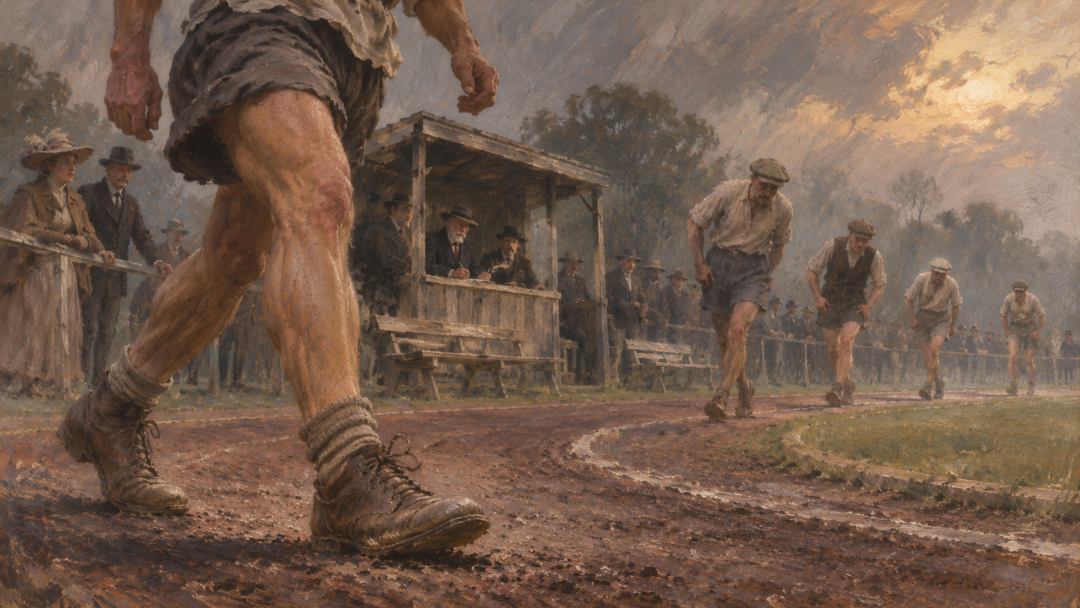
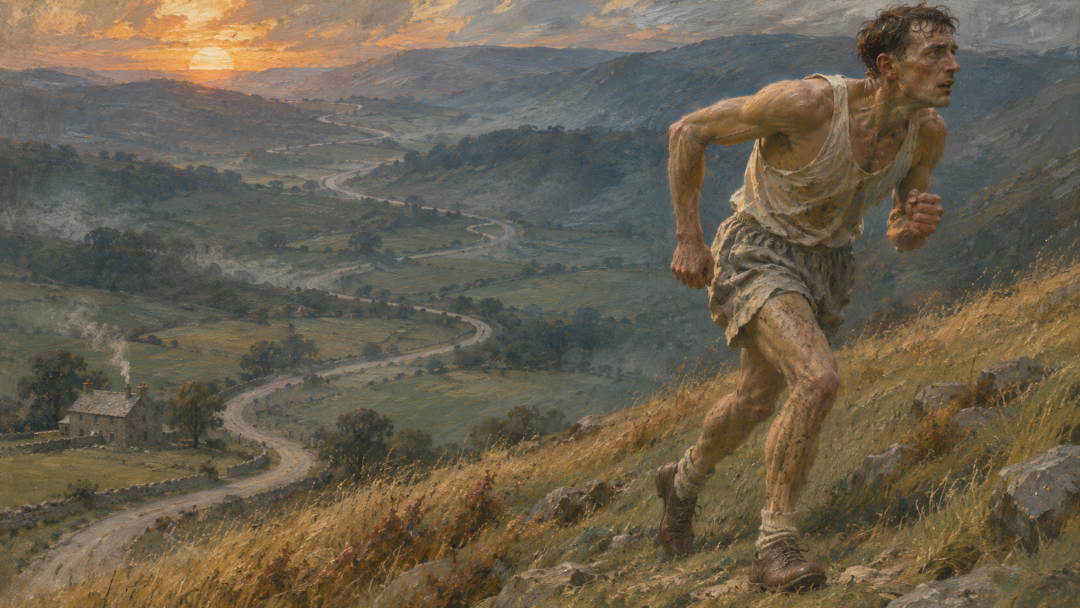
Consider a British long-distance walking event in the early twentieth century. There is no enchanted road, no fleeing Orc-band, and no need to decipher a broken trail. Instead, a competitor has a set distance and a clock. Yet the task is formidable: keep walking until a hundred miles have passed beneath your feet. The Centurions, a British association built around completing 100 miles within 24 hours in a qualifying competition, preserve a history of such performances.
Their published historical account credits J. E. Fowler Dixon with covering 100 miles in 20 hours, 36 minutes, and 8 seconds, dating the performance to 1908. The same account records E. R. “Bob” Gillespie completing 106 miles during a 24-hour race that year. These are not estimates of a day's travel by an imagined army. They are recorded sporting results, supplied with distances and elapsed times, that demonstrate how far some trained individuals could go on foot.
The organization itself emerged from this competitive culture. Its history traces the idea of the Centurions to Gillespie and a founding meeting in London in 1911. Qualification was not a matter of being a generally good walker: the defining accomplishment was finishing the full hundred miles inside a day under the association's competition rules. That standard gave the feat an institutional identity. It also made clear how exceptional it was, since membership depended on actually completing the challenge.
Nor had progress stopped before Tolkien began writing. The Centurions' history names Tommy Richardson, who covered 100 miles in 17 hours, 35 minutes, and 4 seconds at a 1936 track race promoted by the Yorkshire Walking Club. His time was more than three hours quicker than the result attributed to Fowler Dixon. The comparison shows the range of performances recorded in this specialized discipline, not a general improvement that every walker could expect to reproduce.
Runners Had Pushed Far Beyond the Marathon, Too
Walking records tell only part of the story. Arthur Newton, an extraordinary figure in early ultradistance running, provides a different sort of comparison. The historical account at Ultrarunning History describes him covering 50 miles in 5 hours, 53 minutes, and 5 seconds. That is an astonishing pace sustained far beyond a conventional marathon. It is also a reminder that extended effort can look very different depending on whether the athlete is walking, running, or changing pace as conditions demand.
Newton's case offers a further complication: recording an impressive performance and receiving formal recognition for it are not always the same thing. The historical account explains that his 50-mile effort encountered objections because it was undertaken on a road rather than a measured track in an accepted competition. The physical feat and the sporting authorities' decision were separate questions. For anyone trying to discover the “known limit” of endurance, that distinction matters: a list of recognized records can never be treated as a complete inventory of everything people had done.
The marathon provides an even more familiar yardstick. Olympedia records a world-best marathon performance of 2 hours, 26 minutes, and 42 seconds in November 1935. In the Berlin Olympics the following year, Son Gi-Jeong won the marathon in 2 hours, 29 minutes, and 19.2 seconds. Son was Korean but competed under the Japanese flag during Japan's occupation of Korea. The victory was an athletic achievement with a political history, not simply a number on a stopwatch.
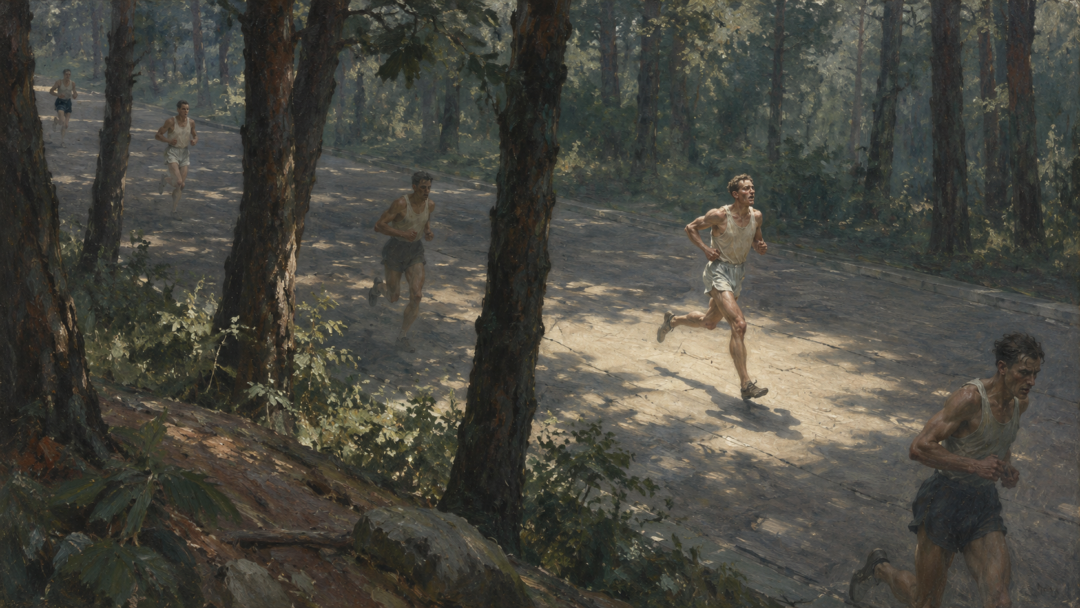
Olympedia describes that 1936 course beginning and ending at Berlin's Olympic stadium, with stretches through forest and along a straight concrete roadway. Its distance was the standardized marathon length: 42.195 kilometers. Son's winning Olympic time was slower than his 1935 world-best mark, illustrating why a championship result and an existing best performance should not be conflated. More importantly for our question, even a superb marathon tells us about rapid, relatively short-duration endurance, not what someone could sustain across several days of interrupted travel.
Why the Chase Across Rohan Is a Different Test
Now return to the trail. The pursuit begins after the breaking of the Fellowship, when Merry and Pippin are taken by the Orcs. Aragorn, Legolas, and Gimli follow through difficult ground, then descend toward Rohan. Aragorn uses his tracking skill rather than relying on a marked route. At one point, Pippin's dropped Elven brooch becomes evidence that the captives passed that way. The hunters have to notice such clues while trying not to lose ground to enemies who are already ahead.
They also stop. The account of the Three Hunters preserved by Tolkien Gateway describes Aragorn choosing to rest rather than continue when darkness threatens to obscure the trail. The companions sleep on subsequent nights, rise weary, and find that the Orcs have gained distance. The reported forty-five leagues in three days therefore must not be imagined as seventy-two uninterrupted hours of marching. Its drama lies partly in the struggle to balance speed, visibility, exhaustion, and the possibility of rescue.
There is another complication no athlete's result can settle. The companions sense Saruman's hostile will pressing against their progress and seeming to lend speed to the Orcs. Whether we read that experience chiefly as a feature of the story's supernatural world or as the hunters' perception under strain, it belongs to the narrative as written. No modern racecourse can reproduce it. Nor should the total distance be casually restated as an exact number of modern miles without first justifying the conversion of the story's leagues.
And the Three Hunters are not three ordinary human beings. Aragorn is a Man, but Legolas is an Elf and Gimli a Dwarf. They belong to three distinct peoples, a fact built into the very name Aragorn gives their company. Their shared achievement is consequently not a controlled demonstration of what a human body alone can do. We can admire Aragorn's endurance in particular without treating the group's overall journey as a test administered to three equivalent participants.
Even among humans, the setting changes the meaning of a distance. A measured walking race offers a known route and a clear finish; a marathon offers officials, a defined course, and a time to beat. In Rohan, the goal keeps moving. The hunters do not know when a useful sign will appear or whether the next hour will bring good footing, a lost trail, or news of their friends. Distance covered is only one part of the difficulty. The uncertainty is another.
What Could People Actually Say the Limit Was?
The honest historical answer is that no absolute ceiling had been established. By the late 1930s, available records showed selected people walking a hundred miles within a day, others going farther in a 24-hour event, and outstanding runners producing remarkable performances over 50 miles and the marathon distance. That is enough to reject the notion that journeys involving extraordinary sustained effort were unimaginable in the period. It is not enough to assign humanity a single maximum distance, speed, or number of hours.
“Limit” can mean several different things. There is the best performance yet documented, the best performance recognized by an organization, the distance one exceptional person can manage once, and the effort someone can recover from or repeat. Those questions are not interchangeable. Nor can a few selected records tell us which unrecorded journeys occurred, how different conditions affected individual athletes, or what an average person could safely attempt. Historical evidence is illuminating precisely when we resist asking it to prove more than it records.
When Éomer calls Aragorn Wingfoot, the name is not a stopwatch reading. It is recognition from a horseman who understands the distances of his own land and is astonished by what these travelers have crossed. Outside the book, competitors had already made a hundred miles on foot a matter of recorded achievement. Inside it, three weary hunters are still looking toward Fangorn, hoping their long chase has not come too late.
Sources & Notes
This article is based on close reading and interpretation of Tolkien's published works and related source material where relevant.