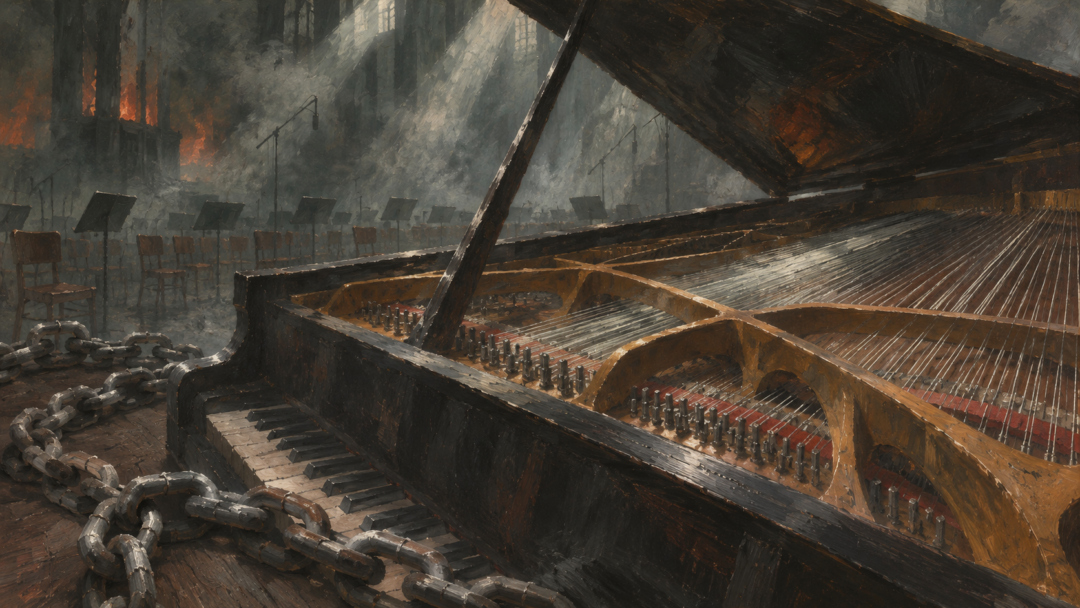
Beneath Isengard, where Saruman’s furnaces blaze and Orcs labor among pits and machinery, the music of The Lord of the Rings seems to acquire a hard, metallic edge. That impression makes a story about musicians lashing chains against a cymbal sound almost plausible. But what do we actually know about how the soundtrack’s extraordinary percussion was made?
The surviving accounts do not identify anyone selecting a cymbal, describe a cymbal comparison, or explain why chains would have been struck against one. They document something different: chains, piano strings, and a percussion technique that became closely associated with the Orcs and Isengard. The strongest evidence comes from a cellist who watched the original recording sessions, an official description of Howard Shore’s score, and a later concert account that preserves unusually specific playing instructions.
A cellist’s view from the recording hall
On September 3, 2001, the London Philharmonic Orchestra assembled at Watford Town Hall to begin recording music for The Fellowship of the Ring. Cellist Catherine Wilmers remembered a huge orchestra, a large hall, and Shore conducting music that needed to fit an unusually long film. Her firsthand diary, published in January 2002 captures the working conditions behind the score.
Wilmers describes Shore watching the film against the music, judging both its character and its precise timing. Players sometimes had to turn four-beat bars into three-beat bars, or adjust another passage to five, to follow an edited scene. Instrumental parts could change immediately. Even for a large orchestra, this was not merely a matter of playing a finished score from beginning to end.
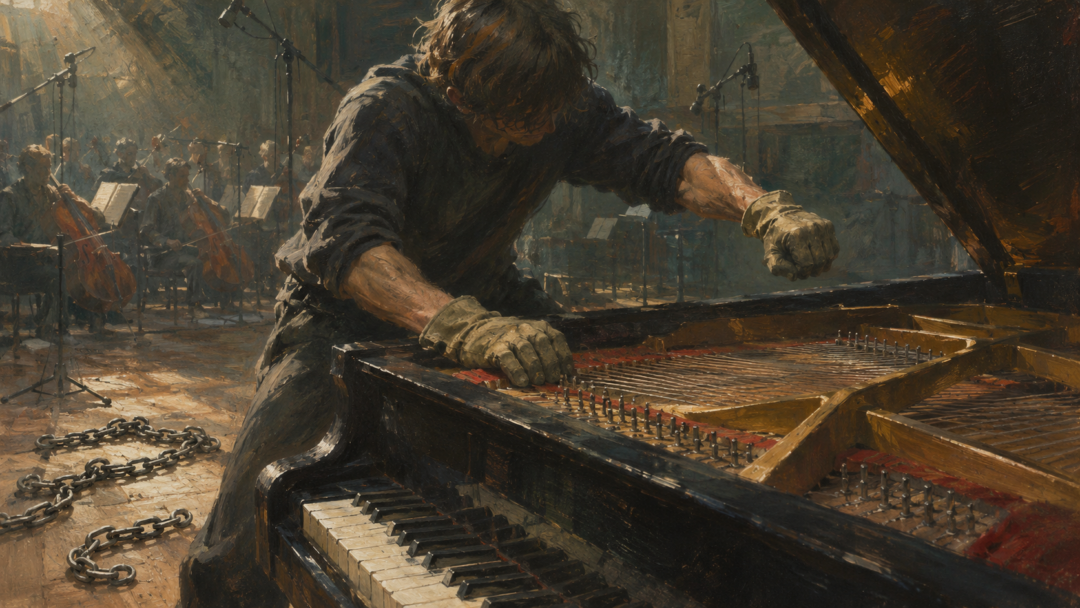
Then comes the detail that matters most to the chain question. Among the percussion instruments listed for the sessions were chains. Wilmers observed percussionist Rachel Gledhill wearing thick gardening gloves while hitting the strings of a piano in a rhythmic pattern. At times, Gledhill also jangled chains on the floor. It is a strikingly physical glimpse of film music being made.
The wording deserves care. Wilmers describes the rhythmic striking of piano strings and the occasional jangling of chains on the floor; she does not set out the precise contact mechanics for every effect. Her diary does not specify whether chains contacted the strings during those particular strokes. Nor does it mention a cymbal used as the striking surface. Its importance lies in what the cellist actually witnessed, not in details we might add afterward.
Her account also explains why an unusual technique might seem to have emerged from experimentation. The musicians spent considerable time on individual sections and sometimes returned to record them again a week later. Wilmers suggests that a new percussion idea could be among the reasons for another take. She also recalls discussion of Irish bodhrán drums, the search for a darker or more military sound, debate over which taiko drums to use, and adjustments to orchestral color. These examples show flexibility, not when or by whom the chain technique was invented.
What the official description names
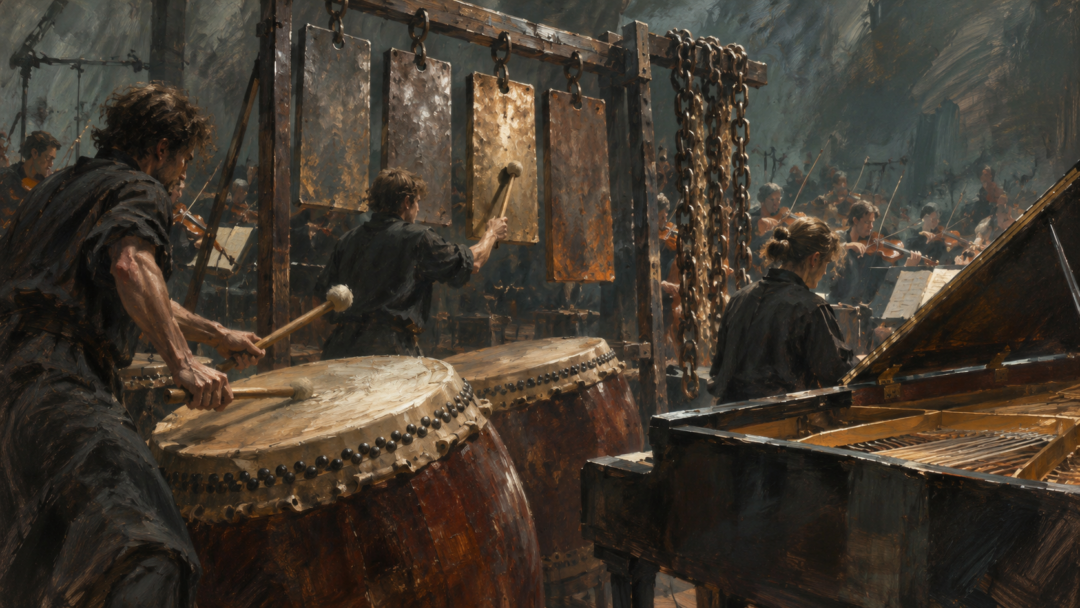
The more explicit identification of the chain instrument comes from Howard Shore’s official description of The Lord of the Rings Symphony. Written by music commentator Doug Adams, this overview looks back on the score as a coherent musical world rather than presenting a minute-by-minute recording diary. For the industrialized Orcs, it identifies especially violent percussion, “including Japanese taiko drums, metal bell plates and chains beaten upon piano wires.” That is the clearest documented description of the relevant combination.
The taiko drums supply a forceful pulse, metal bell plates a metallic attack, and chains against piano wires a less conventional orchestral sound. These are separate items in the description. In particular, a metal bell plate is not simply another name for a cymbal, and the explicitly named surface receiving the chains is not a cymbal at all. Replacing piano wires with a cymbal changes the reported technique rather than merely simplifying its terminology.
This account and Wilmers’s diary illuminate one another without becoming identical testimony. She records actions she saw in the hall in 2001. Adams identifies instrumentation when explaining the completed score’s musical identities. Their shared connection between chains and a piano is significant, even though they do not describe every movement in exactly the same way. Neither source supplies a chain of decisions leading to a selected cymbal. Neither reveals the exact equipment used for a particular take.
A separate official concert guide to The Two Towers adds a useful rhythmic detail. It associates Isengard with a recurring five-beat pattern scored for metal bell plates, anvils, bass drum, taiko drum, and chains striking strings inside a piano. The unconventional percussion therefore contributes to a recognizable musical figure, not just an isolated sound effect.
Why metal and piano strings suit Isengard
In the films, Isengard’s imagery makes the sonic association easy to understand. Saruman’s domain changes from an ordered landscape around Orthanc into a place of felled trees, excavated earth, furnaces, and mass production. Orc armies are prepared there on an industrial scale. It is reasonable to hear hammering rhythms and abrasive metallic sounds as an acoustic counterpart to that transformation. That is an interpretation of the effect in context, not a claim that Shore left a specific explanation of why one piece of metal was chosen over another.
A pianist normally presses keys, allowing felt-covered hammers to strike strings and produce controlled pitches. Striking the exposed strings directly makes the contact itself part of the musical gesture. Add chains, as the official instrumentation describes, and the result can combine a sharp attack with the complicated resonance of vibrating strings. The sound can suggest both impact and lingering vibration, qualities that fit a world of ironwork and relentless motion without requiring us to invent an exact studio setup.
Equally important, the effect is not just a special noise placed on top of an otherwise ordinary tune. The five-beat Isengard figure gives the unusual instruments a repeated task. A returning rhythmic cell makes another blow feel inevitable. Against the smoother motion of many orchestral passages, the pattern can feel inflexible, insistent, and difficult to escape. Much of the menace comes from organization: the sound of individual impacts becoming something as regular as a machine.
Shore’s broader musical design sharpens this contrast. The same symphony overview associates the Hobbits with gentle, Celtic-colored music, a world far removed from the Orcs’ battering percussion. Hearing those languages of sound side by side makes the stakes legible without requiring a character to explain them. The Shire’s musical warmth evokes home and daily life; Isengard’s metal and pounding rhythms suggest what threatens that life. The percussion helps place a culture inside the story.
The chains return to the concert stage
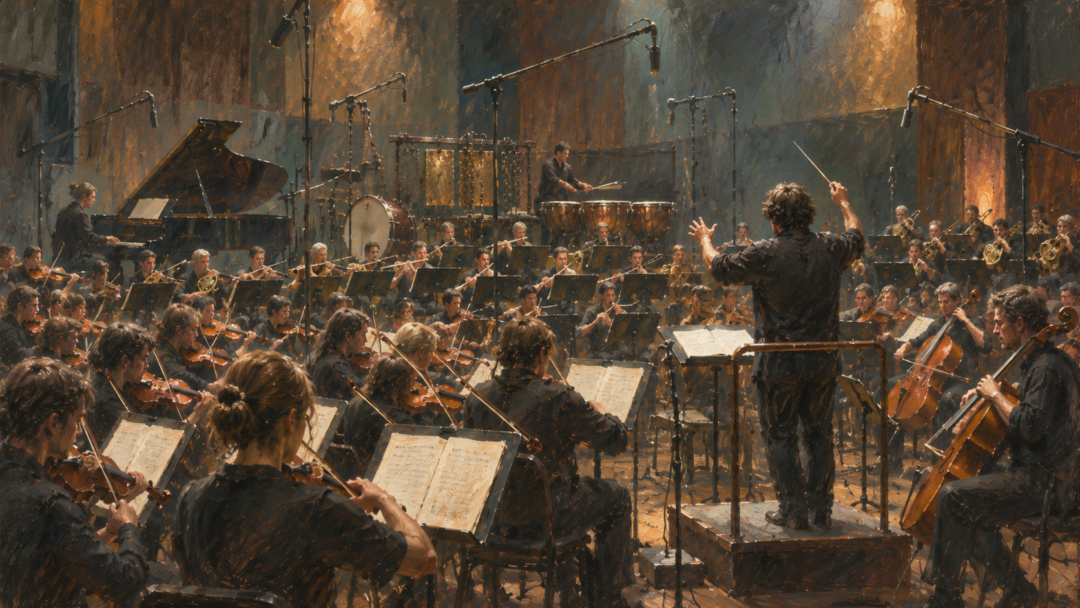
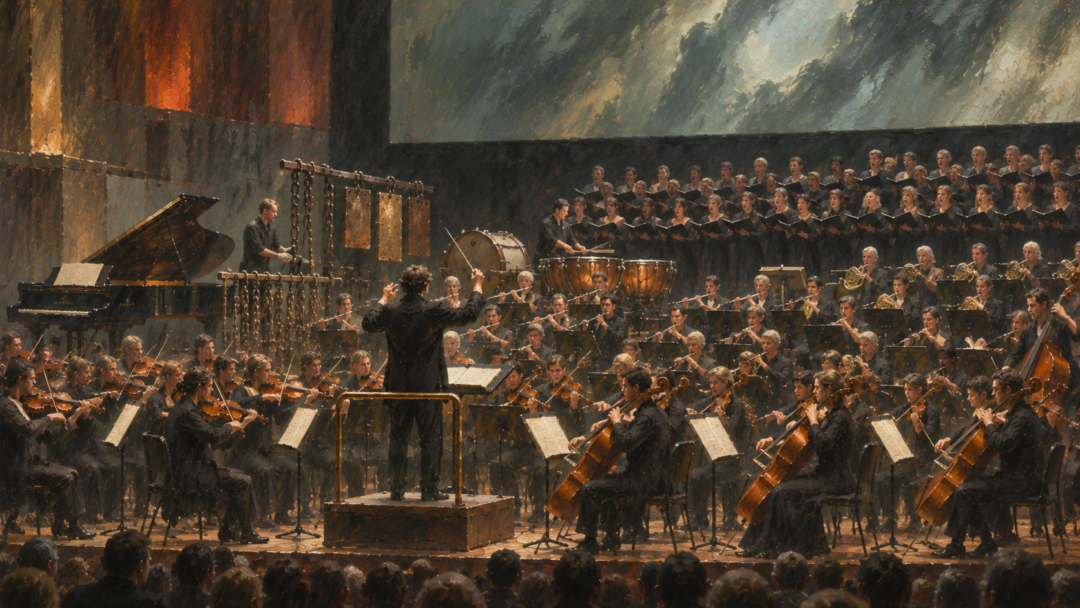
A later perspective appeared in an April 2026 article from the London Philharmonic Choir. Choir member Vicki Holdway was writing ahead of performances of the trilogy with live orchestra and choir at the Royal Albert Hall. She also recalled a March 2022 concert rehearsal conducted by Ludwig Wicki and a part identified by the choir librarian. It had a memorable name: “Distressed Piano.”
The playing instruction is much more specific than the older diary. For that concert material, it calls for a gardening glove on one hand, a medium-gauge chain wrapped around it, and strikes against the piano’s lower strings. It also says the piano need not be in tune, with the damper pedal held down by a sandbag. These are concrete performance directions for later concert material, not a complete reconstruction of the 2001 recording. Holding the dampers off the strings lets them resonate after being struck, helping explain why the piano itself matters as a sounding body.
Holdway points listeners toward “The Caverns of Isengard” on The Fellowship of the Ring soundtrack as a place to hear the effect. That clue is particularly welcome because it brings the unusual method back to a recognizable moment in the finished music. Instead of hunting for an isolated metallic crash and guessing what made it, a listener can attend to how the percussion sits amid the cue’s rhythmic movement, and how it contributes to the underground industry associated with Saruman’s forces.
The anecdote that gives Holdway’s article its title is even more vivid. During the 2022 rehearsal, Wicki stopped an Orc-related passage and called for more chains. The chain sound was distinctive enough to be singled out in rehearsal. That moment shows how the technique continued to matter in live performance years after the films were recorded. It does not tell us who first devised it or why.
Where the cymbal story stops
So why has the question of a cymbal become attached to this effect? The idea has an intuitive appeal. Cymbals and chains are both familiar metal objects, and a dramatic clang seems tailor-made for a scene of Orc machinery. Yet similarity in sound or appearance is not evidence of a decision. To establish a cymbal-selection story, we would need testimony, a recording note, a documented instruction, or another reliable account connecting that object to an actual choice made by the soundtrack team. The sources at hand supply none. That does not establish that cymbals were never used elsewhere in the scores or in later performances.
The memorable image, then, is not a composer pointing to a chosen cymbal. It is a player in gardening gloves at a piano, bringing chains into the sound of Isengard. We know enough to hear the iron in the music and to appreciate the craft behind it. We do not know that anyone settled on a cymbal for those chains—and the documented story is more interesting without that invented decision.
Sources & Notes
This article is based on close reading and interpretation of Tolkien's published works and related source material where relevant.