At Dol Guldur, a spectral figure attacks Radagast, leaving behind a blade that will trouble the White Council. By the time the Nazgûl confront Elrond and Saruman in The Battle of the Five Armies, those shadows have become an extraordinary sight: pale, partly transparent warriors wearing elaborate helmets and armor. They resemble an assembly of haunted champions more than the Black Riders who pursued Frodo.
Giving the Nine different armor and weapons invites closer attention, while their ghostly presentation suits a supernatural confrontation. Yet the execution is uneven. The redesigns sometimes lose the instant recognition, consistent Witch-king imagery, and visual individuality that could have made them a natural extension of The Lord of the Rings films. Their success depends on which qualities a viewer prizes.
The appeal of giving the Nine their own armor
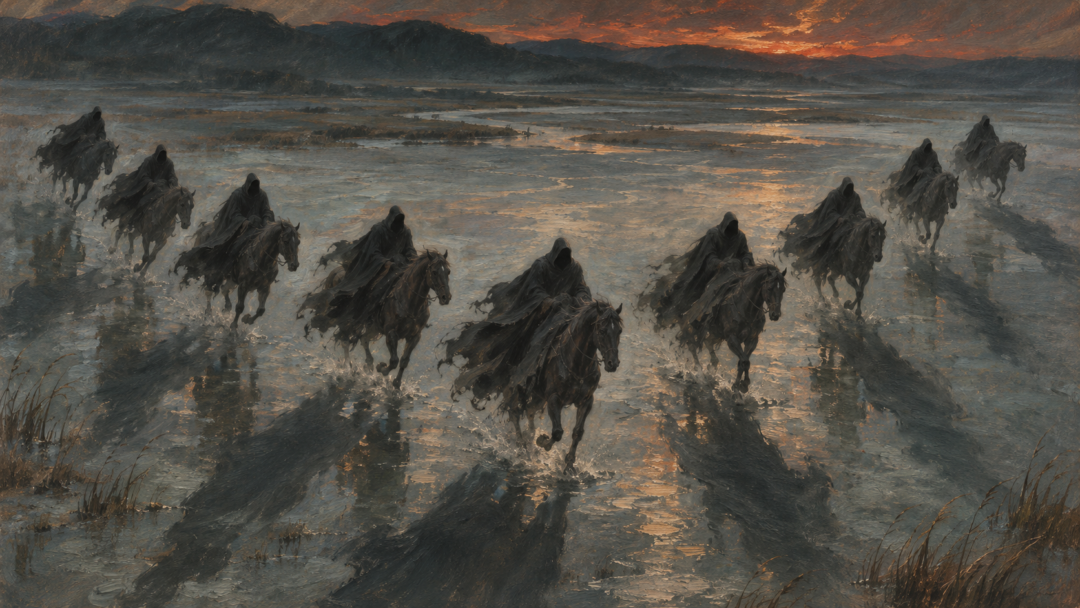
Think of the Black Riders outside the Shire. They terrify partly because their clothing reveals so little: dark hoods, long cloaks, and a suggestion of something human where no face can be seen. In The Fellowship of the Ring, their near-uniform appearance makes them feel less like nine separate opponents than one relentless threat. Their anonymity is part of the horror. A single black horse emerging from a bend in the road can announce the danger without revealing its rider.
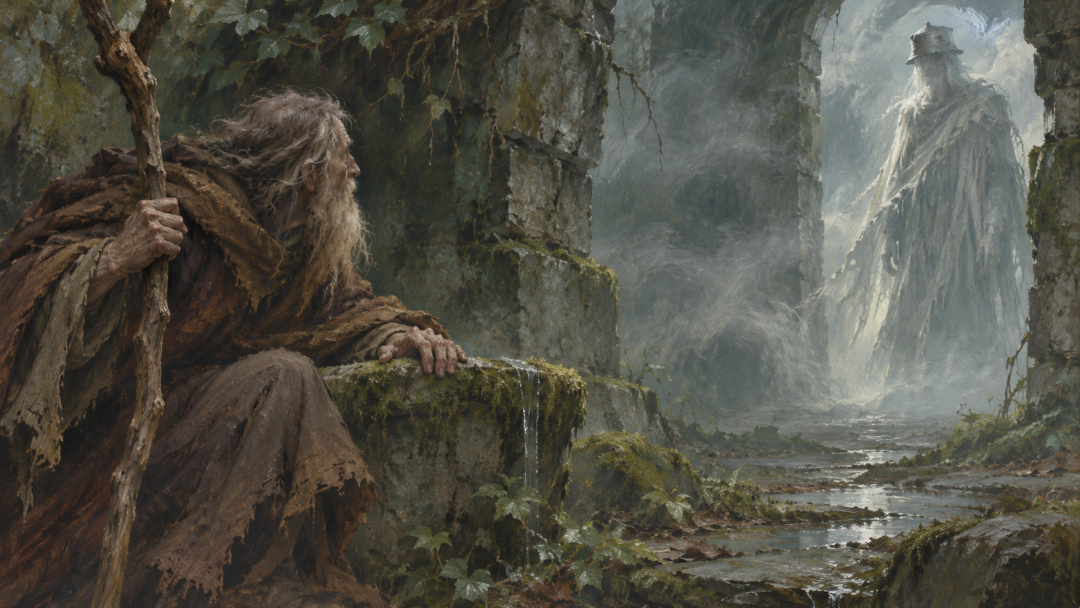
The books allow more variety than black cloth alone. When Frodo puts on the Ring at Weathertop, he sees pale faces, grey robes, and silver helms beneath the Riders' dark coverings; the leader is distinguished by a crown. Elsewhere, the dark garments give visible shape to beings who have faded from ordinary sight. That glimpse of former humanity leaves room for armor beneath the hoods. The wraith-world reveals details that ordinary onlookers are not meant to see.
The Hobbit films take advantage of that opening. Distinctive headpieces, differing shoulder armor, and individual weapons suggest that each apparition once belonged to a particular human life, even though the films do not establish a separate biography for each one. A viewer can imagine a fallen ruler or warrior without needing a name or backstory. The designs imply history without narrating it. That is more suggestive than assigning each wraith an elaborate invented personality.
From the tombs to the confrontation at Dol Guldur
The films introduce the thread gradually. In An Unexpected Journey, Radagast encounters a ghostly attacker at Dol Guldur and retrieves a Morgul blade. Its appearance recalls Frodo's glimpse of the wraith-world in The Fellowship of the Ring. An investigation of tombs in the High Fells then connects the disturbance to the Nine. Their later appearance is thus framed as a revelation, not an entirely new threat.
The tombs inspired curiosity before the final film. In March 2013, a TheOneRing.net staff discussion of an advance glimpse of Gandalf and Radagast investigating the tombs expressed excitement at the reported number: nine. The contributor wondered who had been imprisoned there and how the chambers opened, openly treating the questions as guesses. That is anticipation about the story, not a review of the later armor. The distinction matters because these early questions preceded the final designs.
Film invention must be separated from book history. The High Fells burial story belongs to the movies; it is not an established account of how the Nazgûl were entombed and released in the written legendarium. The storyline culminates in the White Council confronting the Nine at Dol Guldur. The scene offers a chance to reveal the wraiths beyond their riding cloaks, making continuity especially noticeable. Its ensemble staging also invites direct comparisons among the figures.
The Witch-king is the hardest design to reconcile
In a December 2018 essay on Forge World's Nazgûl miniatures, the writer behind Eyes of the Snake points out that the Witch-king's spectral appearance in the first Hobbit film recalls the twilight-world form seen in The Fellowship of the Ring. His later armored presentation in The Battle of the Five Armies looks substantially different. That shift can jar more than changes to less recognizable wraiths. Viewers have already been given a strong visual reference for the character.
There is a second comparison, with The Return of the King. That film's commanding helmet and substantial dark silhouette gave the Witch-king a memorable identity. The Battle of the Five Armies does not simply reuse it. The critic finds the newer version insufficiently evocative, making its leader harder to distinguish. That is an intelligible continuity complaint, not proof of a production error. A recognizably related helmet could have offered a bridge without being a copy.
A pale apparition in a ruin need not look exactly like an armored figure years later; a prequel can explore other possibilities. Yet resemblance can matter without a strict costume chronology. The Witch-king is the wraith whose appearance viewers most readily remember. When his armor does not immediately summon that memory, the redesign loses an easy source of menace. Familiarity can heighten fear rather than diminish it.
How individual are these individual wraiths?
The group raises another problem. The same 2018 commentator identifies apparently matching features among particular figures: an owl-like helmet, similar torso armor, and a corresponding weapon on two wraiths in the group image. The Witch-king is also said to resemble a figure at the far left, while another pair appears to share helmet and shoulder details. Visible similarities do not prove repeated costumes or digital assets. The critique concerns how the completed group reads on screen.
Some commonality suits servants of the same dark master. Shared iron tones and angular forms suggest a common fate. The difficulty comes when the similarities concern the very elements that ought to make them legible as individuals. Changing a sword angle cannot distinguish nearly matching helmets and breastplates. Matching colors create unity; matching contours can confuse the eye.
Not all nine need unique powers, identities, or sculptural languages. The films barely characterize them individually, and a crowded fight needs some unity. Still, an armored ensemble invites the eye to compare silhouettes. A stronger hierarchy of shapes might have let the Witch-king dominate, a few companions stand apart, and the rest remain anonymous. The designs promise more distinction than they consistently deliver. That mismatch becomes easiest to notice when all the wraiths share a frame.
Spectral spectacle versus the black-robed silhouette
Transparency changes their effect further. In the earlier films, the black cloak gives an invisible pursuer weight and a recognizable outline. A rider passing between trees, a hood bending toward a frightened hobbit, or a dark figure standing against fire can be understood almost at a glance. Visible clothing makes the hidden body mysterious. Removing much of that darkness changes the way the threat registers. It exchanges the menace of a physical presence for the unease of an apparition.
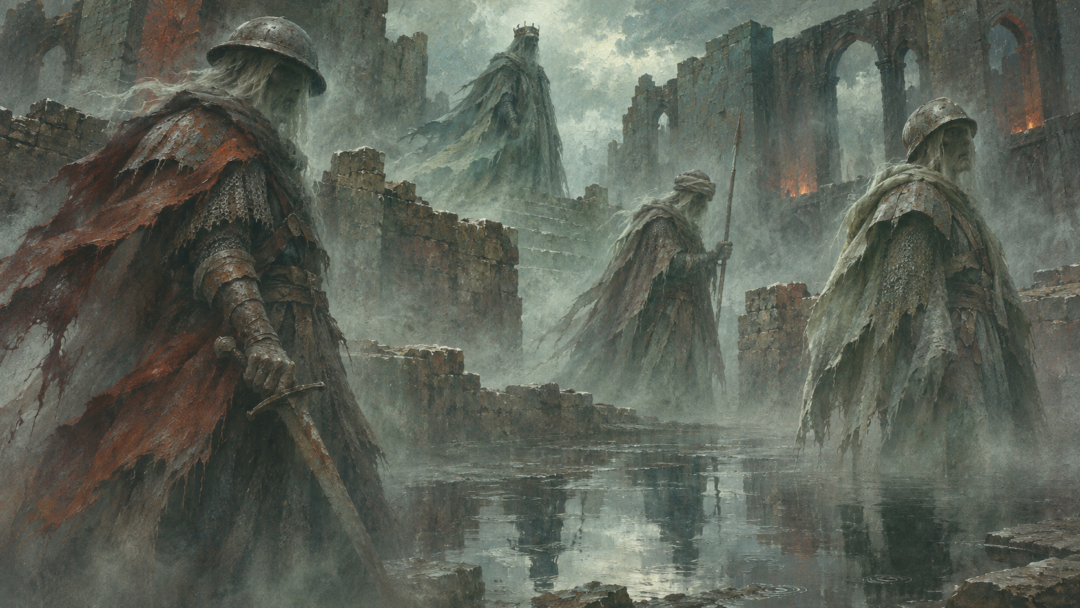
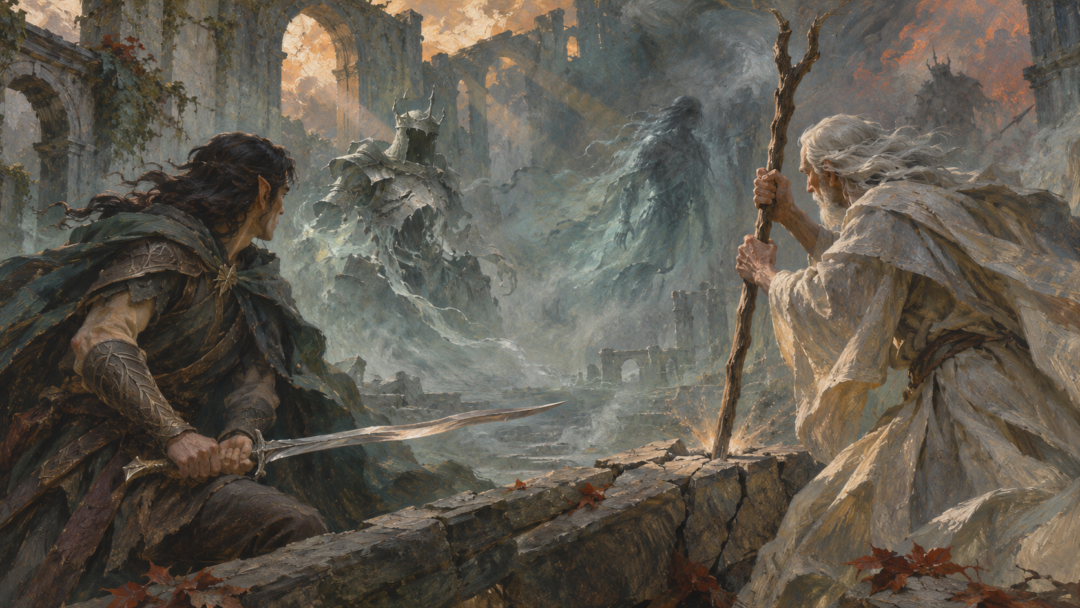
At Dol Guldur, the armored wraiths hover between warriors and apparitions. Their pale edges and translucent bodies communicate something that simple black robes cannot: these enemies are no longer quite participants in the ordinary physical world. Against ruined masonry and the tangible White Council, that effect impresses. It differs sharply from the Riders' earlier pursuits. For a battle against powerful members of the White Council, that heightened supernatural quality has real appeal.
The cost is a weaker silhouette. When armor and fabric fade together, the eye has less to follow. Movement can be spectacular without a figure remaining memorable once it stops. In the fight with Elrond and Saruman, the wraiths' agility and swirling garments provide flashes of personality, but the effect relies more on action than on instantly identifiable outlines. Those who loved the Riders' restraint may miss it. The ruined stonework provides hard edges, but cannot supply a missing character silhouette.
Why the Forge World miniatures deserve a separate verdict
The 2018 critique ultimately focuses on Forge World tabletop figures. Its author, considering a Dol Guldur army, dislikes both the film designs and the sculpts. Those complaints differ. If two movie wraiths look too similar, the model maker inherits that difficulty. If a miniature's anatomy or stance looks awkward, that is a separate question about translating a screen design into a small physical object. An ethereal fighter can become unexpectedly earthbound on a gaming base.
The blogger argues that some models have legs that appear disproportionately short beneath their torsos and robes. Comparisons with film imagery and a human-proportion diagram illustrate a subjective judgment, not verified measurements. The poses also seem too static: weapons largely at rest, bodies standing upright, little sense of the acrobatic combat seen at Dol Guldur. A static model exposes proportions that a moving image can conceal. It also lacks the camera movement and lighting that direct our attention during a film.
More animated sculptures offer a revealing contrast. The blogger points to Weta's larger Nazgûl pieces, where twisting cloth and fragments of ruined architecture help turn a spectral fighter into a dramatic composition. The movie imagery clearly allows dynamic sculpture, although scale and format change the challenge. Speculation about rushed filmmaking or outside interference does not explain these choices without further evidence; a weak miniature does not prove a weak movie design. The comparison instead underscores how much dramatic posing contributes to supernatural presence.
The armored Nazgûl work best as remnants of formidable people, given shape by iron and shadow. They are less persuasive when similar helmets blur together or the Witch-king disappears into the group. I would keep the experiment, anchored more firmly to the earlier films. At Dol Guldur, a wraith should be able to emerge from the mist and be recognized before its sword begins to move.
Sources & Notes
This article is based on close reading and interpretation of Tolkien's published works and related source material where relevant.