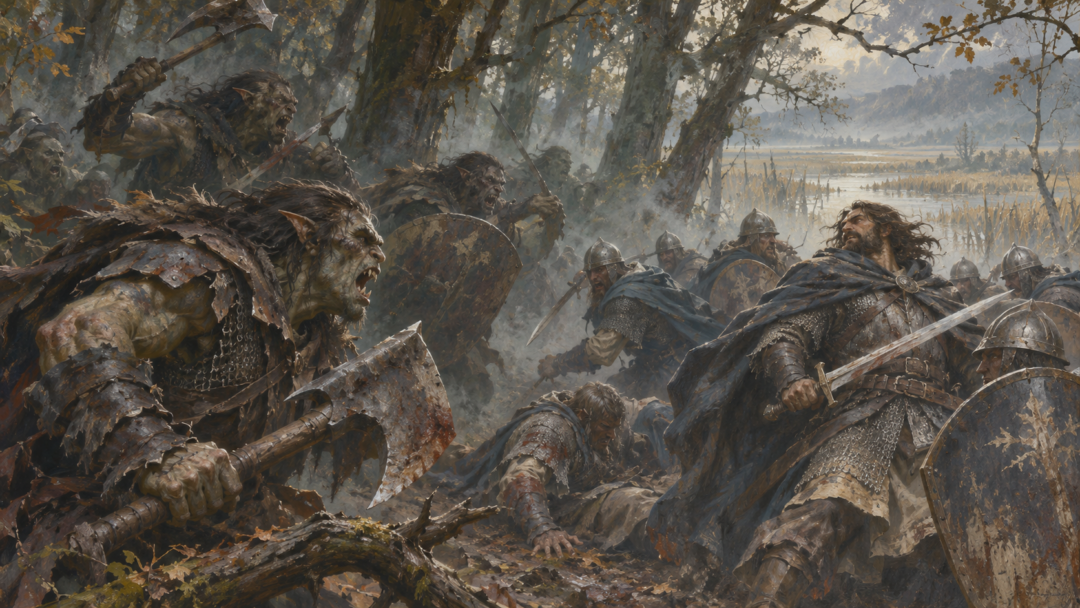
Near the Gladden Fields, shortly after the Second Age ended, unusually formidable Orcs fell upon Isildur's company. Many centuries later, a different force of powerful black Orcs came out of Mordor and seized Osgiliath. Both episodes challenge the assumption that Orcs grew steadily weaker with each Age. If the earlier hosts were stronger, where is the passage that actually establishes the change?
The short answer is that the evidence considered here does not establish a gradual physical decline. It shows exceptional Orc warriors at widely separated dates, but gives us no reliable measure of how the average Orc changed from the First Age to the Third. The question gets more interesting when individual strength, the makeup of a fighting force, military success, and a master's supernatural power are separated.
What would a weaker Orc actually look like?
An Orc might be weaker in several senses. One soldier could be smaller, less enduring, or less effective with a weapon. An elite company might be stronger than ordinary troops without telling us anything about its entire race. An army might lose through poor leadership, divided loyalties, or a stronger enemy. None of these observations automatically proves that Orc bodies have deteriorated over generations.
The problem grows across thousands of years. We seldom see representative samples; the stories favor ambushes, sieges, pursuits, and supernatural wars. A comparison between the most terrifying warriors of Morgoth's day and an unnamed guard in Mordor would be misleading. Establishing decline would require an explicit chronological statement or genuinely comparable groups. The distinction matters because a battlefield chronicle records who won, whereas a claim about physical decline needs to tell us something about the soldiers themselves. Neither kind of proof is available here.
The Great Orcs who fought Isildur
Isildur's ambush provides an early test case. It occurred in Third Age 2, immediately after Sauron's defeat ended the Second Age. The Encyclopedia of Arda, summarizing the account associated with Isildur's disaster, describes Great Orcs among the attackers and dates such exceptional warriors back at least to the end of the Second Age. Powerful Orcs were no invention of Saruman.
The same account describes severe losses among those formidable fighters. Although they destroyed Isildur's company, comparable attacks did not immediately follow. Even a victorious force can lose its strongest troops. It is not evidence that all later Orcs inherited weaker bodies. Their disappearance from the record tells us about casualties and visibility, not biological decline. Even if a particular warrior class was lost, that would be a break in military history, not proof that ordinary Orcs born afterward were smaller or less capable.
The name adds another caution. The encyclopedia explicitly distinguishes these early Great Orcs from the Uruk-hai who appear much later, and leaves any direct relationship uncertain. “Great Orc” can describe a warrior's exceptional size or fighting role without identifying an unbroken lineage. We cannot turn that contingent into the ancestors of every later elite Orc, or its destruction into the loss of a stronger bloodline.
Osgiliath supplies the strongest objection
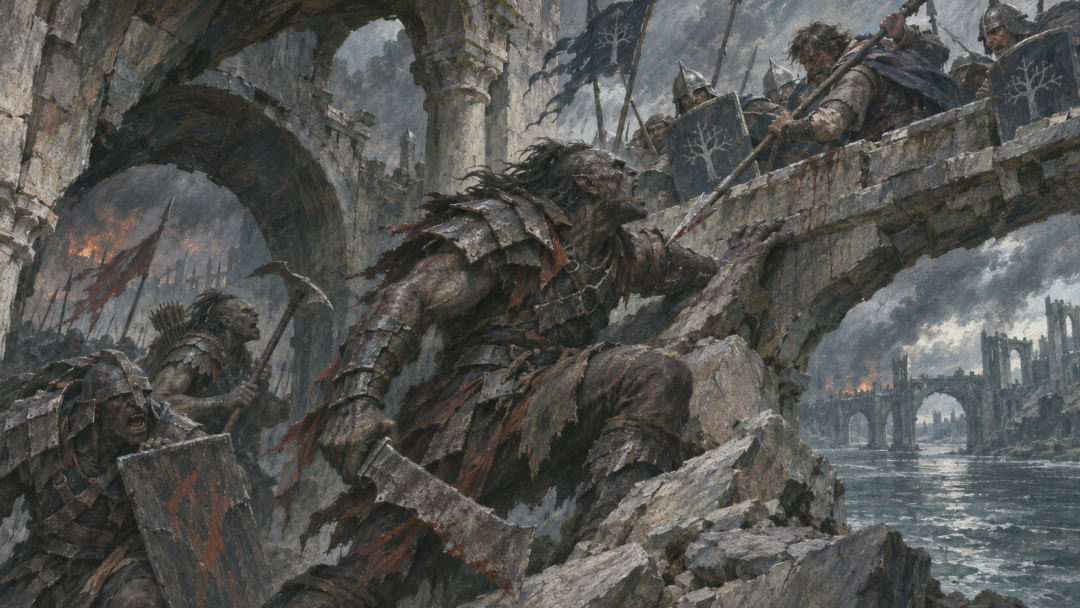
Jump to Third Age 2475. In the last years of the Steward Denethor I, formidable Orcs issued from Mordor, crossed Ithilien, and took Osgiliath. The Encyclopedia of Arda quotes Appendix A of The Lord of the Rings describing the newcomers as “the race of uruks, black orcs of great strength.” Boromir, Denethor's son and namesake of the Fellowship's Boromir, defeated them and recovered Ithilien, but Osgiliath and its great bridge lay ruined.
The chronology now challenges the weakening theory directly. Over two thousand years after Isildur's death, the historical record still singles out remarkably strong Orc soldiers. Their assault permanently scarred Gondor's old capital. According to Appendix A's history of the Stewards, nobody inhabited Osgiliath afterward. A notable victory for Gondor still came at an enduring cost. It gives no average height or power; “first appeared” means these Uruks emerged from Mordor then, not that powerful Orcs were new.
Nor does an exceptional Third Age company prove that Third Age Orcs, taken as a whole, exceeded their First Age predecessors. Ordinary troops could have been weaker than specialists. The crucial point is narrower: a story of inevitable, uninterrupted deterioration has trouble accommodating the emergence of a notably powerful soldier population so late in the timeline. Appendix A gives us a dated military development. It provides no physiological trend.
The problem with Orc names
Confusion begins when labels become species. In Black Speech, uruk originally meant simply “Orc.” As the language was used in the later Third Age, the word was applied particularly to the great soldier-Orcs of Mordor and Isengard. Appendix F, discussed in the Tolkien newsgroups FAQ and Encyclopedia of Arda, explains the narrower usage. Uruk-hai is a related collective form, not by itself a laboratory definition of a breed.
The shift from a general word to a military term is easily missed. “Goblin” and “Orc” are not two neatly separated biological categories in the books, either. Likewise, Great Orc, soldier-Orc, Uruk, and half-orc do not always answer the same question. Some describe a creature's appearance, others its function or possible ancestry. The same label may even be used more loosely by enemies describing Orcs from outside, without access to their origins. One rigid ranking makes changing terminology look like changing biology.
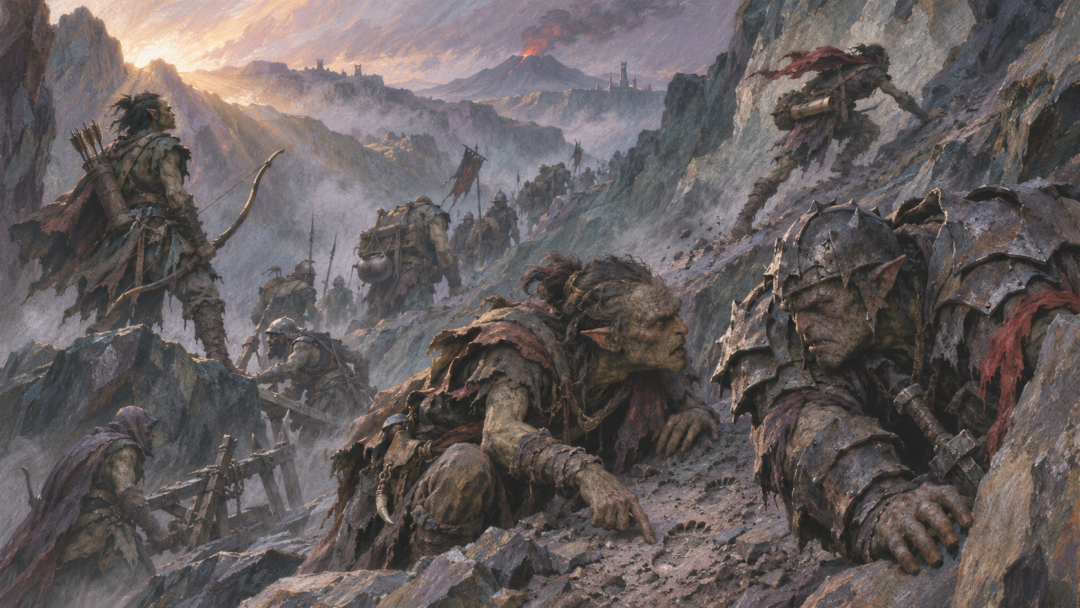
The variety inside Mordor reinforces the point. Around Cirith Ungol and along Mordor's roads in The Return of the King, Orcs differ in stature and duties. Smaller troops can be driven by larger fighting Orcs; trackers and garrison soldiers need not perform identical work. Shagrat and Gorbag are rival commanders, not partners in a harmonious force. These differences coexist; they are not stages of chronological decline.
What Saruman changed, and what remains uncertain
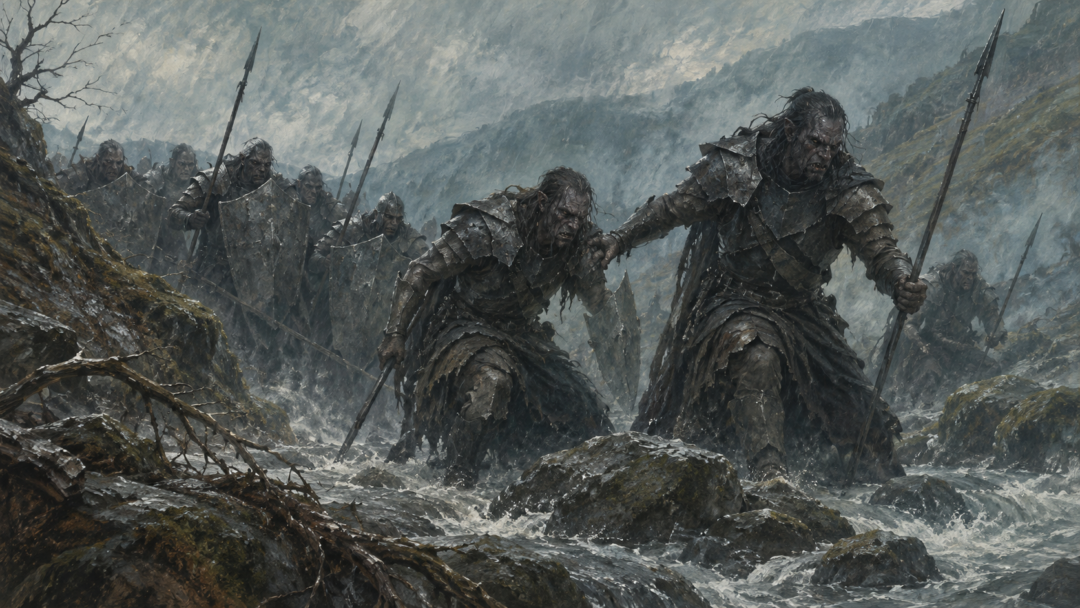
Saruman's distinctive Isengarders invite biological explanations. Uglúk's soldiers move swiftly and endure daylight, a quality that troubles Treebeard. In The Two Towers, he wonders whether Saruman has somehow blended Orcs and Men. His suspicion suggests unusual breeding, not a complete explanation of every soldier's ancestry. The scene is valuable precisely because Treebeard notices a difference and asks what caused it; the story does not turn that question into a census of Isengard.
Outside the narrative, stronger evidence appears. The Tolkien newsgroups FAQ cites a passage from “Myths Transformed” in Morgoth's Ring discussing Saruman's interbreeding of Orcs and Men, with resulting forms described as Man-orcs and Orc-men. But identifying every Uruk-hai as such a hybrid remains difficult to prove. Uruks were already coming from Mordor centuries before Saruman's armies became prominent, so he did not invent the whole category.
Daylight tolerance also warns against generalization. Treebeard notices that the Isengarders endure something many Orcs dislike; that does not establish equal tolerance among all Third Age Orcs, or prove that endurance in sunlight is interchangeable with raw muscular strength. Training and equipment can distinguish a force while its ancestry remains uncertain. Isengard complicates the comparison rather than solving it.
An army's strength is not its soldiers' strength
Another shortcut runs through the Dark Lords. Morgoth commanded the terrible hosts of the First Age; Sauron, his former servant, marshalled the armies of Mordor afterward. Their relative powers tell us nothing numerical about their Orcs. Morgoth's wars also involved other creatures, including Balrogs and dragons. A devastated battlefield cannot measure one Orc's strength.
Orc armies depended heavily on command, fear, and domination, while their own factions were often quarrelsome. In The Two Towers, the captors of Merry and Pippin are divided among Isengarders, Mordor Orcs, and Northerners, with competing orders and grievances. Their disputes undermine their mission before Rohan's Riders overtake them. None has to become physically weaker. Their difficulty is that the group has several masters, and no shared loyalty strong enough to settle its disputes.
At the Black Gate it becomes dramatic. When the Ring is destroyed and Sauron's rule collapses, his forces lose the direction that held them together; many flee or are overwhelmed by panic. That catastrophe changes no muscle or bone. Accounts of Orcs scattering when a dominating will is removed help explain why an army's effectiveness can rise or fall with its master, without supplying a biological timeline. And Sauron's talent for imposing order on a force is not the same as Morgoth's cosmic power.
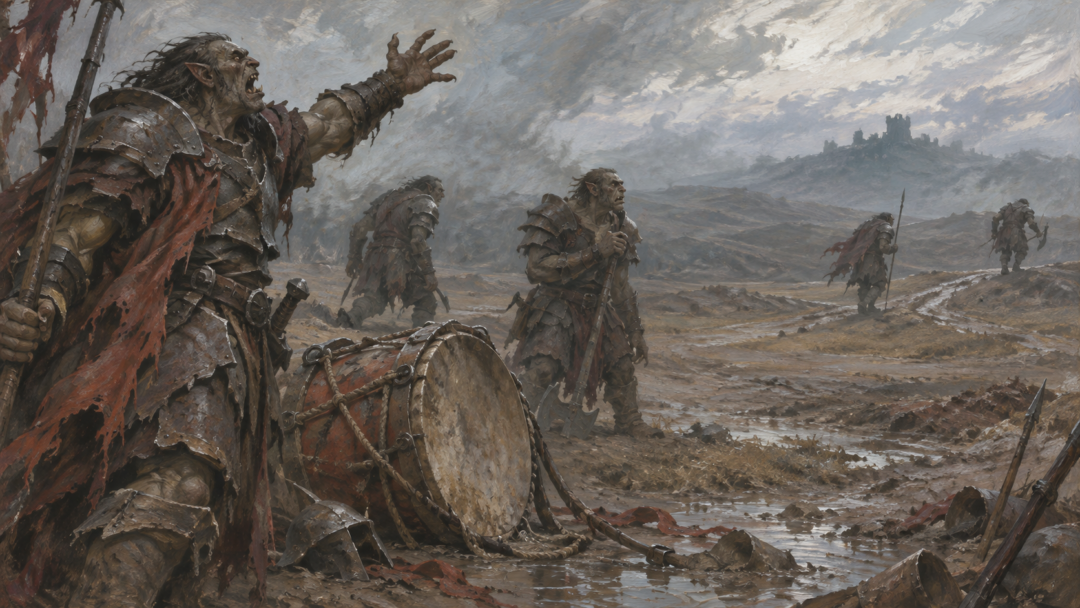
The missing First Age comparison
The largest gap remains. Neither the Gladden Fields nor Osgiliath tells us what an ordinary Orc in Beleriand could reliably accomplish. First Age battles are preserved largely through the deeds of great leaders and extraordinary enemies, not measurements of rank-and-file Orcs. Morgoth's hosts wreak havoc, but those accounts offer no consistent physical averages. Imaginary ancient super-Orcs cannot fill the gap. Even a comparison of famous Orc captains would select outliers, not the ordinary fighters whose supposed long decline is at issue.
Even Orc origins changed across Tolkien's drafts. The Silmarillion presents their corruption from Elves, while later discussions collected in Morgoth's Ring consider origins connected with Men and mixed possibilities. The Tolkien FAQ on Orc origins lays out these developing and sometimes conflicting explanations. They frustrate tidy biological histories, yet offer no evidence of an Age-by-Age weakening. Uncertainty about beginnings is not evidence of degeneration afterward.
Three findings remain: the evidence does not show universal physical decline; formidable Orcs existed near the end of the Second Age and in the Third, though their relationship is uncertain; and leadership, troop composition, and supernatural control can alter victories without altering bodies. At Osgiliath, black Uruks still broke a city's defenses. The real puzzle is not how far their race had fallen, but what the surviving stories allow us to compare.
Sources & Notes
This article is based on close reading and interpretation of Tolkien's published works and related source material where relevant.