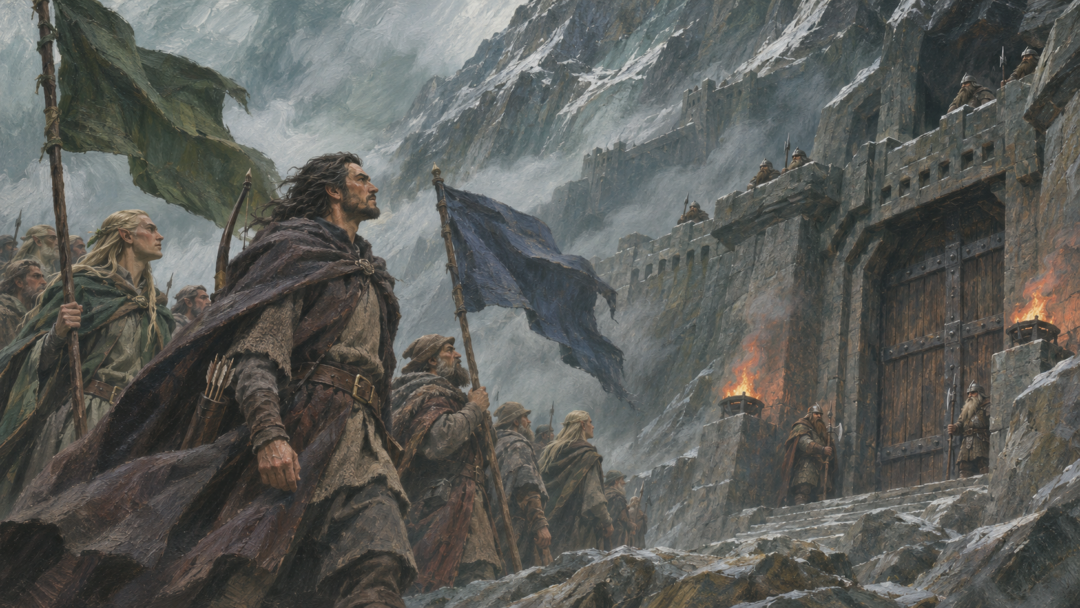
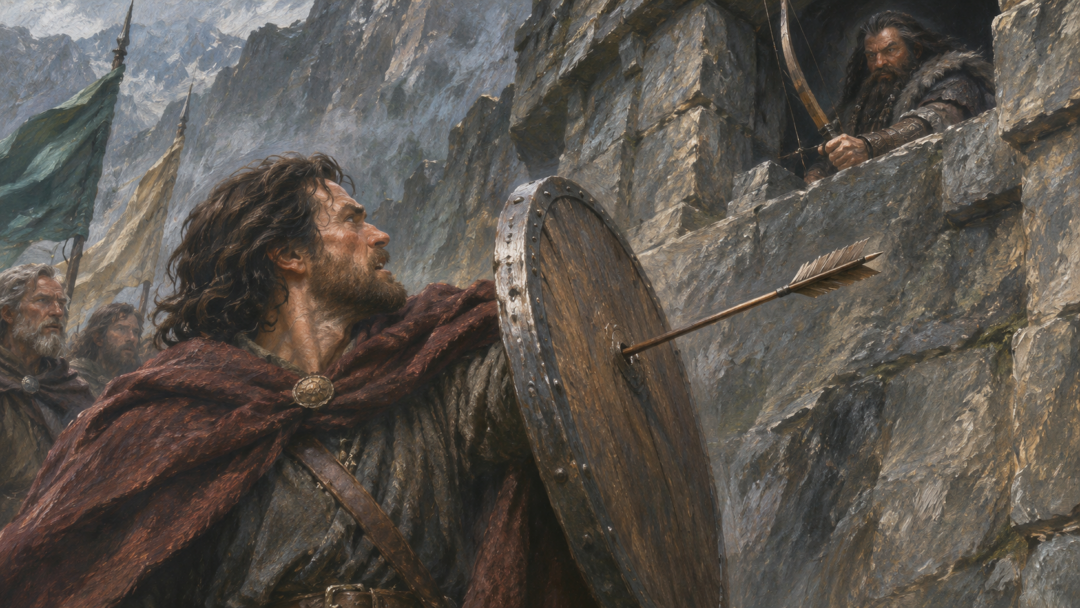
An arrow flies from the fortified Gate of the Lonely Mountain and lodges in a visitor's shield. The man below has come with words, not a challenge to single combat. Behind him stand the interests of Lake-town and the Woodland Realm; above him stands Thorin Oakenshield, newly restored to the treasure of his ancestors and unwilling to surrender it under pressure. It is one of the sharpest moments in the quarrel that follows Smaug's death.
Yes, Bard's representative can properly be called a herald. He serves as a diplomatic messenger between opposing parties at the brink of war, and accounts of the chapter actually use that word for the negotiators. The designation describes his job in the encounter, not a documented personal title or membership in an order of heralds. To see why the distinction matters, follow the messages in the order they arrive at Erebor.
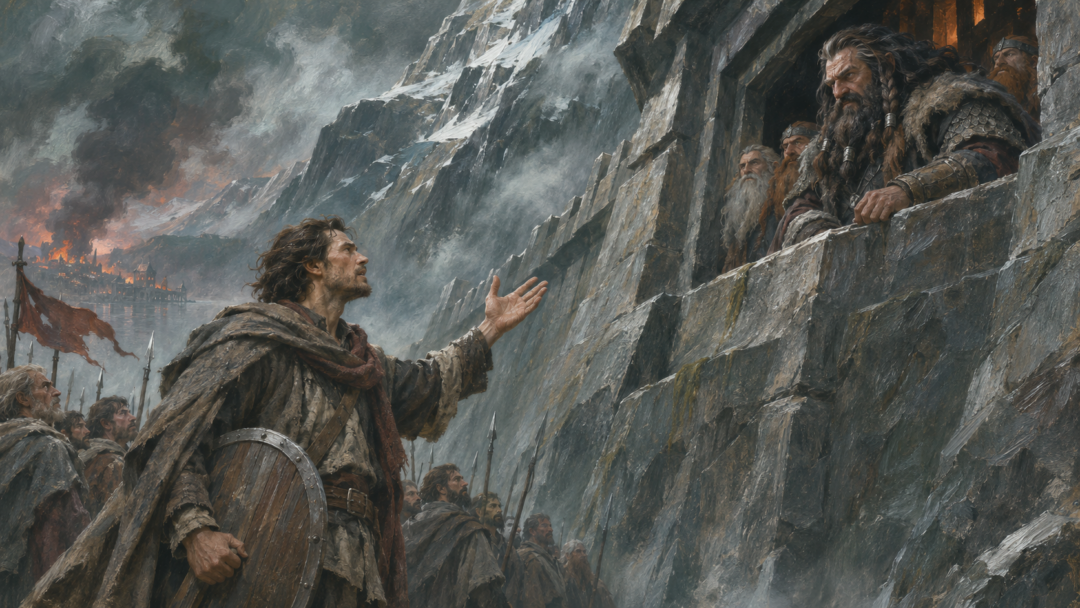
A gate closed against an approaching army
Smaug's destruction has left two very different scenes behind him. Beneath the Mountain lie the riches gathered by the dragon, including treasures taken from the dwarves and from Dale. At the Long Lake, Esgaroth has been devastated by Smaug's attack. Bard, the archer who killed Smaug, becomes the leading voice for their claims on the wealth now accessible inside the Mountain.
Thorin sees the situation from behind walls. The old raven Roäc brings news of the dragon's death but also warns that others are coming to the hoard. He advises trust in Bard rather than in the Master of Lake-town. Thorin instead sends word to Dáin in the Iron Hills and prepares the Front Gate for defence. The dwarves raise a stone barrier with openings through which they can watch or shoot. The visitors will have to address a fortified gate.
The first approach is not the famous arrow incident. Armed men and elves come near the gate, their banners announcing the peoples gathered below, and an initial encounter ends without a settlement. Bilbo, who had hoped Smaug's death might finish the adventure, feels the gap between celebrating a homecoming and preparing for another conflict. The visitors have not yet become an undifferentiated enemy, but suspicion is setting the terms.
Bard then approaches in person, accompanied by banner bearers associated with the Lake and the Forest. He makes his own case to Thorin: he slew the dragon; he descends from Girion of Dale, whose wealth was among Smaug's spoils; and the people of Esgaroth suffered after aiding the dwarves. These are different grounds for asking compensation or assistance. Thorin disputes the pressure of an armed host at his door and refuses to bargain on those terms.
Bard speaks first; heralds return afterward
That sequence is easy to flatten into a single conversation, especially when the arrow becomes its most memorable image. Yet the later demand arrives through representatives after Bard's personal appeal. Bard's first appearance establishes who is asking and why; the subsequent heralds communicate the position of the parties outside the gate in a more formal and confrontational shape. Calling the arrow-struck speaker a herald does not mean Bard himself was standing behind the shield.
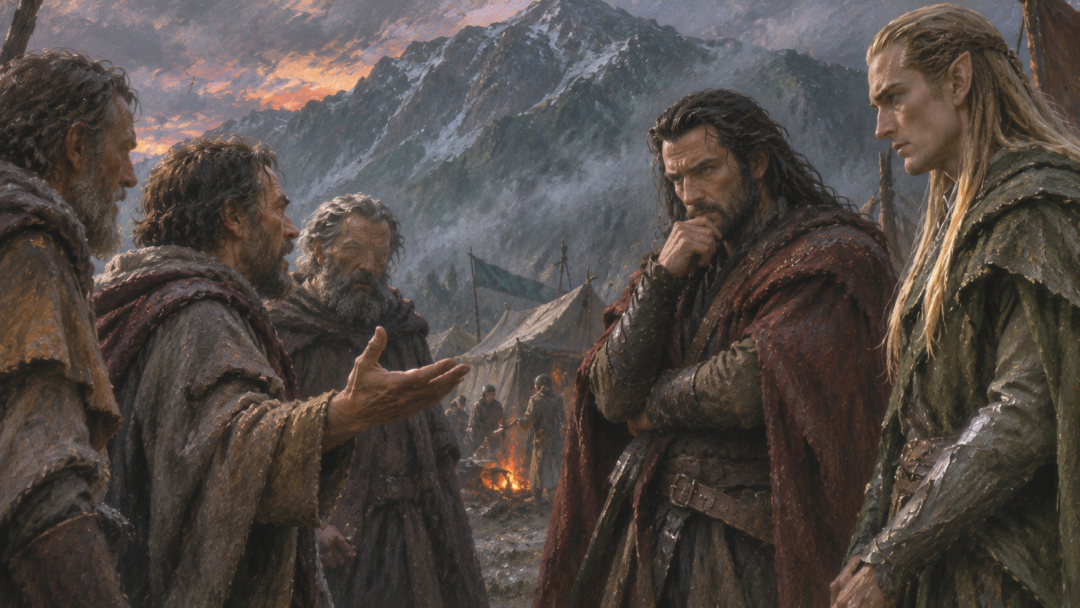
The renewed message demands a portion of the treasure for Bard, in recognition of his defeat of Smaug and his connection to Dale. It also addresses the distress of the Lake-men and the possibility of friendship between the Mountain and its neighbours. The Forest is named too, though the demand is not for elvish gold. Bard's alliance with the Elvenking gives the appeal weight, and from Thorin's position that same alliance makes the visitors look threatening.
The heralds are doing more than delivering a request for charity. Their words link a proposed settlement to the future relationship between neighbouring powers, with the possibility of declared hostility if Thorin refuses. That is why the occasion is diplomatic rather than domestic: the question concerns claims, recognition, assistance and the consequences of rejection. A messenger who brings an ultimatum does not stop being a messenger because the ultimatum is unwelcome. Such difficult communication calls for an intermediary.
What the word 'herald' actually establishes
Modern readers may first picture a herald as someone holding a trumpet at a tournament, announcing knights and displaying elaborate coats of arms. Those associations are genuine parts of the word's history, but they are not the relevant definition here. Dictionaries, including Collins, also describe a herald as an official messenger representing a ruler or authority, especially in wartime diplomacy. Erebor's parley fits the messenger sense directly.
This does not require Bard to have created a permanent court office. There is no established name for the speaker whose shield catches Thorin's arrow, no documented appointment to a heraldic college, and no known personal insignia that proves his status. The narrative's use of heralds is sufficient for the role they perform on this occasion; adding a biography or official rank would be filling silence with invention.
The banners at the gate are worth noticing for a different reason. They identify the groups involved and frame an approach as communication between organized parties, not a chance conversation with a traveller. Neither banner proves an individual held a heraldic office. What gives the word force is that he speaks on behalf of others and conveys their terms to Thorin.
Roäc and the ravens carry important news and requests, including Thorin's appeal to his kinsmen; that does not make every raven a diplomatic herald. Here the representative addresses the leader of an opposing camp, communicates demands concerning a political settlement and receives an answer intended for those who sent him. The encounter is a parley, however badly it goes. The task, not the messenger's costume, explains the designation.
An arrow as the answer
The pivotal action comes when Thorin fires at the speaker and the arrow sticks in the herald's shield. The shield matters. The scene does not report a wound or death, and it does not tell us enough about Thorin's aim to prove that he meant to kill the man. What it undeniably shows is the replacement of a verbal reply with a weapon. A representative receives a demonstration of resistance by force.
Thorin's anger is not without context. His people lost Erebor to Smaug, and recovering their ancestral home has cost them dearly. He resents being asked to give up treasure while armed elves and men remain outside, especially when he has painful memories of the Elvenking. A reader can understand that objection without treating the arrow as a measured or peaceable answer.
Nor does Bard's position have to be judged wholly correct before the herald can be recognized. Thorin has competing claims as an heir of the dwarves. None of those questions changes the capacity in which the speaker approaches the gate. The justice of a message and the identity of its bearer are separate matters, even when the encounter encourages us to argue about both.
The representatives respond by announcing enmity and a siege. Rather than immediately storm the defences, the forces outside will leave the dwarves shut in with the gold they have chosen to defend. The threat has an edge of bitter irony: treasure cannot be eaten. The gate that Thorin strengthened to keep others away can now keep his company confined. The herald's answer turns failed negotiation into open coercion.
What Middle-earth suggests about envoys
There is a useful, though limited, parallel in The Return of the King. At the Black Gate, the Mouth of Sauron asserts the standing of a herald and ambassador when he faces Gandalf and the captains of the West. As a passage reproduced by the Tolkien Gateway encyclopedia shows, Gandalf qualifies the claim by invoking proper conduct from ambassadors while assuring the messenger that nobody has threatened him.
But that scene does not hand us a complete code of Middle-earth law to apply retrospectively at Erebor. Gandalf's response is qualified, and the circumstances differ. It does not establish an identical set of legal privileges, a specific offence committed by Thorin, or the personal status of Bard's unnamed representative beyond the encounter itself.
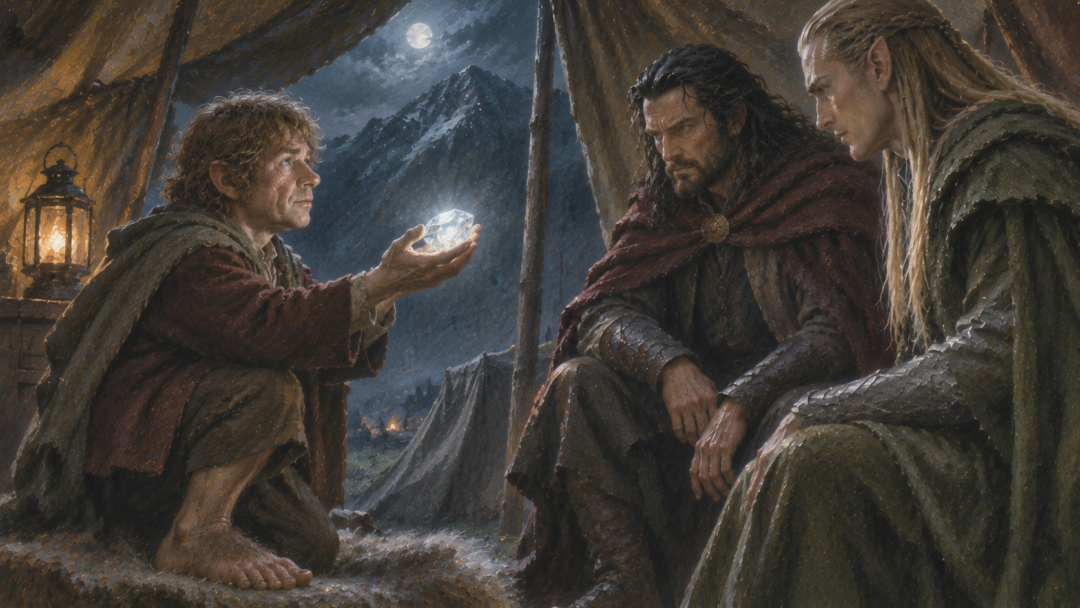
The Arkenstone opens the conversation again
The siege does not end the need for messengers. In the next chapter Bilbo slips from the Mountain and visits Bard and the Elvenking, bringing the Arkenstone. He knows how intensely Thorin values the gem, and he hopes its surrender will make an agreement possible before dwarves, men and elves fight one another. It is Bilbo acting independently, turning a treasure that might deepen the quarrel into bargaining power.
When Bard returns to the gate with companions, the exchange takes another form. Thorin is confronted with the Arkenstone and with Bilbo's admission that he gave it away. Gandalf, present among the visitors, intervenes as Thorin's fury turns toward the hobbit. The approaching forces of Dáin and the ensuing battle complicate the settlement. The important continuity is that hostile parties still communicate through formal approaches after an earlier parley has ended with an arrow.
At Erebor, a shield catches the arrow and a herald carries the quarrel onward in words. Later, the Arkenstone brings those words back to the gate. The title fits the messenger because of what he was sent to do; the violence of his reception shows how perilous that work can be. He needs neither an invented name nor a grand office to leave a mark on the story.
Sources & Notes
This article is based on close reading and interpretation of Tolkien's published works and related source material where relevant.