At the Council in Rivendell, Elrond recalls the slopes of Orodruin: two kings fall, a sword breaks, and Isildur takes the Ring from Sauron's hand. It is the kind of scene that invites a deceptively practical question. Who was close enough to witness every decisive movement? And when an old heroic poem gives dying warriors beautifully shaped final speeches, who could possibly have written those words down?
The choice is not between a secret battlefield stenographer and a story worth nothing. No historically verified recorder of Roland's last words is established by The Song of Roland. The poem makes those words part of an epic account, not a transcript. Elrond, however, explicitly presents himself as an eyewitness. Reading the two together can illuminate how a story chooses its central figures, without turning either its poetry or its testimony into something it never claimed to be.
What Roland says when death is near
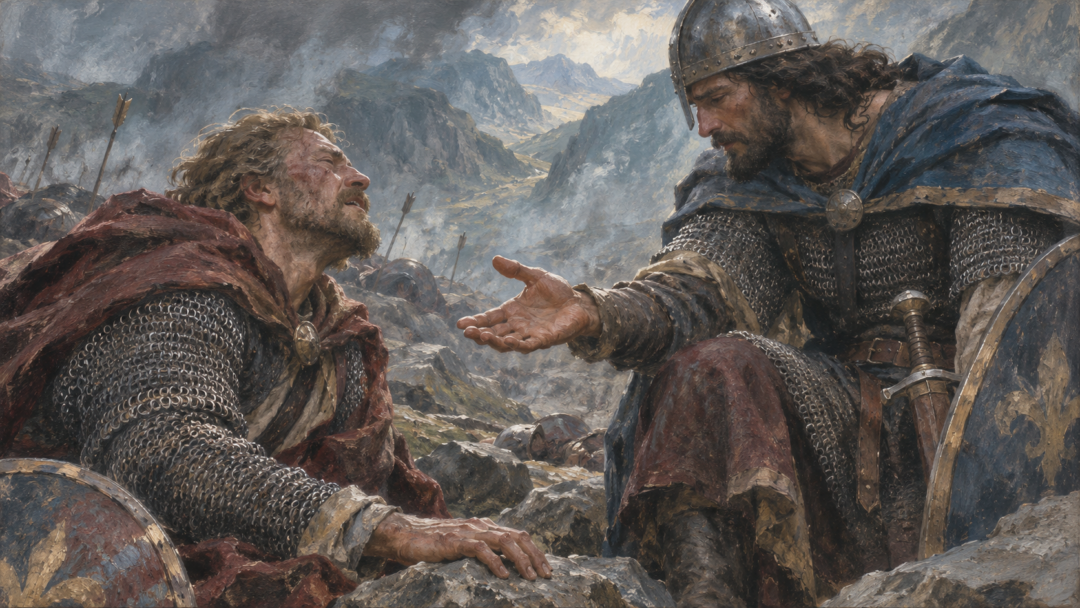
Begin with Oliver rather than Roland's celebrated last prayer. Badly wounded and losing his sight, Oliver encounters Roland without recognizing him and strikes his companion's helmet. Roland asks whether the blow was deliberate. Recognizing his voice, Oliver asks forgiveness; Roland grants it, and the two lean together in affection. Oliver plainly has a listener inside the story. This is not a speech delivered to empty air.
Yet an interlocutor does not make their dialogue a documented conversation. The poem arranges the misunderstanding so the companions can part reconciled. The blow is frightening because they have fought together throughout the disaster. Forgiveness gives their friendship a final shape as battle destroys it. Whether every word was spoken in just that form is beyond what these verses can establish. They show us what the parting means.
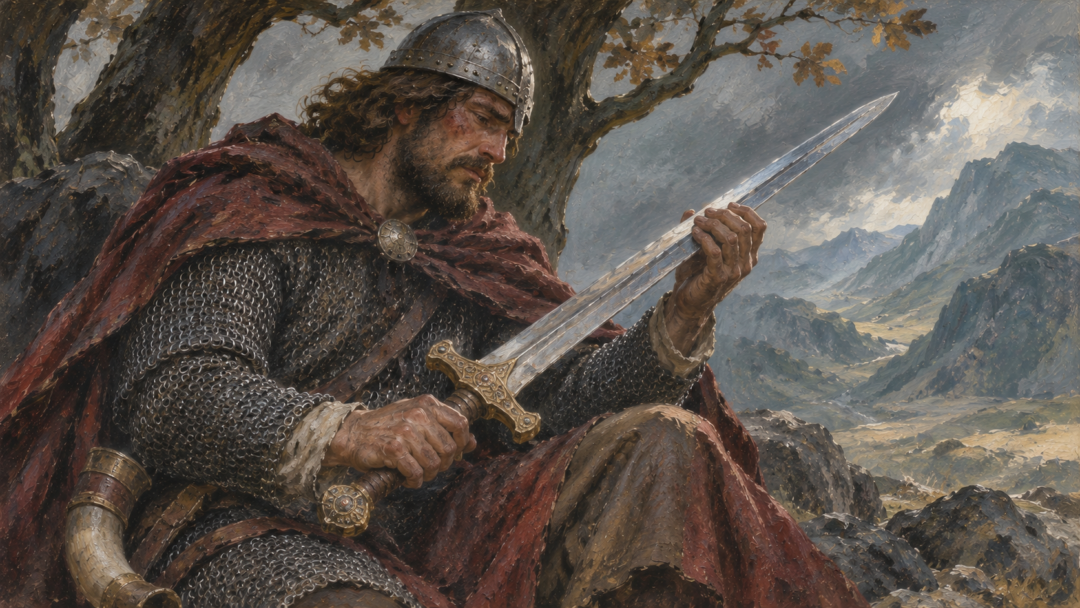
Roland's own ending is harder still to approach as reportage. After helping the wounded Archbishop Turpin and mourning the dead, he moves away with his horn and sword. An enemy feigning death tries to seize Durendal, and Roland fights him off. Only then does he attempt to smash the sword against stone rather than leave it as an enemy's prize. This is a sequence of actions, not one uninterrupted private monologue.
When the sword refuses to break, Roland addresses Durendal and recalls lands he has helped win for Charlemagne. The immense inventory binds a physical object to a career of conquest and service. This sword carries its bearer's reputation and the honor of the king who entrusted it to him. We need not imagine a clerk behind the rocks to understand why the poem grants its dying captain such an extended farewell.
The lament then turns from victories to the relics enclosed in Durendal's golden hilt. The poem names sacred remains associated with saints and holy figures, making the sword's possible capture a religious loss as well as a military one. Roland grieves not only because his fighting is finished, but because something consecrated might pass into hostile hands. His attachment becomes more than a soldier's concern for his equipment.
Finally Roland faces the enemy, confesses his sins, remembers France and Charlemagne, and offers his glove to God. The narrator explains his direction: Roland wants his king and countrymen to know he died facing his opponents. Angels receive his soul. Desire, memory, divine acceptance, and the meaning of a gesture are not things an observer could establish by seeing where a body lay. The poem presents them as part of its heroic vision.
The narrator's authority and the captains in view
It would be too sweeping to claim that The Song of Roland never gestures toward a source. Describing Archbishop Turpin's exploits, its narrator invokes Saint Giles as someone present who wrote charters. This is an assertion of authority worth noticing. It is not independent verification of Giles's presence, however, nor does it establish him as the recorder of Roland's prayers or inward lament. A narrator may invoke a witness while telling a highly shaped story.
One sword lament is introduced as something Roland complains of within himself. The phrase signals access to an inward experience. Elsewhere the poem tells how heaven responds to his death. Neither move belongs to a painstaking deposition. The poem freely crosses from what another person might see or hear into what its hero feels and what his ending means. That reach is part of its manner of storytelling.
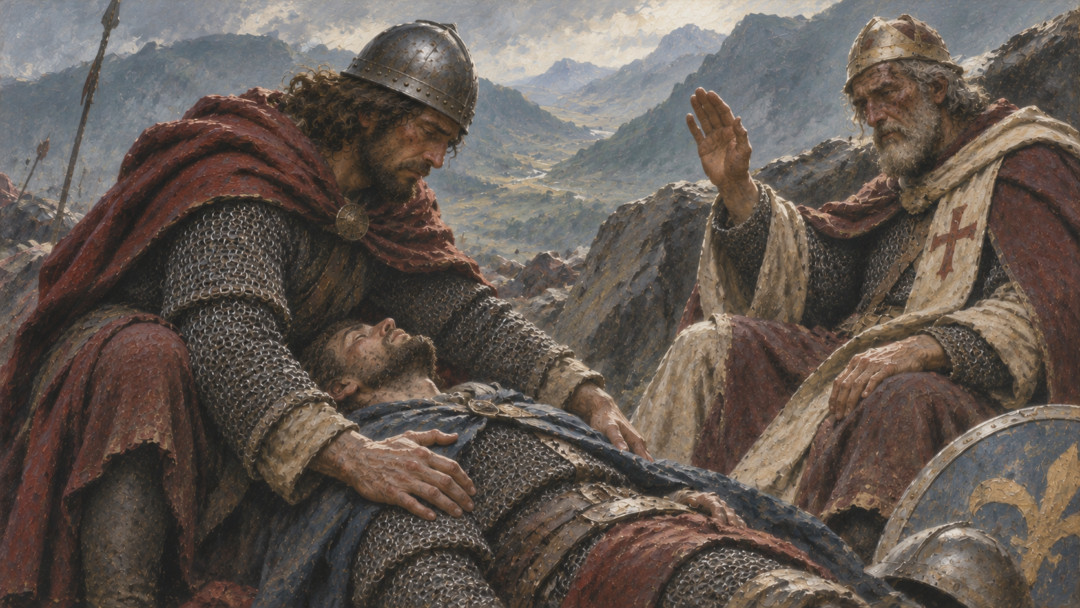
Notice whose names gather around the aftermath. Roland searches for fallen peers, carries them to Turpin, and arranges them for the archbishop's blessing; Oliver receives special attention. When Charlemagne reaches the devastated pass, he calls for his nephew, Turpin, Oliver, and other captains by name. The field contains many dead, but rank and personal ties direct our attention. An enormous defeat becomes a succession of losses the emperor can recognize.
That is one useful sense of high romance: an army's catastrophe is concentrated into the fates of identifiable leaders and companions. It does not mean unnamed soldiers disappear. The poem acknowledges the slaughter and grief of the wider host while granting its fullest gestures of farewell to particular people. Those present in the story's world are not necessarily the same as those occupying the narrative foreground. Keep that distinction in mind at Mount Doom.
Elrond is not an anonymous epic narrator
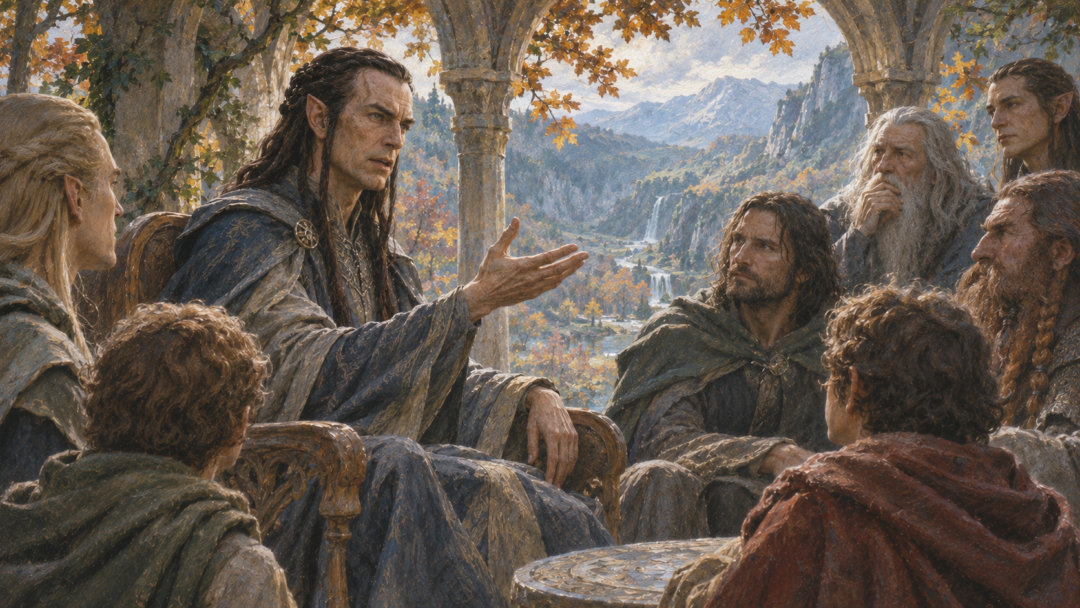
At Rivendell the circumstances differ. In The Fellowship of the Ring, Elrond addresses a council deciding what to do with the One Ring. He is not recounting Gil-galad's fall simply for its tragic beauty. The past has returned as a practical and moral problem. The Ring should have been destroyed after Sauron's defeat, he explains, and Isildur's refusal has consequences for everyone listening. This account concerns history with a decision still attached.
Elrond identifies his place in that history. In the passages reproduced in [Oshun's discussion of Ohtar](https://www.silmarillionwritersguild.org/reference/characterofthemonth/ohtar.php), he says he served as Gil-galad's herald, marched with his army, and witnessed the last combat on Orodruin's slopes. He describes Gil-galad's and Elendil's deaths, the breaking of Narsil, Sauron's overthrow, and Isildur's taking of the Ring. This is an explicit eyewitness claim, not a singer's invented access to an unobserved prayer.
The neighboring sentences sharpen that claim. Elrond says few noticed Isildur's act. He describes Isildur alone beside his father in the final contest, while Círdan and Elrond stood beside Gil-galad. Read together, these statements distinguish noticing an act from attending a particular leader. Neither automatically provides a diagram of every soldier on the volcanic slopes. The narrow focus is real, but its boundaries must be understood rather than assumed.
Being beside Elendil is not identical to seeing Isildur remove the Ring. Being beside Gil-galad is not identical to occupying every possible vantage point on the mountain. And being somewhere nearby would not amount to standing with either king in the final struggle. Elrond's exclusive wording about who attended the kings has genuine force. It does not require us to imagine an otherwise uninhabited landscape.
Nor does the reference to few observers give an exact count. Elrond identifies a small named group around the fallen leaders, but does not state how many people elsewhere saw something, misunderstood it, or arrived too late. His own claim to witness the combat remains clear. The uncertainty concerns what his focused description establishes beyond the people he names.
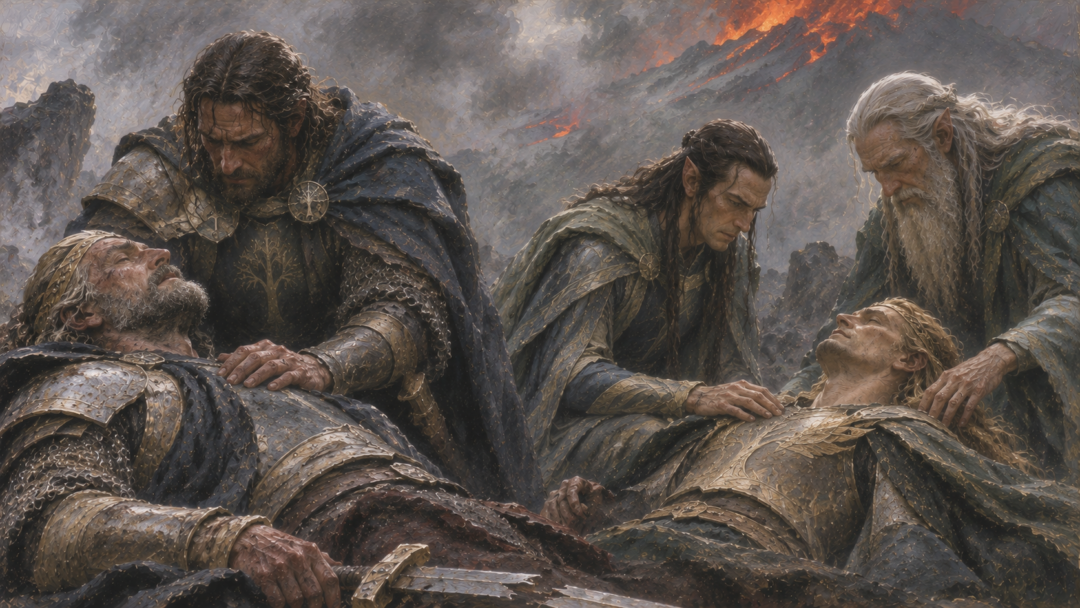
Does 'alone' mean the whole mountain was empty?
Here Roland offers a helpful comparison. An epic can stand amid an army and bring a few captains into brilliant relief. On a similar literary reading, Elrond foregrounds the great leaders of the Last Alliance and those immediately beside them. Isildur's singular position beside Elendil would mark his relationship to the fallen king, not supply a census of the battlefield. That is an interpretation of narrative focus, not new information about anyone farther away.
But Elrond does not merely omit other companions; he uses words of exclusion. We cannot dilute his statement into a claim that several important people happened to be nearby. Within the immediate scene of attendance beside the kings, its exclusivity matters. What it does not conclusively establish is the absence of every unnamed warrior, messenger, or onlooker elsewhere within sight. Equally, it offers no evidence that any such person was actually there.
Each sentence must be allowed its own kind of claim. Roland's narrator discloses inward lament, carries a prayer into heaven, and singles out mourned peers while acknowledging multitudes beyond them. Elrond can testify as an eyewitness while selecting the relationships essential to his account. The analogy illuminates attention; it cannot prove borrowed influence, establish an intended arrangement of troops, or authorize us to invent extra witnesses.
There is also a difference in purpose. Roland's narrator shows what a warrior's death signifies for king, country, and salvation. Elrond explains why a dangerous object survived victory. His account moves from the combat to Isildur's choice and the counsel Isildur rejected. The named witnesses matter because they connect Sauron's defeat with a warning that was actually given. Literary shaping does not automatically discredit that testimony.
An empty patch of page is not an empty patch of ground. Nor does a well-told event lose its witness because the teller remembers the captains first. The poem leaves Roland's glove extended toward heaven, a final gesture made radiant by its narrator. At Rivendell, Elrond remembers a broken sword and a Ring that should have vanished into fire. In each case, the foreground is vivid. It is not the whole world.
Sources & Notes
This article is based on close reading and interpretation of Tolkien's published works and related source material where relevant.