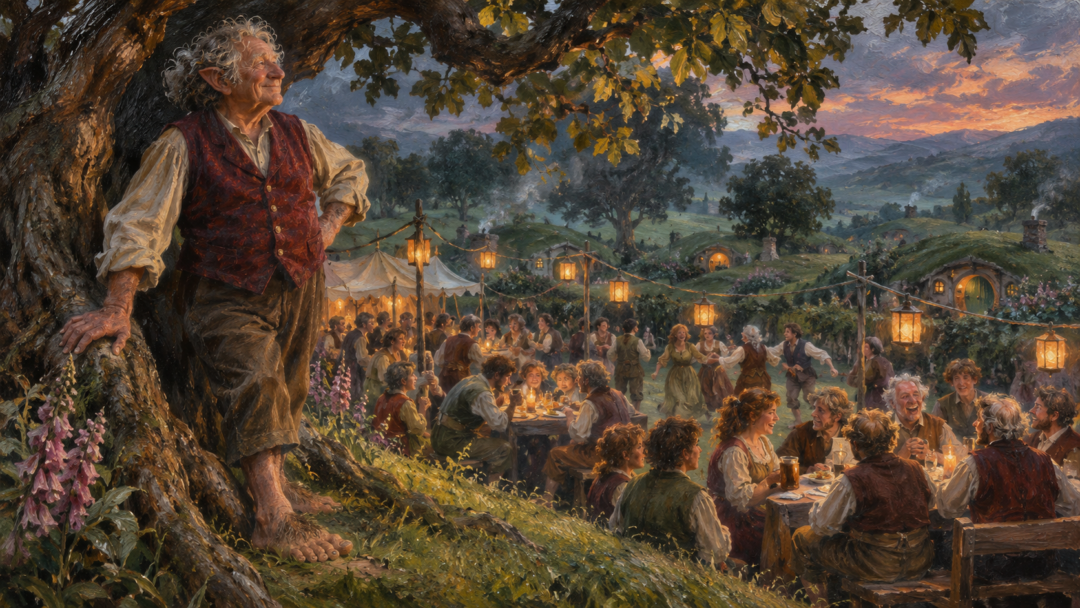
Bilbo Baggins vanishes from his birthday party, leaves the One Ring at Bag End, and walks away from the Shire. Not long afterward, as the film tells it, Gandalf returns with frightening news, Frodo learns what his inheritance really is, and the comfortable world beyond the round front door suddenly becomes dangerous. Yet readers of The Fellowship of the Ring know that these events are separated by an astonishing stretch of ordinary life. Could Peter Jackson's films be hiding a seventeen-year jump in those intervening scenes? Or even nineteen years?
The strongest evidence says no. The book has a seventeen-year gap between Bilbo's party and Frodo's departure, but the filmmakers discussed deliberately compressing it so that the movie suggested only months. The films do mention sixty years, six months, thirteen months and four years. The trick is to ask what event each interval actually begins with.
Where the seventeen years come from
The literary chronology gives the question its foundation. As reported in secondary accounts of Appendix B, the Tale of Years, Bilbo's farewell party takes place in Third Age 3001, while Frodo leaves Bag End in Third Age 3018. Subtract one year from the other and the famous seventeen-year interval appears. These are dates from the reported book chronology, however, not dates independently established for Jackson's adaptation. A reader cannot simply transfer the entire calendar to the films and declare an unseen time skip.
That gap is part of the book's particular atmosphere. Bilbo's disappearance is a local scandal, but Frodo does not immediately become a fugitive. He inherits Bag End, goes on living among his neighbours, and gradually finds his association with Bilbo and his odd habits attracting attention. The wizard's concern develops alongside a broader investigation into the Ring. The danger is real long before Frodo understands its full weight, yet the Shire continues to have its seasons and routines.
Even the book's seventeen years should not be mistaken for seventeen years spent on the road, or for the time needed to destroy the Ring. The period begins at Bilbo's birthday celebration and ends when Frodo sets out from home. Secondary chronologies place Gandalf's warning in April 3018 and Frodo's departure that September; neither is the end of the quest. Mixing these milestones can make almost any proposed interval seem plausible, particularly when the story contains several departures and homecomings.
What the filmmakers said about changing the clock
The clearest indication of the films' intended passage of time comes not from a calendar but from a transcript of the extended-edition commentary on The Fellowship of the Ring. In a discussion featuring Peter Jackson, Fran Walsh and Philippa Boyens, the filmmakers explicitly acknowledge altering the book's chronology. They roughly recall the seventeen-year interval while discussing Gandalf's absence, then explain that their movie reduced it to the impression of a few months. The transcript does not reliably distinguish every individual voice, so the statement is best attributed to the group rather than to Jackson alone.
That wording is revealing in two ways. First, it treats the long gap as something to change, not a secret for viewers to detect. Second, the emphasis is on what the audience feels has elapsed. A few months is an approximate impression, not an authorized figure of three months, ninety days or a specified season. The comment gives strong evidence for an adaptation decision while leaving the precise replacement duration undetermined.
The surrounding conversation explains why the change suited this version of the story. The filmmakers describe wanting more tension in the Bag End scenes, with the Ring's menace already pressing against the Shire's calm. They also discuss the problem of conveying all the slow investigation and preparation that a novel can accommodate. On screen, Gandalf's discovery needs to lead to a decision the audience can feel immediately: Frodo must get away before the danger reaches his home.
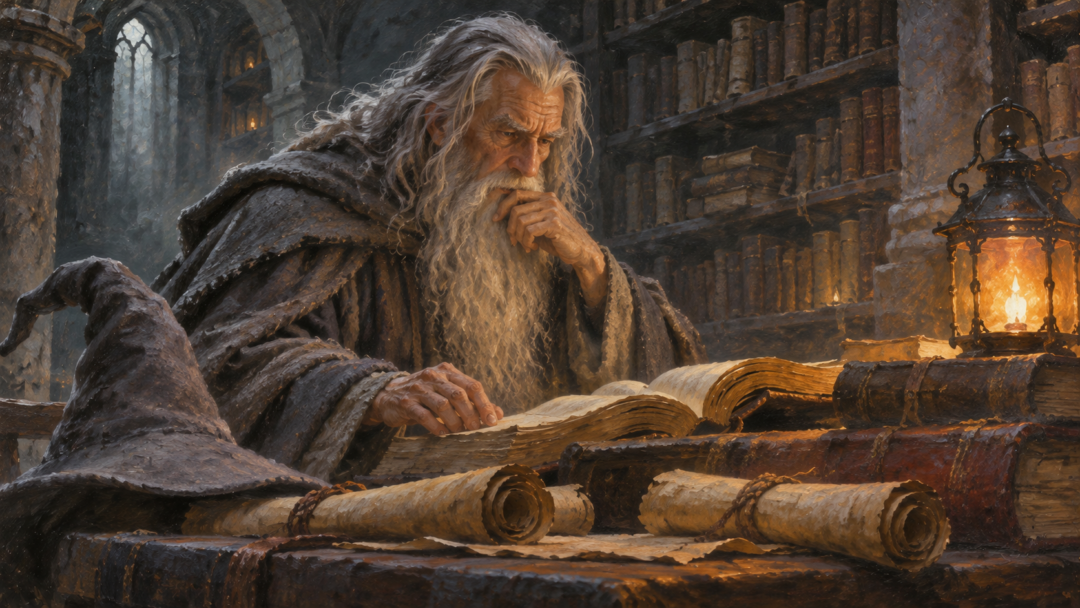
The movie does give Gandalf business away from Bag End. He searches ancient records in Minas Tirith, learns more about the Ring, and comes back with a different understanding of what Bilbo left behind. Those scenes establish research, distance and a return journey; they do not supply a seventeen-year stopwatch. In fact, the commentary also describes the aim of making Gandalf's return seem like an urgent, difficult journey. That helps explain why the change can feel natural even without an on-screen date.
There is a second compression tucked into the adaptation. In the book, learning the truth does not propel Frodo out of Bag End that very instant: practical arrangements and further time intervene. The film pushes the warning and the departure much closer together. This is not merely an erased number between two scenes. It changes the rhythm of the opening from a long period of apprehension followed by planning into an escalating emergency, carrying Frodo from his familiar rooms toward the road.
Why the sixty-year references aren't the missing gap
Early in The Fellowship of the Ring, the story moves from Bilbo's discovery of the Ring beneath the Misty Mountains to the Shire sixty years later. That is a genuine long interval, but it begins when Bilbo comes upon Gollum's lost treasure, long before his birthday celebration. Its destination is the elderly Bilbo at the time of his party. It accounts for the Ring's residence in his keeping, not a later wait while Frodo holds it.
Gandalf makes a similar point when he explains that the Ring remained with Bilbo for sixty years, sustaining him and delaying his aging. Again the starting point is Bilbo's finding of it, rather than his decision to pass it on. The two references reinforce the object's history and the unnatural effects of possession. Neither gives us permission to add sixty years, seventeen years or nineteen years between the party and the hobbits' departure.
What the six months at Bree actually tell us
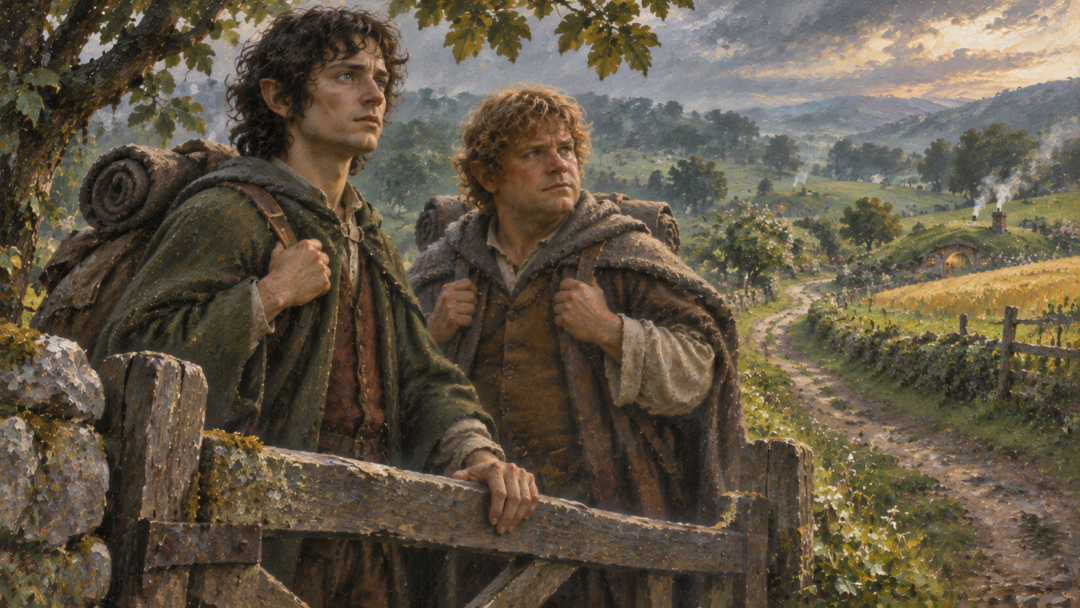
Another apparent clue arrives at the Prancing Pony. Frodo and his companions reach Bree looking for Gandalf, but the innkeeper, Barliman Butterbur, says he has not seen the wizard for six months. It is an enticing number. Six months sounds like enough time for Gandalf to investigate the Ring, and a reader who already knows about the book's missing years might be tempted to treat this remark as the film's replacement timetable.
But Butterbur's clock begins with his own last sighting of Gandalf in Bree. It makes Frodo's search for a trusted guide more uncertain, not more precisely dated. It does not begin at Bilbo's party, and the innkeeper does not claim to know every place Gandalf has visited since. Most importantly, a last encounter in one town is not the same event as Gandalf leaving Bag End or returning there with his discovery. The remark supplies information about his absence from the inn, not an exact measurement of Frodo's time with the Ring.
The extended edition's awkward date
The extended edition offers something more specific than a rough duration: in its Concerning Hobbits opening, Bilbo dates his account to the year 1400 by Shire reckoning. The corresponding year of the birthday party in the literary chronology is 1401. This one-year mismatch is a genuine point of difference between the reported film dialogue and the book, and it deserves notice precisely because it looks like a fixed calendar reference rather than a vague recollection.
What it does not do is establish a hidden eighteen- or nineteen-year delay. A date at the beginning of the film is only one endpoint. To calculate the interval before Frodo leaves, we would need another reliable date for that departure within the movie's own chronology. Supplying the book's 3018 endpoint would assume the very continuity between book and adaptation that the commentary tells us was changed. Arithmetic cannot repair a missing premise.
The later clocks start much later
The Return of the King provides two especially clear measures of elapsed time, both attached to events after the Shire departure. When the hobbits finally return home, Frodo's narration says that thirteen months have passed since Gandalf sent them on their journey. That gives the homecoming a recognizable distance from the moment the adventure began. It tells us about the long road away and back, not about any wait between Bilbo's party and the warning at Bag End.
Later, Frodo speaks to Sam of four years having passed since Weathertop, where the Witch-king wounded him. That reference has an even more specific starting point: an injury sustained after the hobbits were already fleeing. The remark lets the story acknowledge years of life beyond the triumph over Sauron. Frodo has had time to come home and write, but the wound has not simply become an old memory because ordinary days have resumed.
These references also show why treating every time statement as one continuous count produces a misleading picture. Thirteen months measures a journey and homecoming; four years measures the distance from a particular wound. They can both be true without saying anything about how long Frodo remained at Bag End after inheriting the Ring. They also show that the films are willing to speak plainly when a later interval matters to a scene's meaning.
No evidence here establishes a nineteen-year alternative. The book's reported seventeen-year interval is deliberately shortened in the adaptation, although its exact replacement remains unspecified. And perhaps that is the most fitting difference between these clocks: Bilbo's party measures an inheritance passed on; Frodo's later reckoning measures the years it costs him to carry it. The Shire may look unchanged when he returns, but time has not left its Ring-bearer untouched.
Sources & Notes
This article is based on close reading and interpretation of Tolkien's published works and related source material where relevant.