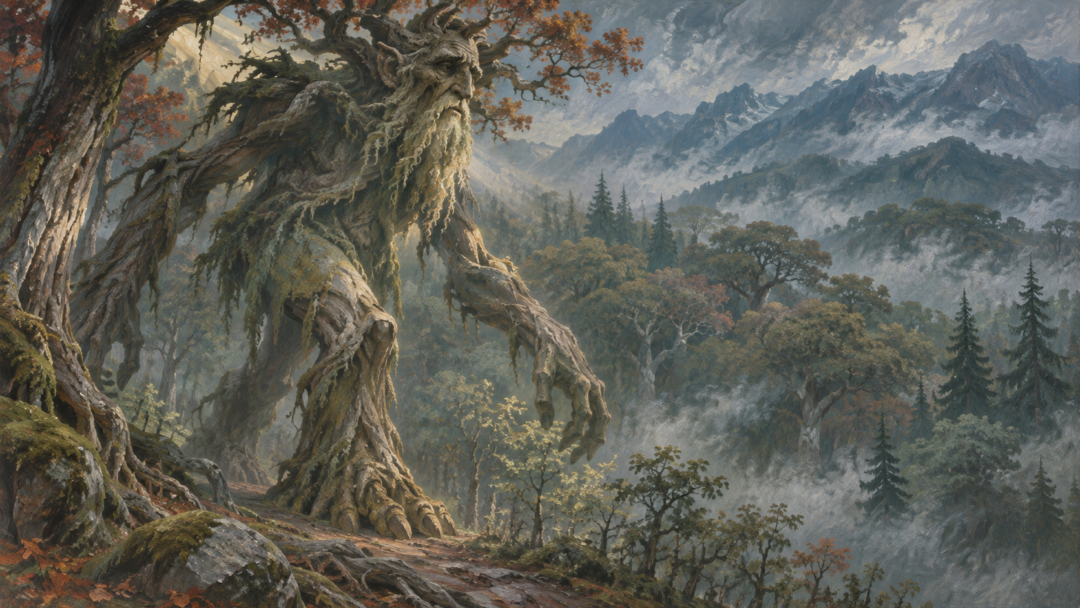
The Dwarves of Nogrod were almost home. After the sack of Doriath, their surviving warriors fled east with plunder from Thingol's ruined kingdom. Beren and the Green-elves caught them at a river crossing, but the last fugitives escaped toward the mountains. There, near Mount Dolmed, another enemy appeared: Ents emerging from the wooded country. It is a glimpse of tree-shepherds far from the familiar Fangorn Forest.
Could descendants or survivors of those Ents still have lived near the Blue Mountains thousands of years later? Possibly, but no known account establishes a Third Age community there. The published Silmarillion tradition places Ents in this western region during the First Age; later history makes survival conceivable without confirming it. The most revealing clues lie in what happened to the forests themselves.
What the Ents Actually Did After Doriath Fell
The Ents did not take part in the sack of Doriath itself. That disaster began with the quarrel over the Nauglamír, the great necklace of the Dwarves, into which Thingol had wished to set a Silmaril. Dwarven craftsmen killed the Elven king, and a subsequent host from Nogrod attacked Menegroth, the underground capital of Doriath. The raiders carried away treasure, including the necklace, and began the journey back toward their mountain city.
Their return led them to Sarn Athrad, a ford on the River Gelion. Beren, who had once recovered the Silmaril with Lúthien, intercepted the Dwarves with the Green-elves of Ossiriand. The Dwarven force was broken at the crossing; Beren recovered the Nauglamír. Some survivors, however, reached the slopes of Mount Dolmed, where the account introduces Ents. Tolkien Gateway's summary of the published tradition describes an Ent-host coming forth near Dolmed and driving the remaining Dwarves into the shadowy woods of Ered Lindon, from which none escaped.
That changes the geographical picture. Nogrod belonged to the Blue Mountains, also called Ered Luin or Ered Lindon, on the eastern edge of Beleriand. Mount Dolmed stood in that range, near the Dwarven cities and the routes connecting them with the lands to the west. The Ents are therefore associated not merely with Doriath, which lay farther away, but with the mountain country through which the fugitives attempted to return.
Yet the episode is an encounter, not a description of an Ent settlement. It does not identify a home grove, say how long the Ents had been present, or tell us where they went afterward. Nor does the fact that their action helped finish Beren's victory mean that they lived under his command. The story gives them a role in the fate of the Dwarves, then lets them disappear from that particular historical account.
Treebeard Remembered a Much Larger Forest
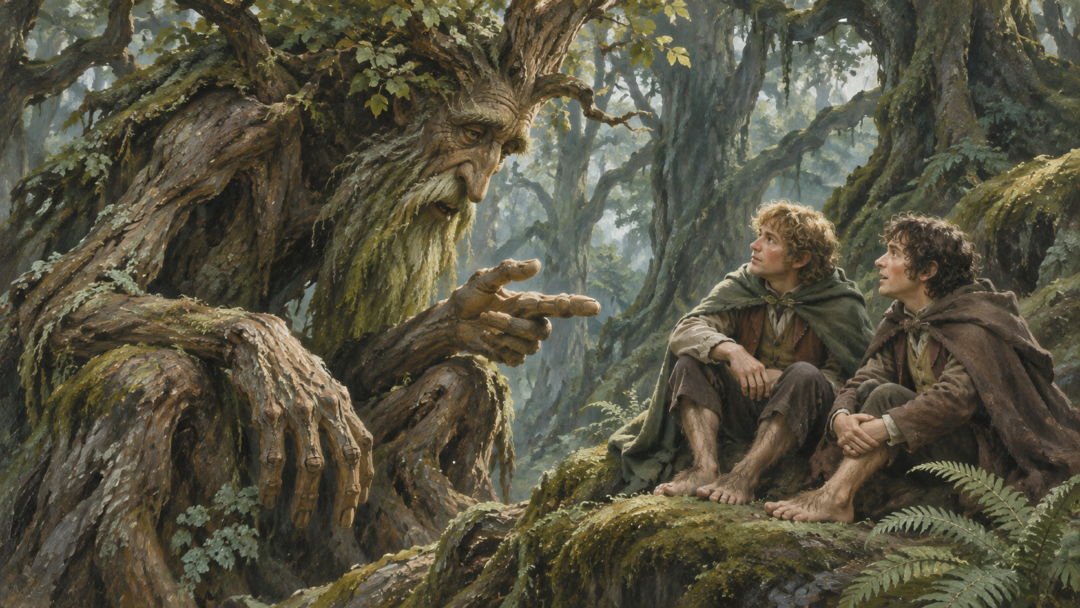
The stronger reason to consider Ents near the Blue Mountains comes from Treebeard himself. When Merry and Pippin meet him in Fangorn, he remembers a time when the woodland around his home was only the eastern end of a continuous forest stretching west toward the Mountains of Lune. Those mountains are the Blue Mountains. His recollection puts Fangorn and the far western hills within the same ancient wooded world, before the landscape was broken into the separate forests seen in the War of the Ring.
Elrond recalls a related change during the Council of Elrond. He evokes an Eriador so thickly wooded that a squirrel could once have travelled from near Rivendell toward the Great Sea without descending to the ground. The point is clear: the roads, farms and open country familiar to the hobbits were not the original condition of the Westlands.
That matters because Ents were not originally confined to Fangorn. Accounts of their early history place them across the great forests of Eriador and in East Beleriand, with a possible further reach into Tasarinan. Treebeard's own memories embrace ancient western lands, some of which would be lost beneath the sea. The Dolmed episode fits into that wider picture: the Ents who appeared by the mountains need not have been wanderers from the distant Fangorn of the Third Age.
There is still a necessary distinction between forest and inhabitants. Ents tended trees, spoke with them and moved among them, but not every old woodland was an Ent dwelling. Treebeard's description establishes that the Blue Mountains once lay beside an immense forest; it does not list communities along its entire length. The ancient woods make the idea of western Ents plausible, while the encounter at Dolmed provides the more concrete evidence that some were actually there.
The Blue Mountains Did Not Remain the Same
One obstacle to tracing those Ents forward is that their world was physically transformed. At the end of the First Age, the War of Wrath shattered Beleriand, and much of the land west of the Blue Mountains sank beneath the sea. Water broke through the range to form the Gulf of Lune. Places that had once stood amid inland routes and wooded foothills now belonged to a very different coastline and mountain system.
Even the later whereabouts of Mount Dolmed are debated in reconstructions of the geography. Some interpretations place its destruction among the changes that opened the gulf; others identify a possible surviving mountain. That uncertainty discourages pointing to a Third Age map and placing Ents in the same valley. An event recorded beside a First Age mountain cannot automatically be located beside an unchanged Third Age landmark.
Survival would also have required enduring changes less sudden than the War of Wrath. During the Second Age, great stretches of the western forests were cut down, notably through Númenórean exploitation, while war with Sauron brought further destruction. The landscape that Treebeard remembered receded over centuries. An Ent might have remained in an isolated wood, travelled elsewhere, or vanished without leaving a recorded history. Each is imaginable; none can be assigned specifically to the Blue Mountains from the surviving account.
The range did not become an empty wasteland. Lindon endured to the west, while the Blue Mountains remained associated with Dwarven habitation in later ages. But an inhabited region and an Ent-inhabited region are not the same thing. Neither the survival of a mountain range nor the presence of scattered woodland supplies the missing link between Dolmed and a Third Age population of tree-shepherds.
Why Fangorn Is the Best-Attested Refuge
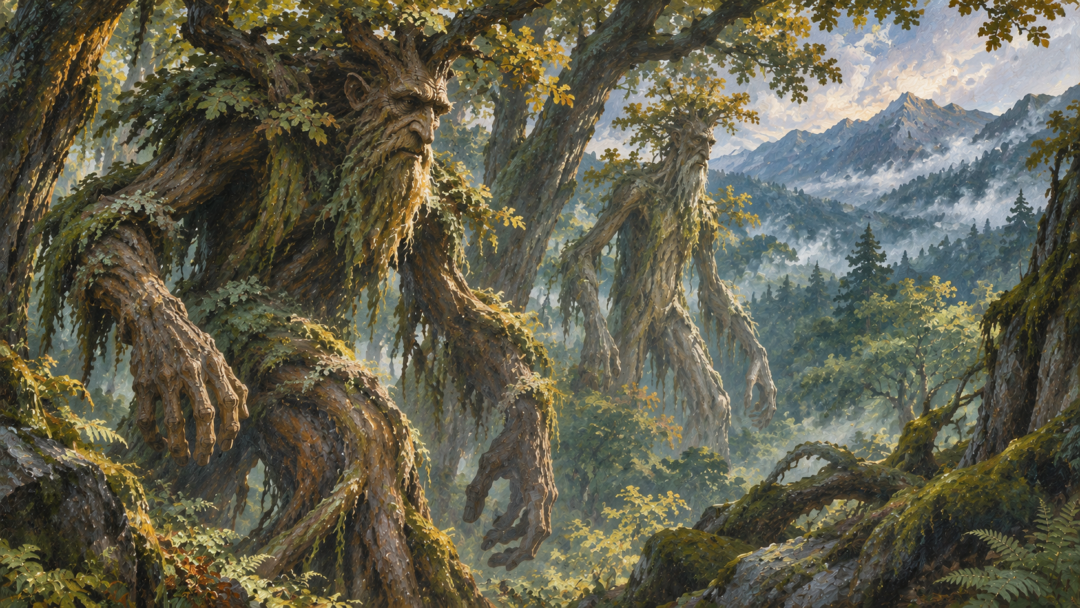
By the time of the War of the Ring, the Ents we actually meet belong to Fangorn. Merry and Pippin encounter Treebeard there; the Entmoot gathers in Derndingle; and the Ents march against Saruman after the devastation of their trees. They are not presented as representatives arriving from different forests across Middle-earth. The narrative focuses on a surviving people whose world has steadily narrowed.
Their decline has more than one cause. The Entwives, whose love of cultivated plants differed from the Ents' care for growing forests, had long been separated from them. Their gardens were destroyed, and their fate remained uncertain. Without the Entwives, there were no new Entings to replace those who died. Some of the old Ents also grew increasingly tree-like, becoming less inclined to move or speak. Their extraordinary longevity allowed them to outlast vanished landscapes, but longevity alone could not restore their numbers.
This is why reference accounts describe Fangorn as apparently the only remaining place inhabited by Ents during the Third Age. The word 'apparently' deserves to stay. It reflects the evidence we have, rather than a census of every inaccessible valley. No passage needs to announce that the last Ent west of the Misty Mountains died for Fangorn to remain the strongest documented answer to where Ents still lived.
Huorns complicate the picture without solving the Blue Mountains question. These are dangerous or watchful tree-like beings associated with Fangorn, and the boundary between a tree grown wakeful and an Ent grown treeish is not always easy to describe. Suggestions that Ent-like beings survived elsewhere, perhaps in places such as the Old Forest, leave room for wonder. They do not establish that any particular stand of trees concealed an organized group of Ents.
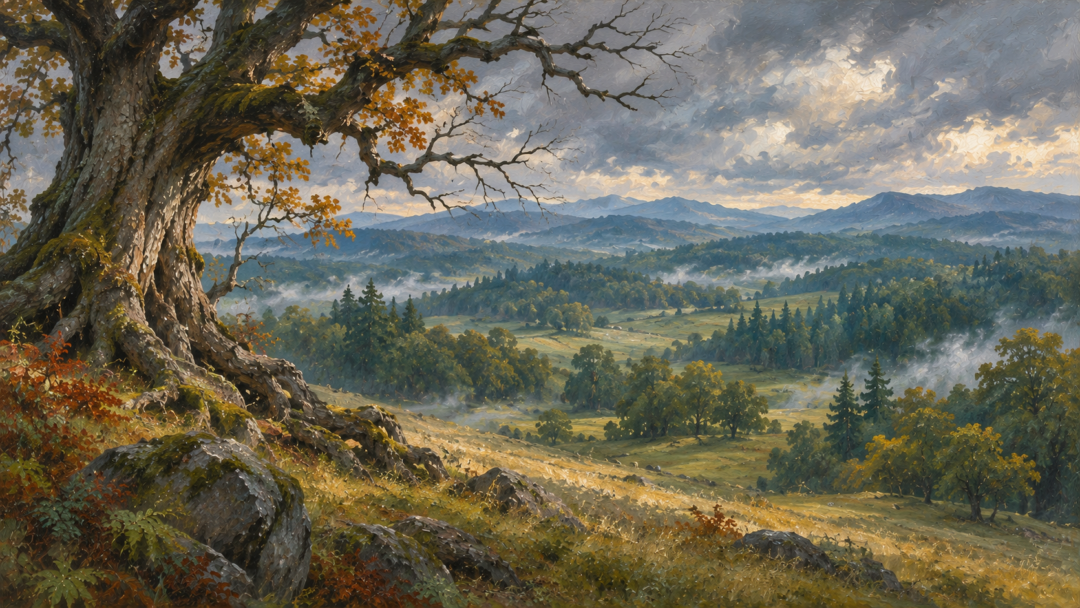
Does the Tree-Man Near the Shire Change Anything?
There is one tantalizing report much closer to the western mountains than Fangorn. In The Fellowship of the Ring, Sam Gamgee says his cousin Hal saw a huge walking figure like a tree beyond the North Moors. For a reader already wondering about surviving Ents in Eriador, it sounds like an invitation to connect the scattered clues.
But the figure's identity is not settled by Sam's story. In a letter dated February 1964, Tolkien doubted that Hal had seen an Entwife and tentatively suggested a troll. A later editorial account of correspondence reports a different explanation in which Tree-men were Ents watching the Shire at Gandalf's request. That reported interpretation is intriguing, but it cannot turn Hal's secondhand glimpse into firm evidence for an Ent colony among the Blue Mountains.
Even if a wandering Ent passed near the Shire, travelling through a region would not prove residence there. Hal's North Moors are not Mount Dolmed, and a sighting shortly before the War of the Ring cannot bridge the unrecorded ages between them. It would show that the Ents' movements were less confined than their best-known home suggests, not that their ancient western settlements endured intact.
The most compelling possibility is quieter than a lost Ent kingdom. Somewhere among the changed hills of the West, a surviving wood might have sheltered an ancient shepherd long after the forests around it fell silent. The account of Dolmed tells us such beings once walked there. It leaves open whether, centuries later, any trees still had a shepherd to remember them.
Sources & Notes
This article is based on close reading and interpretation of Tolkien's published works and related source material where relevant.