Bilbo Baggins does not find Smaug in a forest clearing. He finds him deep beneath the Lonely Mountain, asleep on gold in a hall made by Dwarves. It invites a practical question: if a dragon fits inside a treasury, how large can it be? Somewhere between sky and chamber, surely there is a doorway.
There is, and it tells us something useful, though less than a dragon-size chart would promise. Smaug could enter Erebor through its enormous Front Gate and reach the hall where he slept. He could not use the little secret entrance Bilbo discovered. That limits particular routes, not dragons universally. It also exposes an assumption: possessing a hoard does not mean a dragon entered ordinary houses, or personally carried every treasure through their doors.
Smaug Had a Kingdom-Sized Front Door
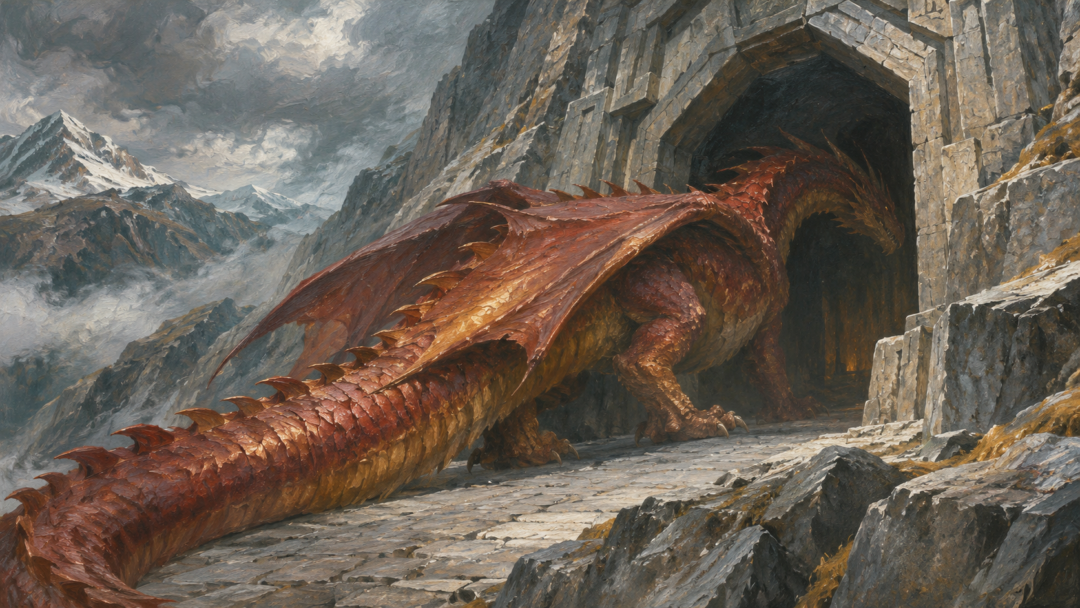
Erebor was not a cottage with an ambitious basement. The Dwarves had carved a kingdom into the mountain, with chambers, passages and a grand entrance. In The Hobbit, the Front Gate is approached by a stone-paved road broad enough for many people walking side by side. A tall arch opens towards the valley and Dale. This was an entrance built for a substantial underground realm, not a human-sized door in a domestic wall.
When Smaug descended upon the Lonely Mountain, he entered through that gate. His conquest of Erebor is therefore direct evidence that the opening accommodated him. The story supplies a successful passage, not a dragon posed beside impressive masonry. Smaug was large, and Erebor's entrance was large enough. Neither fact turns the arch into a ruler: the narrative gives no usable height and width, or measurements of the creature that crossed it.
Smaug did not have to squeeze through the front door of each Dwarf's room to claim the kingdom's wealth. Much of the treasure already lay within a connected system of excavated halls. He seized riches accumulated over generations. A conqueror taking possession of a treasury is not necessarily a courier making repeated trips through every threshold of the surrounding settlement. The original location of the valuables is part of the answer.
The approach road is not a measurement of Smaug's body. It does not reveal his full length, how he held his wings, or the space he required to turn. The gate proves he could negotiate that entrance in the circumstances described. To learn what that means inside a mountain, we have to follow Bilbo down to the hoard itself.
The Great Hall and the Door Smaug Could Not Use
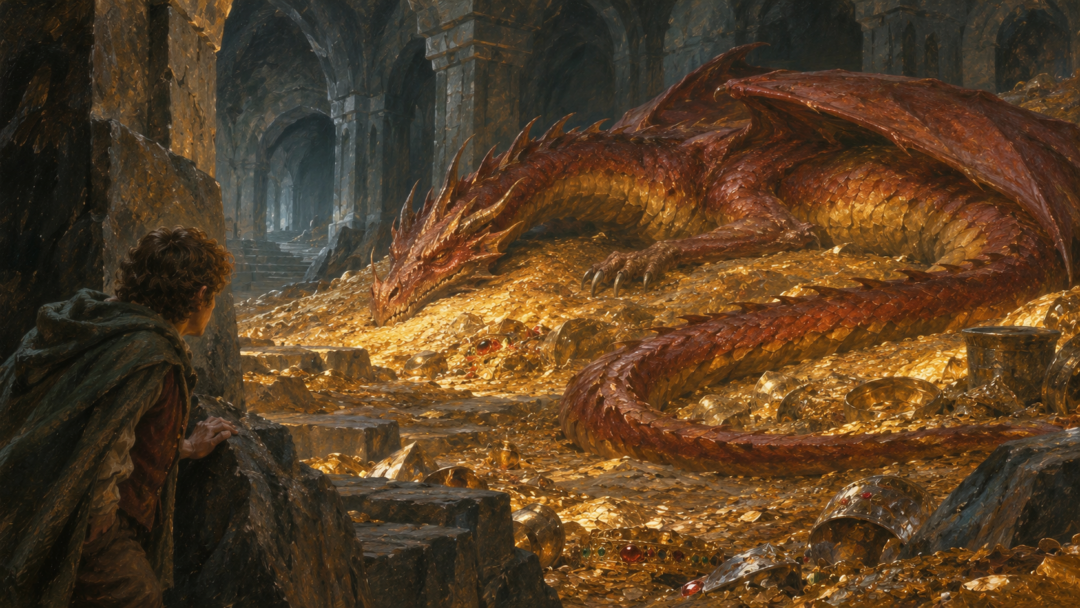
Smaug's bed was in the Great Hall of Thráin, at the roots of the Mountain. Bilbo finds treasure heaped up there, with gold and gems stretching beyond his immediate view. Later, the stairs and echoing passages towards the Front Gate exhaust even the travelers on foot. The hoard is not sitting just behind the entrance arch. It lies deep within a complex whose routes matter as much as its chambers.
The hall's accessibility provides another piece of evidence. Smaug could reach it from the larger workings of Erebor; at least one internal route was sufficiently roomy for him. A great outer gate would have accomplished little if every passage beyond it narrowed impossibly. Conversely, a chamber spacious enough for him to lie among treasure does not mean the entire mountain was equally spacious. Its builders made monumental spaces as well as confined passages.
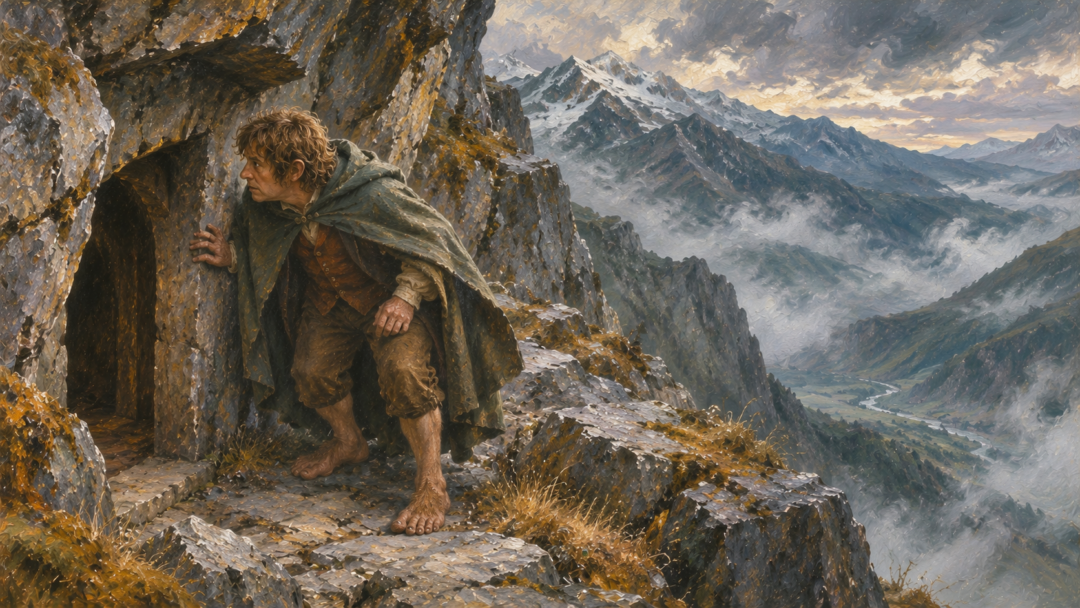
Bilbo's route makes that distinction vivid. Thrór's Map leads the company to a hidden Back Door high on the mountain's western side. It opens into a narrow passage leading towards the dragon's hall, a route a hobbit can use unseen. But Smaug cannot pass through it. The same hoard is accessible to the dragon by one route and to the burglar by another. Their access is not interchangeable, although both eventually reach the same chamber.
This is a pleasing reversal of what doors usually mean. The secret entrance that makes Bilbo's adventure possible is useless to the enormous owner of the gold. A chamber might contain a dragon while a side tunnel excludes him; a wide gateway might admit him even where a tight bend would not. Smaller corners of the mountain remained beyond Smaug's reach.
What a Doorway Can—and Cannot—Measure
The physical inference is straightforward: to move into an enclosed chamber by an ordinary route, a creature must fit through the available openings and negotiate the way between them. Yet a doorway presents only a local constraint. It does not establish the creature's total length. A long body passes through a corridor differently from a broad one; flexibility affects a turn differently from sheer bulk. These are geometrical observations, not an account of Smaug's movements.
Wings offer another tempting shortcut. Smaug is winged, but the story does not give a technical account of his wings in Erebor's passages. His spread in flight need not match the outline he presented while moving through a gate; assuming a particular folding mechanism would nonetheless add information not supplied by the text. Similarly, the Great Hall cannot be converted into a body-length estimate by imagining how neatly he filled it. There are no measured floor plans or precise proportions to support that calculation.
The treasure poses a separate problem. A hoard records possession and accumulation, not a list of deliveries. Bilbo encounters the craftsmanship of Erebor, including objects made for its Dwarven halls. Smaug changed who controlled those riches. The story does not require him to have collected every cup from a household hearth. Nor can we confidently reconstruct how individual valuables were moved into the piles around him. The distinction between taking a place and carrying its contents becomes even sharper with another dragon's assault on an underground kingdom.
Glaurung and the Broken Doors of Nargothrond
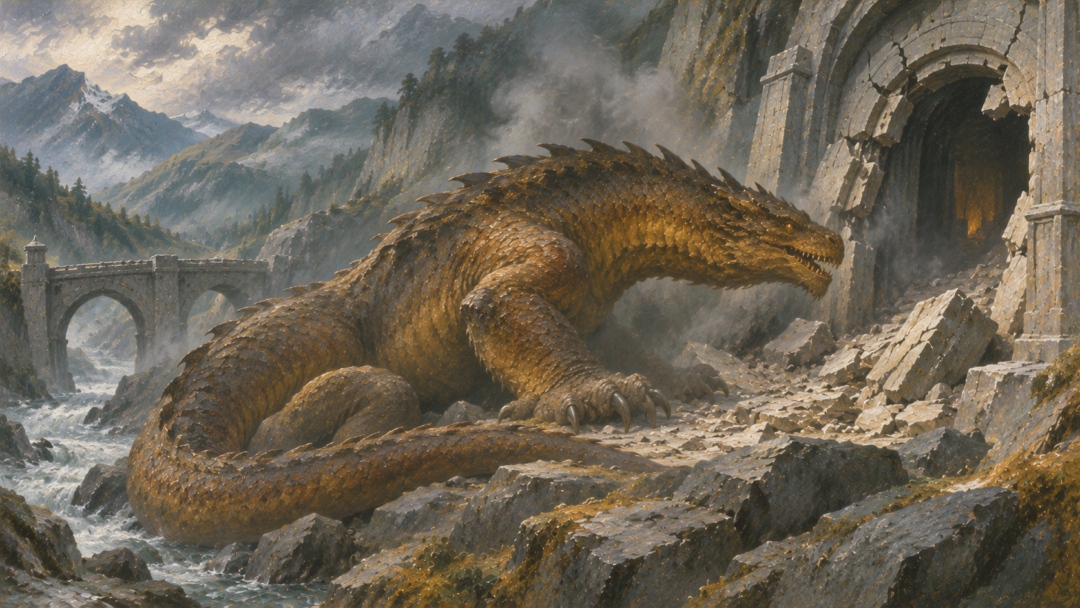
Glaurung's attack on Nargothrond in The Silmarillion and The Children of Húrin offers a harsher comparison. This was another wealthy realm carved into rock, but an Elven stronghold associated with Finrod Felagund rather than a Dwarven kingdom. Its great Doors stood across the river Narog. Under Túrin's influence, a mighty bridge was built so Elven forces could move out more easily. The same crossing later made the hidden city dangerously accessible to its enemies.
Following the defeat of Nargothrond's army, Glaurung crossed the bridge and destroyed the Doors of Felagund. He did not merely demonstrate that an intact doorway had always been constructed to admit him. He broke through its defenses. That defeats any calculation based on the original opening: if a dragon destroys an entrance, the damaged structure cannot tell us the clearance it offered beforehand. Force changes the architectural problem.
Glaurung then occupied Nargothrond and lay upon its treasure. The hoard is unmistakable, but its handling is not described. His story establishes that he gained control of a fortified underground complex and its riches. It does not specify his dimensions or identify precisely who moved each treasure to its resting place. Saying he accumulated a hoard follows the account; inventing an elaborate carrying method would not.
The bridge supplies another irony. It had been built to ease movement for Nargothrond's defenders, despite warnings that the city's secrecy was in danger. Eventually it offered an approach for the destroyer. Architecture creates opportunities and vulnerabilities for creatures of very different kinds. Where Smaug used an entrance big enough to admit him, Glaurung overcame one designed to resist enemies. Neither incident tells us what doorway an entirely different dragon would require.
Why Ancalagon Cannot Set the Scale
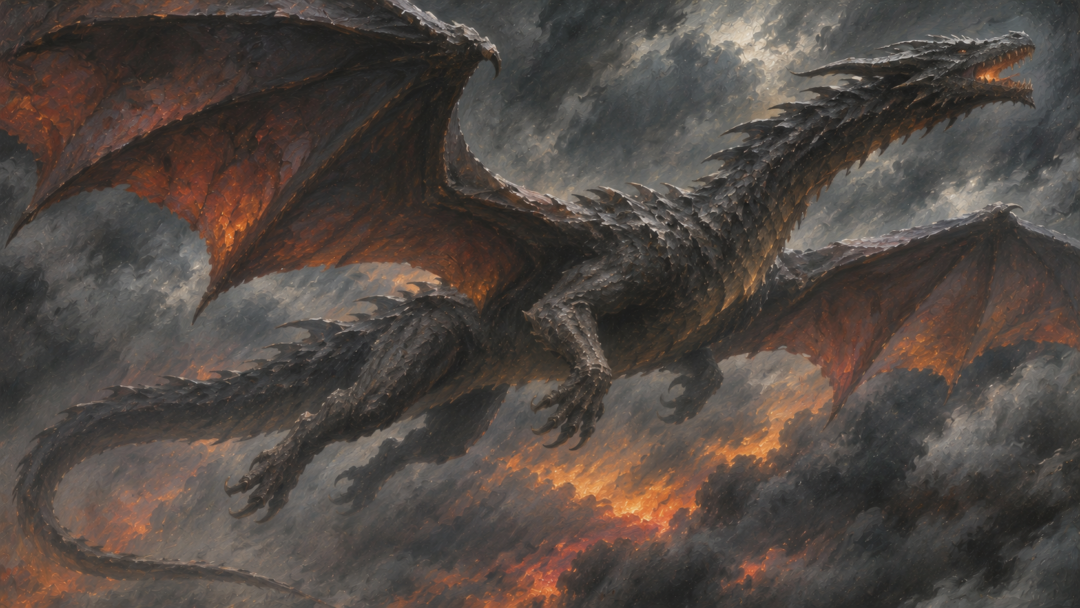
Ancalagon the Black raises the spectacle but not the precision. At the end of the First Age, this mighty winged fire-dragon fought in the War of Wrath. Eärendil brought him down, and his fall broke the towers of Thangorodrim. The image invites arguments about colossal dragons. But the passage gives Ancalagon no described indoor hoard, identifies no doorway he used, and tells us nothing about his access to a treasury.
The destruction of Thangorodrim cannot simply be reversed into a body-size calculation. The event comes to us in the elevated language of an ancient war, without the physical dimensions or conditions such an exercise would require. We know the fall was ruinous. We do not know its mechanics or Ancalagon's exact proportions. His stature cannot be used to measure Smaug's gateway, and no hoard route is shown.
Pictures are no safer as measuring tools. The writer John Garth notes that Tolkien acknowledged a deliberate mismatch of proportions in his own illustration Conversation with Smaug: Bilbo was drawn far too large relative to the dragon and hoard, as though occupying a separate visual plane. It conveys the encounter, not a survey. Medieval-style dragon pictures and modern adaptations can sharpen our imaginations without supplying reliable dimensions for a door, a wing, or a mountain.
The established routes are clear; their architectural implications are reasonable; exact proportions remain unknown. Bilbo's little Back Door captures the point better than any scale chart. It admitted a burglar into the heart of Smaug's treasure while keeping Smaug himself out. The gold lay in the same mountain for both, but the mountain offered each a different way through.
Sources & Notes
This article is based on close reading and interpretation of Tolkien's published works and related source material where relevant.