When the Fellowship struggles through the snow on Caradhras, Legolas moves lightly over the drifts while his companions labor beneath them. He seems perfectly at home in the impossible: keen-eyed, quick-footed, and ready with a teasing remark. Yet the more closely we look at this memorable Elf, the stranger one absence becomes. Who was Legolas before he joined the Fellowship? What had he done in all the years leading up to the War of the Ring?
The surprising answer is that the books tell us very little. Legolas has a recognizable family, homeland, and cultural inheritance, but almost no documented personal history before his arrival at Rivendell. That does not make him an unfinished character. Much of his personality emerges through the journey itself, while the deeper history he carries belongs to his people rather than to a recorded account of his own life.
What we know about the prince of the Woodland Realm
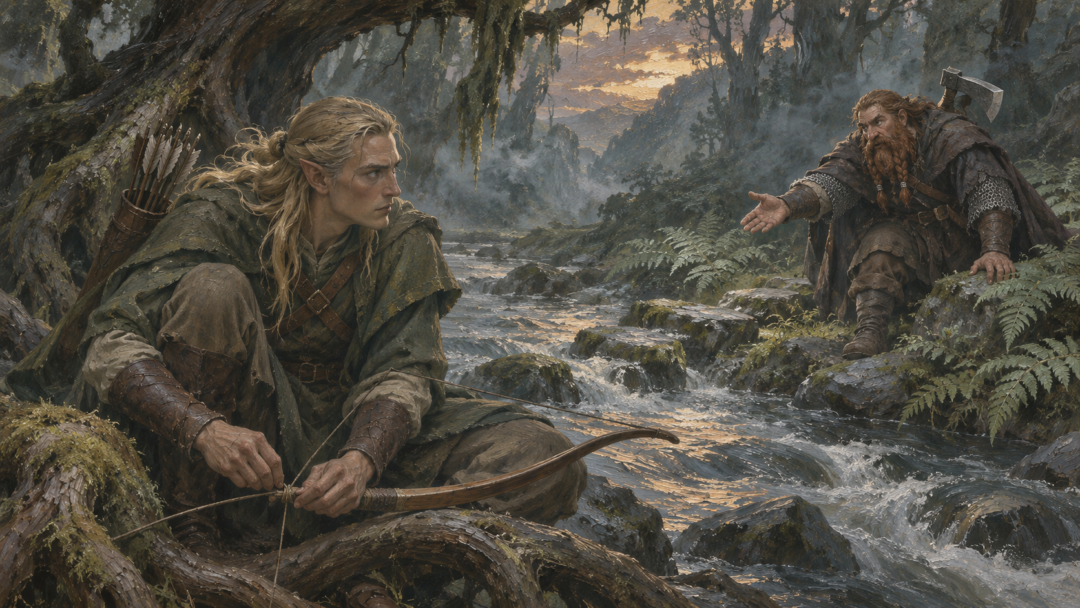
Legolas is the son of Thranduil, the Elvenking who rules in northern Mirkwood. His father leads the woodland Elves encountered by Bilbo and Thorin's company in The Hobbit, although that earlier book does not give the king his name. In The Fellowship of the Ring, Legolas enters the story as Thranduil's messenger. This places him within a real political and geographical setting, not an anonymous forest beyond the maps.
His ancestry and his community are not quite the same thing. Thranduil's house is of Sindarin descent, while Legolas identifies with the Silvan Elves, the woodland people among whom his father's kingdom exists. That helps explain the particular way he speaks of forests, songs, and other Elven peoples. He is not simply a representative of all Elves everywhere; he comes from a distinct branch of their world, with its own memories and loyalties.
What the account does not provide is equally revealing. Legolas's birth date is unknown, so confident claims that he is a particular number of centuries or millennia old go beyond the evidence. We are not given his mother, his childhood, or a sequence of youthful adventures. The Encyclopedia of Arda summarizes his earlier personal life as almost entirely unknown. Even the reasonable assumption that he spent much of it in his father's realm is an inference, not a narrated biography.
He arrives with news, not a life story
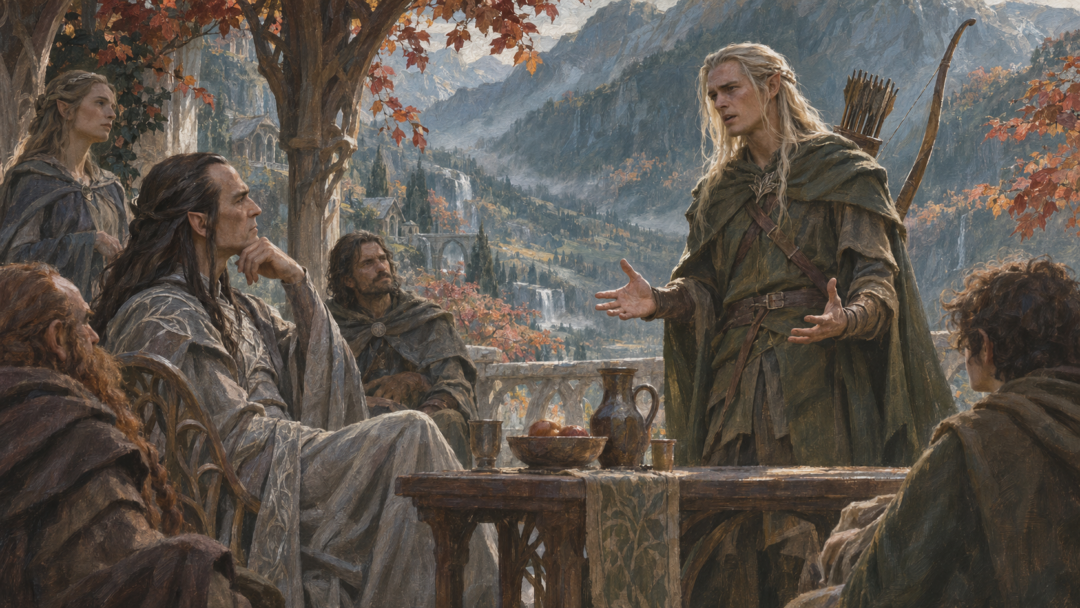
Legolas first steps into the main narrative at the Council of Elrond with an urgent report. Gollum, whom Aragorn had captured and entrusted to the Wood-elves, has escaped their custody during an Orc attack. Legolas must explain how this happened to people who know how dangerous Gollum's freedom may be. His presence at Rivendell is therefore tied directly to the crisis the story is about to confront.
That scene also brings older tensions into the room without turning into a flashback about Legolas. Glóin, Gimli's father, remembers how Thorin's company was treated by the Elvenking in The Hobbit. A meeting between the sons of two houses with an unhappy history might invite a long account of grievances. Instead, the Council moves toward the fate of the Ring, and Legolas is chosen to accompany the Company as its Elven member.
From there, readers learn who he is by watching him travel. He can laugh when circumstances are grim, see what others cannot, and move over snow that defeats stronger companions. He is brave in battle but also alert to beauty that the others might pass without noticing. None of these moments tells us where he learned his skills. They tell us something more immediately useful to the story: what kind of companion he becomes when placed beside people unlike himself.
His memories belong to a much older world
One of Legolas's most revealing moments comes in Hollin, the country once known as Eregion. The Fellowship passes through a landscape where the Elves have long departed, but Legolas senses their absence in the stones. He even distinguishes those earlier inhabitants from his own Silvan people. The scene suggests a sensitivity to the traces of history that goes beyond ordinary recollection. It does not mean that he personally knew the Elves who built there.
Beside the stream Nimrodel in Lothlórien, he gives the Company another kind of access to the past. He tells stories preserved among the northern Wood-elves and sings about Nimrodel, the maiden associated with the water. The song carries grief, beauty, and the feeling of a world slipping away. Yet Legolas introduces it as something remembered and sung by his people. Knowing an ancient song is not the same as having witnessed the events it describes.
Fangorn reveals still another side of him. Where the forest initially troubles some of his companions, Legolas is drawn to its deep, living age. He wants to explore among the trees and later urges Gimli to return with him. The attraction is personal, but it is not a childhood memory suddenly being unlocked. Instead, the forest lets readers experience the particular attention Legolas gives to old, growing things, just as Gimli gives his attention to stone.
Why Elrond and Galadriel seem better documented
The contrast with Elrond or Galadriel is easy to feel. Elrond is closely connected with the wars and alliances that shaped the fate of the Rings, and his long history informs the choices made at Rivendell. Galadriel is bound to the history of the Eldar and to the preservation of Lothlórien. Elsewhere in the legendarium, their earlier lives receive attention that Legolas's does not. Their pasts are woven into major historical events readers encounter across multiple works.
That does not establish a rule that every other Elf has a fuller biography. Plenty of Elves who appear in The Lord of the Rings remain lightly sketched, and even the most important figures have gaps. There is also a difference between a character whose deeds are recorded in ancient histories and one whose ancestry merely connects him to them. Legolas belongs to the latter category more often than his royal parentage might lead readers to expect.
The Tolkien Estate describes The Lord of the Rings as a story that grew to encompass the War of the Ring and glimpses of far older history. That is a useful way to understand the effect. Middle-earth can seem thoroughly documented because ruins, genealogies, songs, and remembered conflicts surround the travelers. But the narrative does not offer a complete dossier for everyone who enters it. One plausible reading is that an extended Legolas origin would add little to the Fellowship's immediate journey; there is no recorded statement proving that was the author's particular reason.
The tempting stories that are not his backstory
There is, intriguingly, another Legolas Greenleaf in early writings about the fall of Gondolin. That Elf helps guide fugitives from the ruined city, making the shared name sound like a possible lost link to the First Age. But the earlier figure appears in a different stage of the legendarium's development. Christopher Tolkien's remarks about the name do not establish that Gondolin's Legolas and Thranduil's son are one person. Treating them as identical would create a history the published story never gives him.
A smaller puzzle concerns The Hobbit. Bilbo spends time among the Wood-elves, and their king is later identified as Legolas's father. Could Bilbo have encountered Legolas there? The setting makes the question understandable, but the book never names him or describes such a meeting. Possibility is not evidence. There is no need to put Legolas in Bilbo's adventure to account for his later appearance at Rivendell.
The Hobbit films offer a more definite-looking past by placing Legolas amid conflicts involving Thranduil and Tauriel. Their story explores differences of loyalty and judgment within the Woodland Realm, giving film audiences a younger-seeming Legolas with relationships to navigate before the Fellowship forms. These are cinematic additions, not scenes from an overlooked Tolkien chapter. They can enrich a viewer's understanding of that version of Legolas without answering what the books say he did before the War of the Ring.
The most important part of his story happens afterward
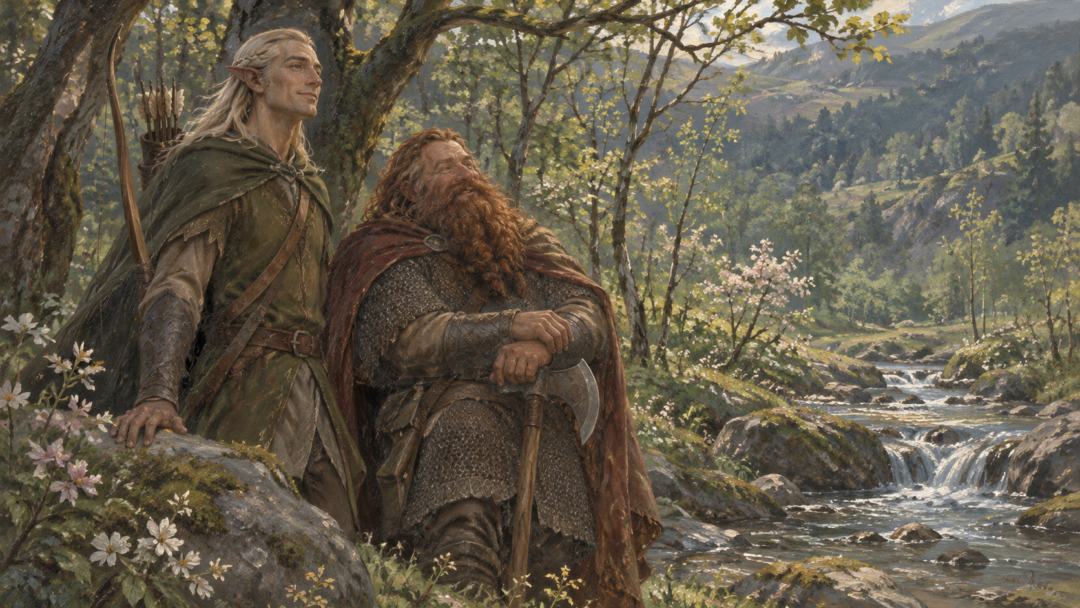
The books do give Legolas an arc, and its clearest measure is his friendship with Gimli. At Rivendell, the old friction between the Wood-elves and Glóin's family is still recognizable. On the road, the Elf and the Dwarf become companions who challenge each other's expectations. Their exchanges during the fighting at Helm's Deep are playful even under terrible pressure, while their later conversations show a willingness to admire what the other loves.
Their agreement to visit the Glittering Caves and Fangorn together is particularly revealing. Gimli sees an extraordinary beauty beneath the mountains; Legolas finds wonder among ancient trees. Neither must abandon his own taste to honor the other's. They choose to enter each other's world. That is a meaningful personal development the reader witnesses directly, without needing to know whether the younger Legolas had ever befriended a Dwarf before.
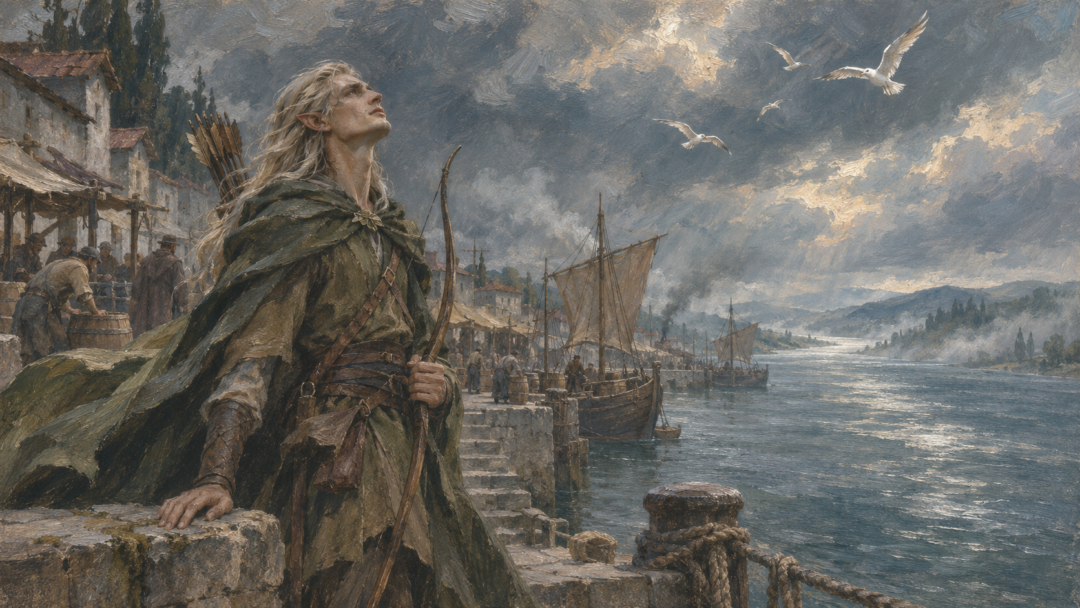
Then, at Pelargir, Legolas hears gulls and feels the sea-longing that Galadriel had warned him about. It changes his relationship with the forests he loves, opening a desire he cannot simply set aside. This is not another hidden episode recovered from his past: it is a new experience within the story. For an Elf so closely associated with woodland life, the pull of the Sea gives his future an unexpectedly poignant direction.
After the war, Legolas brings Elves from Greenwood to Ithilien, helping renew a land scarred by conflict. The appendices preserve the tradition that, after Aragorn’s death, he sails West and Gimli goes with him. Nothing in those later pages fills in his childhood. Instead, they leave us with a fitting image: the woodland Elf setting sail beside the friend whose world once seemed so different from his own.
Sources & Notes
This article is based on close reading and interpretation of Tolkien's published works and related source material where relevant.