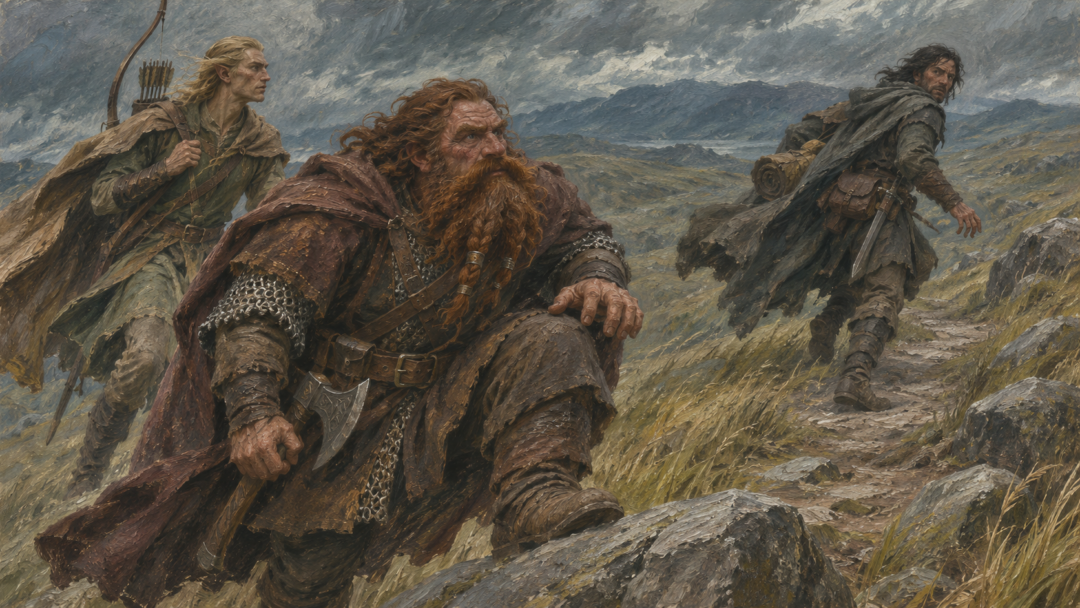
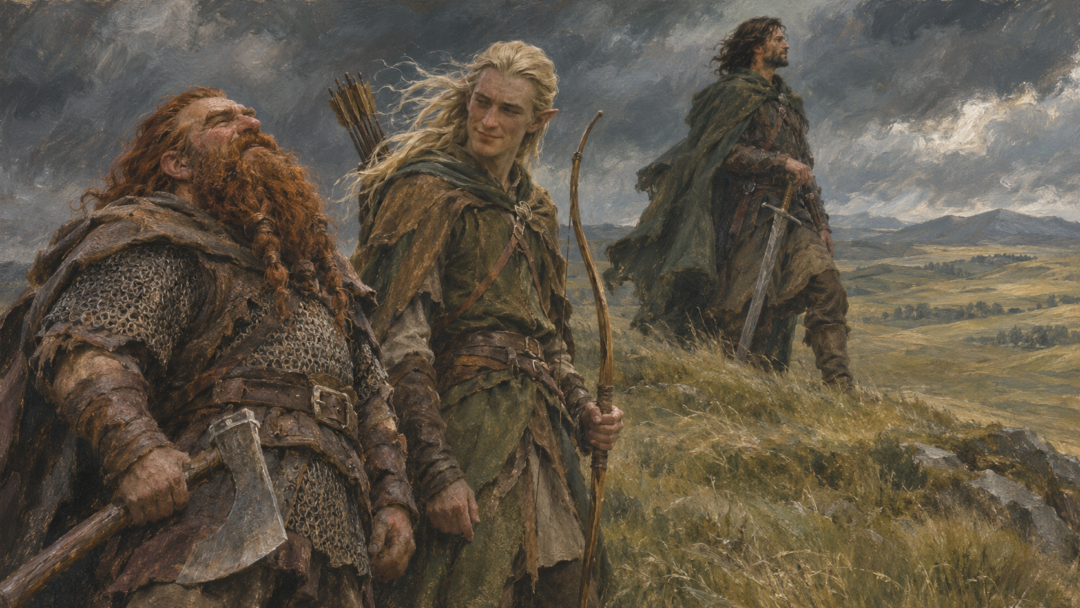
The Three Hunters are racing over the bare rocks and rolling grass of Rohan when Gimli starts to fall behind. Aragorn presses ahead, Legolas seems almost impossibly light on his feet, and the Dwarf is left huffing, scrambling, and defending his reputation. It is one of the most memorable running jokes in The Lord of the Rings: The Two Towers. But is Gimli actually less capable of covering ground than his companions, or is the film asking us to laugh at something else? The short answer is that his exhaustion becomes a comic contrast to Aragorn’s purpose and Legolas’s effortless appearance. It is not a rule about Dwarven stamina, and it is not a running gag involving all nine members of the Fellowship. The best-known example belongs to one urgent chase by three friends.
The chase begins with a broken Fellowship
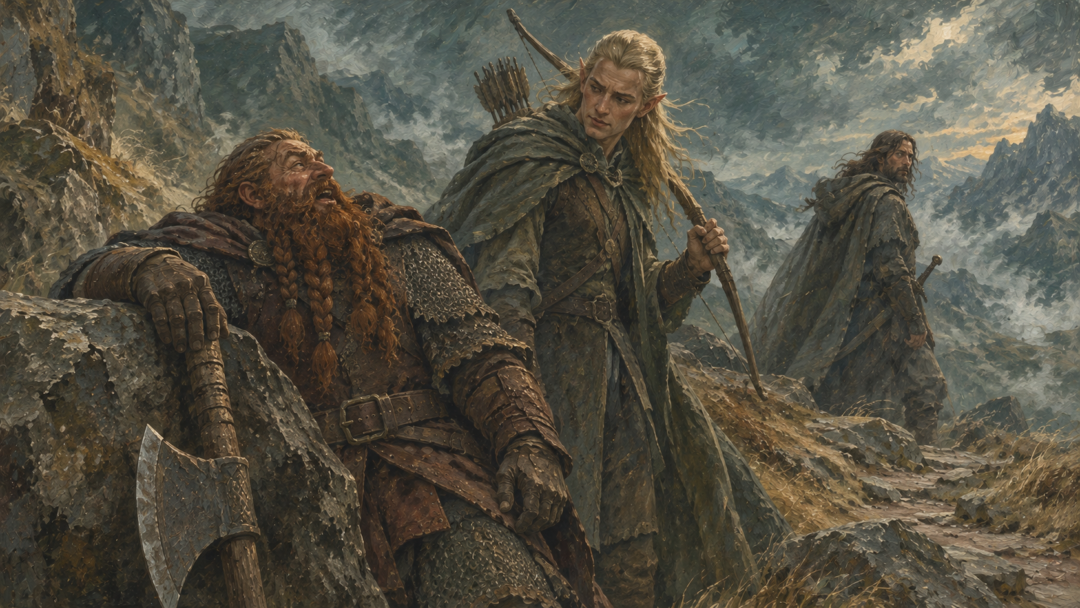
By the time the pursuit begins, the original company has already scattered. Frodo and Sam have set out toward Mordor, Boromir has fallen, and Orcs have carried away Merry and Pippin. Aragorn, Legolas, and Gimli choose to chase the captors rather than abandon the hobbits to their fate. Aragorn calls them the Three Hunters, a name that describes their task better than any idea of a friendly footrace. They are following enemies who have a head start, through terrain that does not readily surrender its clues.
That context is easy to overlook because the chase also delivers a quick, visual joke. The film’s transcript describes Aragorn listening for footsteps through the ground, hearing that the Orcs have increased their pace, and immediately rushing onward. Legolas calls back, “Come on, Gimli!” Gimli pauses to catch his breath and complains of relentless pursuit, scant opportunity for rest, and tracks that can barely be read from stone. Then he carries on. The important detail is not merely that he is panting; he is panting while refusing to quit.
The search carries genuine suspense. The hunters do not know whether their friends are alive or where the Orcs intend to take them. A small object dropped on the trail, an Elven brooch, offers a fragile sign that the captives may still be resisting. Each pause could cost them the trail, yet charging blindly ahead might mean passing the very evidence they need. The sequence has to communicate speed, uncertainty, and fatigue at once. Gimli’s very audible effort gives that strain an immediately recognizable human shape.
How a hard journey becomes a short-distance joke
The film singles Gimli out through a combination of movement and timing. Aragorn leads with the confidence of a tracker, while Legolas travels behind him and looks back for their companion. Gimli, in contrast, is allowed an awkward moment: the transcript describes him stumbling out from behind rocks and rolling onto the ground. Legolas urges him forward because they are gaining on the Orcs. Just when the pursuit seems ready to accelerate again, Gimli has to defend his athletic dignity.
His answer is the famous claim that cross-country running does not suit Dwarves: they are natural sprinters, he insists, and especially dangerous over short distances. It is a wonderful little piece of self-justification, not a statement of Dwarven physiology. The audience has just watched him struggle to keep pace, but he responds not with surrender or an admission of weakness. He relocates the contest to a kind of running in which he imagines himself unbeatable. The comedy comes from the gap between the heroic boast and what we have just seen.
The joke works visually before it works verbally. Put a broad, heavily equipped Dwarf beside a tall Ranger and a light-moving Elf, and their silhouettes already tell different stories. The filmmakers can contrast bodies, strides, and expressions without stopping the action to explain any of them. Yet appearance should not be confused with a biological equation. The scene shows the companions moving differently; it does not prove that the shortest member is inherently the least enduring. Physical contrast gives the line its setup, and Gimli’s delivery supplies its punch.
Why Aragorn and Legolas seem so comfortable
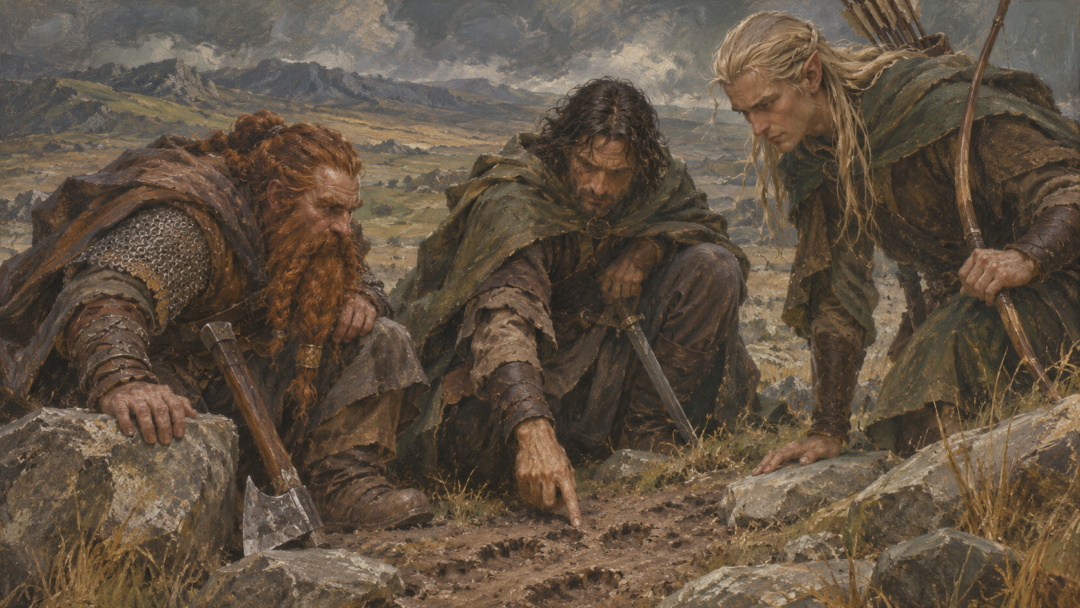
Aragorn’s apparent ease has a dramatic job. As the hunter who reads the trail, he is repeatedly shown deciding where the others should go next. When he stops to listen to the earth or inspect a sign, the audience learns that his attention is on the pursuit rather than his aching legs. His concentration makes him look tireless, even though the story gives us no reason to think such a journey costs him nothing. Leading and tracking are the qualities this stretch of film wants us to notice about him.
Legolas provides a different sort of contrast. His Elven eyesight can pick out details far beyond the reach of his companions, and his movements are presented with extraordinary grace. He looks like someone who belongs among the wide horizons and high ridges they are crossing. More importantly, he keeps turning back toward Gimli. Those glances can strengthen the comedy, because the gap between them stays visible, but they also register awareness of a friend. An Elf who simply vanished into the distance would tell a colder story.
The book gives Gimli a more practical reason to rest
In the novel’s chapter “The Riders of Rohan,” the Three Hunters also hurry across the country after the Orcs, and fatigue matters deeply. But the journey unfolds as a problem of judgment, not simply a comparison of running styles. When night falls, the companions debate whether to keep going or halt. Gimli openly acknowledges that even a well-traveled and hardy Dwarf cannot run indefinitely without a pause. Far from treating himself as weak, he speaks as someone who knows the cost of continuing without recovery.
He also contributes a practical argument. In darkness they might miss tracks showing that a prisoner has escaped or been taken away from the main trail. This is especially important after the hunters have found evidence of Pippin’s resourcefulness. Gimli’s desire for rest is therefore bound up with the larger question of how to rescue the hobbits successfully. Legolas wants to close the distance; Aragorn must weigh the risk of losing the trail. Gimli is not merely the slow friend asking the others to stop. He is part of the decision.
Aragorn ultimately chooses to rest, and the book does not exempt him from weariness. As the pursuit continues, he admits to a fatigue that troubles him precisely because he is an experienced Ranger. He suspects a hostile influence in the country ahead, something helping their enemies and weighing against the hunters themselves. This adds an unsettling dimension to their exhaustion: the land is not just difficult to cross, but may be affected by Saruman’s will. Fatigue becomes part of the atmosphere of danger, not Gimli’s personal shortcoming.
Legolas does stand apart in the novel. While Aragorn and Gimli sleep, the Elf can remain upright and watchful, and he is often the first ready to move again. The narrative gives him a strikingly different relationship to rest, perception, and the surrounding world. Still, that is not the same as establishing a universal ranking of Dwarven, human, and Elven running endurance. All three hunters continue across the plains, and Gimli’s hardiness is stated rather than denied. The film takes a real contrast among companions and gives it a sharper comic edge.
What John Rhys-Davies said about Gimli’s humor
The actor himself discussed the problem in a public question-and-answer session at Gen Con in 2003. A fan told John Rhys-Davies that some jokes in The Two Towers seemed to come at Gimli’s expense, even while others were enjoyable. The actor did not simply dismiss the concern. He talked about the difficulty of sustaining a film filled with increasing danger, defeats, and battles without some change in emotional pressure. In his account, Gimli became one of the ways to modulate that tension.
Rhys-Davies also returned specifically to the running joke. He described the humor of Gimli charging across country with Strider and an immortal Elf, suddenly confronted with the inconvenience of his short legs. He made the observation comically, even invoking an evolutionary disadvantage. That was an actor’s playful explanation of a scene, not evidence about the biology of Middle-earth. Nor does his recollection establish who wrote the line, who first proposed the gag, or exactly how it was shaped during production.
His answer points toward something that makes Gimli endearing: he does not see himself as lesser than the imposing companions beside him. He is proud, formidable, and unwilling to let an undignified tumble have the last word. The running boast suits that temperament. It also clarifies why viewers can react differently to the same moment. Some hear a warrior staying spirited under pressure; others see a capable Dwarf repeatedly placed at a disadvantage so that the tall heroes can look more magnificent.
Does the joke make Gimli look weaker than he is?
That uneasiness is worth taking seriously. In a critical essay on humor in the films, Brantley Bryant observes how Gimli’s physical mishaps can throw Aragorn and Legolas’s grace into relief. Bryant reads the contrast as part of a larger pattern in which stature and bodily difference shape who is allowed to look effortlessly heroic. That is an interpretation of the films’ effect on an audience, not a window into any filmmaker’s private intentions. Still, it explains why a laugh that lasts seconds can linger as an impression of the character.
There is a cost when the person struggling is almost always the person delivering the punchline. A viewer may remember Gimli rolling across the rocks more vividly than the endurance it takes to remain on the trail afterward. Yet the scene never shows him abandoning Merry and Pippin, asking to be left behind, or losing the will to fight. His breathlessness makes him visibly vulnerable, but his actions keep him inside the same desperate mission as his companions. The humor is more generous when we remember that distinction. He is tired because he is still going.
That is the image worth keeping when Gimli comes huffing over the next rise: Aragorn searching the ground, Legolas glancing back, and the Dwarf catching up once again. One looks determined, one looks impossibly graceful, and one makes the effort visible. They are not running to prove which of them is best. They are running because two friends are still out there, and Gimli has no intention of leaving them behind.
Sources & Notes
This article is based on close reading and interpretation of Tolkien's published works and related source material where relevant.