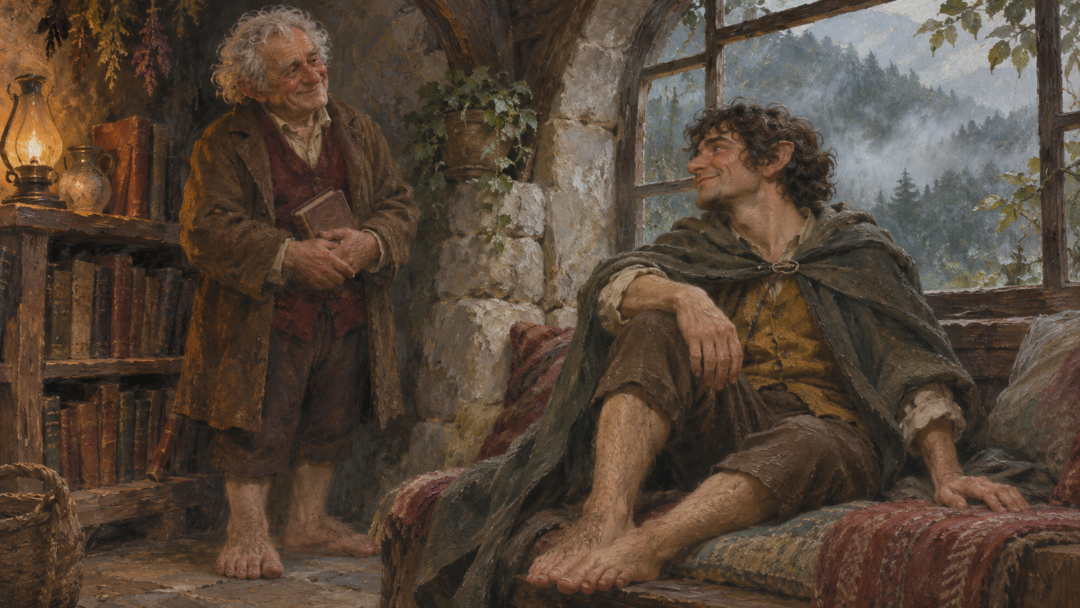
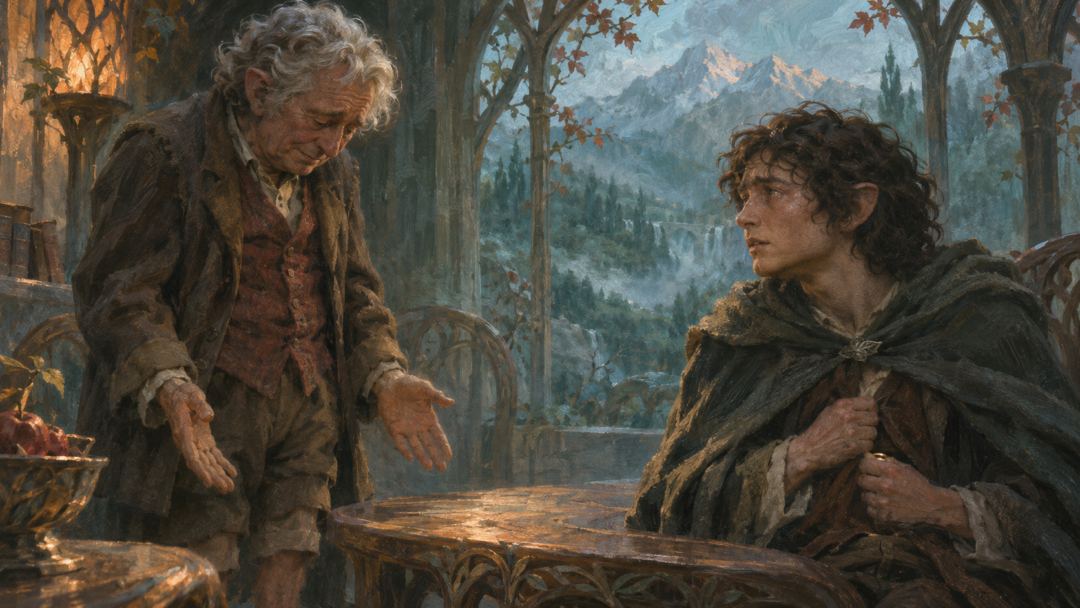
In Rivendell, Frodo finally sits with the uncle he has missed, and for a moment the danger outside seems comfortably distant. Then Bilbo notices the One Ring. He reaches toward it, his face suddenly twists into a ravenous, almost demonic mask, and the warmth of their reunion vanishes. It is one of the most startling images in Peter Jackson’s The Fellowship of the Ring. Because Rivendell is supposed to offer safety and healing, the intrusion feels especially out of place.
Yes, there is an explanation. The frightening image comes from a specific passage in The Fellowship of the Ring, and the film’s commentary even describes how the effect was made: a rubber puppet was briefly morphed into Ian Holm’s face. But what does that face represent? The novel describes Frodo’s disturbing perception, not a verified physical transformation, while the movie gives that fleeting impression a shape we can all see.
The Frightening Moment Is Already in the Book
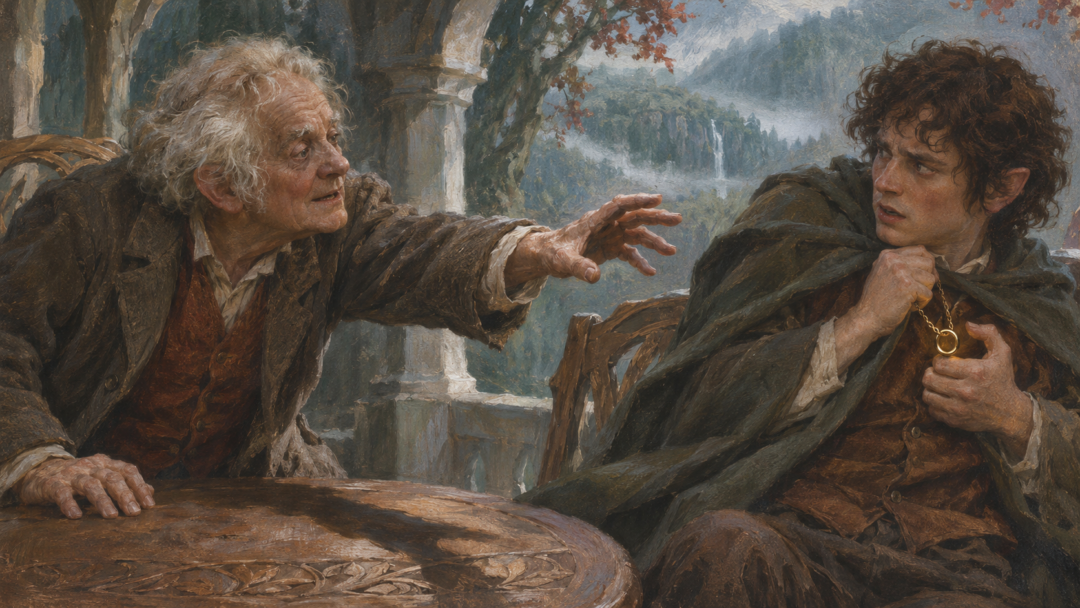
The episode appears in “Many Meetings,” after Frodo has reached Rivendell and recovered from his wound. He finds Bilbo among the Elves, writing songs and enjoying the quiet life he sought after leaving the Shire. They talk affectionately of travel and home. Bilbo also admits that he has heard about the trouble surrounding his old Ring. Gandalf and Elrond have discouraged him from trying to retrieve it himself.
Yet curiosity breaks through. Bilbo asks whether Frodo has the Ring and says, “I should very much like just to peep at it again.” His request sounds almost harmless. Frodo’s response is the first warning. Before Bilbo makes any alarming movement, Frodo feels a strange reluctance to show him the object. The exchange has already become uncomfortable on both sides of the little golden circle.
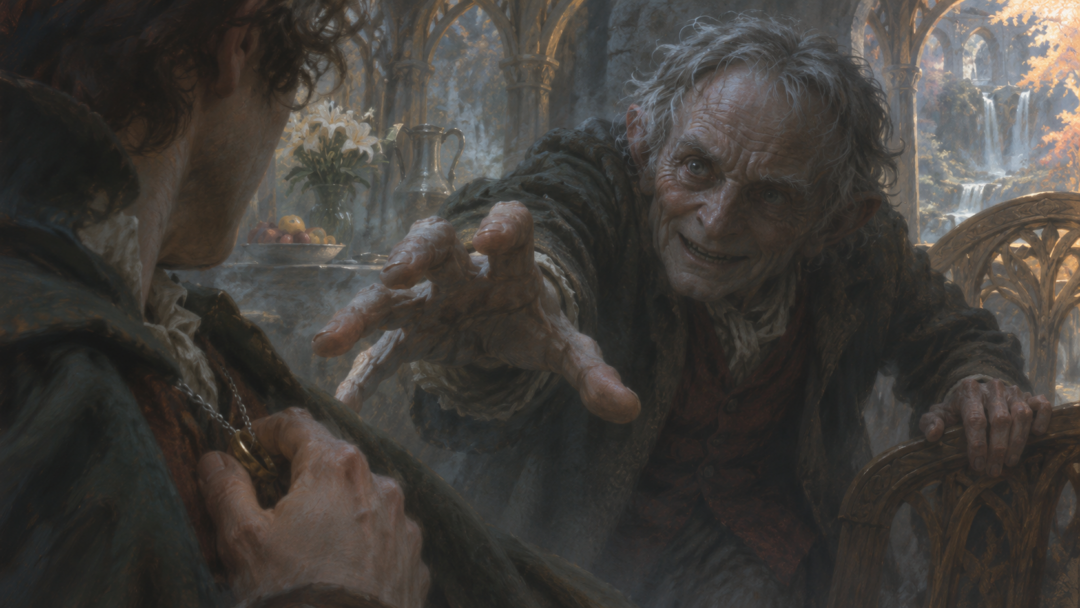
Frodo draws the Ring from the chain around his neck. Bilbo puts out his hand, and Frodo instantly pulls it back. Suddenly Frodo seems to see not his familiar relative but a wrinkled, hungry-looking creature with bony hands reaching toward him. He even feels an impulse to strike. Notice the sequence: the recoil comes before the horrible vision, and the violent impulse belongs to Frodo. The prose does not say Bilbo attacked him.
Then the atmosphere changes again. The music and singing around them appear to falter. Bilbo studies Frodo’s face, passes a hand across his own eyes, and understands enough to tell him to put the Ring away. He apologizes for the burden Frodo has inherited and for everything that has happened. Frodo hides the Ring, the shadow passes, and the familiar light and music return. Soon they are talking happily about the Shire with Sam. The terror interrupts their reunion.
What Did Frodo Actually See?
The crucial wording places us inside Frodo’s shock. A shadow seems to come between the hobbits; through it, Bilbo appears as a grasping, hungry figure. That does not settle whether Frodo has experienced a supernatural vision, a sudden distortion of judgment, or something harder to classify. Middle-earth contains real enchantment, but the narrator does not stop to declare that Bilbo’s bones or facial features physically changed.
Even the silence is filtered through Frodo’s alarm. It is described as the music seeming to falter, not as an independently documented interruption heard by every Elf in the hall. The story stays close to what Frodo perceives and feels. Readers can recognize that something profound has happened without being given an external camera that confirms every detail. That openness is part of why a short exchange can feel so uncanny.
There is another uncomfortable detail: Frodo has an aggressive reaction himself. The former bearer is not the only one behaving strangely around the Ring. Frodo feels reluctant to show it, snatches it away, and briefly wants to hurt someone he loves. Those facts suggest that his own growing attachment matters to the encounter. They do not prove that the Ring has projected an illusion into his mind, or that the same influence operates identically on both hobbits.
Bilbo’s temporary appearance also resembles the language used for Gollum: smallness, age, hunger, and grasping hands. That resemblance can help explain why Frodo finds it horrifying. Both characters have known an unnatural attachment to the same object. But resemblance is not a literal forecast of Bilbo becoming Gollum, nor proof that he would have undergone a matching bodily change. The passage shows how the desire for the Ring can make a beloved person suddenly seem unrecognizable.
How the Movie Created the Shock
The film faces a different problem from the novel. On the page, the narration can simply carry us into Frodo’s perception. Onscreen, a glance or a moment of hesitation might not convey how violently his view of Bilbo changes. The movie therefore turns the impression into an abrupt visible horror: Ian Holm’s kindly face becomes something gaunt and ravenous for an instant, before the scene returns to the two frightened hobbits.
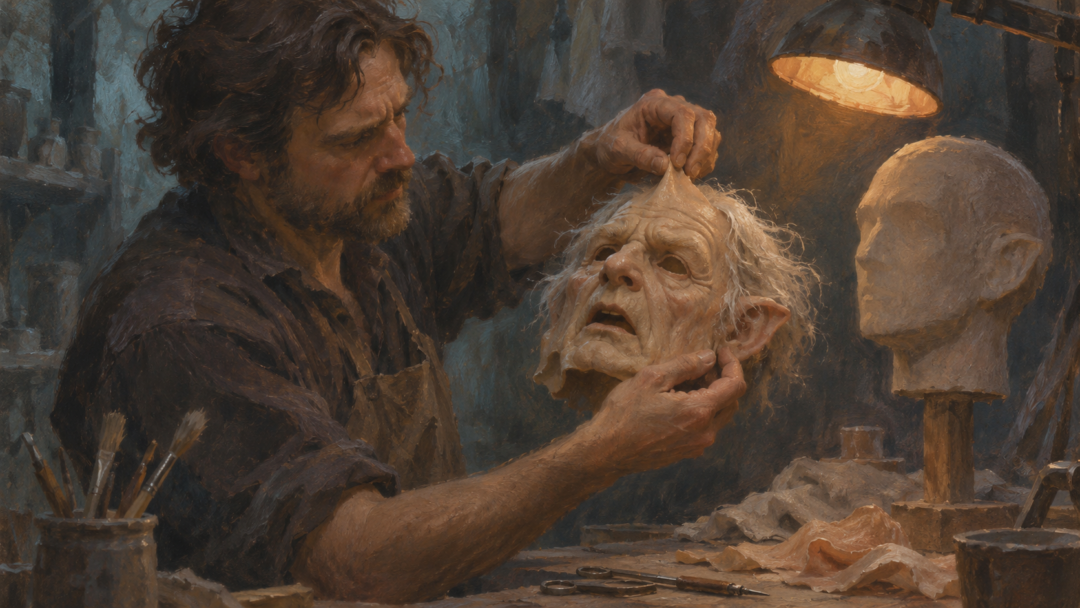
There is a concrete production answer, too. At approximately 1:47:57 in the Fellowship commentary, the discussion explains that the shot used a rubber puppet, morphed into Holm’s face for a few frames. The speaker describes the image as part performer, part puppet. The commentary also notes Holm’s separate, later-stage aging makeup in Rivendell; that everyday older appearance is distinct from the instant puppet-assisted scare. It identifies the practical element and the brief blend, without naming a software package or individual effects artist.
The same commentary immediately connects the result to the novel. One participant describes the book moment as a shadow passing across Bilbo’s face while Frodo sees something horrible and grasping; the others confirm that the shot was inspired by it. That description conveys the idea, though the book places the apparent shadow between Frodo and Bilbo. The difference is telling. A written shift in perception has become a visible alteration of a face.
Because the transformation lasts so briefly, it can feel almost like an involuntary flash rather than a monster scene. We see the familiar Bilbo, the horrifying interruption, then Bilbo again, still recognizable and deeply upset. The shot works through sharp contrast rather than an elaborate creature reveal. It borrows the visual language of horror to make the Ring’s danger legible in a conversation that otherwise takes place in one of Middle-earth’s safest refuges.
Does the Face Mean Bilbo Was Possessed?
Nothing in this encounter identifies Sauron as personally taking control of Bilbo’s body, and neither the book nor the commentary establishes literal demonic possession. The One Ring is Sauron’s creation and carries his malice, but that broad truth does not explain every visual detail as a direct act by him. “Demonic Bilbo” is a useful fan nickname for a frightening movie image, not the name of a new creature or a confirmed event in the story’s biology.
The film can nevertheless encourage a more literal reading than the page. A camera shows an apparent change in Holm’s face; audiences naturally treat photographed faces as things that are physically there. The novel, by contrast, tells us how the person closest to Bilbo experiences that second. The movie’s choice is best understood as a cinematic externalization: a private, unsettling impression made public so viewers share Frodo’s alarm at once.
That choice does make Bilbo seem momentarily more threatening. The book describes an outstretched hand and Frodo’s urge to strike, not a deliberate attempt by Bilbo to assault or kill his nephew. In the movie, the combination of movement, sound, expression, and rapid transformation can suggest an attack is about to happen. But suggesting danger is not the same as establishing conscious murderous intent. The scene ends before Bilbo acts on any such intention, and his next response is distress.
Consider how the two hobbits arrived here. Bilbo had surrendered the Ring when leaving Bag End, though not without a painful struggle. Frodo now carries it into danger, despite never having sought it. The Rivendell scene lets those histories collide in a small gesture: one hand extends, another draws back. The effect is not a verdict that either hobbit has become evil. It makes their bond suddenly vulnerable to an object both have reason to fear.
The Most Revealing Part Comes After the Face
Bilbo does not continue reaching. In the book he sees Frodo’s expression, withdraws, and apologizes. Rather than demanding another look, he recognizes that Frodo is carrying a burden he once knew only in part. He recognizes that the adventure he passed on has become something dreadful. His question about whether adventures ever end gives the scene a sadness that a monster transformation alone could never supply.
The return to Shire gossip is equally specific. Once Frodo hides the Ring, Bilbo is delighted by tiny scraps of news, and the two lose themselves in familiar talk while Rivendell’s music surrounds them. Their relationship does not require a dramatic reconciliation speech. In the same chapter, Bilbo resumes his songs and work with Aragorn. These ordinary continuities matter: the frightening perception interrupts Bilbo’s recognizable character, rather than replacing it with another permanent identity.
Before the Fellowship departs, Bilbo also gives Frodo Sting and his mithril coat. Those gifts do not erase his troubling interest in the Ring, but they show what he actually chooses to do for Frodo. The old adventurer cannot accompany him; he can send him better protected. Seen beside that act, the reach toward the Ring feels like one frightening moment within a much larger relationship of care, memory, weakness, and generosity.
The face is unforgettable precisely because it is so brief. For a handful of frames, a beloved hobbit seems to disappear behind the hunger for a small gold object. Then Bilbo pulls back, and there is a face Frodo knows again. Rivendell’s light has not defeated the Ring, but it has room for an apology, a lowered hand, and two hobbits talking about home.
Sources & Notes
This article is based on close reading and interpretation of Tolkien's published works and related source material where relevant.