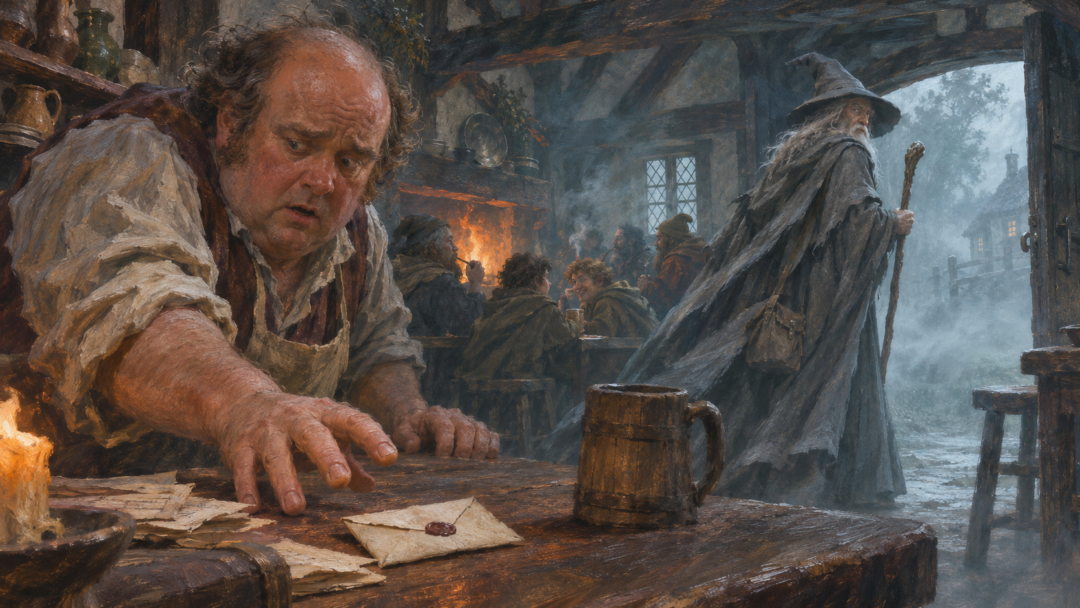
At the Prancing Pony in Bree, Barliman Butterbur has something far more important than a room or a mug of ale: a letter from Gandalf addressed to Frodo Baggins. By the time the innkeeper remembers it, Frodo is already standing in his parlour, far from the Shire and dangerously close to the Black Riders. The warning has arrived, but not where or when its writer intended.
Imagine Butterbur finding someone to carry it promptly to Bag End instead. Frodo would have learned sooner that he should hurry toward Rivendell, and he would have known a name to look for on the road: Strider. That could have transformed the journey that eventually brought the Fellowship together. It would not, however, automatically have produced an earlier Council of Elrond or the same nine companions on a different schedule. Those outcomes depended on people and decisions beyond Frodo's doorstep.
A warning that could change Frodo's departure
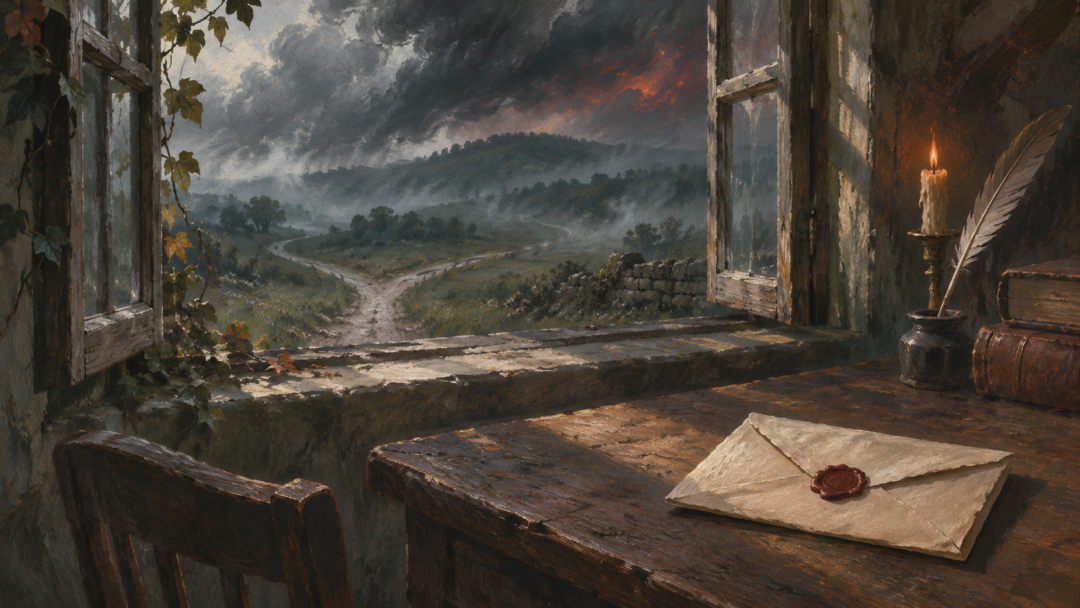
Gandalf wrote after hearing through Radagast that servants of Sauron were seeking the Shire. He had expected to return and help Frodo leave around late September. Now he urged Frodo to leave as soon as possible, preferably before August, head for Rivendell, avoid travelling at night and refrain from using the Ring. Gandalf would try to catch up. Frodo already knew the Ring was dangerous; what the message changed was his information about the urgency.
This was practical intelligence, not merely an anxious reminder. In the actual story, Frodo waits for Gandalf, who cannot return as promised, and leaves Bag End on 23 September. A timely message might have prompted him to act sooner, before his plans settled into their familiar shape. But the hypothetical delivery date and Frodo's response are unknown. The advice supplies a deadline, not proof of a different departure day.
Frodo's preparations were complicated even without enemies nearby. He sold Bag End and used his supposed move to Crickhollow to disguise his intentions. Advancing the journey could mean reconsidering that cover, deciding what to take and what to tell friends already noticing his plans. Crickhollow stood near the eastern edge of the Shire, making that cover useful for the planned exit. A letter could provide urgency; it could not settle those conversations or make an inexperienced traveller ready.
An earlier start might have changed Frodo's exposure to the Black Riders. In the familiar journey, they pursue him from the Shire, and he is wounded at Weathertop. Leaving ahead of some of their movements could improve his chances. Yet Sauron's search was already under way; no alternative itinerary guarantees safety or bypasses the Old Forest, the Barrow-downs or Weathertop. Nor would Butterbur's delivery have freed Gandalf from Saruman's imprisonment at Orthanc. Frodo might still have travelled without his expected guide.
Strider's introduction might have happened differently
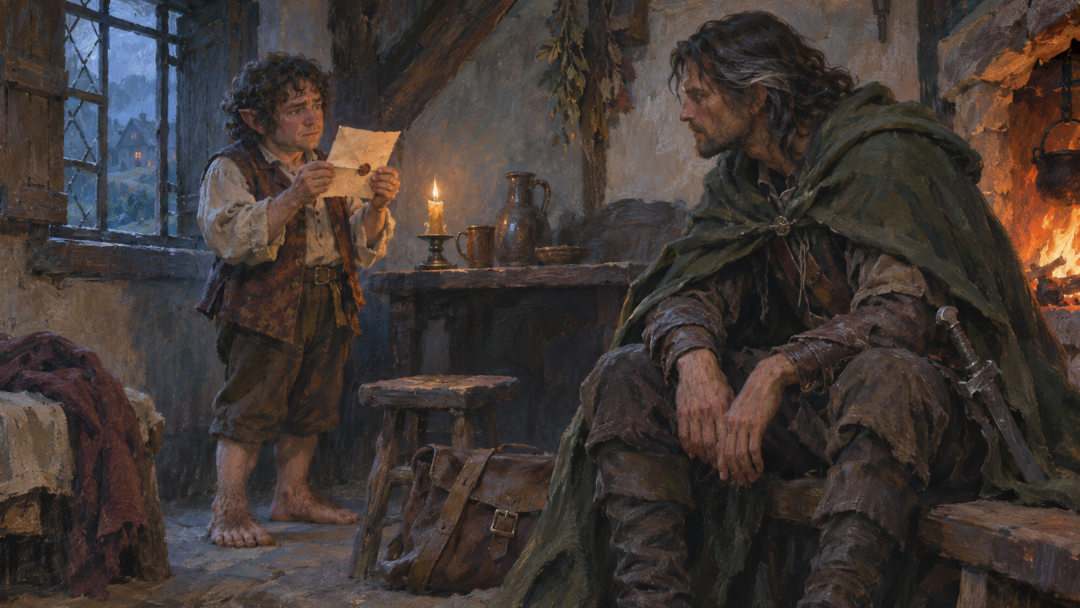
The other treasure in the letter was a recommendation. Gandalf described a Ranger called Strider, gave his true name as Aragorn, and included clues connected with the broken sword and its heir. At Bree, Frodo has reasons to hesitate before trusting a weather-beaten stranger who knows too much about him. Butterbur's belated letter helps establish that Strider is Gandalf's ally. One identifying clue is a poem composed by Bilbo, linking that unassuming Ranger with a much older history.
Having read it at home, Frodo could approach Aragorn with a way to test his claim. Caution would still be necessary: Sam remains suspicious even after the letter appears in the original scene. Knowing a name does not establish someone's identity. Strider, too, had to establish who Frodo was, rather than accept a stranger's claim on sight. The likely improvement is Frodo's ability to recognize the value of Strider's offer without discovering it in the middle of an alarming night at the inn.
The encounter itself is another matter. Aragorn was already working with Gandalf against Sauron, but the letter appointed no meeting place or hour. A different departure could mean a different arrival at Bree, or a route that never reaches the Prancing Pony. Aragorn might still help, though the story cannot say how. His place in the actual Fellowship grew from his history and purposes as well as the trust earned guiding Frodo.
Would all four hobbits still have gone?
Sam is the easiest companion to picture beside Frodo, although no earlier departure guarantees his presence. He overheard Gandalf and Frodo discussing the Ring and was drawn into the journey before the letter reappeared. His attachment to Frodo was independent of Butterbur's mistake. With a fresh warning and less time to prepare, Frodo would still have good reason to rely on someone he trusted.
Merry and Pippin present a more complicated question. In the actual story, Frodo's friends form a quiet conspiracy to help him, with Fredegar Bolger assisting and staying behind. Merry knows more than Frodo realizes, and the friends resist his attempt to face danger without them. Their determination is genuine. Fredegar's role in keeping up appearances also shows how carefully that particular departure had been arranged. None of this proves they would uncover every earlier plan in time or accompany him on every possible departure.
That question reaches Rivendell. Merry and Pippin did not join the Fellowship merely because two extra hobbits were available. Their persistence became part of an argument about the companionship the quest required. A differently assembled Shire party could have presented Elrond with different claims. Or an early warning might have brought the friends into Frodo's confidence sooner. The letter opens possibilities without sorting them into a definitive passenger list.
Rivendell was a meeting place, not a timetable Frodo controlled
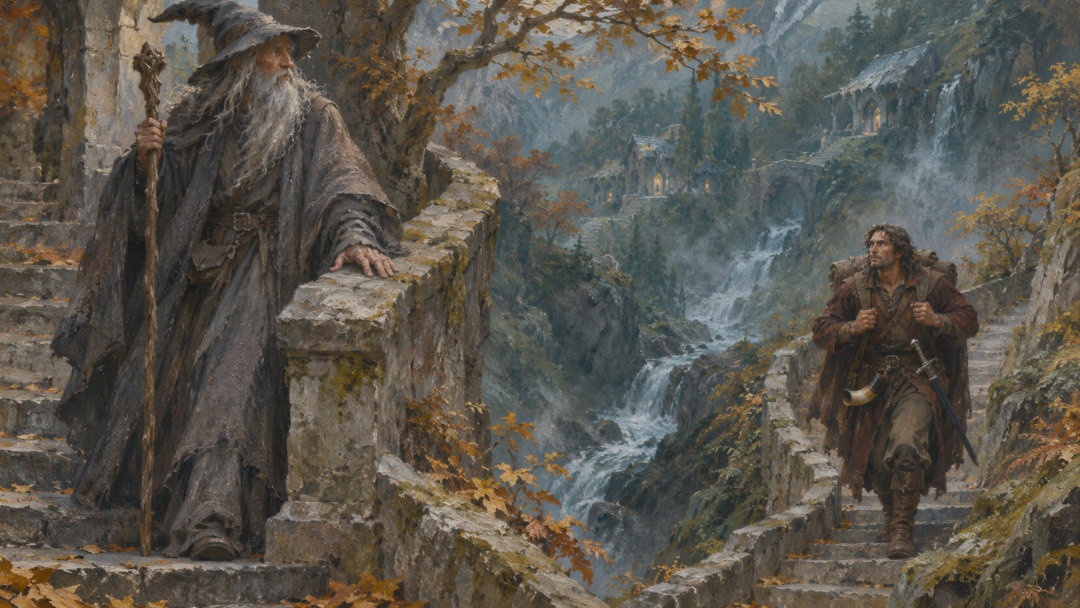
The Council of Elrond took place on 25 October, after Frodo reached Rivendell and survived the crossing at the Ford of Bruinen. It is tempting to shift that gathering backward if Frodo leaves sooner. But the Council draws strength from separate concerns converging. Frodo brings the Ring; the others bring knowledge of a wider crisis. Their journeys were not appointments made for the day a hobbit would arrive.
Boromir comes from Gondor seeking the meaning of a troubling dream shared with his brother Faramir. References to Imladris, a broken sword, Isildur's Bane and a Halfling point him north; Frodo's departure does not initiate that quest. Gondor faces danger before the Council meets. Boromir's questions matter whether or not Frodo spends extra weeks in Elrond's house. His difficult journey north began with little certain knowledge of where to find Imladris. His arrival shapes that particular Council, not every possible one.
Others have independent business. Legolas brings news from Mirkwood that Gollum has escaped Elvish custody. Glóin and Gimli arrive from Erebor after a messenger of Mordor asks about Bilbo and his Ring; they also seek word of Balin's company in Moria. Galdor comes from the Grey Havens. The Council gathers information as well as deciding the Ring's fate. An earlier Frodo might hear some news sooner while waiting for other reports.
More time would not necessarily supply an easy answer. Elrond, Gandalf and the others weighed using, hiding or destroying the Ring, knowing the danger if Sauron recovered it. Frodo's account mattered but was not the only testimony. Bilbo could recount finding the Ring, while Gandalf could explain the evidence for its true identity. Tolkien Gateway's chapter-referenced summaries trace the separate arrivals and discussions, not a hypothetical second Council date. Rivendell would remain a plausible place for the larger choice, though the circumstances might differ.
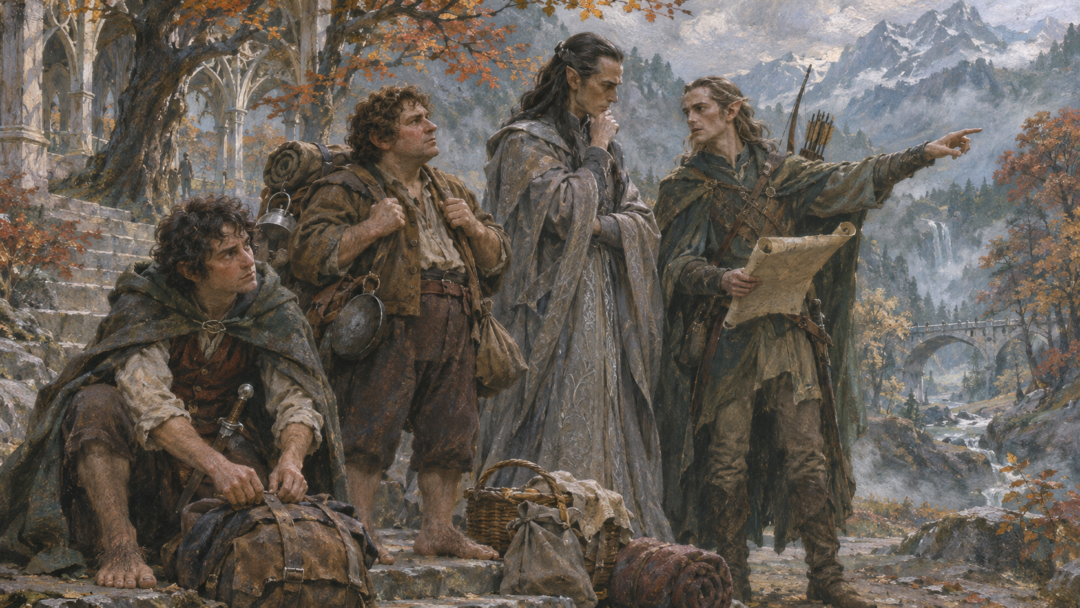
The Fellowship was chosen in stages
Even in the familiar timeline, the Council does not send nine travellers down the road that afternoon. First comes the decision to destroy the Ring in the fire where it was made. Frodo volunteers to bear it, and Sam insists on joining him. A different journey could affect Frodo's strength, experience and understanding. Whether he would volunteer in the same way, at the same gathering, remains open.
The companions bring distinct commitments. Gandalf supplies knowledge of the Enemy. Aragorn bears Isildur's heritage and intends to go south to aid Gondor. Boromir's route home also lies southward; Legolas and Gimli represent peoples whose troubles the Council has heard. Their participation does not depend solely on Frodo's arrival date. The particular company nonetheless reflects relationships and opportunities at Rivendell once those stories were shared. Companions other than Frodo were not all bound to follow the Ring to the journey's end.
Elrond chooses nine companions to stand against the Nine Riders. The number has symbolic force, but it is a decision, not a rule compelling every imagined expedition to contain nine. The final two places are contested. Elrond considers members of his household; Gandalf argues for Merry and Pippin, valuing friendship and loyalty over greater apparent strength. Change who reaches Rivendell, and the discussion could change without inventing replacements.
Preparation matters too. After the Council, scouts search for the Black Riders, while the travellers remain in Rivendell awaiting reports. They eventually find scattered traces, including lost horses and torn cloaks, rather than the Riders themselves. The company departs on 25 December, after choosing and equipping its members. Aragorn's sword is reforged; Bilbo gives Frodo Sting and his mithril coat. Reaching Rivendell sooner would not make reconnaissance or equipment irrelevant. Getting the Ring to safety and deciding how to send it onward were separate tasks.
Butterbur's forgotten letter is striking for its smallness beside what follows. It could have sent Frodo out with better warning and a clearer idea of whom to trust. It could not summon Boromir's dream, bring Legolas's news or choose Elrond's companions. The Fellowship emerged where independent journeys met acts of courage. The letter might have changed how Frodo reached Rivendell, while leaving one question to be answered there: who would walk beside him?
Sources & Notes
This article is based on close reading and interpretation of Tolkien's published works and related source material where relevant.