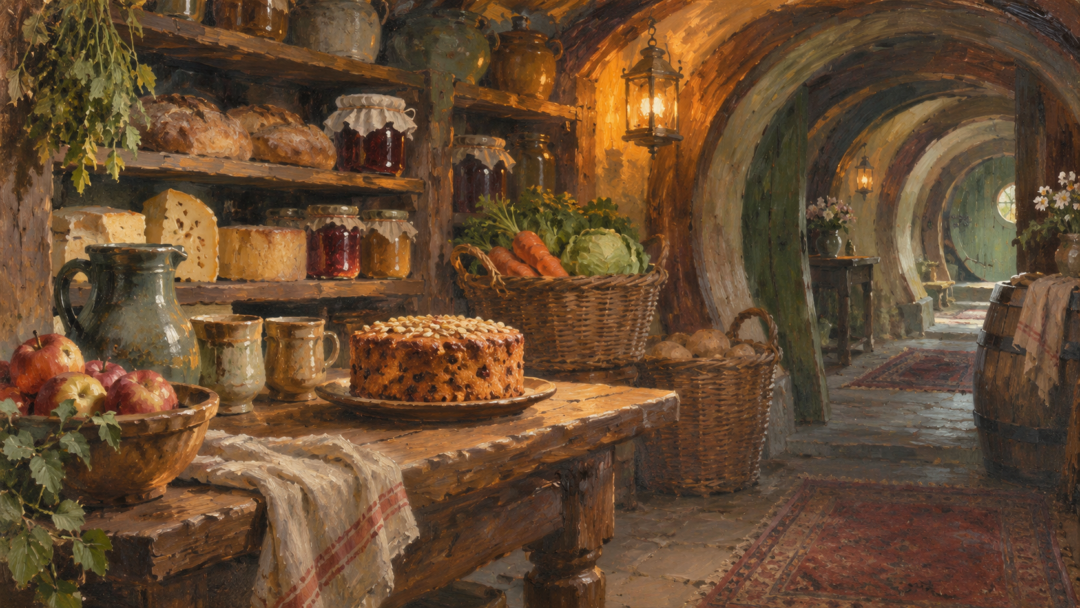
At Bag End, the doorbell keeps ringing, the pegs fill with travelling hoods, and Bilbo Baggins finds himself fetching food for strangers who behave as though they have been expected. His carefully prepared seed-cakes are suddenly in danger, and the requests soon extend well beyond afternoon tea. It is easy to picture the Dwarves deliberately feasting their way through the hobbit's stores before setting out into danger.
But [the opening chapter of The Hobbit](https://catdir.loc.gov/catdir/samples/hm051/98102207.html), “An Unexpected Party,” supports a narrower answer. Thorin expresses a personal preference for a substantial breakfast before travelling. The chapter does not establish a Dwarven rule requiring a feast before a quest, or suggest that the visitors deliberately emptied Bilbo's larder. Instead, it explains who arranged the gathering, why Bilbo keeps serving, and what the travellers do afterward.
Thorin's breakfast request is the strongest clue
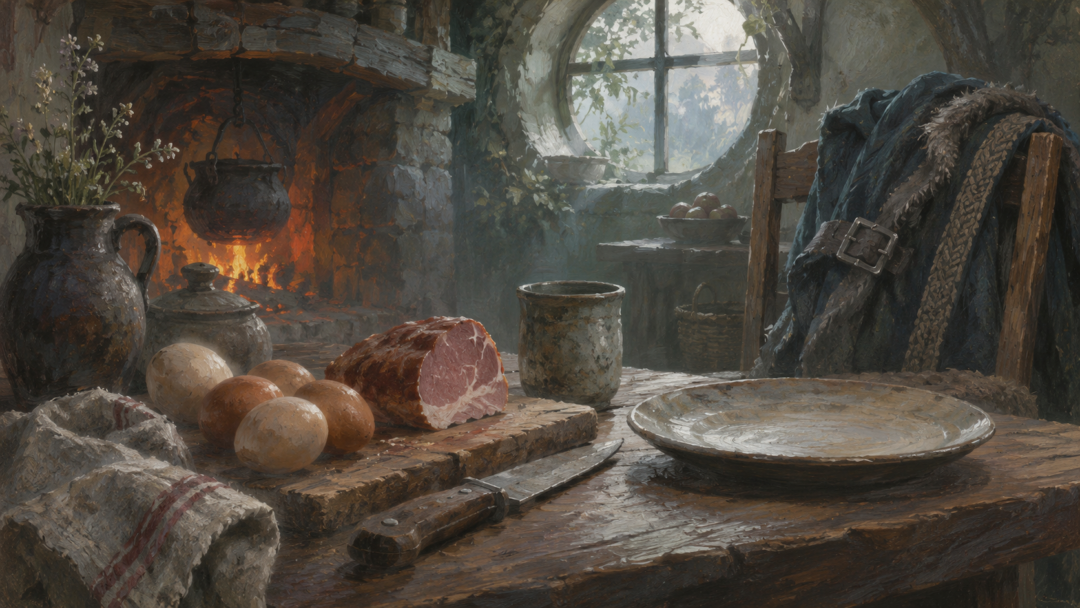
Near the end of the evening, Bilbo proposes going to bed and promises the company breakfast before they leave. Thorin immediately specifies how he likes his eggs served with ham, including a notably generous helping. He connects that preference to “when starting on a journey”. This is the clearest evidence linking a Dwarf's appetite with departure. The request may be funny, but it is also revealing. Thorin is answering Bilbo's offer, not opening a discussion of how Dwarves must formally mark departure. Its immediate setting is an exacting guest telling his host what to cook.
Notice, though, whose words these are. Thorin speaks for his own appetite and describes what he likes; he does not announce an obligation imposed on every Dwarf. No one specifies a ceremonial menu or says that a company must dine together before taking the road. A traveller wanting a hearty breakfast before a difficult day is a plausible interpretation, not a cultural rule stated in the text.
The timing also resists a simple explanation of the previous meal. Thorin makes this remark after the visitors have eaten and after the evening's discussion has run late. It concerns the following morning, not the refreshments demanded on arrival. His taste for eggs and ham cannot explain why thirteen Dwarves asked for cakes, drinks and supper hours earlier. Eating before a journey is observable; eating because custom requires it is a separate claim.
The party began with Gandalf, not a Dwarven invitation
The chain of events starts outside Bilbo's round green door. Gandalf approaches him about an adventure, and Bilbo, anxious to end the conversation politely, invites the wizard to tea the next day. The invitation is for Gandalf, not for a council of Dwarves. Gandalf marks the door so the travellers can find it. By Wednesday afternoon Bilbo has nearly forgotten the appointment, and his surprise grows with every arrival.
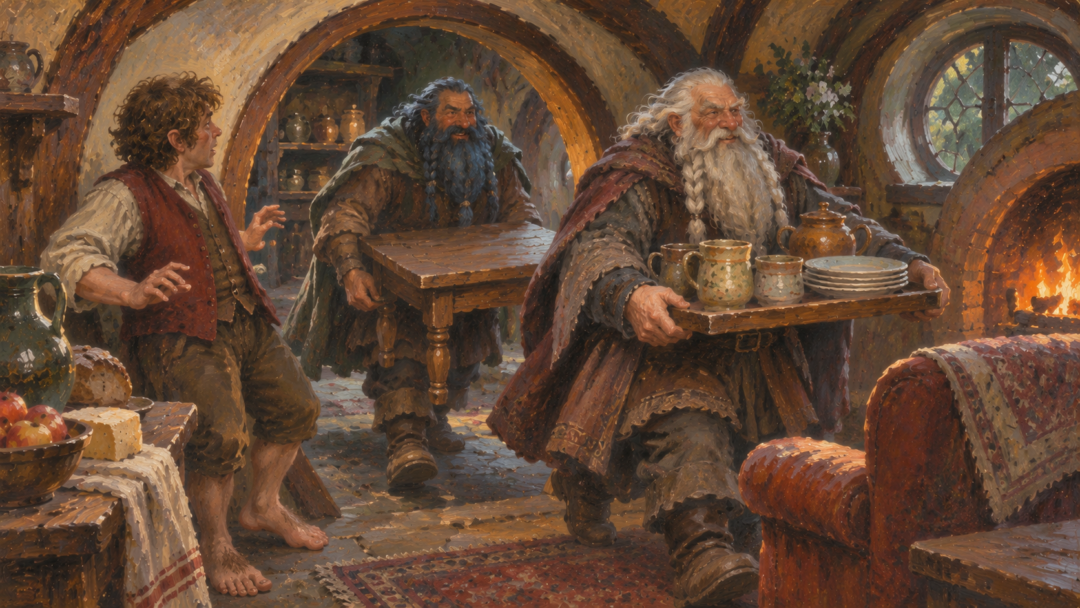
Dwalin arrives first, followed by Balin, then Fili and Kili, then five more Dwarves. Gandalf finally comes with Thorin and the remaining three. The staggered entrance is the joke: Bilbo must repeatedly revise how many people he is entertaining. He cannot prepare a company feast, since he has not agreed to host a company. The visitors may be organised, but Bilbo's hospitality is improvised.
Each new arrival also changes the demands on the household. What begins with tea gives way to beer, cakes and increasingly varied requests for food and drink. By the time the group is complete, requests include pies, cheese and salad. Balin has asked for beer and seed-cakes, the visitors move on to buttered scones, and Gandalf calls for eggs, cold chicken and pickles. Rather than ritual courses, these are individual appetites adding up, to the dismay of a host expecting one wizard for tea. Gandalf's participation matters too: not every request even comes from a Dwarf, so their shared culture alone cannot account for the whole spread.
Did they actually empty the larder?
Bilbo's worry about his seed-cakes is concrete. He had baked them for himself, and the guests finish them before he gets his share. By the time the final visitors knock, the seed-cakes are gone: that much depletion is explicit. The chapter also describes trips to the pantry and cellar, along with an escalating number of refreshments. His stores take a hit, and the humour depends on real inconvenience. From Bilbo's kitchen, the visitors certainly seem ravenous.
Yet a depleted cake supply is not a complete inventory of Bag End. The narrative never counts every loaf, jar or bottle, or reports empty shelves afterward. Bag End has multiple pantries; fetching a great deal of food does not establish that everything is gone. The familiar shorthand that the Dwarves emptied his larder describes the comic impression of the visit, not a documented condition of the household.
There is a further gap between eating heavily and trying to clear someone's stores. We hear specific requests and see Bilbo running to satisfy them. We do not hear the travellers instruct one another to use everything up, ration nothing for their host, or prepare the house for an absence. Their demands may be inconsiderate, but a purposeful pantry-clearing operation would need evidence of its own.
Bilbo's hospitality is part of the cause
The narrator supplies an unusually direct explanation for why Bilbo continues to serve. When he fears the cakes may run short, he thinks about what a host ought to do, even if meeting that duty means going without himself. This is Bilbo's sense of obligation. He resents his unexpected guests but cannot easily refuse food to people he is hosting. He even politely offers them supper, which Thorin accepts. His predicament explains the meal more directly than an inferred Dwarven code.
This works because food already defines the world Bilbo wants to preserve. Bag End is furnished for comfort, with room for coats, meals and respectable routines. The visitors disrupt its familiar rhythm. A private tea becomes an overflowing gathering. Bilbo, who expects to decide when and with whom he eats, is reduced to answering the bell and hurrying between rooms. Later he sits by the fire with a biscuit, his appetite gone while the visitors occupy the table.
Nor are all the guests' actions simply those of people waiting to be served. Some of the Dwarves help move furniture and set things out as the company settles in. Their confidence looks presumptuous to Bilbo, but also makes the gathering practical and bustling. The chapter shows appetite alongside useful activity. It does not divide the company into solemn celebrants obeying a pre-departure feast law.
The dishes tell a different story
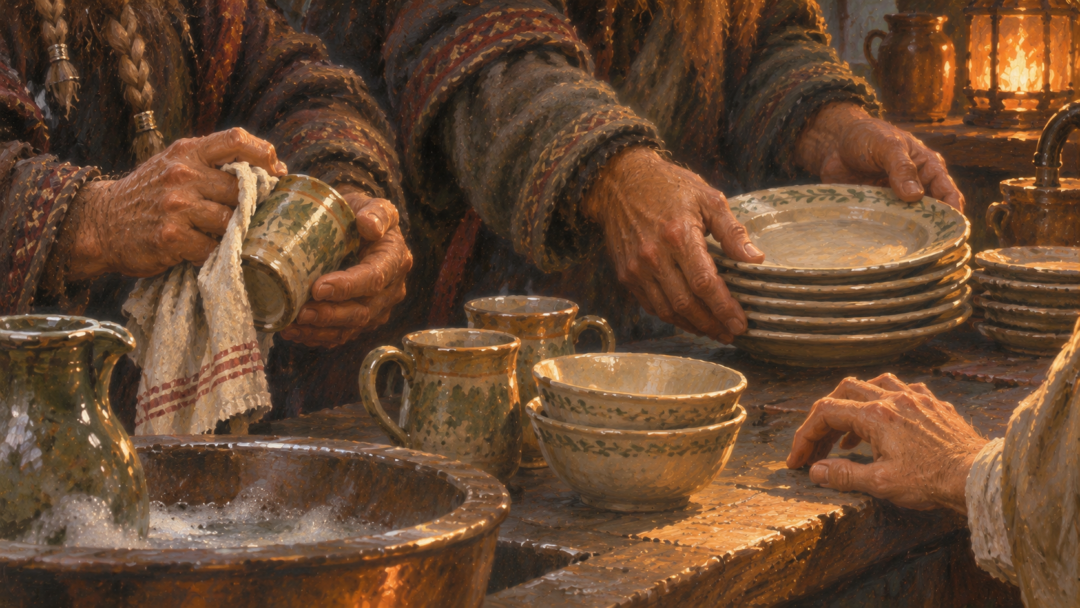
After the eating, twelve of the Dwarves undertake the washing-up while Thorin remains apart, talking to Gandalf. They sing a teasing song that makes Bilbo fear for his plates and glassware, but the narrator explicitly distinguishes that frightening performance from what happens. The crockery is washed and put away safely. Taking the threatened breakages literally would reverse the joke: Bilbo imagines catastrophe while his visitors competently finish the job.
Their efficiency is worth noticing because it complicates the picture of guests who only consume. They have made considerable demands on Bilbo, yet they also clear up after themselves. That shows practical helpfulness, not a charitable mission to remove perishables during Bilbo's travels. Washing plates restores order after a meal; consuming every provision would be quite different. Only the first action is narrated.
The evening is a meeting before it is a send-off
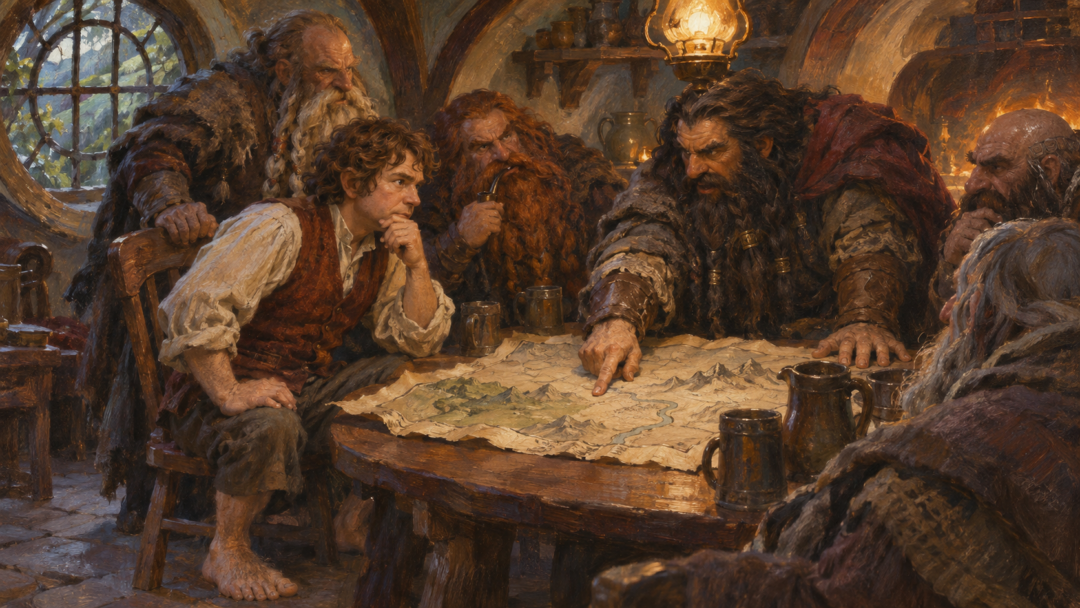
Once the bustle subsides, the gathering changes character. Music fills Bag End, and Bilbo hears something of the longing that drives the Dwarves. The company then turns to serious discussion. Thorin makes clear that they have gathered to consider their plans and the means of carrying them out. A map comes out as the focus turns to practical questions about the proposed journey and Bilbo's possible part in it. The evening has an explicit purpose beyond food.
Bilbo himself has not settled into the role of willing fellow traveller. He is stirred at moments by the Dwarves' music and challenged by their doubts about him, yet by bedtime his enthusiasm is fading. He makes sleeping arrangements for his guests while remaining far from comfortable with the prospect of leaving. The supposed pre-quest feast is happening in the home of someone still struggling to imagine joining the quest. He does not knowingly host a departure ceremony.
What would prove a Dwarven custom?
A cultural expectation is more than a memorable incident. To call this a Dwarven pre-quest tradition, we would want another explicit statement that such a feast is customary, or independent examples showing Dwarven companies consistently observing it as an obligation. To claim deliberate larder-emptying, we would need some sign that consuming Bilbo's remaining supplies was an aim rather than a consequence of the gathering. Neither follows from the number of plates on the table.
This is a bounded reading of the first chapter, supported by the scene itself and relevant lore summaries, not a claim to have exhaustively searched every writing set in Middle-earth. A wider text might offer comparisons, but they cannot be silently assumed into this scene. Hearty appetites and pre-journey preferences can coexist with uncertainty about any supposed custom.
In the end, Bag End's most revealing detail is not an empty shelf but Bilbo's anxious care for his cakes. Thorin has a breakfast preference, the guests make generous demands, and their host serves them despite his misgivings. A required Dwarven feast and a plan to exhaust the pantry remain additions to the story, awaiting evidence. For now, the adventure begins with a bell ringing at the wrong sort of tea party.
Sources & Notes
This article is based on close reading and interpretation of Tolkien's published works and related source material where relevant.