In the dark of Mirkwood, Bilbo Baggins follows a line of captured Dwarves toward the Elvenking’s underground halls. He is invisible, the great doors are closing, and Thorin’s company depends on a hobbit whom the Wood-elves have not noticed. Could Legolas have been somewhere behind those doors? Yes, reasonably so, particularly around the Woodland Realm ruled by his father, Thranduil. But the books do not establish that Legolas saw Bilbo, guarded the Dwarves, or participated in any particular incident. His connection to the place is real; his involvement remains a possibility. Peter Jackson’s films, meanwhile, give him an unmistakable role in these events. To understand the difference, we need to look first at the kingdom Bilbo entered, then at what the written story actually tells us.
A prince with a good reason to be nearby
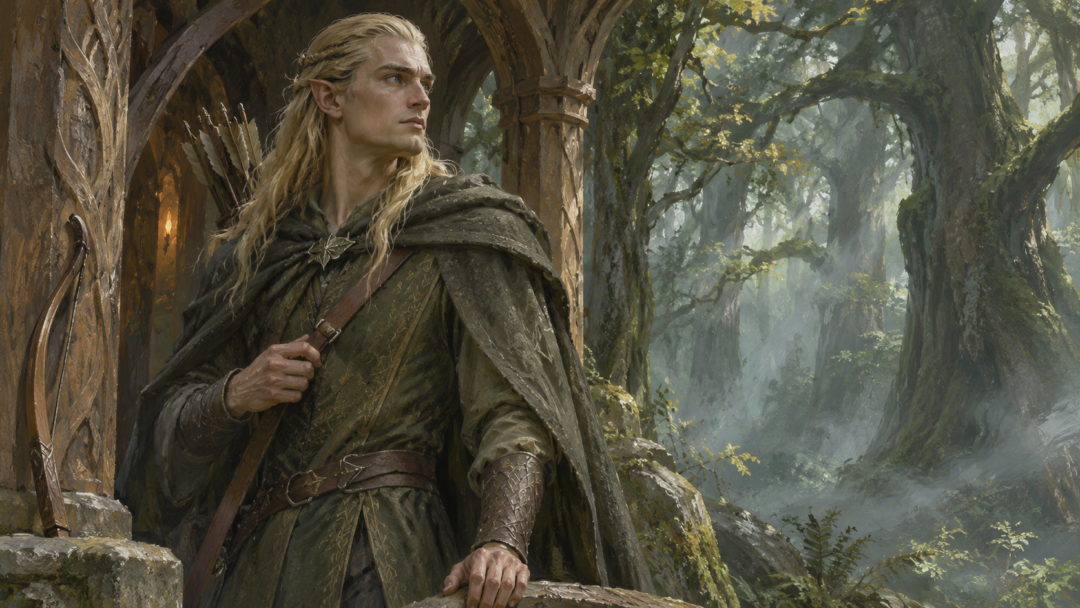
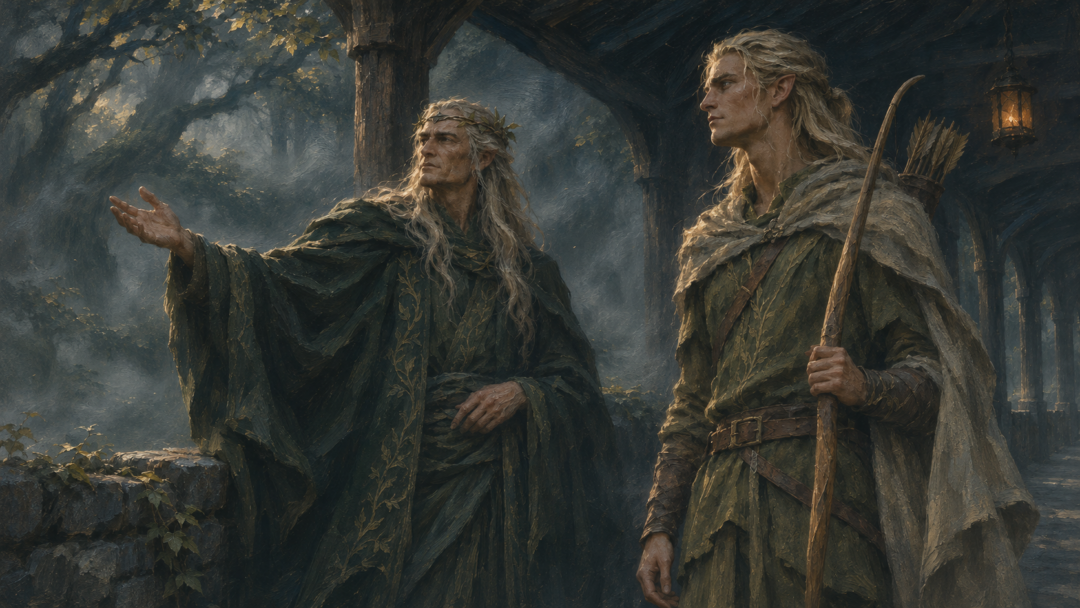
The strongest clue is neither his bow nor his future Fellowship membership. It is his family. Legolas is the son of Thranduil, ruler of the Wood-elves of northern Mirkwood. The king appears in The Hobbit as the Elvenking, although the novel does not name him Thranduil. That identification connects Bilbo’s host with the father of the Elf in The Lord of the Rings. It establishes a genuine family and geographical link without supplying an imagined encounter.
Thranduil’s realm is an inhabited, working place. His people feast, patrol, guard their halls, and trade by river beyond the woodland. A prince associated with this community might plausibly have spent time at its royal center. The Encyclopedia of Arda describes Legolas as presumably raised in the Elvenking’s Halls. That qualifier means plausible reconstruction, not a confirmed childhood address or proof he was home when the Dwarves arrived.
Nor does royal parentage provide an official job description. Nothing confirms that Legolas commanded the captors, supervised the prison, or joined any patrol. A king’s son could be close to the realm’s affairs without attending every arrest or feast. We can place Legolas in the world where the Dwarves were captured; placing him among their captors would be another step, unsupported by the text.
The Mirkwood adventure is the best test
The company’s route through the forest offers several opportunities for a near encounter. Hungry, the travelers approach lights among the trees, but the feasting Elves disappear. Spiders later capture most of the Dwarves, until Bilbo rescues them. Thorin, separated from his companions, falls into Elven hands; the others are eventually captured too. These events unfold in Thranduil’s domain, among mostly unnamed Wood-elves. It is reasonable to wonder whether a prince of their realm was nearby.
But Mirkwood is vast, and the scenes move between the forest path, feasting places, spider-haunted trees, and the guarded halls. The Elves in one place need not be those elsewhere. Even a palace resident might never inspect the prisoners or hear of their escape. The narrative tells us what particular groups of Wood-elves do, without identifying Legolas as one of them. His kingdom alone cannot locate him in a particular clearing.
Captivity brings Bilbo particularly close to the realm’s daily life. Wearing his ring, he slips into the halls, finds the cells, and learns the passages. He discovers the water-gate and the route by which empty barrels leave the cellars. Here a meeting seems most imaginable: Bilbo moves through Legolas’s presumed household. Yet invisibility complicates the picture. Bilbo could have observed an Elf without being seen himself, and the narrative never names Legolas among those he observes.
The escape also involves people whom the book does identify. Galion, the king’s butler, drinks with the chief guard; both fall asleep, letting Bilbo take the keys. He releases the Dwarves and conceals them in barrels headed downriver. Their roles leave no vacancy for a famous prince. The chief guard is not identified as Legolas, nor is there a reason to assume Legolas directed the imprisonment. Bilbo’s ingenuity and the guards’ carelessness are enough to explain the escape.
The Encyclopedia of Arda suggests that Bilbo and Legolas might well have crossed paths, while acknowledging that no such meeting is recorded. That captures the limit. Readers can imagine Legolas passing through a gallery, hearing news of troublesome Dwarves, or being elsewhere in the forest. Each fits the setting; none becomes a book event. We know Bilbo entered his father’s halls. We do not know which members of the royal household he passed.
Could he have marched to the Lonely Mountain?
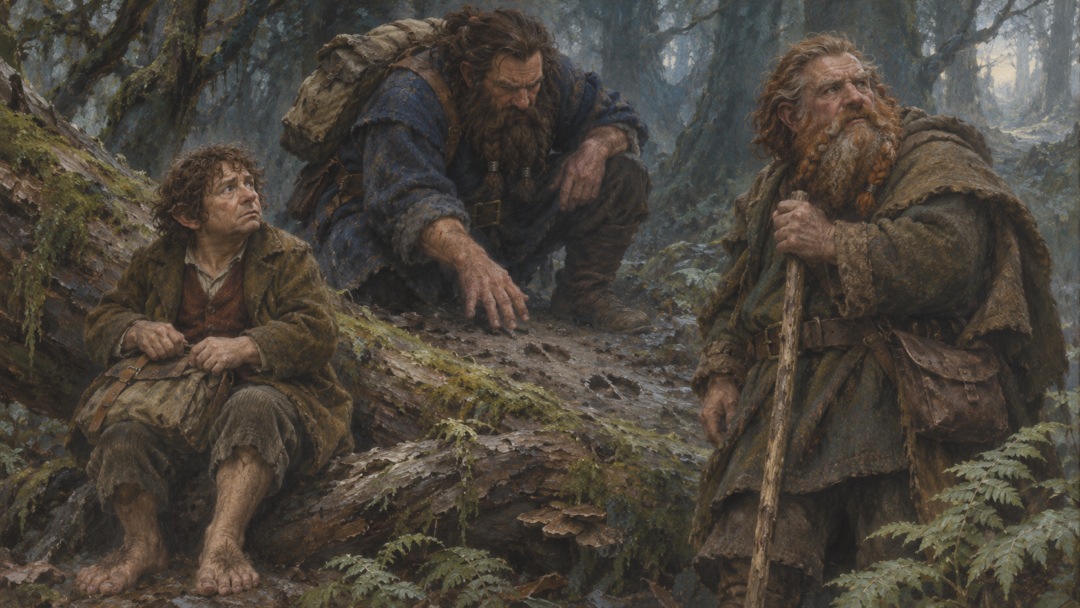
The possibilities continue after the barrels drift away. After Smaug dies, the Elvenking leads an armed host toward the Lonely Mountain. He helps the people devastated by the destruction of Lake-town and becomes involved in the confrontation that culminates in the Battle of Five Armies. Legolas might have marched with his father’s forces. Yet the novel describes the host collectively. It never establishes whether Legolas joined its journey, fought in the battle, or remained elsewhere in the Woodland Realm.
Unlike the halls, the Mountain requires an assumption about military service and travel. Legolas’s later reputation as an archer cannot answer it. The story records Elves fighting and Bilbo meeting their king again. It does not identify any of those warriors as Legolas. Being eligible to march with an army is not the same as appearing in its recorded history.
Why the book can leave a prince unseen
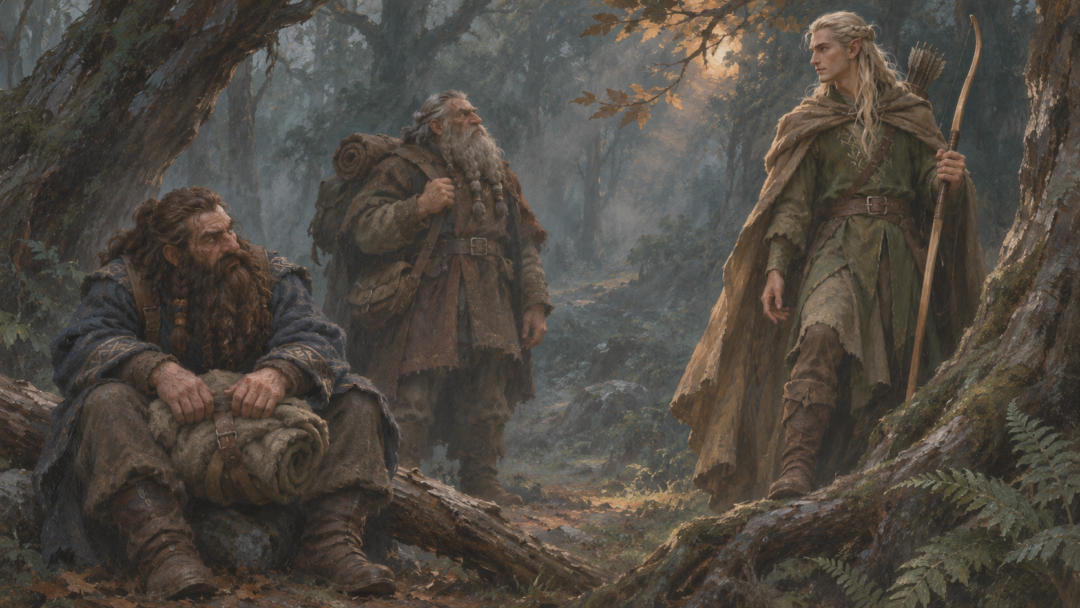
The Hobbit does not attempt a complete account of life in Thranduil’s kingdom. It follows Bilbo’s journey, ingenuity, and endangered companions. The forest chapters dwell on hunger, enchantment, captivity, and escape because those are the travelers’ troubles. The publisher’s teacher’s guide likewise describes the adventure through Bilbo’s actions, especially his rescue of the Dwarves. That focus might explain how a palace resident could remain unnamed without leaving a narrative hole.
Narrative focus, however, is not evidence of an off-page event. We cannot say the author deliberately kept Legolas out of the adventure, or that an unseen prince must have known what happened. The book simply offers no answer. Its silence cannot establish Legolas’s presence, but it does not establish that he was elsewhere, either. Confusing unmentioned possibilities with documented actions turns speculation into false lore.
The chronology provides another boundary. Legolas has no established birth date, a gap explicitly acknowledged by the Encyclopedia of Arda. His appearance in the War of the Ring cannot establish his age during Bilbo’s adventure. Nor should the long lives of Elves be treated as proof that he was already fulfilling particular duties. Without recorded movements, any Hobbit-era itinerary is reconstruction, not biography.
Peter Jackson’s films make the possibility visible
The films give a firmer answer, but only in their own version of the story. Orlando Bloom plays Legolas in The Hobbit: The Desolation of Smaug, among the Wood-elves capturing Thorin’s company. He appears alongside Thranduil and Tauriel in an expanded forest storyline and pursues dangers beyond the halls. The Battle of the Five Armies also involves him in the conflict around the Lonely Mountain. In these films, his participation is plainly shown.
Those sequences are not illustrations of events confirmed elsewhere in the novel. The adaptation gives Legolas encounters and relationships absent from the novel. Tauriel, a character created for the films, is central to that expansion. The screen story follows the Elves outside Bilbo’s immediate experience, including their pursuit of Orcs. The Woodland Realm becomes a continuing drama, not merely the Dwarves’ prison.
Jackson described Thranduil, Legolas, and Tauriel as separate perspectives on the Elven storyline. The production notes also confirm Bloom’s return and the filmmakers’ desire to connect the character with the wider cinematic Middle-earth. Fran Walsh’s remarks about The Hobbit as a fairy tale, alongside the team’s efforts to connect it with the graver tone of The Lord of the Rings, fit that approach. They explain his larger screen role, not a hidden book encounter.
The decision fits an established relationship: the Elvenking’s son appears in an adaptation featuring the Elvenking. No new kingdom has to be invented to accommodate him. The filmmakers must decide where he stands and what he does. His appearance can feel natural without making those battles and pursuits missing book chapters. Plausibility explains why the addition works. It does not make those actions book facts.
What his later journey actually establishes
When Legolas enters the recorded action of The Lord of the Rings, he travels to Rivendell as Thranduil’s messenger. At the Council of Elrond, he reports Gollum’s escape from the custody of the Wood-elves. This shows that he could later represent his father’s realm in important affairs. It shows his standing, not earlier service among Bilbo’s guards or the Elven host.
There is a quieter connection between the stories. Legolas becomes a close friend of Gimli, whose father, Glóin, was among the Dwarves imprisoned by the Elvenking and freed by Bilbo. Their friendship gives the earlier quarrel new resonance. Unlike an imagined glimpse of Legolas watching the barrels pass, that bond belongs to the written story. Families connect these adventures without any documented Bilbo–Legolas encounter.
Picture Thranduil’s lamplit halls: Legolas might be nearby as Bilbo hunts for the keys—or somewhere far away. Neither picture can be verified. The family and geographical connection is supported; a specific encounter remains unrecorded; the films plainly place him in the action. Legolas could reasonably have been present near some events of The Hobbit, but the book does not confirm that he was.
Sources & Notes
This article is based on close reading and interpretation of Tolkien's published works and related source material where relevant.