
At Bag End, Bilbo slips his gold ring and its fine chain into an envelope addressed to Frodo. It is a wonderfully ordinary detail for an object that will trouble all of Middle-earth. But it raises a surprisingly practical question: how did anyone get a solid gold ring onto a chain without cutting either one? The simplest possibility is an openable end or detachable fitting, threaded through the Ring and fastened afterward. The books never explain the actual hardware. They do, however, give us several clues about how the Ring was carried.

Bilbo's chain was already there
In “A Long-expected Party,” the chain appears alongside the Ring when Bilbo prepares to leave it behind. That places the arrangement firmly in the Shire, long before Frodo reaches Rivendell. The scene doesn't show Bilbo assembling anything. Nor does it establish whether he acquired the chain himself or received it from someone else. It tells us what he possessed, not how the two objects first came together.
That distinction matters because the necklace Frodo later wears is not the first mention of a chain. Bilbo's is described as fine, but nothing in this passage identifies a clasp, a link that opens, or a special device for securing the Ring. Even the familiar picture of a ring suspended neatly around someone's neck is ahead of the story at this point.

Frodo could take the Ring off
“The Shadow of the Past” provides the clearest practical evidence. When Gandalf asks to examine the Ring, Frodo takes it out of his pocket, where it is attached to a chain hanging from his belt. He unfastens the Ring before handing it over. That verb does important work: the attachment is something Frodo can release without damaging the Ring.
There is a second example at Tom Bombadil's house. Frodo draws the chain from his pocket and unfastens the Ring to give it to his host. Bombadil may be an extraordinary figure, but the act of detaching the Ring belongs to Frodo. Neither scene pauses to describe the fastening. Still, together they make an everyday, reversible connection a much better fit than a permanently sealed arrangement.

Rivendell brought a different chain
After Frodo's ordeal at the Ford and his recovery in Rivendell, “Many Meetings” reveals a change. While he slept, someone hung the Ring around his neck on a new chain, described as light but strong. The story doesn't show that person doing the work. Frodo simply discovers the new arrangement when he dresses.
This also marks a change in how he carries it: the earlier chain hung from his belt, with the Ring in his pocket; now the Ring rests on a neck-chain. We are not told why the replacement was made. A new chain might suggest a different way of carrying the burden, but it does not prove that the old one broke or that anyone needed extraordinary means to attach the replacement.
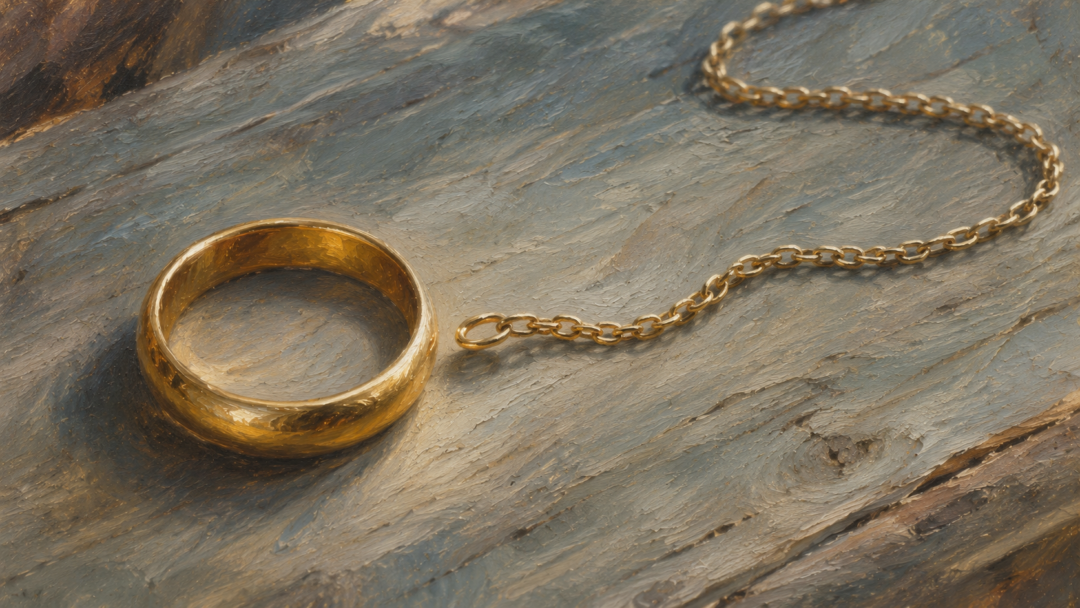
The simple answer is a possible fitting
Imagine the chain before its ends are joined, or with a small connecting piece that can open. Pass a sufficiently narrow part through the Ring's hole, then secure it. The gold band itself remains untouched. This is a demonstration of how such a thing could work, not a description supplied by the narrative. Frodo's ability to unfasten the Ring suggests a releasable connection, but not its exact construction.
The story follows hands receiving, surrendering, and carrying the Ring rather than the work of a jeweller. Its most revealing detail is not a forge or an enchantment, but Frodo quietly freeing the gold circle from his belt-chain to place it in another hand. A little piece of ordinary fastening is enough to make that moment possible.
Sources & Notes
This article is based on close reading and interpretation of Tolkien's published works and related source material where relevant.