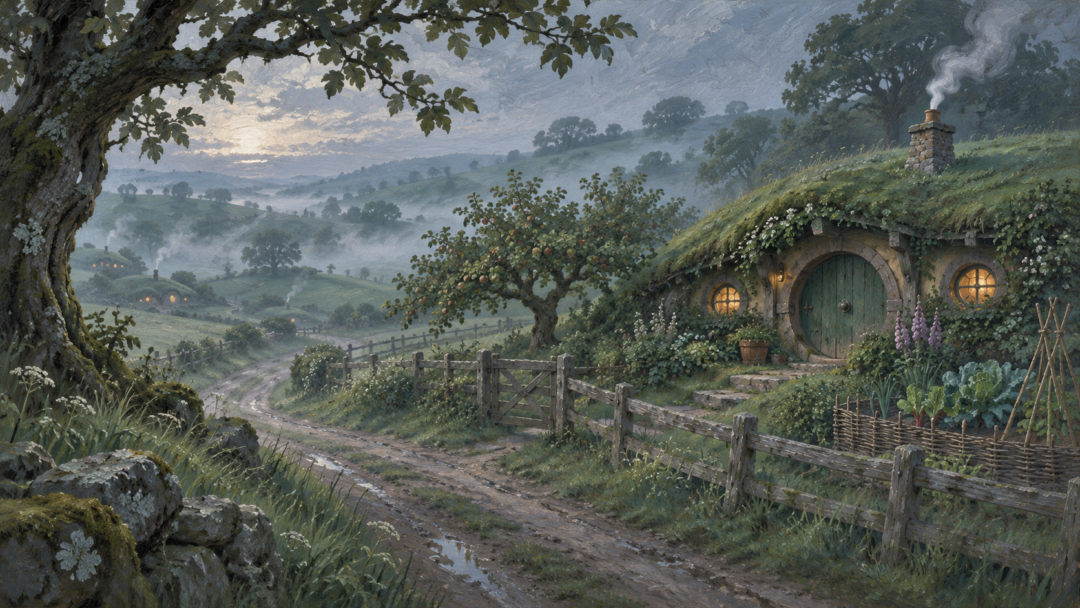
In the Shire, Bilbo’s ring looks at first like a remarkable souvenir: something found beneath the Misty Mountains, useful for vanishing when adventure turns dangerous. By the time Frodo leaves Bag End, that small object has drawn an ordinary hobbit road toward a much older history. The story changed in the writing, and the words above it changed too. Did its author give the developing tale a working title of his own?
Yes. The Magic Ring is reported as an early title, and dated letters show forms of The Lord of the Rings in use while the sequel remained unfinished. Tolkien also proposed names for the six internal books and the three publication volumes. Mixing those different sorts of names together creates an appealing but misleading list of supposed original titles.
An Early Name for a Story Still Finding Its Shape
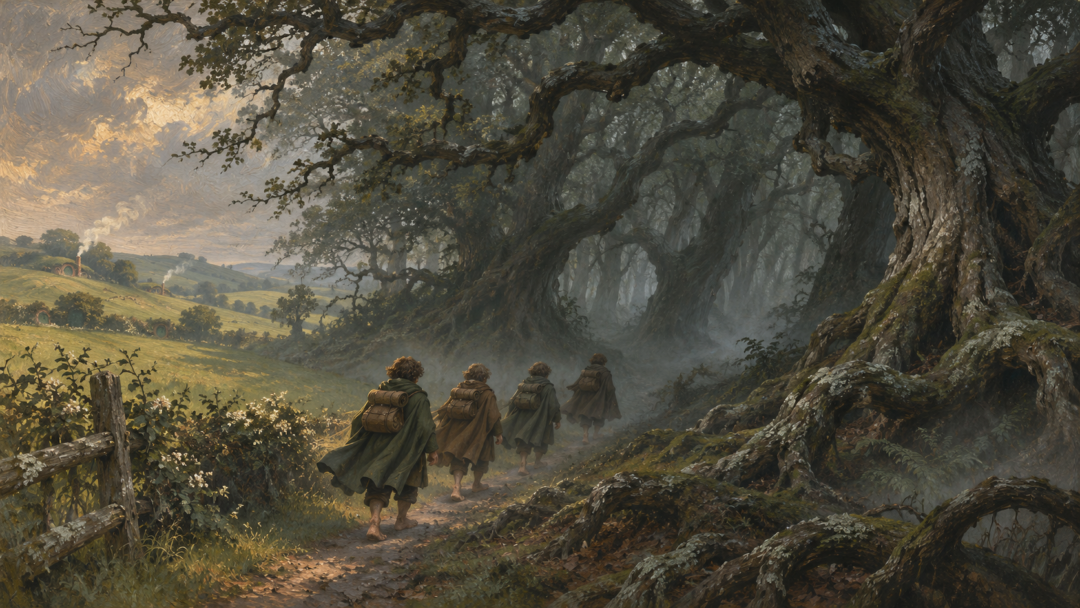
When The Hobbit appeared in 1937, Bilbo’s adventures seemed complete enough to end with his return home. A sequel began later that year, initially carrying forward birthday gatherings, hobbits and roads out of the Shire. Yet it did not remain a second treasure hunt. The ring became central to a larger story, and a name suitable for one stage of the writing was not necessarily the one that would survive another.
Tolkien Gateway’s overview reports The Magic Ring as an early title. That is a useful lead with an important limit: its reference to The History of The Hobbit currently lacks a completed page number. It does not securely date the title, locate its earliest appearance or establish how long it was used. The phrase should not be presented as a verified, long-standing official name that the author replaced on one particular day.
There is additional context from scholars Wayne G. Hammond and Christina Scull. In corrections to their J.R.R. Tolkien Companion and Guide, they describe a manuscript leaf at Marquette University on which The Magic Ring was crossed out and a tentative The Lord of the Rings written instead. Their account, pointing to Catherine McIlwaine’s Tolkien: Maker of Middle-earth, also records a note about Priscilla and Christopher Tolkien favoring the latter title. That is a glimpse of a working choice, not proof of the change’s precise date or circumstances.
Two Letters, One Important Difference
For chronology, the firmer foothold is a dated letter. Tolkien Gateway’s summary of Letter 33 identifies it as correspondence to C. A. Furth of Allen & Unwin on 31 August 1938. The author was discussing several pieces of writing, including the sequel to The Hobbit, which he had resumed. The summary records its name as The Lord of the Ring—singular—and explicitly notes that Ring had not yet become Rings in that letter.
That missing final s is easy to overlook because readers know the plural title so well. It is also the kind of detail a quick list of original names flattens. In August 1938 the Hobbit sequel had reached roughly Chapter VII, and the letter’s account shows the story growing beyond its first expectations. Yet the title visible in this dated record was not precisely the one printed on later book covers.
Letter 35, also addressed to C. A. Furth, supplies another clear marker. Dated 2 February 1939, it names the unfinished work The Lord of the Rings, plural. According to Tolkien Gateway’s summary, the manuscript had reached Chapter 12 and exceeded 300 pages. Ringwraiths had appeared, although much writing still lay ahead. The familiar name therefore existed well before the narrative, its final arrangement or the volumes that readers would eventually buy were complete.
These letters establish a sequence of dated uses: singular in August 1938, plural in February 1939. They do not prove that the plural was conceived on a particular day between them, especially when the manuscript leaf discussed by Hammond and Scull cannot be securely placed in that interval. A dated appearance proves a name was in use by then, not when someone first thought of it or whether other variants were circulating.
The Six Books Were Not Six Separate Novels
A second puzzle begins when readers encounter names such as The Ring Goes South or The Treason of Isengard. They sound like possible lost novels, and some have indeed appeared on book spines. But The Lord of the Rings is a continuous narrative divided into six internal books. Its original publication came in three volumes, each containing two of those books. A heading for Book II is not another name for the entire work.
The clearest distinction appears in Letter 136, dated 24 March 1953 and addressed to Rayner Unwin. As summarized by Tolkien Gateway, the letter concerns preparations for publication and includes suggestions for the six internal books: The Ring Sets Out, The Ring Goes South, The Treason of Isengard, The Ring Goes East, The War of the Ring, and The End of the Third Age. These headings identify stages and strands within a narrative already known by its overarching title.
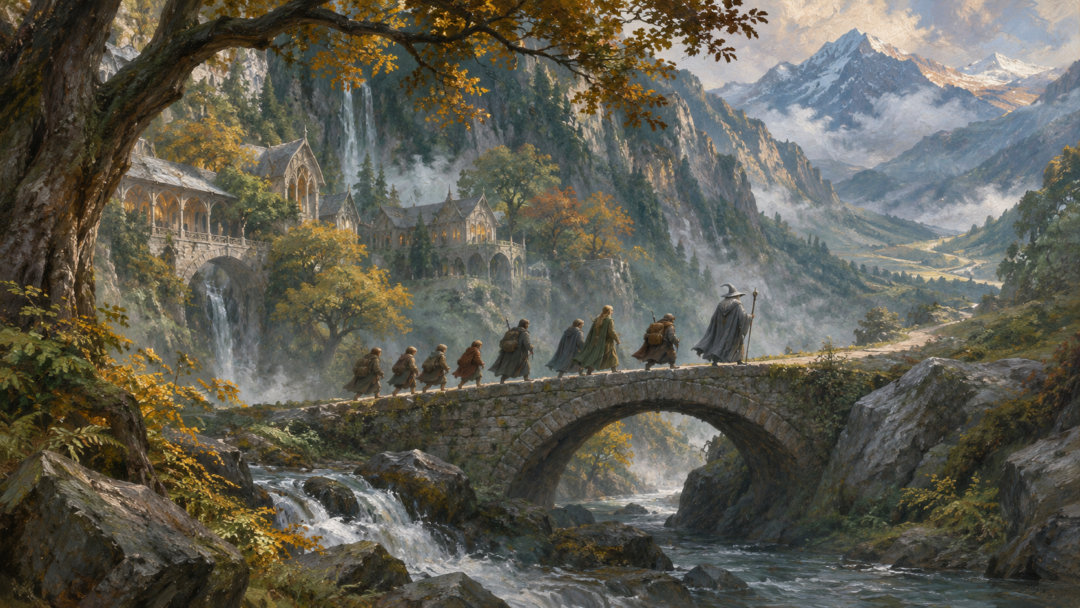
Consider The Ring Goes South. It fits Book II, where the Fellowship forms in Rivendell and leaves for the road toward Moria. The Treason of Isengard, proposed for Book III, draws attention to Saruman’s power and the western struggle after the Fellowship breaks. The Ring Goes East, for Book IV, follows Frodo and Sam instead. The names are signposts through interwoven journeys, not competing titles for all six books together.
The March letter also offers a second set, this time for the three publication volumes: The Shadow Grows for Volume I, The Ring in the Shadow for Volume II, and either The War of the Ring or The Return of the King for Volume III. Here the unit being named is larger: two internal books together. The repeated phrase The War of the Ring makes confusion understandable, but a list arranged by volume cannot be treated as a collection of discarded titles for the whole novel.
What The Return of the Shadow Really Named
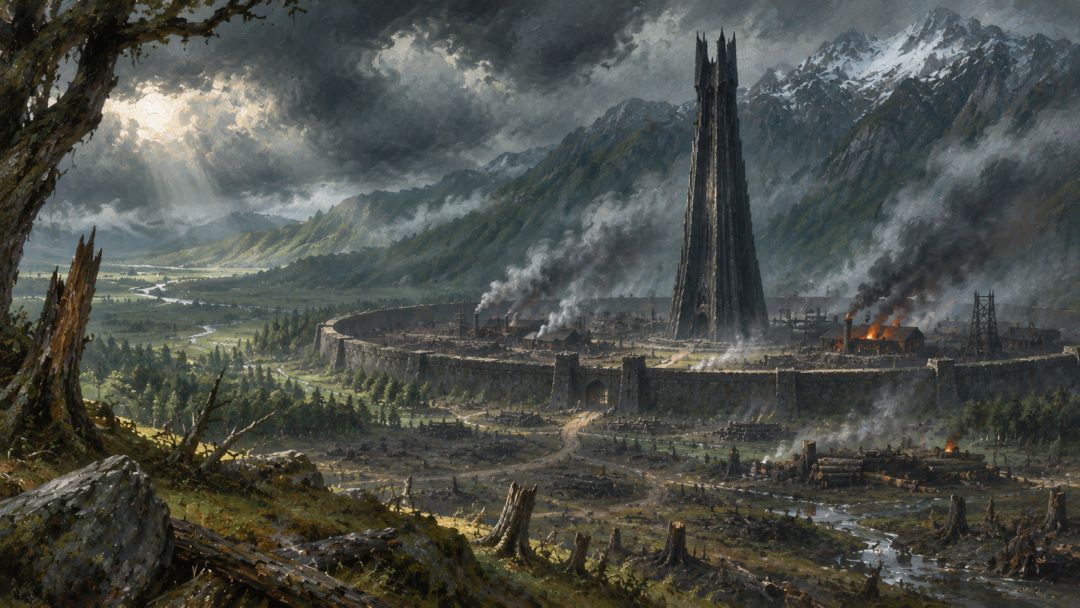
One of the most tempting claims about the novel’s original title centers on The Return of the Shadow. It sounds like a sweeping alternative to The Lord of the Rings, and it later became the title of a book about the early drafts. But the decisive 1953 reference identifies something narrower. In Letter 137, dated 11 April and addressed to Rayner Unwin, Tolkien calls Part I of The Lord of the Rings, comprising Books I and II, The Return of the Shadow.
The context is practical. The manuscript was being prepared for printing; those first two books had undergone extensive revision, and the author was discussing what could be sent to his publisher. The Return of the Shadow was the proposed name for the portion readers would eventually buy as The Fellowship of the Ring. It was not introduced as a replacement for the six-book narrative. Nor does this publishing discussion establish what the unfinished sequel was called when writing first began years earlier.
The three volumes eventually received the familiar names The Fellowship of the Ring, The Two Towers and The Return of the King. They were not three independent novels, even though each has its own dramatic shape. The first published volume ends when the Fellowship breaks, but the wider story plainly does not. The proposals of 1953 reflect a practical and literary challenge: how to give distinctive covers and names to sections of one long, connected tale.
Why the Discarded Titles Still Look Familiar
The abandoned names did not disappear. Decades later, Christopher Tolkien edited his father’s manuscripts into The History of Middle-earth, including four volumes concerned with the writing of The Lord of the Rings. The first study, published in 1988, was called The Return of the Shadow. It follows developing drafts from the Shire toward Moria, revealing earlier versions of characters and episodes familiar from the published story. Its name was borrowed from a discarded volume proposal, not from a separate finished novel.
The succeeding studies were The Treason of Isengard and The War of the Ring, with Sauron Defeated completing the sequence. The End of the Third Age, another proposed book heading, was subsequently used for a separately published selection from the latter work. These editions let readers explore the actual process of composition. But titles reused decades afterward are not evidence that a series of manuscript-history volumes had been planned when the Hobbit sequel was first being written.
There is a second reason those headings turn up on modern shelves. A seven-volume edition of The Lord of the Rings issued in 1999 gave separate volumes to its six internal books and to the appendices, using several names Tolkien had proposed. Such an arrangement makes the story’s divisions visible, but it can also make an editorial choice look like an original publication plan. Nor should the fictional Red Book of Westmarch, the hobbits’ imagined record of events, be confused with the real letters and working papers that document these titles.
The evidence has different strengths: The Magic Ring is an attributed early-title report whose overview reference is incomplete; the singular The Lord of the Ring appears in a dated 1938 letter summary; the plural appears in a 1939 summary; and distinct book and volume proposals are documented in 1953. None requires a neat ceremonial renaming. The little ring that once lay hidden beneath the mountains grew into a story whose name, like its road, took shape as the journey unfolded.
Sources & Notes
This article is based on close reading and interpretation of Tolkien's published works and related source material where relevant.