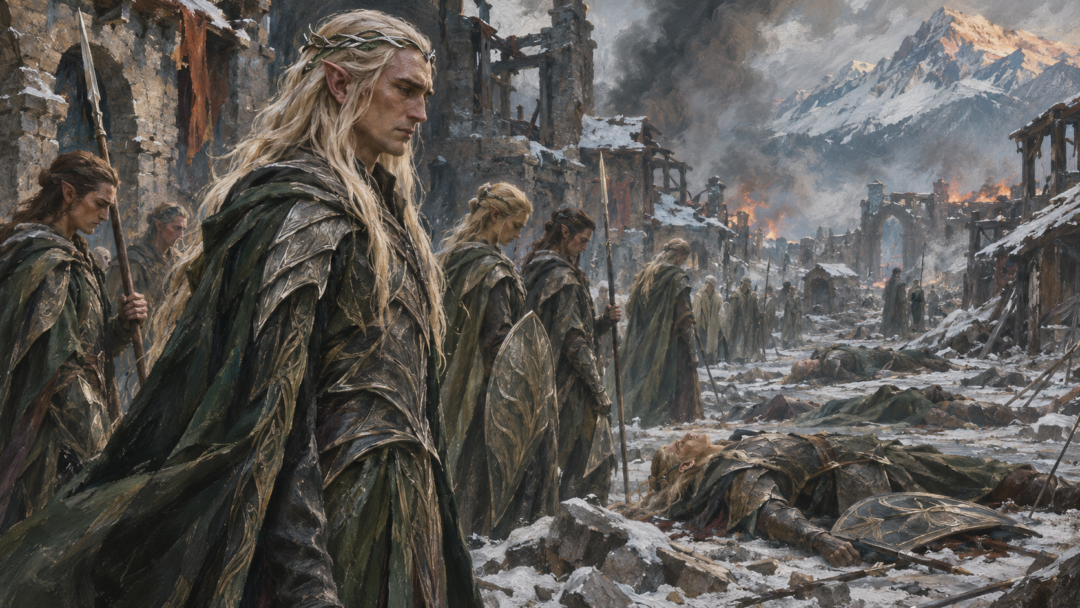
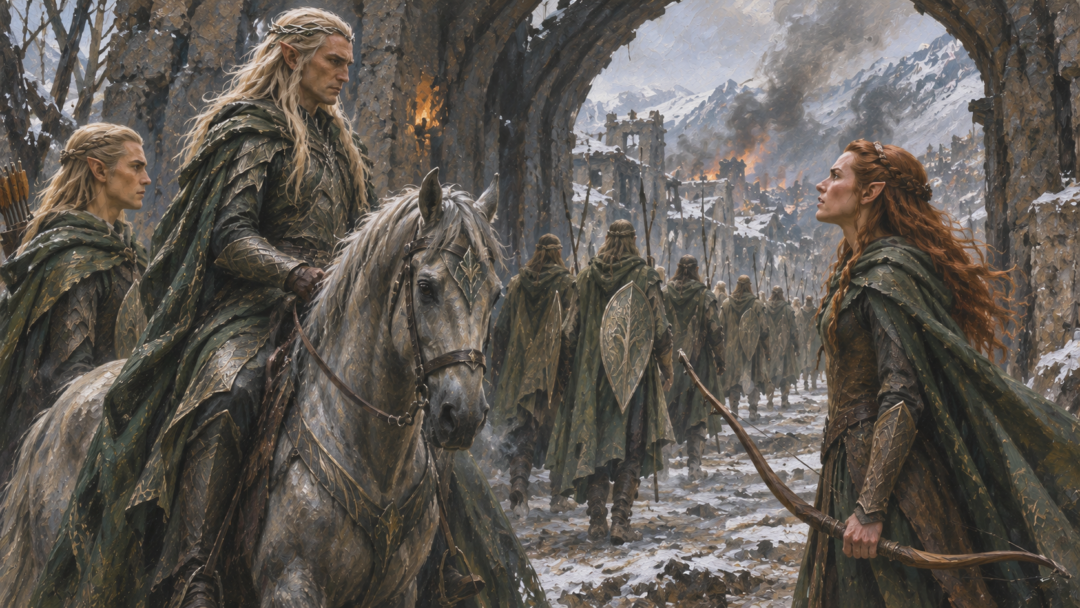
Gandalf needs soldiers at Ravenhill. A second Orc army is approaching from the north, Thorin and his companions are exposed, and the battle is far from won. But in the ruined streets of Dale, Thranduil has reached a different conclusion. He refuses Gandalf’s request: “I've spent enough Elvish blood in defense of this accursed land. No more!” Then Tauriel steps into the path of his withdrawing forces, unwilling to leave the Dwarves to their fate.
It is easy to read this as a rather late discovery that war kills Elves. Yet the dialogue never says Thranduil has only just learned that lesson. The more convincing interpretation is that seeing the losses makes him decide he will tolerate no more of them. That distinction explains his conduct, but it does not settle whether the film makes his reversal persuasive—or whether his decision is defensible.
The bodies change his orders, not his understanding of death
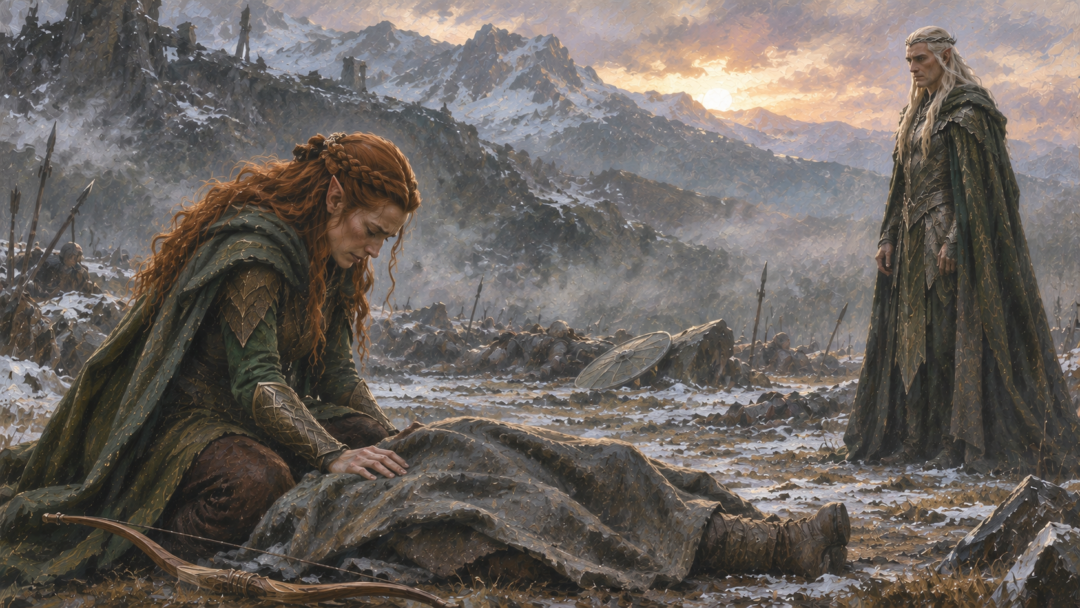
The battlefield gives Thranduil something that even a ruler accustomed to danger can find difficult to ignore: the visible price already paid by the people who followed him. His army arrived as an organized force, equipped to threaten Erebor and then fight the Orcs. By the time Gandalf asks for help at Ravenhill, Thranduil is dealing not with an imagined risk but with Elven casualties. The sight can be a turning point without being a revelation about how weapons work.
Thranduil has responsibilities Gandalf and Tauriel do not carry in the same way. His soldiers are his subjects, and further fighting could kill more of them. A king should consider that cost rather than treat every battle as an opportunity for heroic sacrifice. But protecting an army is not automatically the same as making the right decision. Withdrawal might preserve his surviving warriors while leaving allies to be overwhelmed and allowing the enemy to gain ground.
Gandalf, meanwhile, is not asking for a decorative display of solidarity. Legolas has reported a second enemy force moving against Ravenhill, where Thorin, Fíli, and Kíli are in danger. The requested help has an urgent purpose. The film does not give us a complete tactical calculation proving exactly what Thranduil's troops could accomplish there. It does show that his refusal leaves others facing a threat he understands. His duty is real; so is the price of drawing its boundary around his own people.
This is not the first time he has understood destruction
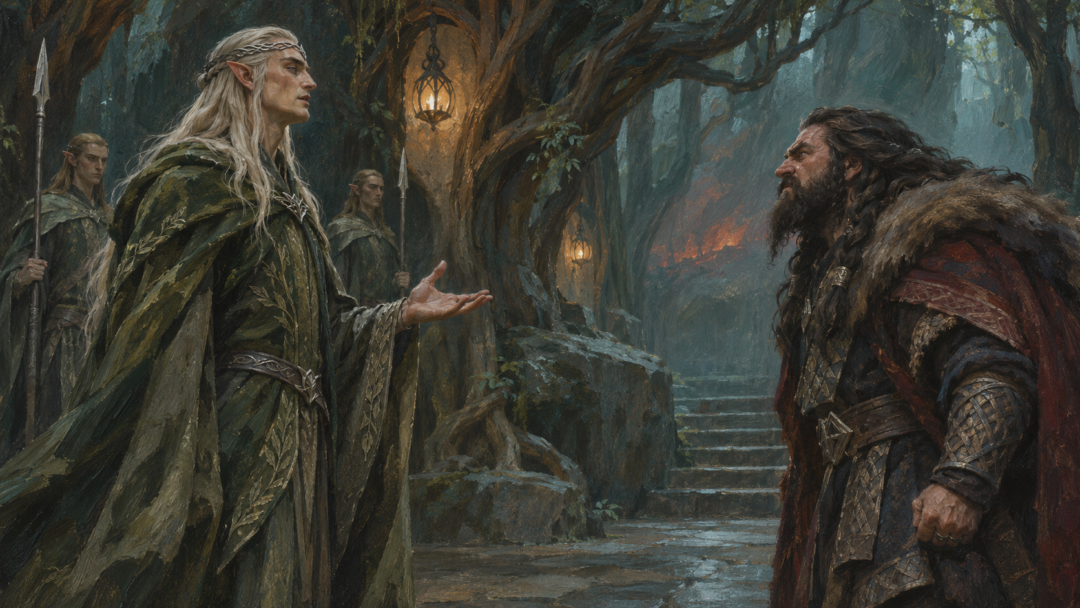
An earlier exchange in The Desolation of Smaug makes the literal reading especially hard to sustain. When Thorin accuses Thranduil of abandoning the Dwarves during Smaug's destruction of their home, the Elvenking responds by describing his knowledge of dragon fire's wrath and ruin. He claims to have faced the great serpents of the North. The film presents someone familiar with devastating violence, without establishing when those encounters occurred or exactly what caused his damaged appearance.
The scene is not just a piece of dramatic backstory. Thranduil is trying to defend himself against Thorin's accusation that he turned away from suffering. He replies by invoking danger he knows, then blames the Dwarven king's forebears for inviting disaster through greed. Long before Dale, he can explain why someone else's catastrophe should not become his responsibility. His certainty may be self-serving, but it is not innocence.
An Elf's immortality does not remove the stakes. Elves do not age as mortals do, but violence can kill them. A long life may change his sense of time and loss; it cannot stop an Orc blade. His reference to mortal lifespans judges whose lives he values, not whether Elves can fall.
Tauriel forces the question he would rather avoid
The confrontation with Tauriel is the moral center of the withdrawal. She stands against the retreat and insists that the Dwarves will be slaughtered if the Elves turn away. Thranduil does not deny that danger. Instead, he treats the Dwarves' eventual deaths as a reason their immediate deaths matter less. They are mortal, he argues in substance; whether they die today or far in the future, death will come. It is a chilling answer precisely because it acknowledges what is about to happen.
Tauriel challenges the premise behind that answer. She asks how he can prize his own life so highly when he appears to have shut love out of it. He responds by questioning her attachment to Kíli and whether she would die for it. The argument moves beyond tactics. Thranduil counts the Elven lives an intervention could cost; Tauriel asks what their safety is worth if it requires abandoning others.
Her challenge is not a tidy argument that a ruler must spend all his subjects' lives whenever someone else is threatened. Tauriel is willing to risk herself for Kíli, and personal devotion is not the same thing as authority to sacrifice an army. That tension makes the scene more interesting than a simple contest between cowardice and courage. She exposes the cruelty in his dismissal of mortals, but she does not answer every strategic question Gandalf's request raises.
His reasoning has a conspicuous weakness. The fact that Dwarves have shorter lifespans than Elves does not make the years ahead of them disposable. To say that someone will die eventually is no reason to abandon them to an avoidable death now. Elven longevity becomes an excuse for withholding concern. Tauriel cannot accept that excuse while Kíli is in danger.
Lee Pace's Thranduil is a ruler shaped by isolation
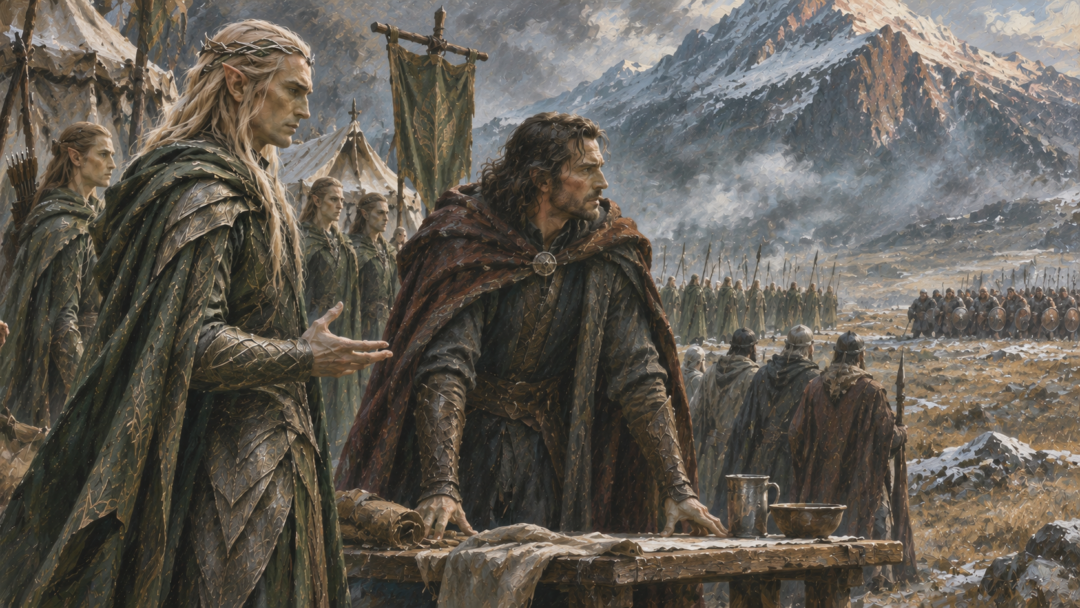
There is useful evidence for how the actor approached this tension. In an on-set interview published by TheOneRing.net on November 29, 2014, Lee Pace described Thranduil as a figure whose connection to nature and ancient stillness had become troubled by desire. “I believe that grief has corrupted him, greed has corrupted him, wanting things, hunger has corrupted him.” This was his performance interpretation, not a diagnosis or a director's explanation of the finished cut.
Pace also discussed patience and isolation. He imagined the Woodland Realm as a place so old and quiet that its ruler could feel detached from the urgency of shorter lives. That approach helps make sense of a king who can wait out other people's plans and who prefers his own borders to the uncertainty of an alliance. He is not portrayed simply as someone who loves battle until it turns unpleasant. His composure can be a form of distance, and his distance can become a moral failing.
The film complicates that composure before the withdrawal. Thranduil comes to Dale after Smaug's fall, and he supplies aid to the displaced people there. Yet he also makes clear that he has come to recover precious gems from Erebor, not merely to help the survivors. When negotiations with Thorin fail, he is prepared to use force. That mixture of generosity, possession, and pride fits Pace's reading better than the idea of a purely peace-loving king.
But an actor's account of a character is not a substitute for what reaches the screen. Pace's reflections tell us what he was trying to play; they cannot establish that every audience member will see the same progression, or that the final sequence expresses it with ideal clarity. The strongest criticism of the casualty moment is not that Thranduil ought to know Elves can die. It is that the film may ask viewers to accept a major policy change faster than it has prepared them to accept it.
There is a difference, too, between an image that conveys devastation and a scene that lets us follow a decision. Seeing fallen Elves can tell us that the campaign has become costly. To believe Thranduil's withdrawal, we may also need to feel how his concern for those survivors has overcome his other aims, including his hostility to the Orcs and his willingness to confront the Dwarves. Pace's restraint may persuade some viewers; others may find the turn abrupt. Neither reaction depends on mistaking it for a discovery of death.
The book offers a different kind of restraint
The Elvenking in The Hobbit provides a useful, smaller contrast. In Chapter 17, “The Clouds Burst,” Bard wants to attack the arriving Dwarves, but the Elvenking hesitates to begin a war over gold and hopes for reconciliation. Once the goblins and wolves descend, the opposing peoples join forces against a common enemy. This is restraint over treasure before battle, not withdrawal after casualties. The film, by contrast, has Thranduil threaten war over gems before he refuses further losses against a common enemy.
The film does give Thranduil one last encounter with what Tauriel has been trying to tell him. After Kíli's death, she is devastated by the pain of loving someone she has lost. Thranduil acknowledges that her love was real. It complicates his earlier dismissal without proving he has never loved or has suddenly overcome his isolation. He can recognize her grief without undoing the choice he made when the Dwarves were still alive and in danger.
That is the hard edge of the Ravenhill dispute. Thranduil knows a battlefield can take his people from him. What he must decide is whether preventing more of those losses justifies turning away from lives outside his kingdom. And what the film must make us believe is how he arrives at that decision. The fallen Elves explain why he stops; Tauriel makes us look at those he is prepared to leave behind.
Sources & Notes
This article is based on close reading and interpretation of Tolkien's published works and related source material where relevant.