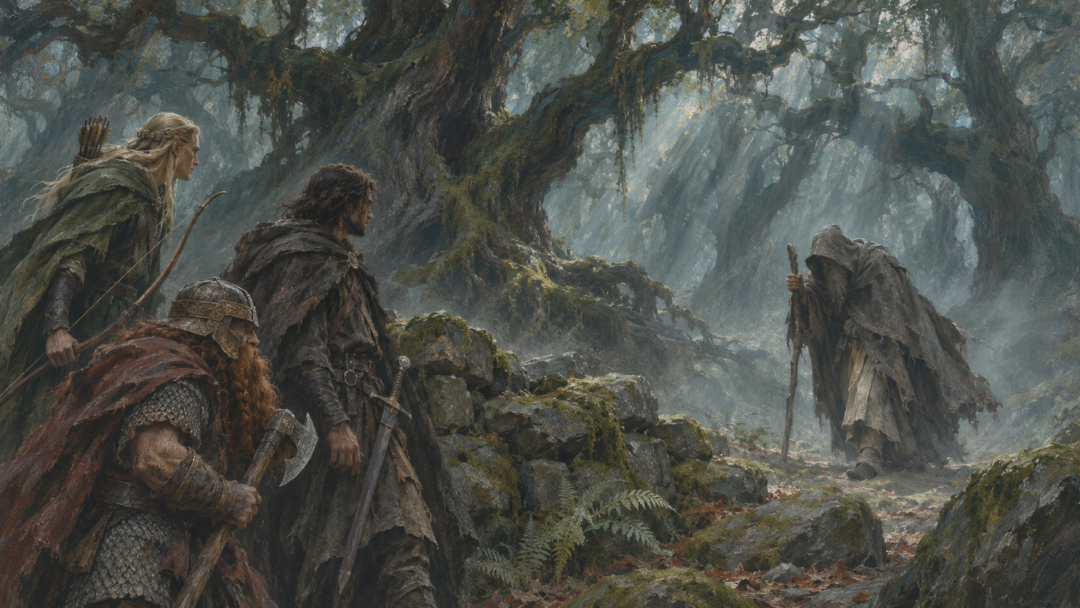
A small fire burns beneath the trees at the edge of Fangorn, and a bent old man appears where the firelight runs out. Aragorn, Legolas, and Gimli have already lost two friends, chased Orcs across Rohan, and reached a watchful forest. Yet a silent old stranger who vanishes as the horses disappear presents a disturbing puzzle.
Saruman is an immediately plausible guess, especially to Gimli. But the question of who the old man is has two stages, and the answer changes between them. The later figure encountered in the woods is Gandalf, returned in white. His return brings relief tinged with awe. These are the clues and the companions’ reactions, not a survey of readers: some may guess Gandalf early, others Saruman, and others remain unsure.
First, the old man beside the night fire
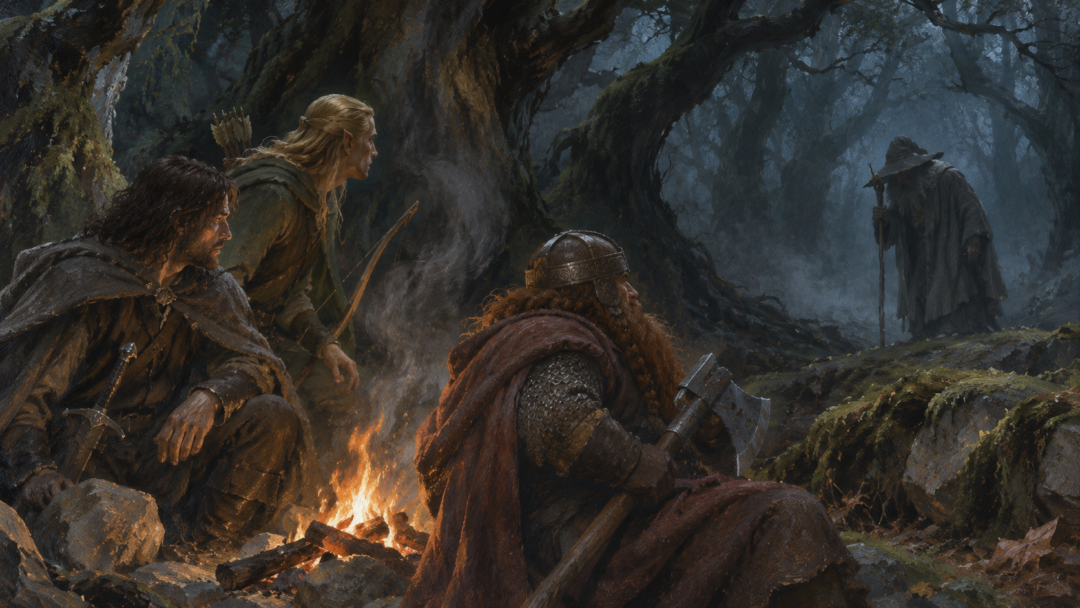
The nighttime visitor appears at the end of The Riders of Rohan. The three hunters have found the burned remains of the Orcs’ defeat, but not Merry and Pippin. Éomer’s borrowed horses, Hasufel and Arod, will carry them back across Rohan. Éomer has also warned them that Saruman can go abroad in the guise of an old, cloaked man, so even a silhouette can be suspicious. Their rest beneath Fangorn is soon disturbed. Gimli sees a stooped figure, cloaked and hatted, with a staff at the edge of the light.
The figure neither introduces himself nor explains his presence. Before the travellers can question him, he vanishes from their sight, and the horses have gone as well. Gimli’s conclusion is understandable: Saruman has been described as a dangerous wizard who can move about looking like an old man, and his Orcs have been active nearby. The timing makes an innocent explanation harder to accept.
But the next morning, at the beginning of The White Rider, the companions do not agree about what happened. Gimli remains convinced that Saruman is responsible. Aragorn recalls that the horses did not sound terrified, and Legolas thinks their voices suggested the excitement of meeting a familiar friend. It separates the visitor’s identity from the horses’ disappearance. Later Gandalf explicitly says he was not that night’s visitor and guesses it was Saruman. The horses, meanwhile, turn out to have met Shadowfax. Their joy explains a sound mistaken for panic, but gives no reason to call the visitor Gandalf. The next encounter is separate.
Why Saruman seems to be waiting among the trees
By the time the hunters enter Fangorn, Saruman is no distant name. His servants have carried off the hobbits; the riders of Rohan have fought his Orcs; and the travellers know that the wizard’s influence reaches beyond Isengard. They seem to have reached the meeting point of his plans and the hobbits’ fate. If Saruman himself appears, the hunters could lose their last chance to learn where their friends have gone. When a second bent old man comes into view, Gimli has every reason to fear that the enemy has stepped directly into their path.
The setting makes that suspicion more powerful. Legolas feels the age and strange wakefulness of Fangorn, while Gimli is uneasy beneath its branches. They are not moving through an ordinary roadside grove where a chance meeting would require little explanation. The woods seem full of memory and anger. Legolas does not judge Fangorn itself to be evil, which makes the distinction between danger and wickedness especially significant here. A frail-looking traveller with concealed power is doubly unsettling.
Legolas is first to notice movement between the trees. Aragorn sees someone bent over a rough staff, dressed like a weary beggar. Under different circumstances the hunters might greet such a person kindly. Here they hesitate, sensing power or danger that the rags do not account for. The old man’s head is bowed, his face obscured, and his approach is slow. Nothing proves he is a wizard; Gimli nonetheless sees a threat he thinks he recognizes.
There is also an old clue concerning Saruman’s clothes. At the Council of Elrond, Gandalf described Saruman’s apparently white robes as revealing shifting colours, part of the wizard’s self-important transformation. White was no reliable sign of virtue or identity. A glimpse of white beneath grey layers can naturally deepen suspicion here, but it cannot settle the matter. Appearances can mislead.
A confrontation built from hesitation
Gimli wants Legolas to shoot before the stranger can speak. Aragorn refuses. However ominous their surroundings, an unchallenged old man is not someone they may simply attack. Legolas raises his bow only with difficulty and does not set the arrow to its string. Fear is not proof of guilt. His restraint prevents a disastrous mistake. The choice is more than good manners: their fear of Saruman must not make them treat every unknown person as an enemy.
The stranger makes the situation stranger still. He comes to the foot of the rock wall and climbs with a sudden agility that does not match his bent, weary walk. He orders Legolas to put aside the bow, and the weapon falls from the Elf’s hands. Gimli, too, finds himself checked. His face remains largely hidden by hood and hat, but Aragorn catches a brightness beneath them. Each small action alters the possibilities. The power could belong to friend or enemy. The stranger’s command of the situation, without any visible anxiety about facing armed travellers, makes his apparent vulnerability increasingly difficult to believe.
Then his manner begins to compete with his disguise. He speaks of the hunters’ search, knows that two hobbits have passed into the forest, and treats their desperate questions with an almost teasing familiarity. His laughter stirs Aragorn with a sharp, waking thrill. He hints that they have heard his name before, but withholds it. To someone hoping for Gandalf, these are clues; to someone expecting Saruman, they resemble manipulation.
When the stranger turns aside to sit, the spell-like constraint on the hunters relaxes. Their hands return to their weapons. His grey covering parts, showing white clothing beneath, and Gimli’s worst suspicion bursts out. He lunges with his axe, demanding to know where the hobbits have been hidden. It is a mistake made before recognition, when Gimli believes the white clothing confirms Saruman.
The name that changes the clearing
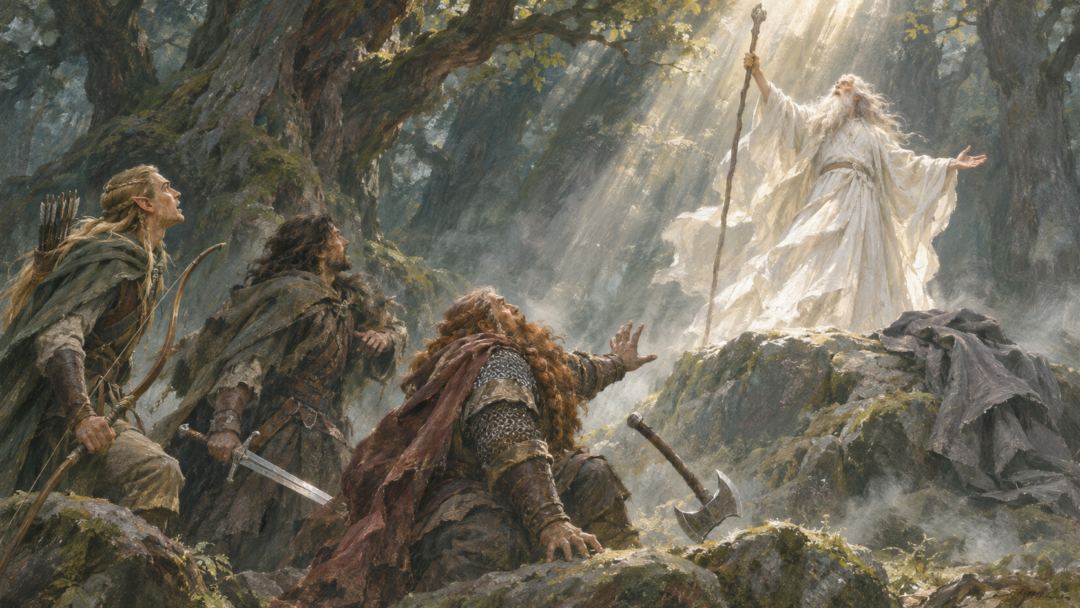
The old man is quicker than Gimli. He leaps onto a rock, casts off the hood and ragged covering, and stands revealed in shining white. His staff rises; Gimli’s axe flies from his hand, Aragorn’s sword catches fire, and Legolas sends an arrow upward, where it vanishes in flame. The transformation exposes power against which their weapons are useless.
Recognition arrives in an exact order, and the order makes the moment sing. Legolas cries out first, using the Elvish name Mithrandir. The figure answers him as someone already acquainted with him. Only then does Aragorn name Gandalf and respond to his return beyond hope. Gimli sinks to his knees, shielding his eyes. The narrator combines wonder, joy, and fear rather than offering uncomplicated celebration.
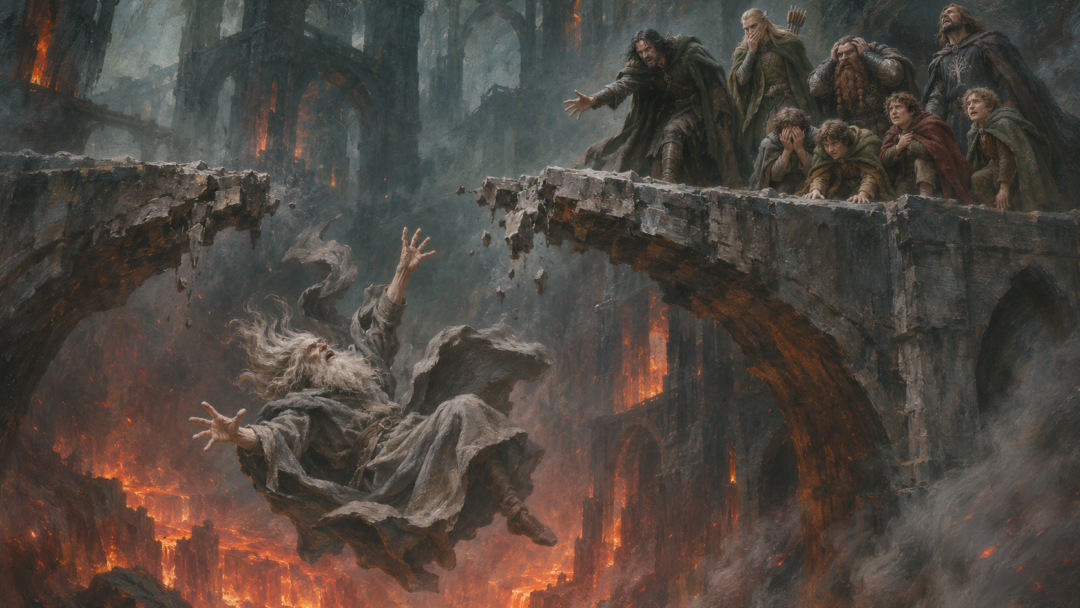
Why fear, when the stranger is a beloved friend? Consider what the three last saw of him. On the Bridge of Khazad-dûm, Gandalf fell into darkness with the Balrog. The remaining Fellowship escaped Moria believing they had lost their guide, and that grief followed them through Lothlórien and beyond. Aragorn had to lead after Gandalf’s disappearance; Legolas and Gimli had to continue without him. The figure now standing above them contradicts what their eyes witnessed and what they have painfully learned to accept.
Their suspicion is hardly stupidity. Saruman is an actual danger, the old man has restrained their movements, and the friend they knew should not be standing alive in Fangorn. The recognition is therefore more than finding the correct answer to a riddle. It asks them to trust an impossible piece of good news while looking at someone who is familiar but unmistakably altered. The light itself inspires awe.
The grey cloak and the friend within it
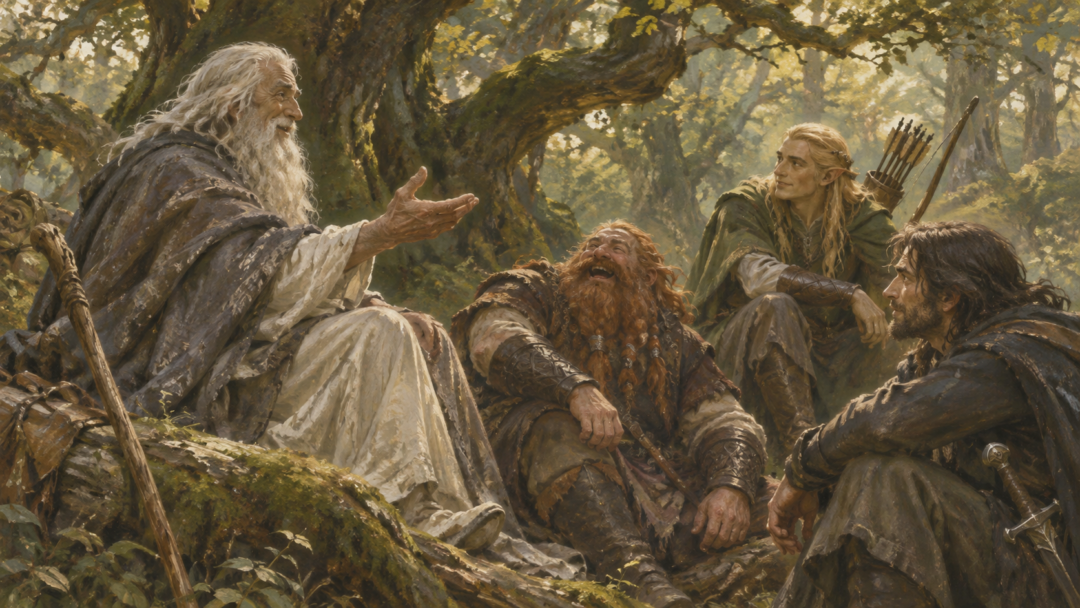
One of the scene’s most moving details comes after the brilliant unveiling. When Aragorn names him, Gandalf seems to recover the familiar name as if it belonged to a distant chapter of his existence. This is no mere change of clothes. His return has placed some distance between his previous life and the being now before them. Yet he steps down from the rock, takes up the old grey cloak, and wraps it around his white clothes.
With that gesture, the dazzling figure becomes approachable again. The light is veiled, and the companions hear the voice of their old guide. Gandalf comforts Gimli rather than reproaching him, and the Dwarf finally looks up and laughs at the astonishing sight of his friend dressed in white. The laughter matters because it comes after fear, restraint, and kneeling. It is the release of someone who can at last recognize the person beneath the bewildering change.
There is a useful distinction between being restored and being unchanged. In the accessible summary of Letter 156, Tolkien’s wording describes Gandalf as having truly died and been changed. That supports what the chapter itself makes plain without requiring a complicated account of how his return occurred. He can remember his companions, care about their worries, and still be different from the Grey Wanderer who fell in Moria. His strength has come at a cost. Gandalf also describes himself in relation to Saruman as the wizard Saruman ought to have been, turning the mistaken identification into a contrast between fulfilled and betrayed responsibility.
His first real concern is not to make them admire that strength. He asks for their news and gives them news of the hobbits. Merry and Pippin have encountered Treebeard, and their arrival has helped stir a force Saruman has badly underestimated. Gandalf acknowledges limits to his knowledge. When he hears that Sam accompanied Frodo, the news genuinely pleases him; even a returned wizard can still be cheered by a friend’s loyalty. Aragorn even recognizes the familiar habit of speaking in riddles. The warmth, impatience, humour, and concern are recognizably Gandalf, even after an extraordinary return.
By the time the companions leave Fangorn, there is work to do in Rohan and no promise of an easy victory. The return has not made the dangers imaginary. It has restored a guide at the very moment the hunters believed their pursuit had failed. The lasting image is not only the white robe shining from a rock, but the quieter movement afterward: the old grey cloak drawn around it, and Gimli able to laugh again beneath the trees.
Sources & Notes
This article is based on close reading and interpretation of Tolkien's published works and related source material where relevant.