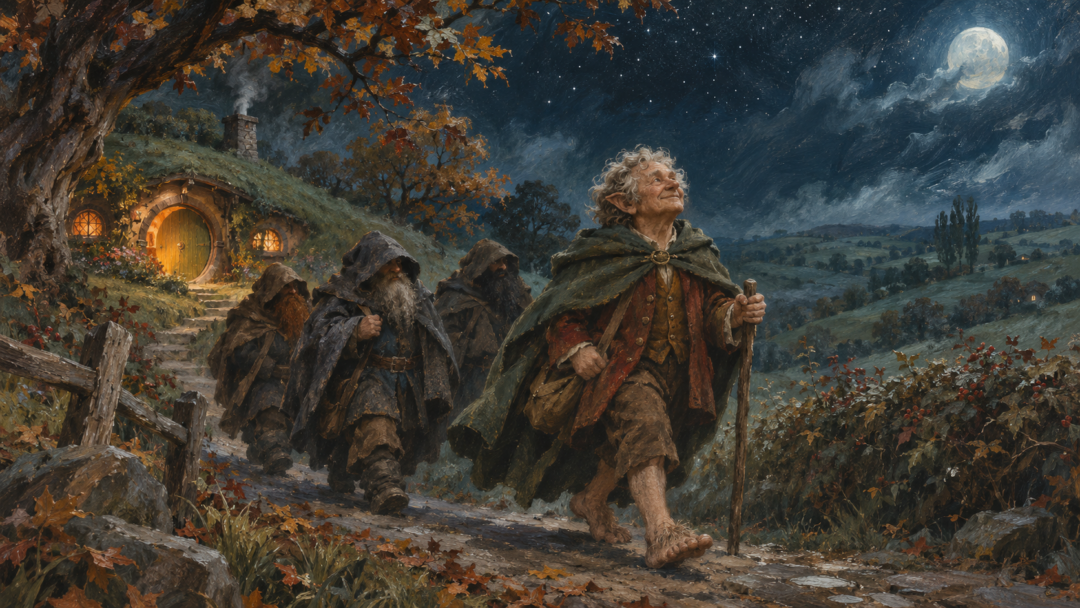
On the night of his eleventy-first birthday, Bilbo Baggins leaves the bright tents of his party behind, takes his walking stick, and steps into the starlight. Three Dwarves follow him away from Bag End. The scene is wonderfully familiar: the old adventurer is setting out again, with companions from the people who once helped draw him into the wider world.
But who are those three, and how long do they stay beside him? In the published Fellowship of the Ring, their names are never given, and the length of their journey together is never stated. Nar, Anar, and Hannar are names preserved in accounts of an earlier draft, not an identification supplied by the finished novel. What the story does give us is a small, revealing trail of details, from farewell presents in Hobbiton to Bilbo’s later account of reaching Rivendell.
The Dwarves were already at work before Bilbo left
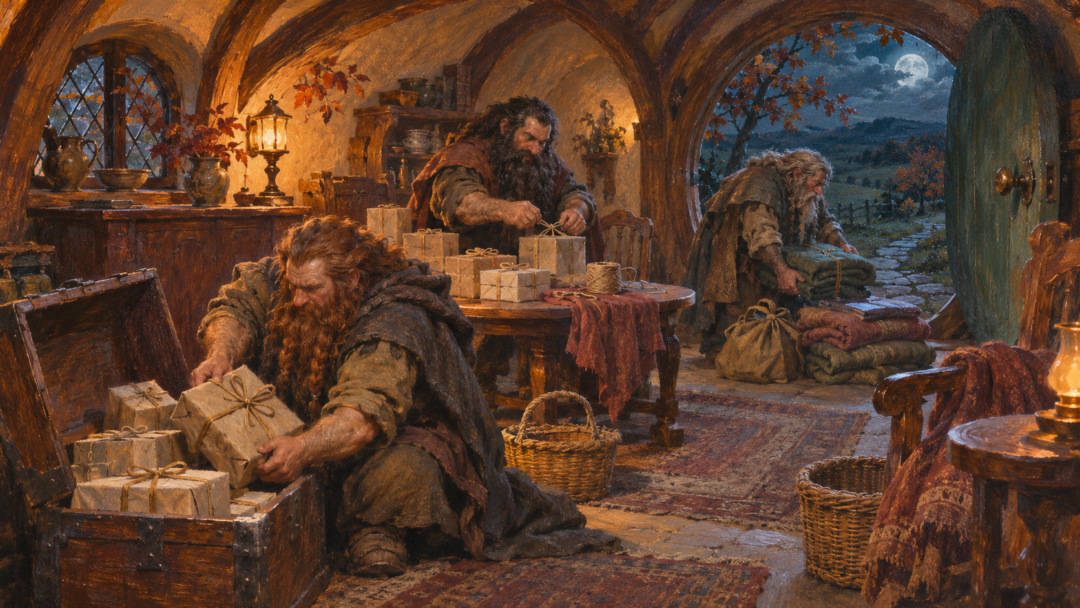
The companions do not simply appear out of the night when Bilbo announces his departure. His extraordinary birthday party has been taking shape for some time, and goods from far beyond the Shire are part of the preparations. Presents have been ordered from the Lonely Mountain and Dale, places tied to Bilbo’s earlier adventures. In September, Dwarves arrive with a wagon of unusual packages, drawing the attention of the local hobbits.
The presents are more than decoration. Bilbo intends to give away much of what has accumulated in his home, leaving Frodo with Bag End and an elaborate assortment of gifts for friends, relations, and neighbours. When he slips back indoors after vanishing from his party, the house is still busy. Dwarves are in different rooms attending to the practical work of packing and labelling. The neat domestic business matters because the departure is already being prepared while the guests are still enjoying themselves outside.
We should not assume that every Dwarf who brought a package earlier in September was one of the eventual travellers. The arrival of suppliers and the departure of companions are separate moments in the narrative. Nor does the connection to Erebor reveal the three travellers’ homes or careers. The book shows Dwarves trusted with Bilbo’s preparations; it does not provide personal histories for the men who will walk out with him.
The three who actually walked out of Bag End
Bilbo’s departure comes after an uncomfortable farewell to Gandalf. The wizard presses him to leave the Ring for Frodo, and Bilbo finally parts with it, along with the arrangements concerning his estate. Only then does the scene turn back toward the waiting journey. Bilbo takes up his stick and summons the Dwarves, who emerge from separate rooms where they have been working. There are three of them. That is the clearest count in the finished narrative.
Bilbo checks that the packing and labelling are complete, and the three answer together. There is no roll call, no individual description, and no private conversation that singles one out from the others. Their response confirms their help with the move, not an assignment as guards or guides. There is no identified leader or stated agreement. The details are practical rather than biographical.
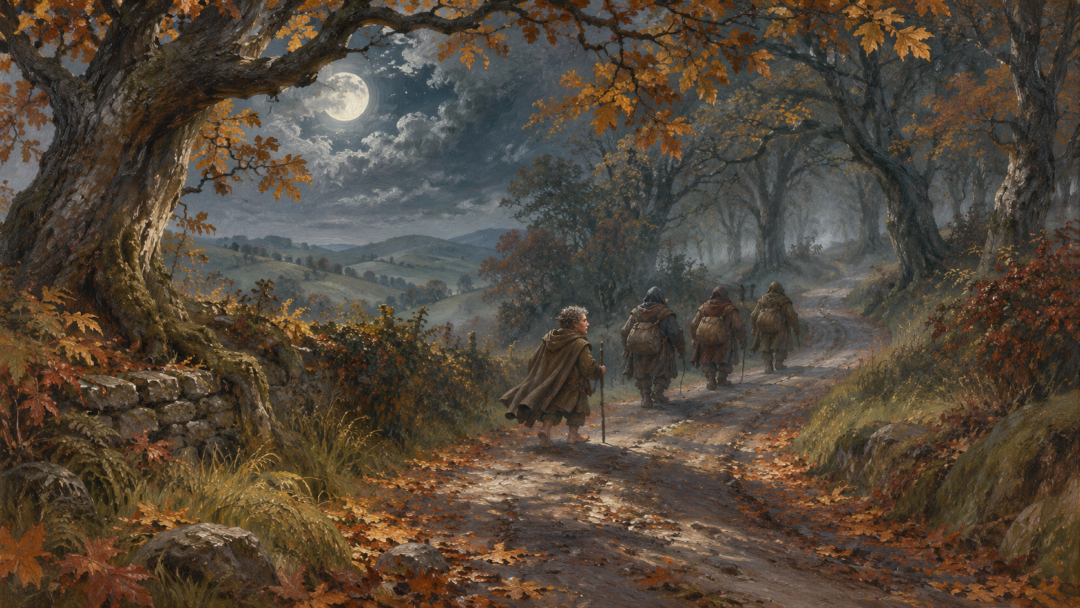
Outside, the night sky is full of stars. Bilbo looks back at his home, says his goodbyes, and delights in being on the road with Dwarves again. His companions follow him around the garden, down the slope, through a gap in the hedge, and into the meadows. That is where the account of this little company ends for the moment: not at an inn, a border, or a known parting place, but in the grass beyond Bag End.
Nar, Anar, and Hannar: names from the earlier drafts
The three names often associated with this departure are Nar, Anar, and Hannar. They have a genuine connection to the writing of the scene, but not to the published scene’s list of characters. Tolkien Gateway’s entry on Nar attributes the names to early material for A Long-expected Party, pointing specifically to The Return of the Shadow, the volume edited by Christopher Tolkien, under the section The Second Phase: XIV. Return to Hobbiton.
According to that account of the draft, Bilbo calls the three Dwarves by name as he gets ready to leave. Nar receives some additional attention and speech in the earlier writing. The entry on Anar likewise explains that his name and dialogue do not survive in the final book. These references are useful for following the composition of the chapter, but they should be presented as reports of draft material, not as words or identities established in the published Fellowship.
Nar also needs care in another respect. He is not the same figure as Nár, the Dwarf who accompanied King Thrór in a much earlier episode of Dwarven history. Their similar-looking names can make searches misleading, particularly when the accent is omitted. One belongs to the history of a discarded companion name in Bilbo’s farewell; the other is a separate character associated with Thrór. They cannot be merged into a single biography.
Draft names offer an intriguing glimpse of how the episode developed. They give faces, or at least possible labels, to people who remain indistinct on the published page. But a draft is not a missing appendix to the finished story. It preserves a stage of composition rather than silently supplying facts to every later version. Readers can say that Nar, Anar, and Hannar were associated with Bilbo’s departure in early writing; they cannot say the final novel names his three companions.
What about Lofar, the fourth Dwarf?
There is a wrinkle in those early accounts. The more detailed Nar entry describes Lofar as a fourth Dwarf present in the draft, but one who stays behind rather than departing with Bilbo’s group. The Return to Hobbiton summary similarly describes three named travellers and Lofar remaining at Bag End for a task involving the envelope intended for Bilbo’s heir. This makes four Dwarves in that draft setting, not four confirmed travellers.
Other brief summaries are less tidy. Tolkien Gateway’s Anar entry calls him one of four accompanying Dwarves, while its Hannar page describes four at Bag End and flags its historical discussion as needing a citation. Those statements should not be combined into a new roster for the published scene. They illustrate how compressed descriptions of changing drafts can blur who was present, who left, and which revision is being discussed. For the final narrative, the count remains three, without names.
How long did the three travel with Bilbo?
The starting point is firm: Bilbo departs on 22 September, Third Age 3001, the evening of his great birthday feast. The next part of the question is much harder. The opening chapter does not return to the three Dwarves to say when they stopped travelling with him. It gives no dated arrival alongside them, no farewell at a crossroads, and no statement that they accompanied him all the way to Rivendell.
One later date can look like an answer until its meaning is examined. Appendix B records Bilbo becoming Elrond’s guest and settling in Rivendell in Third Age 3002, as reflected in Tolkien Gateway’s entry for that year. This is a date for Bilbo’s settlement, not a record of the three Dwarves completing an escort. The intervening months cannot be assigned wholesale to that same little party.
The distinction becomes clearer when Bilbo tells Frodo about his travels in Many Meetings. He describes wandering after leaving Hobbiton, sometimes along the road and sometimes away from it, without a fixed itinerary, though his course kept drawing him toward Rivendell. His recollection is not a day-by-day journal. It tells us something about the wandering character of his journey, but it does not put names, numbers, or a departure date to the companions who set off from Bag End.
That account also rules out the easiest imaginary itinerary: a single unbroken trip from Hobbiton to a permanent home in Rivendell. Bilbo reaches Rivendell, rests, and later goes on to Dale with Dwarves before coming back. His life after leaving the Shire therefore includes more than one stage of travel. The anniversary between 3001 and 3002 is not a measurement of how long any particular Dwarf remained at his side.
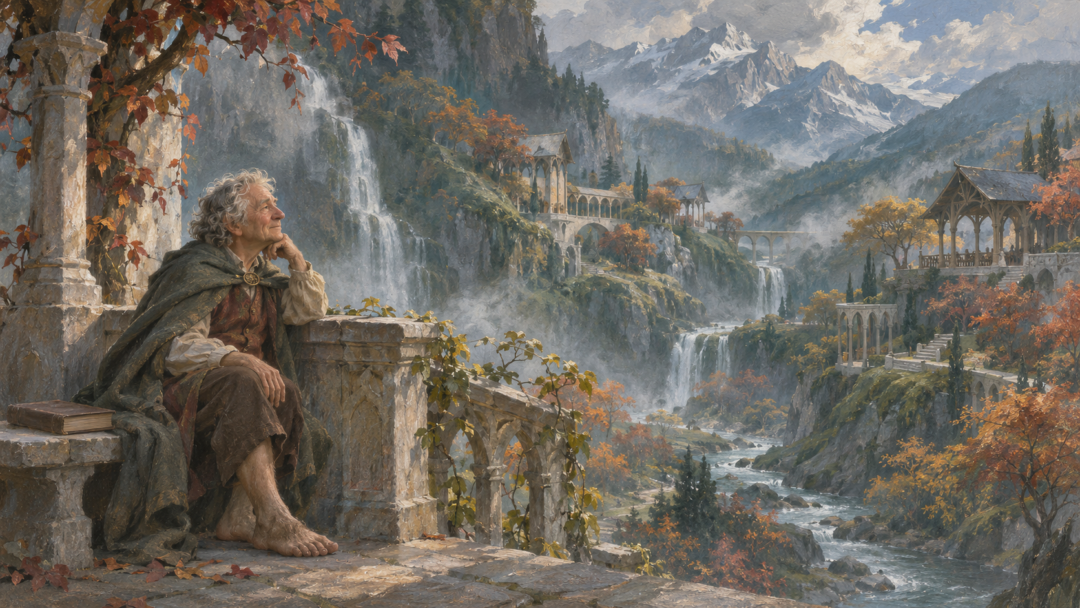
The later journey to Dale is a separate clue
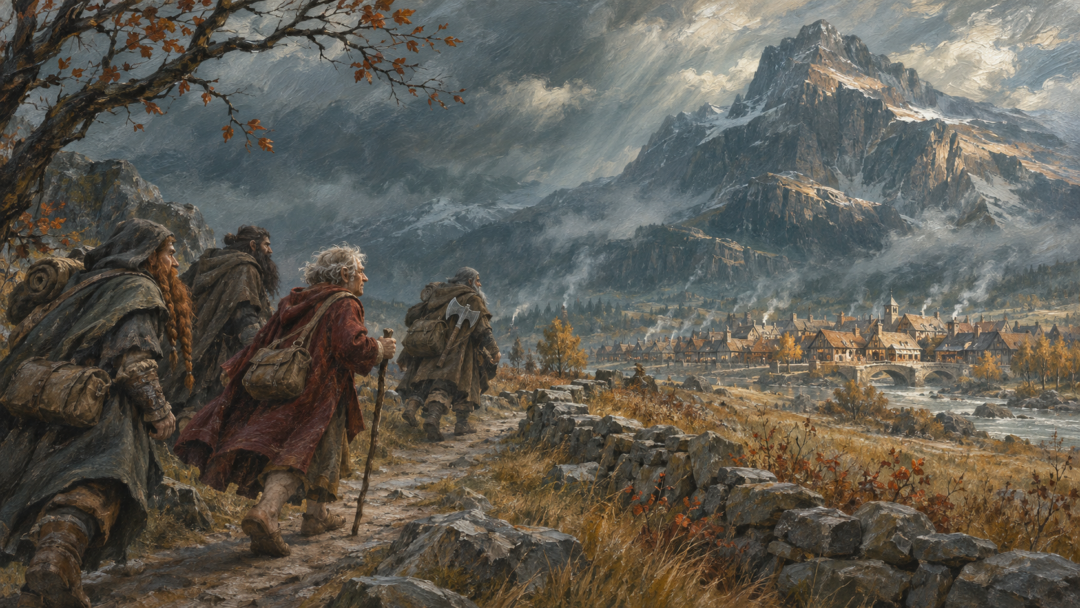
Dale is significant because it lies near the Lonely Mountain and belongs to the region where Bilbo’s great adventure once brought him into Dwarven company. In Many Meetings, he tells Frodo that he travelled there with Dwarves after resting at Rivendell, then returned. He treats that eastern visit as his last journey. What he does not say is that these Dwarves were the very three who had helped pack his belongings at Bag End.
There is no reason to force the two groups into being different, either. The evidence permits the possibility of continuity but never establishes it. A reader may imagine the same friends sharing both stretches, or Bilbo meeting other Dwarves along the way. Neither picture can be turned into a factual timetable. Even meeting Glóin at Rivendell years later supplies no missing identity: a named Dwarf in another chapter is not automatically one of Bilbo’s unnamed departing companions.
The most memorable part of this little company may be the moment when it slips beyond what anyone in Hobbiton can see. Frodo is still among the party guests; Gandalf watches from the doorway; and Bilbo is already beyond the hedge, eager for the road. The Dwarves follow, unnamed, into the meadows. Their shared journey begins in full view of the reader, then quietly passes out of sight.
Sources & Notes
This article is based on close reading and interpretation of Tolkien's published works and related source material where relevant.