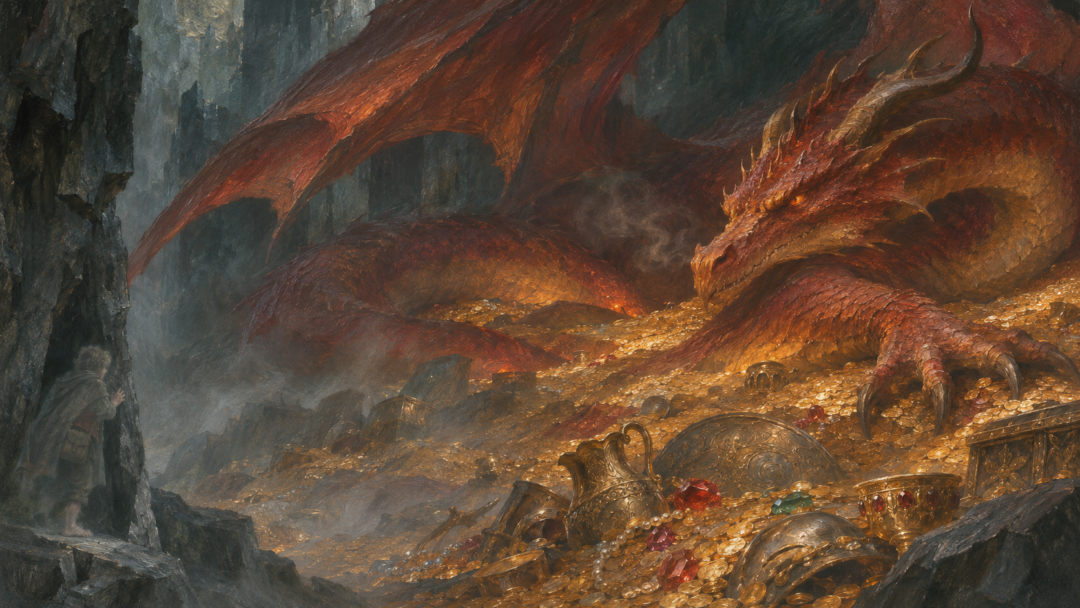
Deep under the Lonely Mountain, Bilbo Baggins stands invisible before a dragon who has found a surprisingly ordinary way to make treasure frightening. Smaug does not merely boast about his scales or threaten to eat the intruder. He asks, “But what about delivery? What about cartage? What about armed guards and tolls?” For a moment, the adventure sounds less like a legend than a dispute over moving an expensive shipment.
Yet the answer to the charge of anachronism is no. Transport costs, dangerous roads, and payments for passage do not require modern capitalism. They arise wherever valuable things must travel. Smaug has spotted a genuine omission in the expedition’s preparations, then wrapped it in accusations designed to loosen Bilbo’s trust in the Dwarves. His question is sounder than his insinuations.
A Dragon Who Understands the Problem of Getting Home
The exchange occurs during Bilbo’s second visit to Smaug’s hall in Chapter 12, “Inside Information.” He has already taken a golden cup, and the dragon is alert to an intruder. The Ring conceals Bilbo from sight but not from conversation or danger. Smaug knows the scent of Dwarves and has picked up clues about Bilbo’s companions, yet the stranger’s own smell baffles him. His apparent certainty exceeds what he actually knows.
Smaug starts with Bilbo’s position in the company. The burglar faces the peril while his employers remain outside; perhaps, suggests the dragon, they will keep the reward. The transport questions follow naturally from that attack. Even if a portion of the hoard belongs to Bilbo, what can he do with it on a mountainside? A right to treasure and possession of treasure are different things when the owner lives across forests, rivers, and hostile country.
Consider what moving metal and jewels would involve, without pretending the book gives us an inventory or shipping estimate. There would have to be manageable loads, animals or vehicles where the terrain permitted them, people able to handle the journey, and decisions about routes and protection. Precious cargo is attractive to thieves precisely because it is precious.
The objection lands because Bilbo has not considered it. His energies have gone into reaching the Mountain and finding a way inside, not into organising the return. Later, Thorin acknowledges the difficulty rather than displaying a secret transport plan. He says the country has grown wilder and offers to help Bilbo with the cost when the time comes. That promise is not a completed arrangement, but it does not support Smaug’s accusation that the Dwarves have deliberately cheated their burglar.
In the dragon’s cavern, the greatest obstacle is not the size of a jewel but the distance to home.
Erebor's Wealth Was Never Separate from Exchange
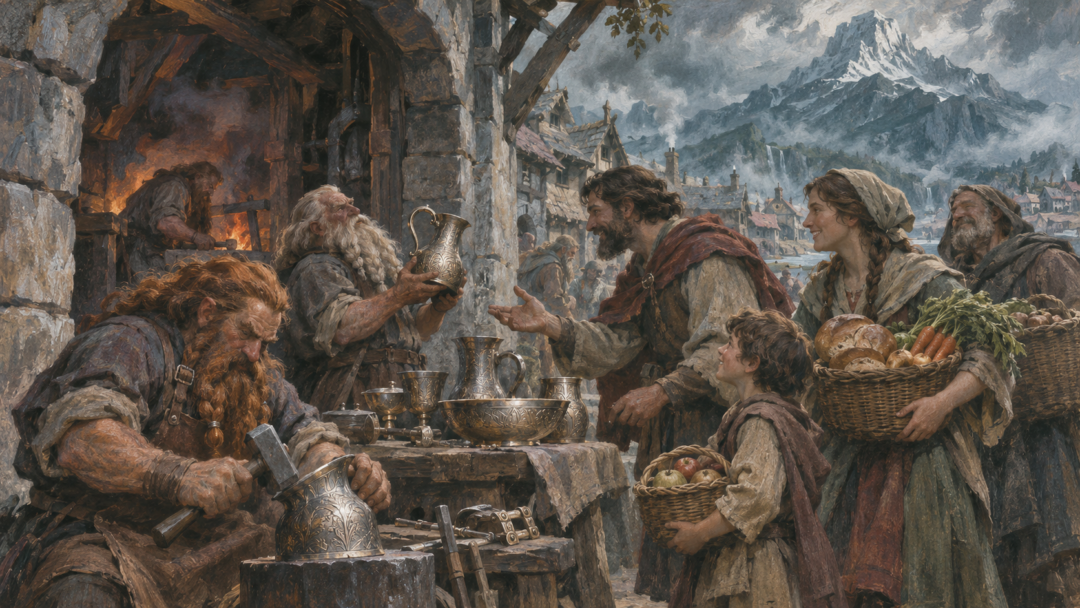
The first chapter supplies a useful check on whether payment and specialised work feel foreign to this world. Recalling the prosperity of his people under the Mountain, Thorin describes smiths whose skill attracted rewards from kings. Families sought places for their sons as apprentices and paid the Dwarves, notably with food supplies. The Dwarves could concentrate on craft because other people provided what they did not cultivate themselves. The account shows exchange and specialisation, not a modern wage system.
There is an even sharper detail in Chapter 12 itself. Among the treasures the company remembers are spears made for the armies of King Bladorthin, left undelivered and unpaid for. That small unfinished transaction matters more to this question than any grand theory of Dwarven finance. A craft order existed, a customer was expected to receive it, and payment was still outstanding. Delivery was part of the problem long before Smaug made it into a joke at Bilbo’s expense.
Nor does the old relationship between the Mountain and Dale require an imagined network of licensed merchants to be intelligible. Craftspeople made desirable goods, neighbours possessed other resources, and visitors had reasons to come to Erebor. Those are reasonable implications of the book’s account, not evidence for formal trade guilds, standard prices, or a single commercial law. The contrast is between productive wealth moving among people and a dragon’s wealth lying untouchable in a hall.
Craftwork at the Mountain’s threshold recalls an economy built on skills, visitors, and supplies.
The Barrels Reveal a Working Transport Network
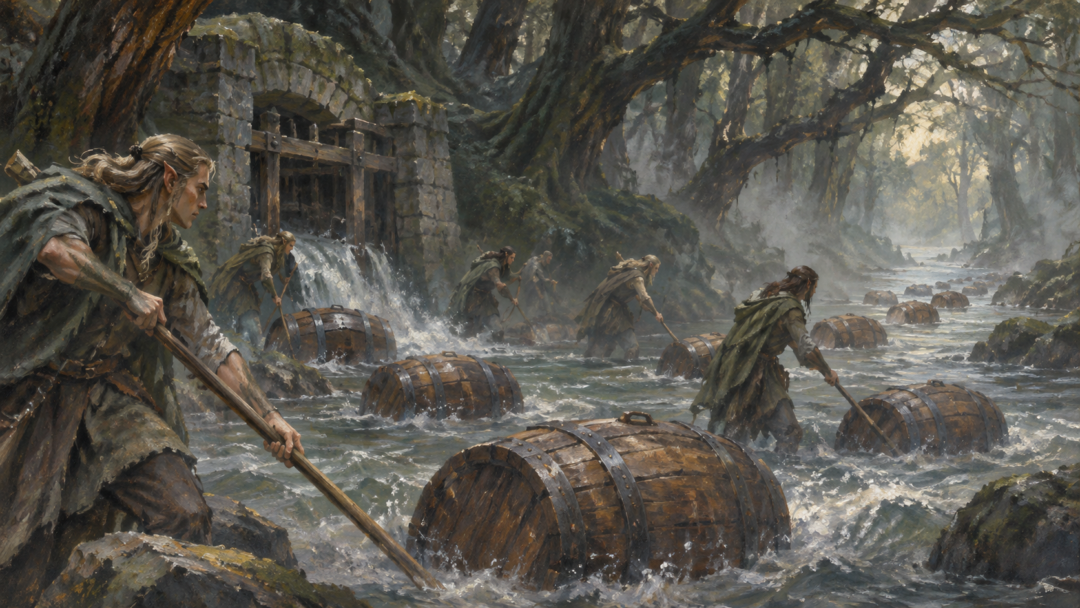
For something still more tangible than Thorin’s memories, return to Bilbo’s escape from the Elvenking. Chapter 9 describes wine and other goods reaching the Wood-elves from distant places, including vineyards far from Mirkwood. Vines do not grow in the Elvenking’s halls. The wine must arrive by routes involving rivers, land journeys, and the Long Lake. Those barrels are ordinary containers in an established pattern of supply, not enchanted vessels conjured for Bilbo’s convenience.
The route has a return movement too. Full barrels travel up the Forest River, sometimes tied into rafts or placed on flat boats. Empty ones go through a water-gate, float downstream, and are gathered by elves before being taken back toward Lake-town. Workers gather and steer casks, noticing when some float suspiciously low. Bilbo turns that routine into an improbable escape plan for his companions. It works only because workers already know where the casks should go and what should happen to them after they leave the cellars.
Chapter 10 widens the view from one underground water-gate to the surrounding community. Bilbo hears discussion of trade along the waterways and disagreements between the Lake-men and Wood-elves about keeping the river and its banks in order. Former roads have become unreliable or fallen out of use. The river’s importance is therefore not merely picturesque: geography and maintenance affect which journeys people can make. Commerce follows the passable route.
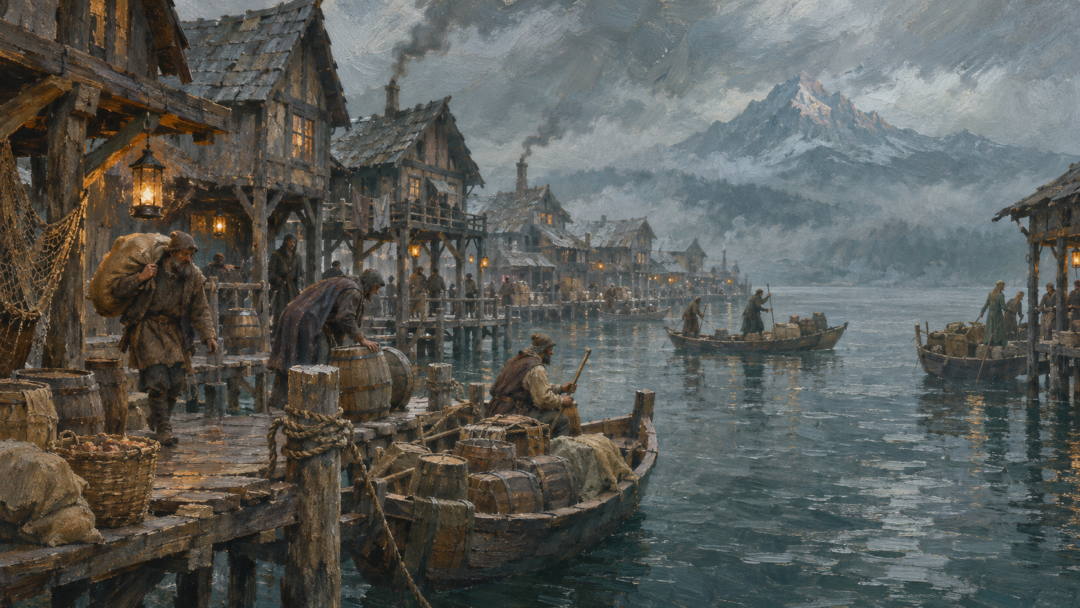
At Lake-town, the barrels do not simply vanish at the end of the chapter’s escape trick. The account anticipates people coming from the South to collect some casks and fill others with goods intended for the Wood-elves. It is an exchange route with movements in more than one direction. The Men of the lake and the Elves of the forest have reasons to cooperate even when their interests and responsibilities do not align perfectly.
None of this means that Bilbo could place a mountainous pile of treasure on the next raft. Barrel traffic is adapted to particular containers, waterways, and destinations. The chapters establish that freight is possible, not that every valuable load is straightforward to move. Smaug’s practical challenge survives precisely because this world already knows what transport takes.
Raft-elves on the Forest River make ordinary cargo travel look almost effortless—until the load changes.
Armed Guards and Tolls Belong to Older Roads Too
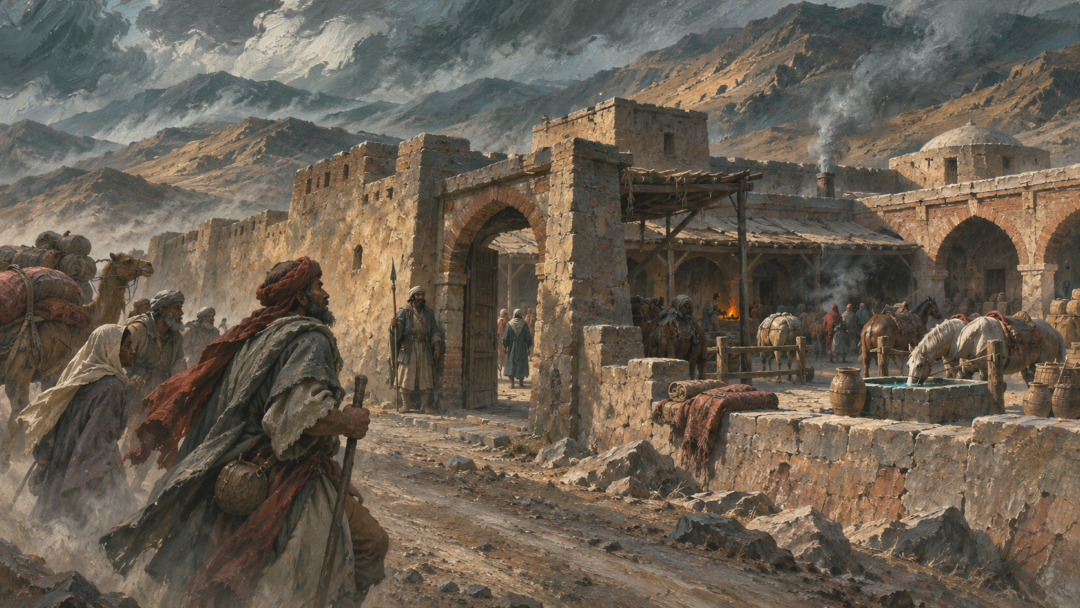
The historical comparison is instructive, provided it remains a comparison. [UNESCO’s account of the Persian Caravanserai](https://whc.unesco.org/en/list/1668/) describes roadside inns along ancient trade and pilgrimage routes. They offered travellers shelter, food, and water, and their locations responded to geography, access to water, and security concerns. Such networks existed before industrial roads and railways. Organised commercial travel is therefore not, on its own, a sign of a modern economy.
UNESCO also notes that caravanserai designs could respond to defensive needs. Merchants and other travellers benefited from stopping places and services built around the difficulties of a journey. This says nothing about whether Smaug’s imagined guards followed Persian customs; nor does it provide a schedule of historical escort wages or tolls. The value of the analogy is narrower and stronger: older societies could support trade with real infrastructure shaped partly by danger.
Smaug’s four questions span different sorts of difficulty. Delivery concerns getting property to its recipient; cartage points to the work of moving it; armed guards raise the matter of security; tolls suggest payments demanded along a route. It is reasonable for a traveller carrying riches to worry about all four. But the speech identifies possible expenses, not a particular Middle-earth toll gate, guard contract, or authority collecting revenue. No quotation for Bilbo’s journey is supplied.
What sounds strikingly modern is the brisk, almost businesslike way the dragon strings these expenses together. He reduces a marvellous hoard to the irritating business of bringing it home. That tonal contrast can be funny without revealing an industrial-style financial system behind the story. Words alone establish no corporate or financial institutions.
An old roadside caravanserai offers a historical parallel for shelter and security, not a map of Middle-earth.
A Good Objection from a Thoroughly Bad Adviser
Smaug is dangerous not because every observation he makes is false, but because he inserts a plausible observation into a dishonest account of the company. He suggests that the Dwarves have sent Bilbo ahead to take the risks while they collect the reward. The text shows the suggestion taking hold: Bilbo begins wondering whether his companions have overlooked transport or are laughing at him. It does not establish that they planned such a betrayal.
The dragon is guessing elsewhere, too. Bilbo’s evasive titles give him clues about the barrels and Lake-town, but he draws conclusions beyond his knowledge. The conversation lets him act like the one creature capable of seeing through everyone’s plans, even while his own uncertainties remain. Bilbo is frightened and susceptible to this pressure, yet he also continues asking questions. Amid the boasting he notices a vulnerable place in Smaug’s armour—a discovery of a very different kind.
No passage gives a price for taking Bilbo’s portion to Bag End, much less a complete economic model of the Mountain. The dragon lies on enough gold to make any burglar rich, but even that hoard cannot abolish roads, rivers, weight, or fear. Smaug understands the obstacle and exploits it. Bilbo’s task is harder than answering the questions: he must hear the truth in the dragon’s words without accepting the poison wrapped around it.
Sources & Notes
This article is based on close reading and interpretation of Tolkien's published works and related source material where relevant.