ChatGPT said: Can Anyone Translate What Gandalf and Saruman Say in the Caradhras Confrontation?
Yes. Gandalf and Saruman are speaking two different Elvish languages during the confrontation on Caradhras in Peter Jackson’s The Lord of the Rings: The Fellowship of the Ring (2001). Saruman speaks Quenya, the ancient language of the High Elves. Gandalf answers in Sindarin, the Elvish language more commonly spoken in Middle-earth during the Third Age.
Their words are not meaningless chanting. Saruman calls upon the mountain to awaken and turn its violence against the Fellowship. Gandalf urges the same mountain to sleep, become still, and restrain its anger.
The distinction matters. One wizard is attempting to provoke Caradhras. The other is trying to quiet it.
The translations are available in the film’s screenplay, although the dialogue is not explained in ordinary English during the finished scene. The Elvish lines were developed for the adaptation, drawing on the languages J.R.R. Tolkien created. They are not passages taken directly from The Fellowship of the Ring.
That last point is important. The novel contains a dangerous storm on Caradhras, but it does not depict a magical contest between Gandalf and Saruman. Tolkien leaves the source of the mountain’s hostility uncertain. The film supplies an identifiable enemy and makes the confrontation explicit.
What Saruman says on Caradhras
Saruman’s invocation is in Quenya. A commonly reproduced transcription reads:
Cuiva nwalca Carnirassë! Nai yarvaxëa rasselya taltuva notto-carinnar!
In English, Saruman commands the cruel Redhorn to awaken. He then calls for its bloodstained horn to fall upon the heads of its enemies.
The wording is particularly violent. Saruman is not merely asking for bad weather. He addresses the mountain as though it possesses a will, a temper, and the ability to strike.
The opening word, cuiva, is an imperative meaning to awaken. Nwalca means cruel or harsh. Carnirassë is the Quenya form of Redhorn, the mountain known in Sindarin as Caradhras.
The second sentence expresses a wish or invocation. The word nai introduces the desired outcome. Saruman wants the mountain’s horn to fall upon enemy heads. The image connects the mountain’s shape with a weapon.
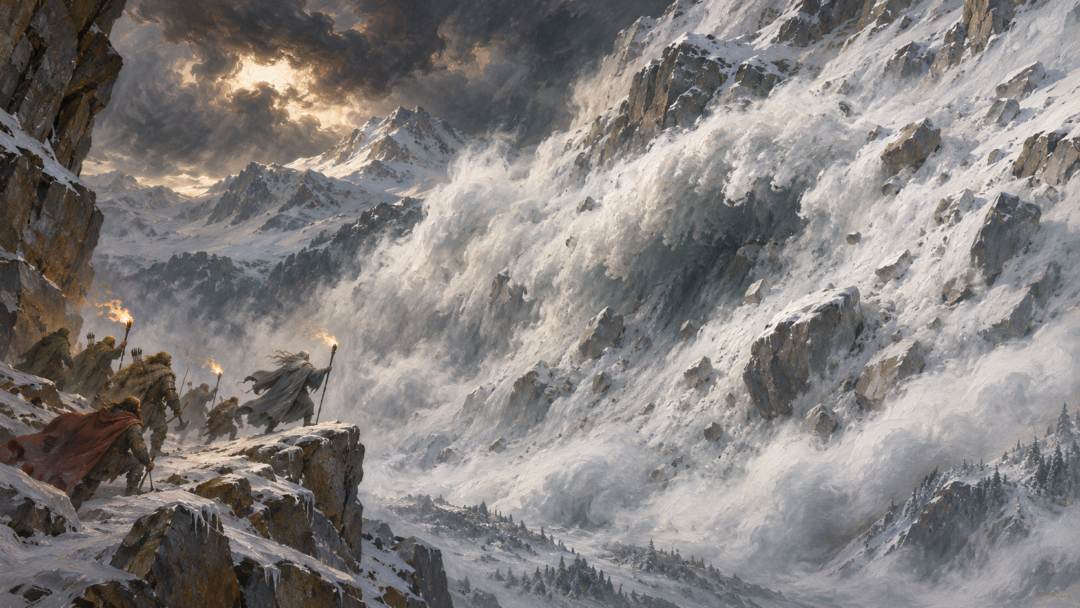
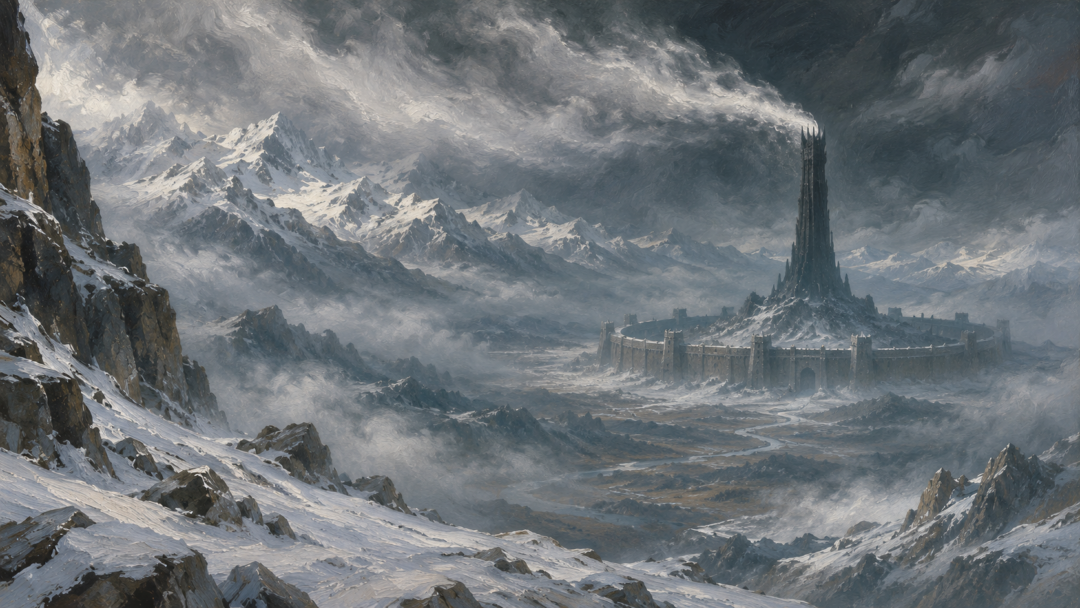
This fits what happens on screen. The clouds gather, the wind intensifies, and rocks begin falling toward the Fellowship. Saruman continues chanting from the summit of Orthanc, far away in Isengard. His words are followed by a violent avalanche.
The screenplay confirms the intended meaning of the invocation. It also makes the causal relationship between Saruman’s chanting and the disaster clear. This is a deliberate act of interference rather than an unexplained change in the weather. OverBlack
The name Carnirassë is worth noticing. It is not a different mountain. It is the Quenya equivalent of Caradhras. Tolkien’s own linguistic material connects the name with the elements for red and horn. In Sindarin, the corresponding elements are caran and ras. The mountain also bears the Dwarvish name Barazinbar, with the same meaning. Tolkien Gateway
Saruman therefore addresses the place by its name in an ancient Elvish tongue. The choice is consistent with his learning and his position as the former head of the White Council. It does not, however, establish that Quenya is inherently more powerful or better suited to destructive magic. The film gives no such rule.
What Gandalf says in reply
Gandalf’s response is in Sindarin:
Losto Caradhras, sedho, hodo, nuitho i ‘ruith!
The English meaning is a plea for Caradhras to sleep, remain still, lie quietly, and suppress its wrath.
The verbs are commands, but their purpose is the opposite of Saruman’s invocation.
Losto tells the mountain to sleep. Sedho asks it to become still. Hodo reinforces the idea of rest. Nuitho means to restrain or hold back. The final expression, i ‘ruith, refers to wrath or anger.
The sentence is constructed around a single intention. Gandalf wants Caradhras to stop attacking.
An early translation published by the Tolkien fan site TheOneRing.net on December 23, 2001, gives the same overall meaning. Its transcription differs slightly in spelling and punctuation, as some reproductions of the film dialogue do. The essential words and their intended sense remain consistent. theonering.net
The contrast between the two wizards is unusually clear. Saruman calls for awakening. Gandalf calls for sleep. Saruman invokes violence. Gandalf seeks restraint.
Both speak directly to the mountain rather than to each other.
This is an important distinction when interpreting the scene. Gandalf is not simply casting a protective spell over the Fellowship. He is trying to influence whatever power or hostility the mountain possesses. His command treats Caradhras as something capable of hearing and responding.
The film does not establish whether Caradhras is literally conscious. It presents the mountain as a place whose anger can be stirred or subdued. The dialogue works within that impression.
Gandalf’s words do not succeed. Saruman’s invocation continues. Lightning strikes the mountainside, and an avalanche comes down upon the Company.
The Fellowship survives, but the attempt to cross the Redhorn Gate has failed.
In the screenplay, Gandalf’s Sindarin line is accompanied by its English meaning, just as Saruman’s Quenya line is. The language contrast is therefore intentional. It is not a case of actors improvising mystical sounds that were given meanings afterward. OverBlack
There is also a linguistic distinction worth keeping in view. Quenya and Sindarin are related languages, but they are not interchangeable. Tolkien gave them different histories, sounds, and grammatical forms.
Quenya retained an ancient and ceremonial character among the Elves of the Third Age. Sindarin remained a widely used Elvish language in northwestern Middle-earth.
The film makes use of that difference without stopping to explain it. Saruman speaks in Quenya from the height of Orthanc. Gandalf responds in Sindarin from the exposed mountain path.
It is possible to read that choice as a contrast between Saruman’s distant, commanding authority and Gandalf’s more immediate relationship with the living world. That is an interpretation of the filmmaking, not a linguistic rule established by Tolkien.
What Tolkien actually wrote about the storm
The original passage appears in The Fellowship of the Ring, Book II, Chapter 3, “The Ring Goes South.”
The Company attempts to cross the Misty Mountains by the Redhorn Gate. Gandalf and Aragorn have already discussed another possible route, but the mountain pass seems preferable to the dangers of entering Moria.
Their decision proves costly.
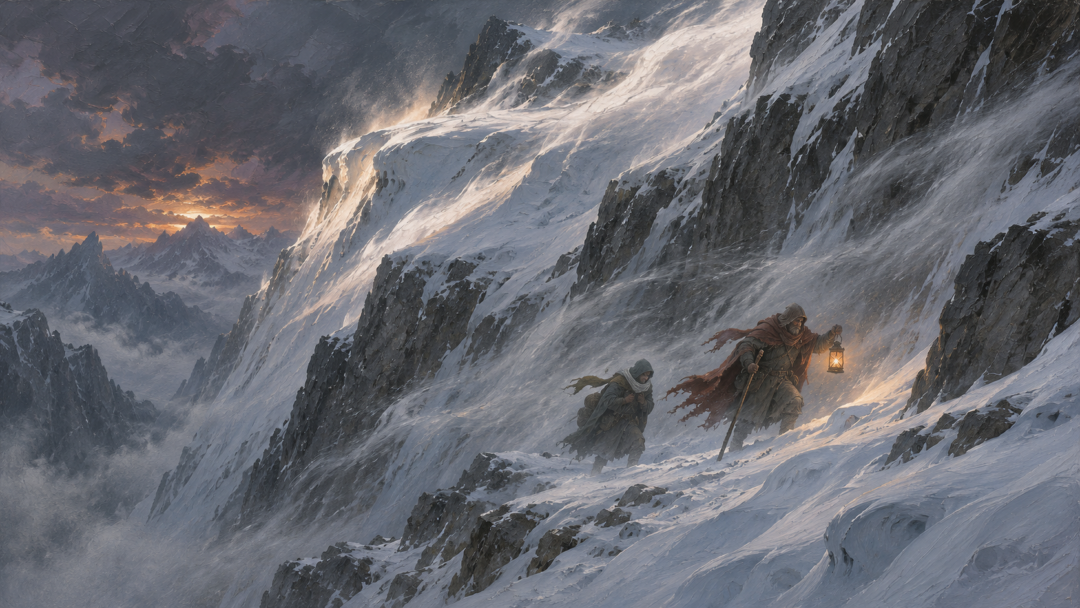
Snow begins falling as the Fellowship climbs. The wind strengthens. Darkness gathers around the mountain. Soon the Company can barely continue.
The characters disagree about what is happening.
Boromir wonders whether the storm has been contrived by the Enemy. He has heard that Sauron can influence the weather in the Mountains of Shadow, far away on the borders of Mordor. Gimli responds with surprise at the apparent reach of such power.
Gandalf does not dismiss the possibility that Sauron’s influence has extended across Middle-earth.
But Tolkien does not confirm Boromir’s suspicion.
As the storm continues, the Company hears strange noises in the darkness. Stones begin falling from the mountainside.
Boromir believes there are hostile voices on the air. Aragorn accepts that the apparent wind may conceal something more dangerous. He observes that the world contains unfriendly powers that are not necessarily servants of Sauron. Some pursue purposes of their own.
This observation changes the question. An enemy need not belong to Sauron’s armies to threaten the Fellowship.
Gimli then recalls the mountain’s old reputation:
Caradhras was called the Cruel
He explains that the mountain was feared long before Sauron’s name became known in those lands.
These exchanges appear in “The Ring Goes South,” in the sequence surrounding the Company’s first encounter with the violent storm. They establish several possibilities without settling on one explanation.
The weather may be influenced by Sauron. Another hostile force may be present. Or Caradhras itself may possess a malice that has little to do with the larger war. Tolkien allows these possibilities to remain unresolved. Amazon Web Services, Inc.
There is no corresponding scene in which Saruman stands atop Orthanc and chants against the Fellowship.
Gandalf does not identify Saruman’s voice in the wind. He does not answer it with a command for the mountain to sleep.
Those details belong to Jackson’s film.
The distinction becomes clearer when the Company begins its retreat. In the book, Gimli speaks of the mountain’s hostility as an established fact. He believes Caradhras has deliberately obstructed their passage.
The narrative supports that impression. As the Fellowship withdraws, another fall of stones and snow blocks the path behind them. The timing makes the mountain seem intent on driving out the intruders.
Yet Tolkien never supplies a definitive account of what causes the attack.
The chapter concludes with the statement:
Caradhras had defeated them.
The subject is the mountain itself. The narrative does not credit Saruman, Sauron, or any named servant of either. That is a meaningful choice in a story where the natural world contains forces older and less easily explained than the immediate struggle for the Ring. Amazon Web Services, Inc.
Gandalf does use Elvish magic in the book
The absence of the film’s confrontation does not mean Gandalf performs no magic during the crossing.
Tolkien gives him a different intervention.
The Fellowship has become trapped by the storm. The cold threatens the hobbits, and the Company must build a fire to survive. Even with the wood that Boromir wisely advised them to carry, the others cannot get a flame to hold in the wind and wet.
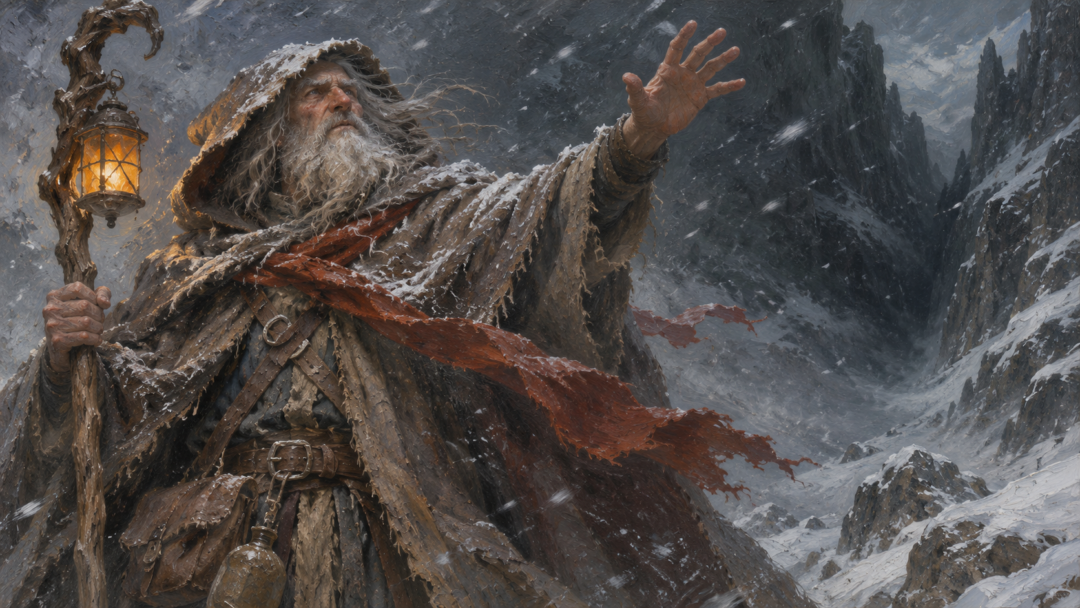
Gandalf finally intervenes. He lifts a piece of wood, speaks a command, and touches it with his staff.
The words are:
naur an edraith ammen!
The Sindarin expression can be understood as a call for fire to save them. Gandalf’s staff produces green and blue flame, and the wood catches.
This is a genuine example of Gandalf speaking Elvish during the Caradhras episode. It appears in “The Ring Goes South” after the storm has become dangerous enough that the Company must shelter against the cliffs.
But the words are not directed at the mountain.
They kindle fire. They do not stop the snowfall, silence the hostile voices, or defeat whatever power is obstructing the pass.
Gandalf also recognizes a serious consequence. If anyone is watching the Company, his use of magic has made his presence unmistakable. He has protected his companions at the possible cost of revealing their location. Amazon Web Services, Inc.
This is characteristic of Tolkien’s treatment of Gandalf’s power. His abilities are real, but they do not remove ordinary danger or make careful decisions unnecessary.
The fire keeps the Company alive through the night. It does not make the crossing possible.
When dawn arrives, the storm has eased, but the snow still blocks the route. Boromir and Aragorn force a passage through the drifts. The Company escapes only through considerable physical effort.
Gandalf cannot simply order the mountain to permit their passage.
The distinction between the book’s fire spell and the film’s calming invocation is essential. Both involve Sindarin. Both occur during the attempt to cross Caradhras. Only the former was written by Tolkien.
Why the film makes Saruman responsible
The film adaptation changes the structure of the episode by giving the storm a visible cause.
Saruman has already betrayed Gandalf. His servants have been watching the Fellowship’s movements. He knows that the Company is attempting to cross Caradhras, and he anticipates that failure may force them toward Moria.
In the film, this makes the storm part of an identifiable plan.
Saruman is not merely an enemy waiting elsewhere in Middle-earth. He can interfere with the Company’s journey from a great distance.
The sequence also establishes a direct contest between the two wizards without bringing them into the same physical location. Christopher Lee’s Saruman commands the mountain from Orthanc. Ian McKellen’s Gandalf struggles to protect the Fellowship on the exposed pass.
Their spoken words reinforce what the images show.
The adaptation gains clarity and urgency. The audience knows who is attacking, why the attack is happening, and what Gandalf is trying to prevent.
But something changes in the process.
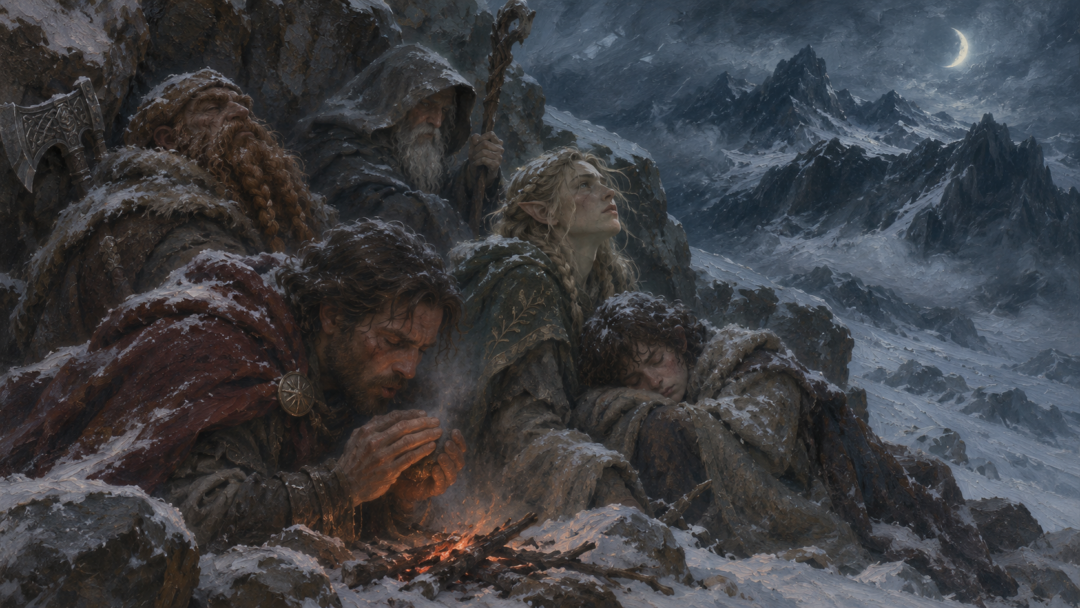
Tolkien’s Caradhras is dangerous partly because its hostility cannot be confidently assigned to a familiar enemy. Its reputation reaches back into the older history of Middle-earth. The mountain seems to have purposes independent of the contest between Sauron and the Free Peoples.
The film retains the impression of an angry mountain but ties that anger to Saruman’s intervention.
It turns an uncertain encounter with an ancient, hostile landscape into a confrontation between two known characters.
Neither interpretation makes the mountain safe. The difference concerns the source of its danger.
Who wrote the Elvish dialogue?
The film’s additional Elvish dialogue was developed with the assistance of linguist David Salo, who worked from Tolkien’s vocabulary, grammar, and linguistic writings.
Salo’s task was not simply to look up English words and substitute Elvish equivalents. Tolkien had created extensive linguistic material, but he had not provided a complete, fixed system for every sentence a screenwriter might require.
The production therefore needed new expressions built from the available evidence.
In an Associated Press interview published on December 30, 2001, Salo explained how he used Tolkien’s linguistic patterns to extrapolate grammatical forms. The filmmakers frequently requested new lines during production, and the actors were coached in speaking them. Seattle Post-Intelligencer
This is why the Caradhras dialogue can be translated while still remaining distinct from Tolkien’s own writing.
It belongs to the film’s constructed use of Quenya and Sindarin. It is grounded in Tolkien’s languages, but the complete invocations are additions made for the adaptation.
The film establishes their intended meanings. That does not mean every grammatical detail must be treated as something Tolkien personally approved or wrote.
What the exchange means
The confrontation is understandable once the words are translated.
Saruman calls on Caradhras to awaken and unleash its destructive force. Gandalf commands the mountain to rest and restrain itself.
The language makes the opposition explicit. Awakening stands against sleep. Violence stands against stillness.
The book provides the deeper context for the mountain’s reputation, but it does not provide the exchange itself.
In Tolkien’s account, the Company encounters a storm whose ultimate cause remains unknown. Gandalf uses magic to kindle a lifesaving fire, not to confront Saruman. The mountain defeats the Fellowship, and the companions must find another road.
In Jackson’s film, Saruman deliberately provokes the disaster, and Gandalf tries unsuccessfully to counter it.
The two versions reach the same immediate outcome. The Fellowship cannot cross Caradhras and must consider the passage through Moria.
Their explanations are different.
The film presents a struggle between two wizards, expressed in two Elvish languages. Tolkien’s novel leaves something older and more uncertain on the mountain.
Sources & Notes
This article is based on close reading and interpretation of Tolkien's published works and related source material where relevant.