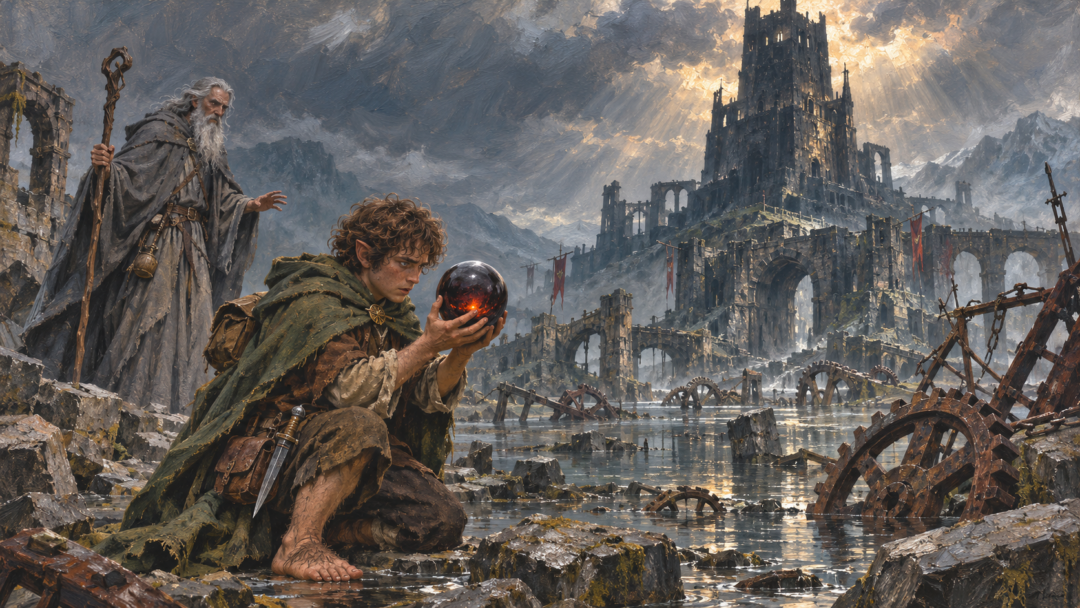
ChatGPT said: Why didn’t the Palantir react to Pippin the first time he touched it in Isengard?
The palantír did not overwhelm Pippin when he first picked it up because merely touching a Seeing-stone was not enough to establish a connection with Sauron. The stones had particular requirements for their use, including orientation and the direction from which they were viewed. When Pippin first handled the Orthanc-stone, he was simply carrying it. Later, when he deliberately looked into it, he happened to place it in a position that allowed him to see through it.
Tolkien explains this distinction in Unfinished Tales, Part Four, Chapter III, “The Palantíri.” The smaller Seeing-stones had fixed directions of vision. The Orthanc-stone was one of these. It could not be used equally well from every angle, and a stone displaced from its original setting could be difficult to orient correctly.
Pippin’s successful use of the stone was therefore partly accidental. He placed it upright and positioned himself on its western side, allowing him to look east towards Mordor.
That is the clearest explanation Tolkien provides. It also reveals an important difference between the books and Peter Jackson’s films. In the films, the palantír behaves almost like a dangerous object that can seize someone through physical contact. Tolkien’s stones do not work in quite that way.
What actually happened at Orthanc
The first encounter occurs in The Two Towers, Book III, Chapter 10, “The Voice of Saruman.”
Gandalf has confronted Saruman at Orthanc after the Ents have destroyed Isengard. Saruman has refused the opportunity to abandon his treachery. Gandalf has broken his staff and cast him out of the order of the Wizards.
Then something comes hurtling down from the tower.
The object strikes the steps near Gandalf but remains intact. It rolls towards a pool, and Pippin runs after it.
Tolkien describes it as a dark crystal globe with an inner glow, almost as though a fire were burning deep within it.
Pippin picks it up. Gandalf immediately demands that he hand it over.
There is no violent reaction. Pippin does not collapse, hear Sauron’s voice, or become trapped in a vision. He carries the stone to Gandalf, who takes possession of it and wraps it away.
Yet it would be inaccurate to say that the stone has absolutely no effect on Pippin.
In the following chapter, Pippin remembers the mysterious red depths he glimpsed when he first handled it. The object has already caught his attention. Gandalf’s refusal to explain it makes the attraction stronger.
This is a quieter form of danger. The stone does not physically overpower Pippin, but he becomes increasingly determined to discover what it contains.
The distinction matters because Tolkien does not present the first encounter as a failed attempt to activate the palantír. Pippin has not tried to use it. He has picked up an unfamiliar object, looked briefly at it, and surrendered it when ordered.
The terrible encounter comes later, when curiosity leads him to make a deliberate attempt to see inside.
The Seeing-stones were not activated by touch alone
The palantíri were ancient instruments of sight and communication. They were not created by Sauron, nor were they originally instruments of evil.
Their history is explained in The Lord of the Rings, Appendix A, and more fully in “The Palantíri” in Unfinished Tales.
They originated with the Elves. Seven were brought to Middle-earth by Elendil and his sons after the downfall of Númenor. The stones allowed their users to observe distant places and, under suitable conditions, communicate with someone using another stone.
Their powers were extraordinary, but they were not unlimited.
They had physical properties, established orientations, and differences in capability. They also demanded attention and mental discipline from those who wished to use them effectively.
The distinction between the greater stones and the smaller stones is especially relevant to Pippin.
In Unfinished Tales, Tolkien explains that the smaller stones, including those of Orthanc, Minas Ithil, and Minas Anor, had fixed orientations. Their different faces were associated with particular directions.
A stone’s western face, for example, was intended for looking west. Turning to another side did not automatically produce a useful view in that direction.
Originally, the stones were installed in carefully arranged positions. Their users therefore did not have to guess which way they should be facing.
But the Orthanc-stone was no longer in its original setting.
Gríma Wormtongue had thrown it from a high window. It had struck the steps, bounced downwards, and rolled away.
Its original orientation had been disturbed.
Tolkien makes clear that a displaced stone could be difficult to set correctly, particularly when its surface offered no visible markings to identify its proper position. Science Fiction & Fantasy Stack Exchange
This gives a concrete explanation for the difference between Pippin’s two encounters.
When he first retrieves the palantír, he does not arrange it for observation. He simply picks it up.
Later, he places it on the ground and looks into it.
On that occasion, its position happens to be suitable.
The text does not explicitly state that the stone failed to respond at Isengard because Pippin was holding it at the wrong angle. That is an inference from the later explanation of how the palantíri functioned.
It is nevertheless a strong inference, and one grounded in Tolkien’s account of their physical limitations.
Why Pippin could see Sauron the second time
The decisive event occurs in The Two Towers, Book III, Chapter 11, “The Palantír.”
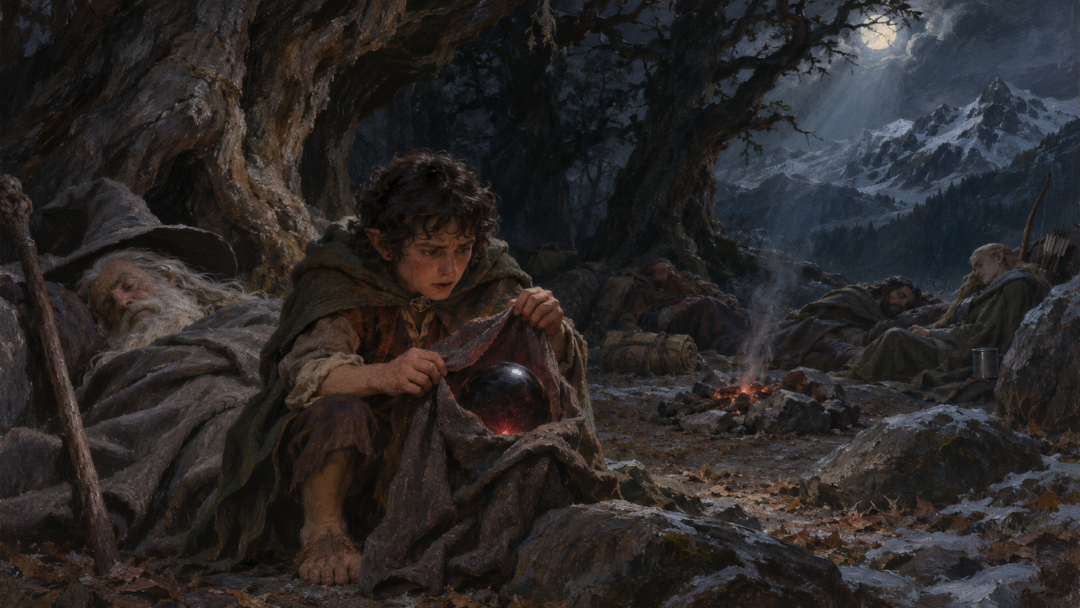
The company has left Isengard. During the night, Pippin lies awake, troubled by his growing desire to examine the mysterious stone.
Gandalf is sleeping nearby with the palantír wrapped in cloth.
Pippin approaches him and carefully exchanges the wrapped stone for another object of similar shape. He returns to his place and unwraps it.
This time, he does not merely hold the stone while examining its exterior.
He deliberately gazes into it.
At first it appears dark. Then its depths change, and Pippin finds himself unable to withdraw his attention.
What follows is not an ordinary vision.
He sees the sky and winged creatures moving around a distant tower. Then Sauron becomes aware of him.
Pippin is questioned and threatened. He experiences the encounter as an overwhelming assault on his mind.
When Gandalf reaches him, Pippin is lying rigid and apparently unconscious. He eventually recovers enough to describe what happened.

The fuller explanation comes in Unfinished Tales.
Tolkien says that Pippin, while fumbling with the Orthanc-stone, must have set it approximately upright. He was also sitting to its west, facing its east-looking side.
This happened without Pippin knowing anything about the stone’s construction.
The significant point is that he had accidentally arranged it in a way that permitted a connection towards Mordor.
The word Tolkien uses for this event is “chance,” although his treatment of chance elsewhere in the story gives the word a larger significance.
The palantír did not suddenly become more powerful between the two encounters. Nor did Sauron need to awaken it remotely.
Pippin had finally placed himself and the stone in a usable relationship.
That made the dangerous connection possible. Science Fiction & Fantasy Stack Exchange
Sauron was not waiting inside the stone
Another misconception comes from treating the palantír as though Sauron had placed part of himself inside it.
Nothing in Tolkien’s account suggests that this was the case.
The Orthanc-stone was not a vessel containing Sauron’s spirit. It was an instrument through which communication could take place.
Sauron possessed another palantír: the Ithil-stone, taken from Minas Ithil after the city fell to the Nazgûl in Third Age 2002.
Through this stone, Sauron had established contact with Saruman.
Saruman’s use of the Orthanc-stone exposed him to an adversary whose strength of will greatly exceeded his own. Sauron eventually gained a decisive advantage over him.
But this was not simply because Sauron could magically possess anyone who touched a palantír.
The danger arose through the use of the stones, the contact between their users, and the capacity of a stronger mind to dominate a weaker one.
Pippin’s experience makes the distinction unusually clear.
Sauron does not immediately understand who has appeared before him. He initially addresses Pippin as though the communication were connected to Saruman’s expected activities.
His questions reveal that he has not yet learned what happened at Isengard.
He also does not recognize that Pippin is not the hobbit carrying the One Ring.
He believes that Saruman may have captured the Ring-bearer and is withholding the prisoner from him.
This misunderstanding becomes important.
Sauron orders that the hobbit be kept for him. He wants the prisoner brought to Mordor, where he can question him personally.
Gandalf later recognizes that Sauron has acted on an incorrect assumption.
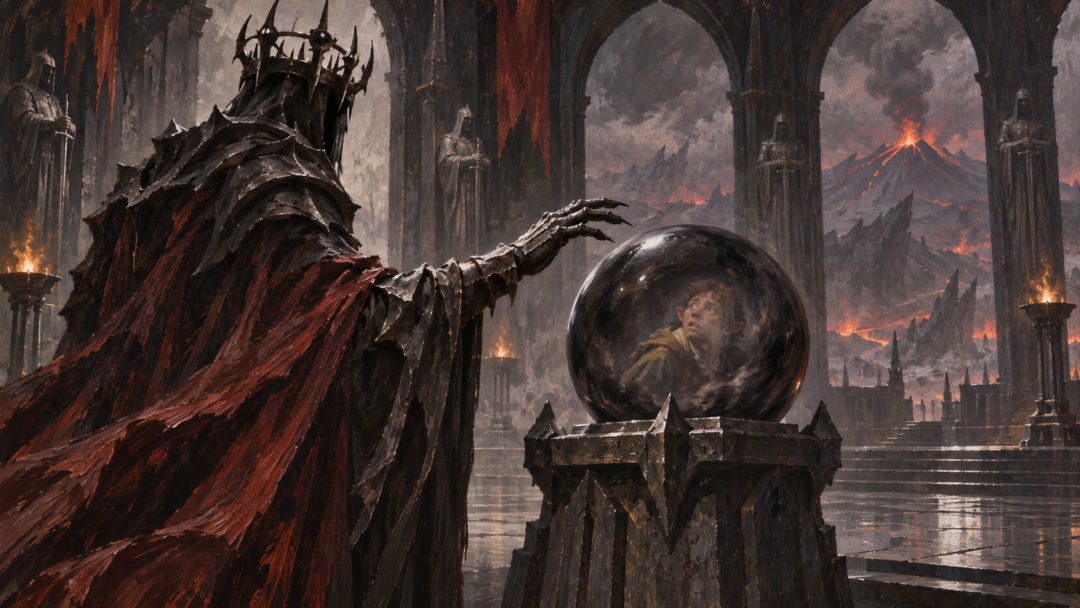
Pippin’s encounter has been dangerous, but it has also misled the Enemy.
If simply touching the stone had automatically exposed a person’s identity and thoughts to Sauron, much of this confusion would make little sense.
The palantír allowed contact. It did not give Sauron unlimited knowledge.
Why the stone was dangerous even without a vision
The fact that physical contact did not immediately overwhelm Pippin does not mean the stone was harmless.
Tolkien distinguishes between the ability to look through a palantír and the desire to use it.
Pippin’s curiosity is not presented as entirely ordinary. His brief encounter with the stone at Orthanc leaves him increasingly preoccupied with it.
He wants to see more. He resents Gandalf’s secrecy. He knows that taking the stone is wrong, yet he does it anyway.
After the incident, Gandalf acknowledges that the desire to look into a Seeing-stone is a temptation he understands.
In “The Palantír,” Gandalf even admits that he would like to test his own will against Sauron through the stone, if only to turn its vision towards the lost beauty of the Elder Days.
That admission is significant.
Gandalf is far wiser and more powerful than Pippin. Yet he recognizes the appeal of an instrument that promises knowledge far beyond ordinary sight.
Pippin’s mistake is therefore not that he possesses some unusual weakness that makes him susceptible to magical objects.
He wants to know what Gandalf knows.
The stone offers the possibility of discovering it without permission.
The danger follows when curiosity becomes an action.
Gandalf’s response also shows that he does not consider Pippin permanently corrupted. He is concerned about what Sauron may have learned, and whether Pippin has revealed anything about Frodo or the Ring.
Once Gandalf establishes that Pippin has not betrayed their mission, his judgment becomes less severe.
The hobbit has behaved foolishly. He has not willingly served the Enemy.
What Peter Jackson changed
The films present the incident differently.
In the extended edition of The Return of the King, Saruman is killed at Orthanc after Wormtongue stabs him. His body falls from the tower, and the palantír slips from his clothing into the flooded ruins below.
Pippin retrieves it.
Gandalf takes it from him before anything especially dramatic happens.
Later, Pippin secretly examines the stone and experiences a violent encounter with Sauron.

The contrast raises an obvious question for viewers. If the stone can seize Pippin so completely, why does it leave him alone when he first holds it?
Jackson’s adaptation does not explain the technical requirements governing the palantíri.
It also changes the circumstances in which the Orthanc-stone is recovered. In Tolkien’s book, Saruman survives the confrontation at Orthanc, and Wormtongue throws the stone from the tower during Gandalf’s attempt to deal with him.
The film instead makes the object’s recovery part of Saruman’s death scene.
More importantly, the film does not establish the rule about the fixed orientation of the smaller stones.
Its visual language emphasizes direct contact, supernatural attraction, and the struggle between Sauron and whoever confronts him.
This makes the palantír’s danger immediately understandable on screen, but it leaves out the physical explanation supplied in Unfinished Tales.
The same distinction matters when Aragorn later confronts Sauron through the stone.
In the films, his encounter is shown as a dangerous contest in which Sauron nearly overpowers him.
In the book, Aragorn deliberately uses the Orthanc-stone at the Hornburg, revealing himself to Sauron as Isildur’s heir.
He succeeds in wresting control of the stone from Sauron’s influence, although the effort is considerable.
Aragorn’s lawful claim to the stone matters, as does his strength of will. His success is not simply a matter of being able to endure a magical attack.
Tolkien’s account of the palantíri is more concerned with authority, knowledge, direction, and will than with an automatic curse triggered by touch.
The difference Tolkien intended
There is no passage in The Lord of the Rings in which Gandalf explicitly says that Pippin was safe the first time because he had not positioned the stone correctly.
That degree of certainty would go beyond the text.
What Tolkien does establish is sufficiently clear.
At Isengard, Pippin briefly handles the Orthanc-stone without using it for communication. Later, he deliberately gazes into it and encounters Sauron.
In Unfinished Tales, Tolkien explains that the stone required a suitable orientation, and that Pippin accidentally achieved one when he placed it on the ground.
The explanation does not depend on Sauron deciding when the stone should become active. It does not require Pippin to have developed any special ability. Nor does it suggest that the palantír needed time to recognize him.
The difference lies in what Pippin actually did with it.
His first encounter was an act of retrieval. His second was an attempt to see.
That distinction fits the larger role of the Seeing-stones in Tolkien’s world. Their danger is not that they are inherently evil objects waiting to possess the unwary. Their danger is that they offer knowledge through a channel that an enemy may already control.
Pippin did not understand that danger when he picked up the stone at Orthanc.
He understood even less when he returned to it in the darkness.
By chance, he placed it correctly. By curiosity, he looked into it. And through that opening, Sauron found him.
The palantír had not changed. Pippin had begun to use it.
Sources & Notes
This article is based on close reading and interpretation of Tolkien's published works and related source material where relevant.