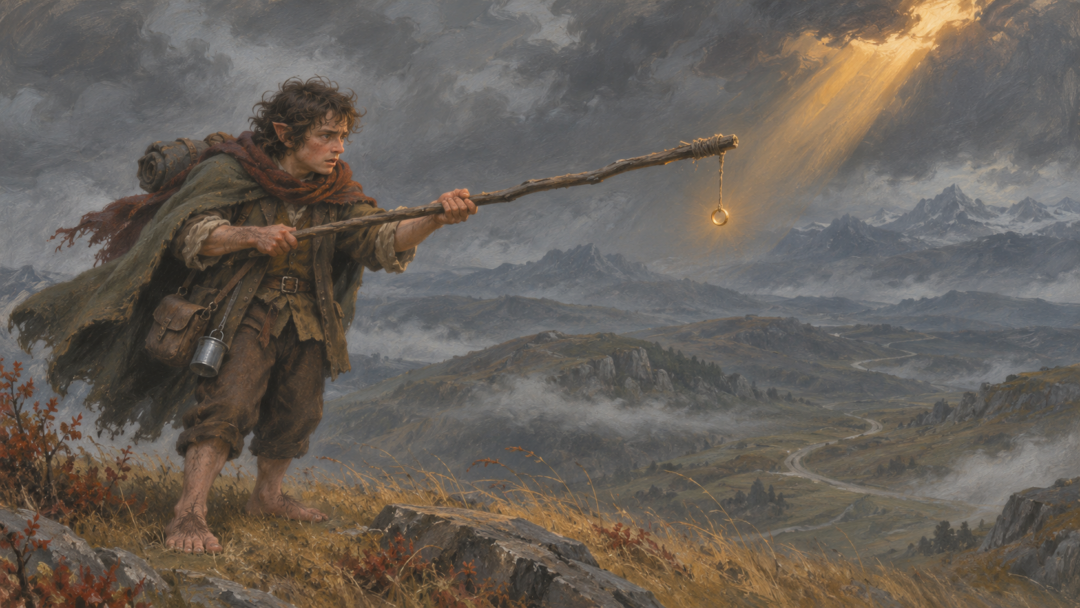
ChatGPT said: Why Didn’t They Just Put the One Ring on a Stick?
There is a reasonable question at the centre of The Lord of the Rings. If the One Ring corrupts whoever carries it, why carry it at all? Why not attach it to a stick, hold it at arm’s length, and walk to Mount Doom? Better still, put it in a box. Tie the box to a pole. Nobody has to touch the Ring, nobody has to wear it, and nobody has to spend six months listening to a piece of jewellery make suggestions.
The short answer is that Tolkien never establishes that physical contact is necessary for the Ring to exert its influence. In fact, he shows the opposite. The Ring affects people who possess it, desire it, or believe they could use it. Wearing it makes certain things happen, particularly invisibility for mortal bearers, but wearing it is not what begins the corruption.
There is also a more awkward answer. Frodo already carries the Ring on a chain for much of the story. He does not generally wear it. Keeping it off his finger is a precaution, but it does not prevent the growing burden.
A stick would have made the Ring easier to carry at a distance. It would not have solved the problem Tolkien was writing about.
The Ring was already kept off Frodo’s finger
In The Fellowship of the Ring, Book I, Chapter 2, “The Shadow of the Past,” Gandalf asks Frodo to produce Bilbo’s ring. Frodo takes it from his pocket, where it is attached to a chain hanging from his belt.
This is an important detail. Frodo has already been warned that the Ring is treacherous. He has avoided wearing it since Bilbo left the Shire. Gandalf approves of that decision.
The Ring is therefore not something Frodo casually slips on whenever he wants to disappear. For seventeen years after Bilbo’s departure, he keeps it without fully understanding what it is. When Gandalf returns and explains its history, Frodo learns that the danger is far greater than he imagined.
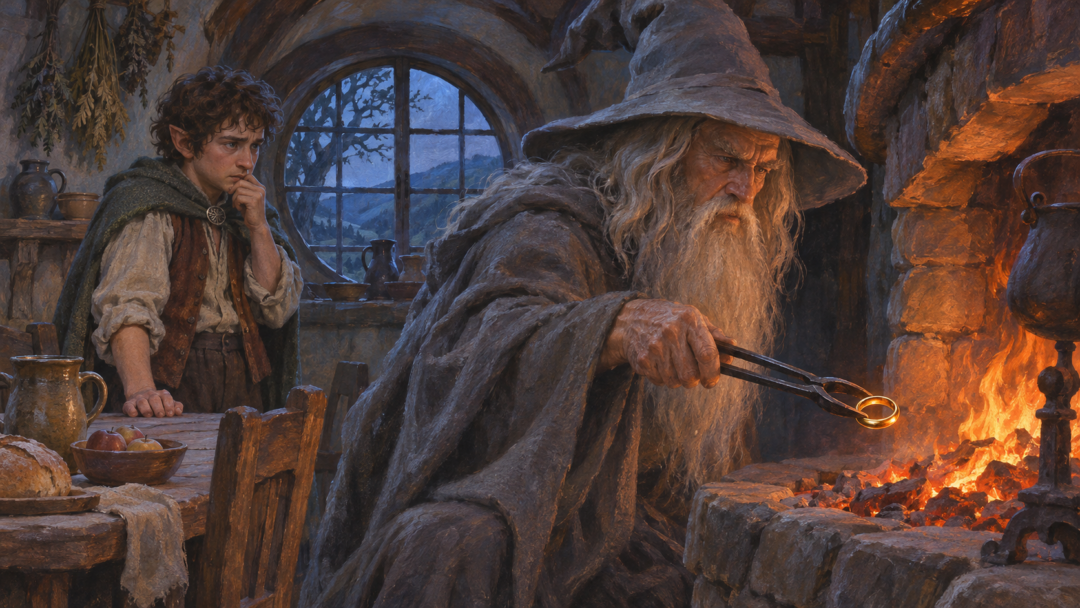
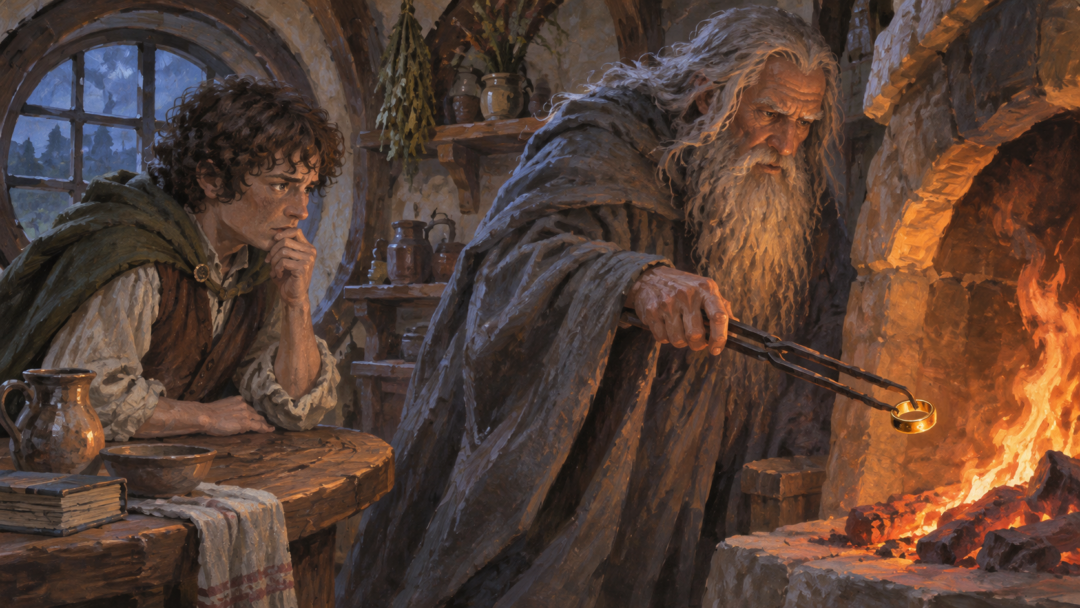
During that conversation, Gandalf puts the Ring into Frodo’s fireplace. He removes it with tongs. The fire reveals the inscription, but it cannot damage the Ring.
The scene establishes two things. First, the Ring can be handled indirectly. Gandalf does not need to hold it throughout the experiment. Second, ordinary physical precautions do not alter its essential nature.
Gandalf even picks the Ring up after removing it from the fire. Brief contact is not presented as an automatic catastrophe.
The distinction matters. The Ring is not radioactive material. Tolkien gives no indication that a momentary touch necessarily causes corruption, or that a layer of wood, leather, or cloth would block its power.
The danger develops through a person’s relationship with the Ring. Frodo owns it. He knows what it can do. Eventually he understands what others might do to obtain it.
Putting the same object on a stick would not remove that knowledge.
Possession matters more than contact
Bilbo provides the clearest early example.
In The Hobbit, Bilbo uses the Ring for invisibility. He discovers its practical advantages long before anyone explains its connection to Sauron. By the beginning of The Lord of the Rings, he has kept it for roughly sixty years.
He is not constantly wearing it. Nevertheless, he has become deeply attached to it.
In The Fellowship of the Ring, Book I, Chapter 1, “A Long-expected Party,” Gandalf has to press Bilbo to leave the Ring behind. Bilbo becomes suspicious and angry. He accuses Gandalf of wanting it for himself.
His attachment is not the consequence of one dangerous moment when gold touched skin. It has developed over decades of possession and use.
Gollum presents a more extreme case. In “The Shadow of the Past,” Gandalf recounts how Sméagol obtained the Ring through murder and kept it for centuries. He rarely had any useful reason to wear it in his underground hiding place. Yet he remained consumed by it.
Even after losing it, Gollum could not free himself from his desire.
That last point is decisive for the stick proposal. Gollum no longer possesses the Ring at all, but he continues to pursue it across Middle-earth.
Physical separation has not ended its hold over him.
Boromir offers another example. At the Council of Elrond, he sees the Ring as a possible weapon against Sauron. Later, in The Fellowship of the Ring, Book II, Chapter 10, “The Breaking of the Fellowship,” he attempts to take it from Frodo.
Boromir has never needed to wear the Ring to become dangerous. Its promise is sufficient.
He believes that the Ring could help save Gondor. His intentions are bound up with genuine courage and concern for his people. This is precisely what makes the temptation effective.
The Ring does not need to persuade everyone to become openly evil. It offers them a way to accomplish something they already believe is good.
A stick would not prevent Boromir from seeing that opportunity.
The Ring is not simply a cursed object
The One Ring is different from an enchanted object that causes a fixed effect whenever somebody touches it.
Its power is bound to the will of its maker.
In “The Shadow of the Past,” Gandalf explains that Sauron placed much of his own power into the Ring. He made it to dominate the other Rings of Power and those who used them. His strength remains connected to it even while the Ring is lost.
This is why destroying it matters. The Ring is not merely a valuable possession that Sauron wants returned. Its destruction would permanently diminish him.
It also explains why the Ring tempts powerful people in particular ways.
Gandalf refuses Frodo’s offer to give him the Ring. In the same chapter, he says:
“Do not tempt me!”
He understands that he might take it with the intention of doing good, then use its power to impose his own idea of goodness on others.
Galadriel confronts a similar possibility in The Fellowship of the Ring, Book II, Chapter 7, “The Mirror of Galadriel.” Frodo offers her the Ring, and she imagines the terrible grandeur of ruling through it.
Neither Gandalf nor Galadriel has to put it on to recognise the temptation.
They understand what possession would mean.
The danger, then, is not confined to the person whose skin happens to be nearest the gold. It concerns power, desire, and the possibility of domination.
Tolkien does not provide a measurable radius for this influence. He does not say that the Ring can affect someone at three feet but not at thirty. Nor does he suggest that a wooden barrier interrupts its power.
Those would be invented rules.
What the narrative does establish is that distance alone offers no reliable protection from wanting the Ring.
Why not put it in a box?
A box would be a reasonable way to conceal the Ring. It might prevent accidental use and make it less likely to attract attention from someone who happened to see it.
That would be useful.
But concealment is not the same as freedom from temptation.
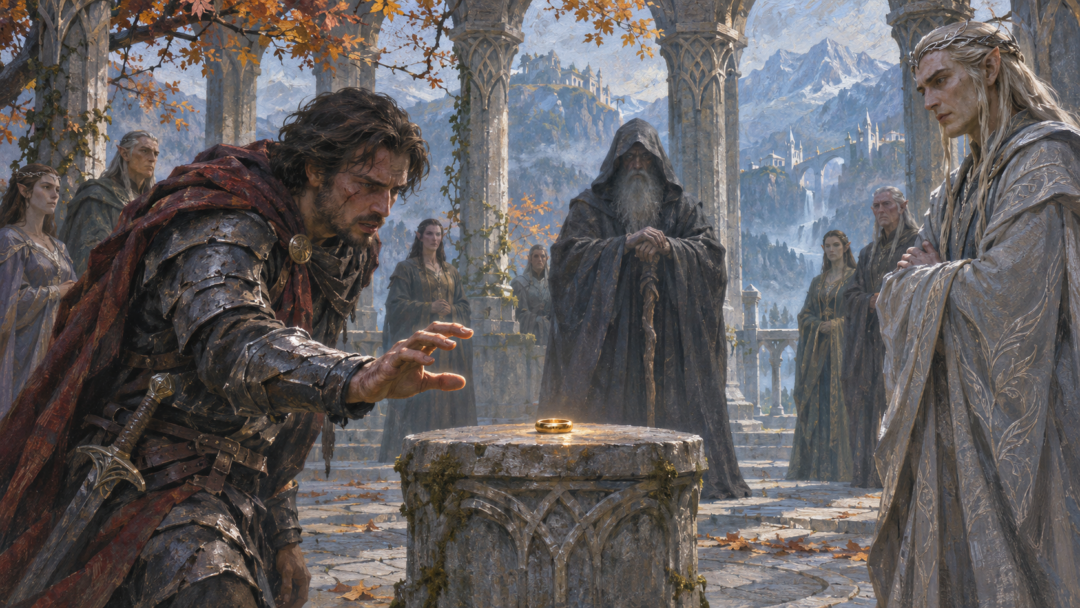
The Council of Elrond considers ways to dispose of the Ring without using it. In The Fellowship of the Ring, Book II, Chapter 2, “The Council of Elrond,” the participants discuss hiding it, sending it away, and throwing it into the Sea.
The objection to hiding it is not that the container would eventually break. It is that Sauron might endure, search, and ultimately recover it. The Sea itself would not be a permanent answer.
The Ring cannot be safely stored while Sauron remains a threat.
There is a further practical difficulty with a box or a pole. Somebody would still have to take responsibility for it.
Somebody would decide where it went, when to move it, whom to trust, and whether to surrender it.
That person would still be its keeper.
The proposed arrangement might reduce opportunities to put on the Ring. It would not remove the keeper’s power to claim it.
Nor would it remove the risk of theft. The Ring passes from one owner to another through loss, murder, inheritance, and reluctant surrender. Its physical accessibility matters, but it is only one part of the danger.
A determined Boromir could take a box. Gollum could steal a stick. Neither would cease desiring the Ring because it was temporarily out of reach.
Tolkien never tests a sealed container as a means of resisting the Ring’s influence, so it would be too strong to say such a precaution could accomplish nothing.
It might have helped in limited ways.
There is simply no textual basis for saying it would have prevented Frodo’s eventual struggle.
The films make the problem look different
Peter Jackson’s films place more emphasis on the immediate visual effects of the Ring.
Characters stare at it. The camera moves close to its surface. Its inscription glows. The soundtrack suggests an active presence. Temptation is often expressed through a character’s hand reaching toward the object.
These choices give an invisible moral struggle a visible form.
They also make it easier to imagine that the Ring works primarily through proximity or touch.
One scene is especially relevant. In Jackson’s The Fellowship of the Ring (2001), Gimli strikes the Ring with his axe at the Council of Elrond. The axe shatters, while the Ring remains intact.
That incident does not occur in Tolkien’s book.
In the novel, Elrond explains that the Ring cannot be destroyed by any craft available to the Council. Gandalf has already explained the necessary means of destruction in “The Shadow of the Past.” The Ring must be returned to the fire in which it was made.
The film adds a dramatic demonstration to communicate this fact.
It is effective cinema, but it should not be treated as additional evidence for the Ring’s precise magical properties in the book.
The films also alter the final struggle at Mount Doom.
In Jackson’s The Return of the King (2003), Frodo and Gollum fight at the edge of the precipice and both fall. Frodo survives by catching the ledge, while Gollum falls into the fire with the Ring.
Tolkien’s account is different.
That difference is central to understanding why a stick would not resolve the story.
The real problem appears at Mount Doom
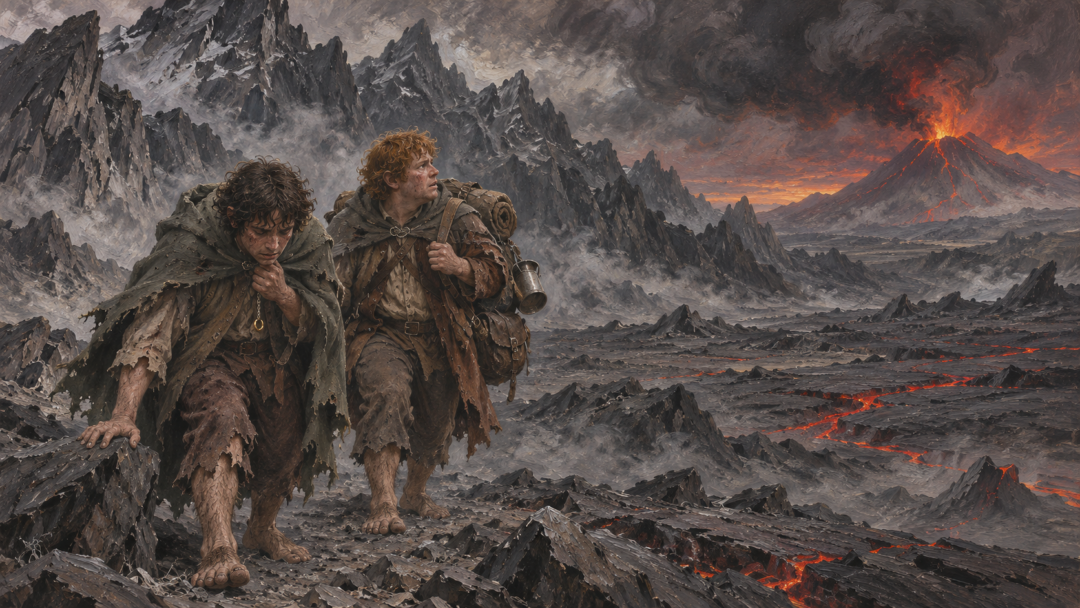
In The Return of the King, Book VI, Chapter 3, “Mount Doom,” Frodo finally reaches the place where the Ring can be destroyed.
He has carried it across Middle-earth. He has endured wounds, hunger, exhaustion, fear, and the burden of the Ring itself.
He is standing at the only place where the quest can be completed.
And he refuses.
Frodo declares:
“I do not choose now to do what I came to do.”
He claims the Ring for himself and puts it on.
This is not an accident caused by the Ring slipping onto his finger. Nor is it a failure of packaging. The decisive event is Frodo’s refusal to surrender the thing he has carried.
A stick might have kept the Ring farther from his body during the journey. It could not guarantee that, at the end, he would willingly cast it away.
The distinction becomes clearer in Tolkien’s letters.
In Letter 246, written in September 1963 and published in The Letters of J. R. R. Tolkien, edited by Humphrey Carpenter with Christopher Tolkien, Tolkien discusses Frodo’s failure at the Cracks of Doom.
He argues that Frodo had reached the limit of what could reasonably be expected of him. The pressure of the Ring, intensified by the place where it was forged, exceeded his remaining strength.
Tolkien does not portray this as an ordinary moral weakness that a better prepared hero would simply have overcome.
Frodo had done everything necessary to bring the Ring to the place of destruction. Yet bringing it there and freely choosing to destroy it were not the same achievement.
That is the central difficulty of the quest.
The Ring is destroyed because Frodo cannot let it go
The novel’s resolution is particularly important.
After Frodo claims the Ring, Gollum attacks him. Gollum bites off the finger bearing it and recovers his precious possession.
In his joy, he dances near the edge of the abyss. He missteps and falls into the fire.
The Ring is destroyed.
Frodo does not throw it in. Sam does not seize it and complete the task. Gollum does not intentionally sacrifice himself to save Middle-earth.
The destruction happens through an unforeseen consequence of Gollum’s desire.
This ending also gives significance to earlier acts of mercy.
In “The Shadow of the Past,” Gandalf tells Frodo that Bilbo’s pity in sparing Gollum may have consequences beyond anyone’s understanding. Frodo later spares Gollum himself. Sam, at the foot of Mount Doom, also refrains from killing him.
These choices allow Gollum to be present at the final moment.
They do not constitute a carefully engineered plan to destroy the Ring. Their importance emerges only afterward.
Tolkien connects the outcome to providence, mercy, and the limits of individual power. In Letter 246, he treats the final destruction as something beyond Frodo’s unaided capacity.
That is a very different resolution from a story in which the heroes simply discover a safer technique for transporting a dangerous object.
If Frodo could have defeated the Ring by using a long enough stick, the climax would become a question of practical foresight.
Instead, he reaches the end of his strength and fails to perform the final act.
The quest succeeds nonetheless.
What the stick would actually change
There is no reason to dismiss the stick as an entirely foolish suggestion.
Keeping the Ring on a chain was already sensible. A container might have offered further protection against accidental loss, unwanted attention, or impulsive use. Tolkien does not forbid such precautions.
He simply does not establish that they would neutralise the Ring’s power.
The decisive evidence lies in the people who desire it without wearing it: Bilbo when asked to surrender it, Gollum after losing it, Boromir before ever possessing it, and Gandalf when refusing the possibility of ownership.
Their struggles differ, but none depends on uninterrupted physical contact.
Frodo’s experience adds the final qualification. Avoiding the Ring’s use was possible for long periods. Carrying it without being changed by the burden was not.
The story also makes no claim that Frodo could simply have chosen another keeper without consequences. By the time the Fellowship breaks, the danger of putting the Ring into more powerful hands has become unmistakable. Frodo’s relative lack of worldly ambition makes him a suitable bearer, not an immune one.
This is why the Ring remains dangerous even when nobody is wearing it.
It offers power to those who might wield it. It inspires fear in those who know its history. It creates attachment in those who keep it. And, at the place of its making, it defeats even the person who has resisted it most faithfully.
The Ring could have been put on a stick. Tolkien gives no reason to think that the stick would have saved Frodo.
The physical problem was always manageable. The moral problem was not.
That is why the Ring reaches Mount Doom on a chain, and why its destruction ultimately depends on something other than the strength of the person carrying it.
Sources & Notes
This article is based on close reading and interpretation of Tolkien's published works and related source material where relevant.