ChatGPT said: Why Didn’t the One Ring Shrink on Frodo’s Finger?
The One Ring could change its size. Tolkien states this directly in The Fellowship of the Ring. It could become smaller, grow larger, and slip from a finger that had previously held it securely. There is no evidence, however, that it failed to shrink for Frodo. The books never describe the Ring as too large for his hand. Nor do they describe a visible contraction whenever he puts it on.
The simplest answer is that the Ring could alter its size, but it did not have to change size every time someone wore it. Its dimensions were not fixed. Neither were they governed by an automatic rule requiring it to fit every wearer as tightly as possible.
This distinction matters. Tolkien gives the Ring a capacity to act against its possessor. He does not present it as an ordinary piece of jewellery with a magical resizing function. The Ring’s changing size belongs to a larger pattern of behaviour. It can remain with someone for years. It can also abandon that person at a dangerous moment.
Frodo’s experience makes sense within that pattern. The Ring fits him when he wears it. It stays on his finger when he needs to remove it. Nothing in the narrative requires Tolkien to describe it shrinking at that moment.
The clearest explanation comes from Gandalf.
What Gandalf actually says about the Ring
In Book I, Chapter 2 of The Fellowship of the Ring, “The Shadow of the Past,” Gandalf explains what Bilbo had discovered during his possession of the Ring.
Bilbo noticed that the object was not always consistent in size or weight. Gandalf reports that “it shrank or expanded in an odd way.” He also explains that it could unexpectedly become loose enough to fall from a finger.
This is the principal textual evidence for the Ring’s ability to change size. Tolkien does not leave the property to speculation. It is something Bilbo observed and eventually considered dangerous enough to mention to Frodo.
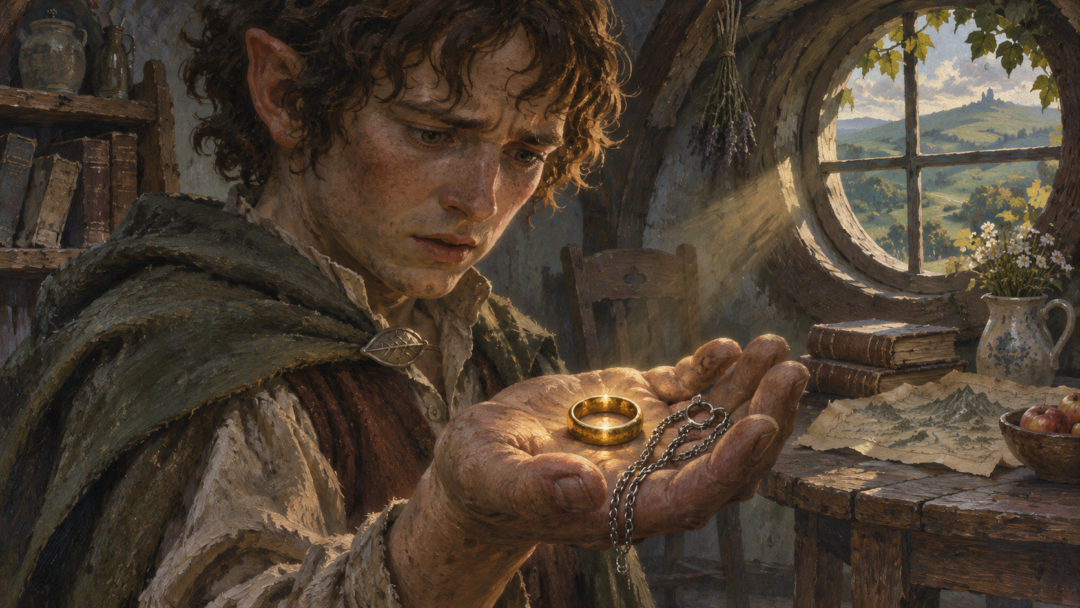
Frodo tells Gandalf that Bilbo had warned him in his final letter. For that reason, Frodo has kept the Ring attached to a chain.
That detail is important. Frodo does not ordinarily carry the Ring on his finger. He carries it around his neck, often concealed beneath his clothing. The chain is a practical safeguard against losing it.
The danger is not that the Ring might become too small. It is that it might become large enough to escape.
Gandalf subsequently explains that a Ring of Power can look after itself. It may betray its keeper, even when that keeper has become unwilling to surrender it.
The distinction between the Ring’s physical behaviour and its influence on the mind is already established. Its keeper grows attached to it. At the same time, its keeper cannot rely on it remaining securely in place.
Tolkien gives no measurements. He does not specify how quickly the Ring changes diameter or whether those changes can always be observed. What matters in this conversation is its unreliability.
The Ring is not simply adapting itself for convenience. It possesses an apparent capacity to make that adaptation serve another purpose. Science Fiction & Fantasy Stack Exchange +1
Isildur provides the clearest example of shrinking
The Ring’s ability to contract appears again in an account written by Isildur.
In Book II, Chapter 2, “The Council of Elrond,” Gandalf recounts his discovery of Isildur’s written description of the Ring. The document had survived in the archives of Minas Tirith.
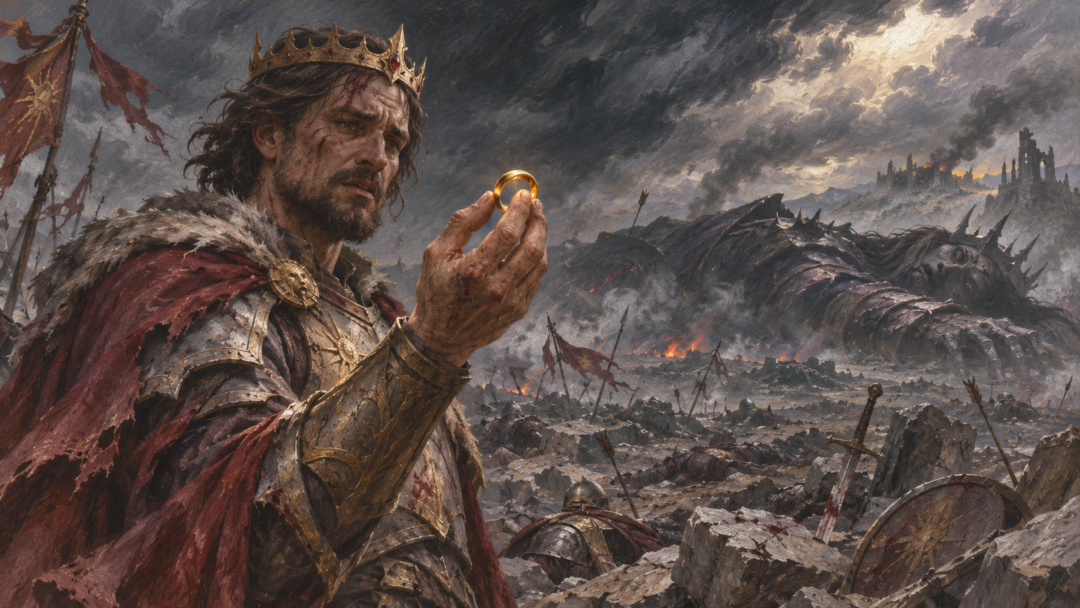
Isildur describes taking the Ring after Sauron’s defeat. It was initially hot enough to burn his hand. Later, the heat faded, and the inscription began to disappear.
He also records that “it seemeth to shrink.”
This is an especially useful passage because it describes the Ring changing after it has passed from Sauron to another possessor.
The Ring had been worn by Sauron. It could subsequently be worn by Isildur, a Man. Centuries later, it could be worn by Gollum and Bilbo, both of whom belonged to the smaller, hobbit-related peoples.
The text establishes the possibility of changes in size. It does not describe a precise relationship between the measurements of those individuals.
Nor does Isildur say that the Ring shrank specifically to fit his finger. He observes that it appeared to be getting smaller as it cooled. That observation is sufficient evidence of contraction, but the reason for it remains unstated.
This is where a common explanation goes further than Tolkien’s words.
It is reasonable to infer that the Ring adjusted to its wearers. Its history strongly supports that interpretation. Yet Tolkien never gives a universal rule that the Ring instantly measures each new finger and contracts to the smallest comfortable diameter.
Isildur’s account describes a change. It does not establish a mechanical law governing every later change.
The same distinction applies to Frodo. Science Fiction & Fantasy Stack Exchange
Why the Ring abandoned Isildur
Isildur’s death shows why the Ring’s ability to expand is more significant than its ability to shrink.
After the defeat of Sauron, Isildur kept the Ring rather than surrendering it. He eventually travelled north with his companions. Near the Gladden Fields, his company was attacked by Orcs.
Isildur escaped the immediate fighting by using the Ring to become invisible. He entered the Anduin and attempted to swim away.
The Ring slipped from his finger.
Without its protection, he became visible again. The Orcs saw him and killed him with arrows.
Gandalf recounts this history in “The Shadow of the Past.” Tolkien gives a fuller account of the disaster in “The Disaster of the Gladden Fields,” published in Unfinished Tales, Part Three, Chapter I.
The Ring’s departure is treated as a betrayal. It does not merely fall because Isildur happens to be swimming. The larger account of its history gives that moment a particular significance.
The Ring leaves Isildur, and its departure contributes to his death.
It is natural to connect this event with the changing size Gandalf describes. An expansion could allow a previously secure Ring to slip away. Yet Tolkien does not describe its diameter increasing while Isildur swims.
The distinction is worth preserving. The slipping is explicitly described. The precise physical mechanism is not.
This also explains why a Ring capable of shrinking would not necessarily remain on Frodo’s finger forever. Its capacity to fit securely did not prevent it from becoming loose when circumstances changed.
The same object could do both things.
Frodo’s finger was not a special problem
Frodo was a hobbit. His fingers were smaller than those of most Men. They were presumably much smaller than Sauron’s.
But by the time Frodo inherited the Ring, it had already spent decades with Bilbo. Before that, it had remained with Gollum for centuries.
There is no reason to assume that it retained the dimensions it had when Isildur first took it from Sauron.
More importantly, Tolkien does not describe Frodo struggling to wear an oversized Ring.
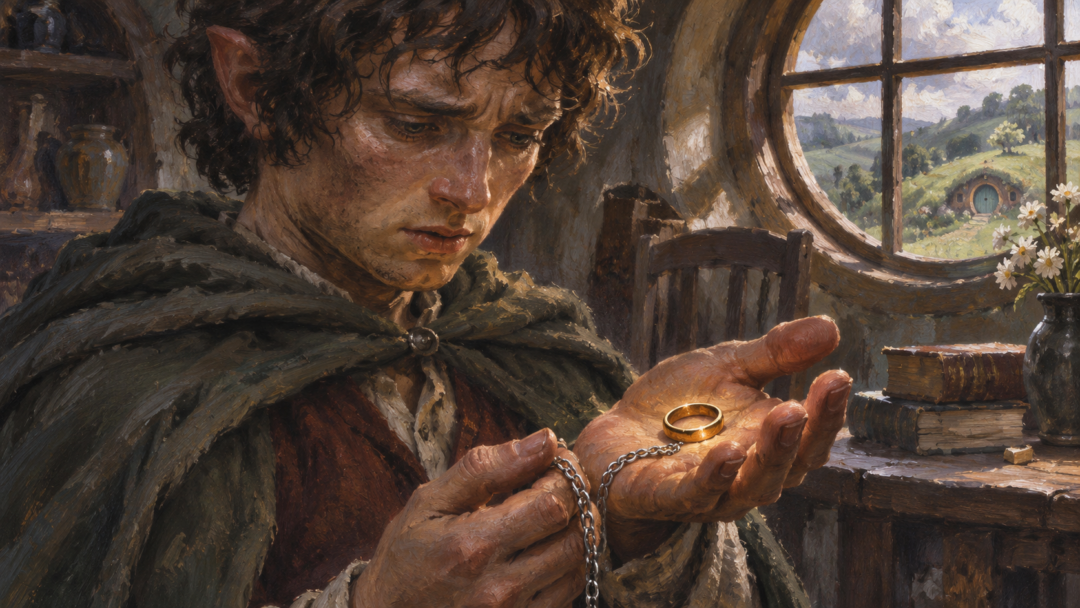
At the Prancing Pony in Bree, Frodo accidentally puts it on while performing a song. He falls from a table and disappears.
The incident occurs in Book I, Chapter 9, “At the Sign of the Prancing Pony.”
Frodo cannot explain exactly how the Ring reached his finger. He supposes that he had been handling it in his pocket and that it slipped on during his fall.
The scene establishes the Ring’s presence on his finger. It does not describe a change in size.
That absence is not evidence that the Ring remained too large. Tolkien simply has no need to describe its dimensions. Frodo is concerned with his sudden disappearance and the attention it has attracted.
The situation is different at Weathertop.
In Book I, Chapter 11, “A Knife in the Dark,” Frodo feels an overwhelming temptation to put on the Ring as the Black Riders approach.
He eventually yields and places it on the forefinger of his left hand.
Again, Tolkien does not describe it shrinking.
After the Witch-king wounds him, Frodo manages to remove the Ring. The action requires great effort, but the difficulty is bound up with the Ring’s influence and the terrible circumstances of the attack.
There is no suggestion that the Ring has physically tightened beyond removal.
The fact that Frodo can put it on and take it off is enough for the scene. A separate description of the Ring changing size would add little. PubHTML5
The Ring did not always get what it wanted
The Ring’s apparent agency can create another misunderstanding.
Gandalf describes it as trying to return to Sauron. It abandoned Isildur. It eventually left Gollum, allowing Bilbo to find it in the tunnels beneath the Misty Mountains.
These events suggest a purpose beyond the wishes of its immediate possessor.
But the Ring is not shown exercising complete control over its circumstances.
Bilbo keeps it for decades. He eventually gives it up, although with considerable difficulty. Frodo carries it across Middle-earth despite its influence upon him. Sam briefly bears it and then returns it to Frodo.
The Ring’s power is considerable. It is not unlimited.
This matters when considering why it remained with Frodo rather than expanding and slipping away.
Gandalf explains in “The Shadow of the Past” that Gollum had become an unsuitable keeper. He remained hidden beneath the mountains and had little prospect of carrying the Ring into the wider world.
The Ring’s abandonment of Gollum therefore served its movement away from that place.
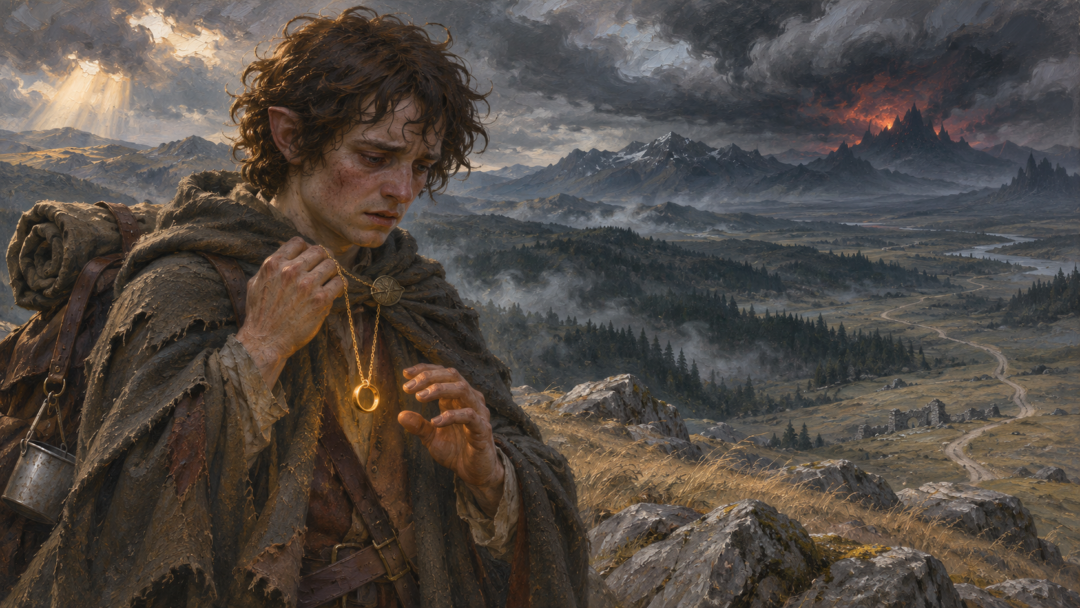
Frodo’s circumstances were different. He carried the Ring out of the Shire and eventually towards Mordor, where Sauron’s power was concentrated.
It is possible to interpret the Ring’s continued presence with Frodo as consistent with its desire to return to its maker.
That remains an interpretation. Tolkien does not say that the Ring consciously decided to maintain a particular diameter on Frodo’s finger because Frodo was taking it east.
There is also another force at work.
Gandalf suggests that Bilbo was meant to discover the Ring, though not by Sauron’s design. Frodo, too, was meant to receive it.
The narrative therefore distinguishes the Ring’s tendency to return to Sauron from the larger purposes operating against him.
It would be a mistake to treat every movement of the Ring as the successful execution of a single, intelligent plan.
What Peter Jackson’s films change
Peter Jackson’s The Fellowship of the Ring (2001) gives the Ring’s change in size a more visible form.
The opening establishes Sauron as an enormous armoured figure. After his defeat, the Ring passes into Isildur’s possession, and the film depicts its contraction.
This visual treatment makes Tolkien’s description immediately understandable. An object worn by Sauron can become small enough for a Man.
The film also places considerable emphasis on the Ring as a physical object. Close-ups, sound effects, movement and visual effects communicate its unusual weight and influence.
The filmmakers made the Ring seem more actively present than an ordinary gold band.
Their treatment of the Prancing Pony incident is revealing.
In Tolkien’s book, Frodo is performing a song when he falls. The Ring somehow reaches his finger, though he cannot explain exactly how.
In Jackson’s film, Frodo falls while trying to stop Pippin from revealing too much about Bilbo. The Ring flies into the air, and Frodo’s finger passes through it as he falls.
The effect makes its movement seem purposeful.
In the filmmakers’ commentary, Jackson and his collaborators explain that they wanted the incident to feel less like Frodo’s foolishness and more like the Ring’s doing. They deliberately changed the staging to make its influence easier to see.
That is a film interpretation of Tolkien’s scene, not a description supplied by the novel. SecondTrack
The same distinction applies to the Ring’s apparent size.
The films use a visibly changing Ring where such an effect helps the audience understand its nature. They do not show an equally conspicuous contraction every time Frodo wears it.
This does not establish that Frodo’s Ring was somehow exempt from its normal powers. It reflects the difference between a visual adaptation and Tolkien’s prose.
The films provide a specific image. The book provides a broader property.
Why didn’t the Ring shrink tightly enough to protect itself?
A related question arises at the end of the story.
If the Ring could change size, why did it not contract so tightly around Frodo’s finger that Gollum could not take it?
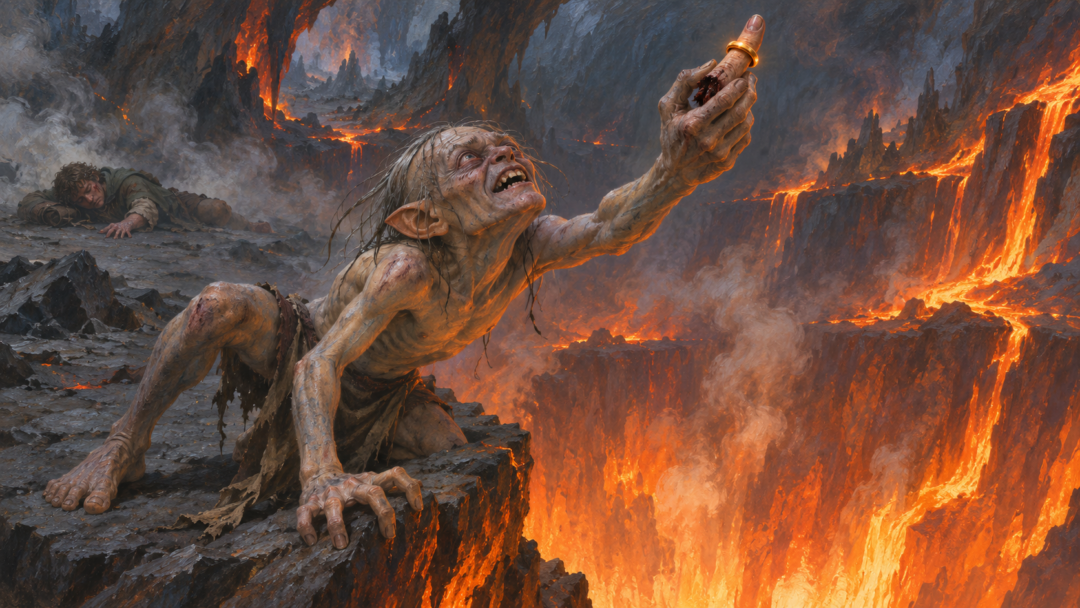
The answer lies in what actually happens at Mount Doom.
In Book VI, Chapter 3, “Mount Doom,” Frodo finally reaches the place where the Ring was forged. He cannot bring himself to destroy it. Instead, he claims it and puts it on.
Gollum attacks the invisible Frodo and bites off the finger bearing the Ring.
The Ring is not removed from the finger. Gollum takes the finger with it.
Tolkien makes the physical detail unmistakable. Gollum celebrates his recovery of the Ring while Frodo’s severed finger remains inside its circle.
No amount of tightening around the finger would necessarily have prevented this.
There is also no evidence that the Ring anticipated Gollum’s attack or could respond instantly to every physical danger.
Gollum’s triumph lasts only moments. He steps too far, falls into the fire and destroys the Ring.
The book does not describe the Ring choosing to fall. Nor does it describe an unsuccessful attempt to shrink itself out of danger.
Its destruction results from Gollum’s actions and the circumstances that brought him to that place.
Jackson’s The Return of the King (2003) changes the final struggle. Frodo and Gollum fight at the edge of the precipice, and both go over. Frodo survives by catching the ledge.
In Tolkien’s account, Gollum falls through his own movement while celebrating his prize. Frodo does not wrestle him over the edge.
The difference matters because the book’s ending is not a contest between Frodo’s strength and the Ring’s physical powers. It is the culmination of choices, mercy, possession and chance. H.M. Turnbull
A changeable Ring, not an automatic mechanism
The question rests on an assumption that Tolkien never establishes: that the Ring must visibly shrink whenever it is placed on a smaller finger.
The text supports a more limited conclusion.
The Ring can shrink. Isildur records observing it. Bilbo notices changes in both its size and weight. Frodo knows enough about this behaviour to carry it on a chain.
The Ring can also become loose. Its escape from Isildur demonstrates the danger, and Bilbo’s own experiences reinforce Gandalf’s warning.
Yet no passage says that the Ring must change size on every occasion, or that its dimensions are always being adjusted to the exact measurements of its wearer.
Frodo’s experience is therefore not an exception requiring a special explanation.
The Ring had already passed through several possessors before reaching him. It could fit his finger. It did not have to undergo a separately narrated contraction whenever he wore it.
Tolkien’s interest lies elsewhere.
The Ring is dangerous because possession of it changes the possessor. Its physical instability is one expression of that danger. The keeper believes he owns something precious and useful. In reality, he cannot rely on controlling it.
A Ring that stays comfortably on a finger can be as treacherous as one that suddenly slips away.
The One Ring did not fail to shrink for Frodo. Tolkien simply never says that it needed to shrink at the moments when Frodo wore it. Its capacity to change size is established. The timing, degree and mechanism of those changes are not.
The films make that capacity visible. The book leaves much of it unstated.
What remains consistent is the more important fact. The Ring could fit its keeper without being faithful to him.
Sources & Notes
This article is based on close reading and interpretation of Tolkien's published works and related source material where relevant.