ChatGPT said: What if the Hobbits Hadn’t Called for Tom Bombadil Early On?
If the hobbits had not called for help in the Old Forest, their journey might have ended before they reached Bree. Merry and Pippin were trapped inside Old Man Willow, Sam could not free them, and Frodo had no effective means of fighting the tree. Tom Bombadil’s arrival saved them from a danger they scarcely understood.
But there is an important distinction in Tolkien’s account. Tom does not appear because Frodo knows how to summon him. Frodo simply cries for help. Tom happens to be passing nearby, singing to himself. Whether his arrival is chance, providence, or something between the two remains deliberately uncertain.
Without that encounter, the hobbits would probably never have visited Tom’s house. They would not have met Goldberry, learned about the dangers of the surrounding country, or received the song that later brings Tom to their rescue on the Barrow-downs.
The consequences would extend far beyond the Old Forest. Most importantly, the hobbits might never have acquired the ancient blades recovered from the barrow. One of those weapons eventually plays a decisive role in the defeat of the Witch-king.
The most likely result, then, is not simply a more difficult journey. It is a journey that ends before the Ring reaches Rivendell, with consequences for the entire War of the Ring.
Yet Tolkien leaves enough room for a less certain answer. The precise nature of Tom’s first arrival matters.
The danger beneath Old Man Willow
The encounter takes place in Book I, Chapter 6 of The Fellowship of the Ring, “The Old Forest.”
Frodo, Sam, Merry, and Pippin have left the Shire by way of Buckland. They hope to avoid the Black Riders by travelling through the Old Forest rather than taking the more obvious roads.
Their choice is understandable. They know the Riders are searching for Frodo, and they have already experienced how difficult it is to evade them. The forest offers concealment.
It also possesses dangers of its own.
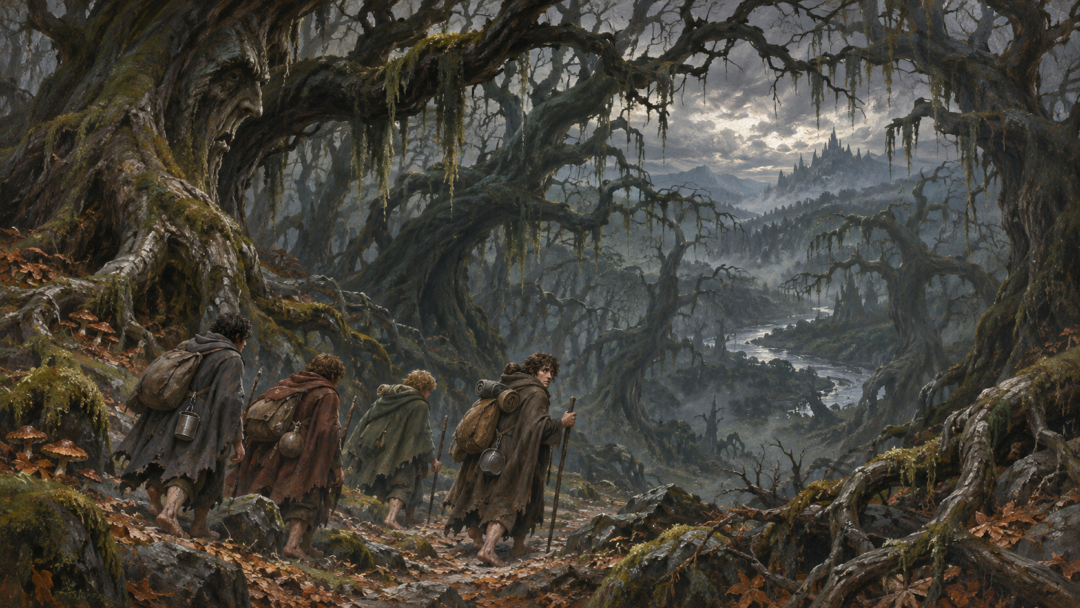
The trees seem to resist the hobbits’ attempts to choose their route. Paths become difficult to follow. The travellers are drawn towards the valley of the Withywindle, where an ancient willow stands beside the water.
Old Man Willow is not merely a large, unfriendly tree. He possesses an active and malicious will. His influence spreads through the surrounding wood, confusing travellers and encouraging them to sleep.
The hobbits succumb to that influence.
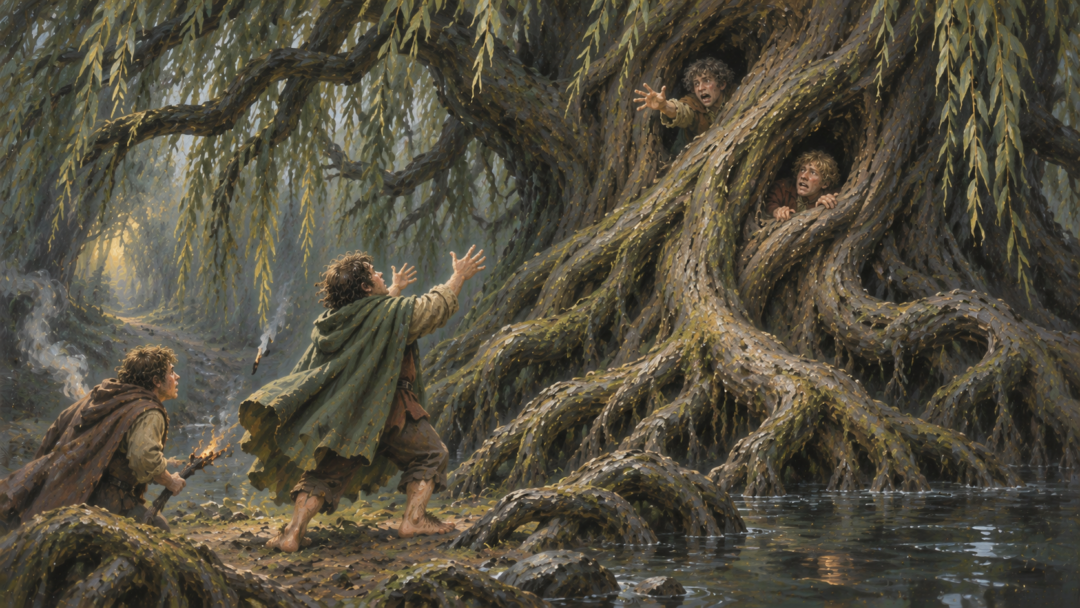
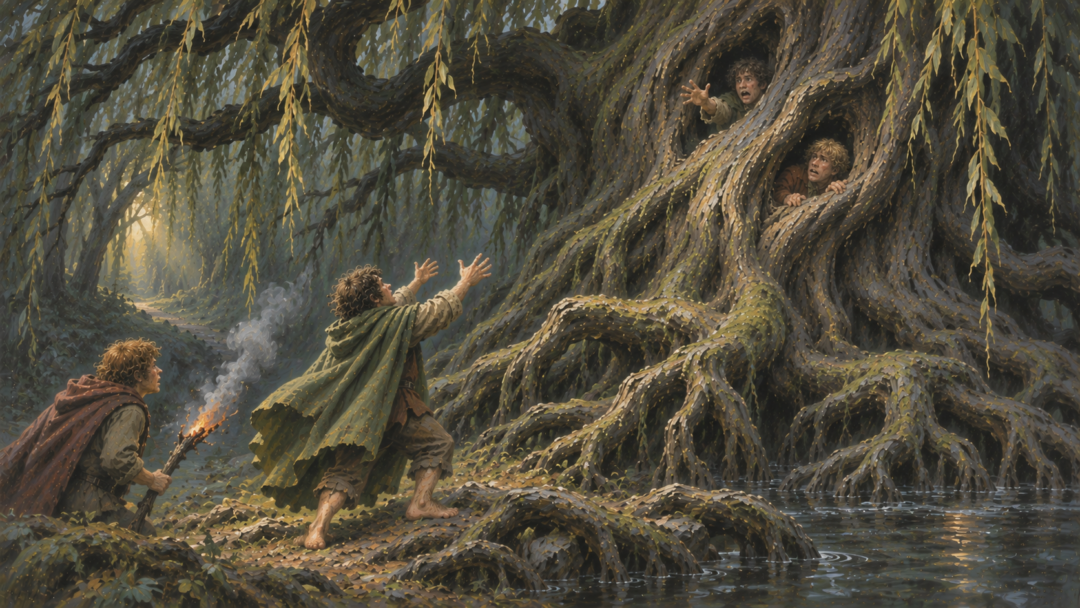
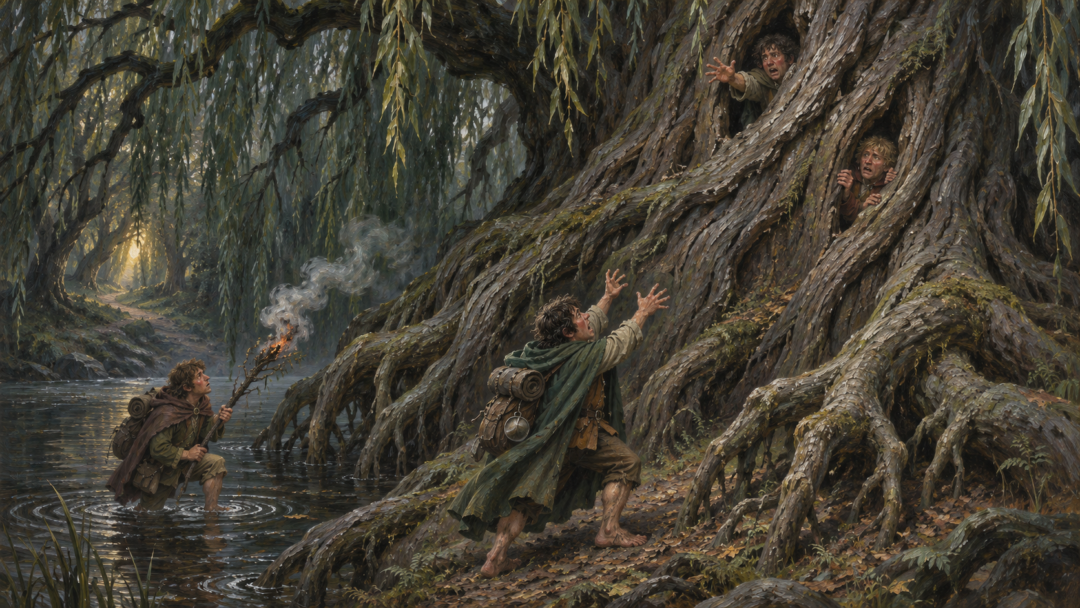
Merry and Pippin become trapped within the tree. Frodo is thrown into the water, and Sam helps him escape. The two remaining free hobbits struggle to release their companions.
Their efforts accomplish little.
Sam attempts to use fire against the willow. The threat produces a response, but it also places the imprisoned hobbits in greater danger. Merry cries out from inside the trunk, warning that the tree may crush him.
This is the point at which Frodo runs along the path calling for help.
The circumstances are important. Frodo is not making a calculated appeal to a known protector. He has no knowledge of Bombadil’s existence. His cry is an expression of desperation.
Tom appears soon afterwards, carrying water-lilies and singing.
He understands the situation almost immediately. His response is not to attack the tree with a weapon, but to command it through speech and song. Old Man Willow releases his prisoners.
Tolkien presents Tom’s authority as something already established within the landscape. He knows the willow’s character, and the willow recognizes his power.
Without Tom, there is no demonstrated way for Frodo and Sam to free Merry and Pippin.
They might have continued trying to use fire. They might have sought another way to injure the tree. But neither possibility offers much reason for confidence.
Merry and Pippin were already in immediate danger. A delayed rescue might have come too late.
That is the first and most straightforward answer to the question. The four hobbits might never have escaped the Old Forest together.
Was Tom’s arrival really caused by the call?
Tolkien complicates the matter in the following chapter.
In Book I, Chapter 7, “In the House of Tom Bombadil,” Frodo asks whether Tom heard him calling or arrived by chance.
Tom does not give a simple answer. He speaks of having been nearby and of knowing the nature of Old Man Willow.
The exchange leaves open the relationship between Frodo’s cry and Tom’s arrival. Tom was already travelling through the forest. He was not waiting at home for a summons.
This means that removing Frodo’s call does not necessarily remove Tom from the scene.
He might still have followed the same path. He might still have noticed the disturbance beneath the willow. His knowledge of the forest suggests that he could recognize trouble without a formal request for assistance.
But that is a possibility, not an event established by the text.
The distinction matters because there are two different counterfactuals.
In the first, Frodo never calls for help, but Tom passes by as he does in Tolkien’s account. A rescue remains possible.
In the second, Frodo’s silence means that the hobbits never encounter Tom at all. The consequences become much more serious.
The second possibility is the more useful one for understanding Tom’s place in the story. It reveals how much depends upon an apparently incidental meeting.
It also raises a familiar question in Tolkien’s writing: whether chance encounters are entirely accidental.
Earlier, in Book I, Chapter 2, “The Shadow of the Past,” Gandalf tells Frodo that Bilbo was meant to find the Ring, though not by its maker.
Tolkien does not explicitly apply that explanation to Bombadil’s arrival. It would be misleading to claim that Gandalf’s words prove Tom was sent to rescue the hobbits.
Nevertheless, the two events share a pattern. An apparently accidental occurrence permits the larger story to continue.
The significance becomes clearer when the hobbits leave Tom’s protection.
The second rescue would never have been possible
After their first encounter, Tom invites the hobbits to his house.
They spend time with him and Goldberry, receiving food, rest, shelter, and knowledge of the country. Tom also reveals something extraordinary about his relationship with the Ring.
In “In the House of Tom Bombadil,” he handles the Ring without showing the usual signs of temptation. When he puts it on, he does not disappear. Later, Frodo puts it on himself, but Tom can still see him.
These details establish that Tom stands outside some of the Ring’s ordinary effects. They do not establish that he can destroy it or defeat Sauron.
For the hobbits, his more immediate gift is practical.
Before they depart, Tom teaches them a song by which they can call upon him if they encounter danger within his country.
That lesson becomes essential in Book I, Chapter 8, “Fog on the Barrow-downs.”
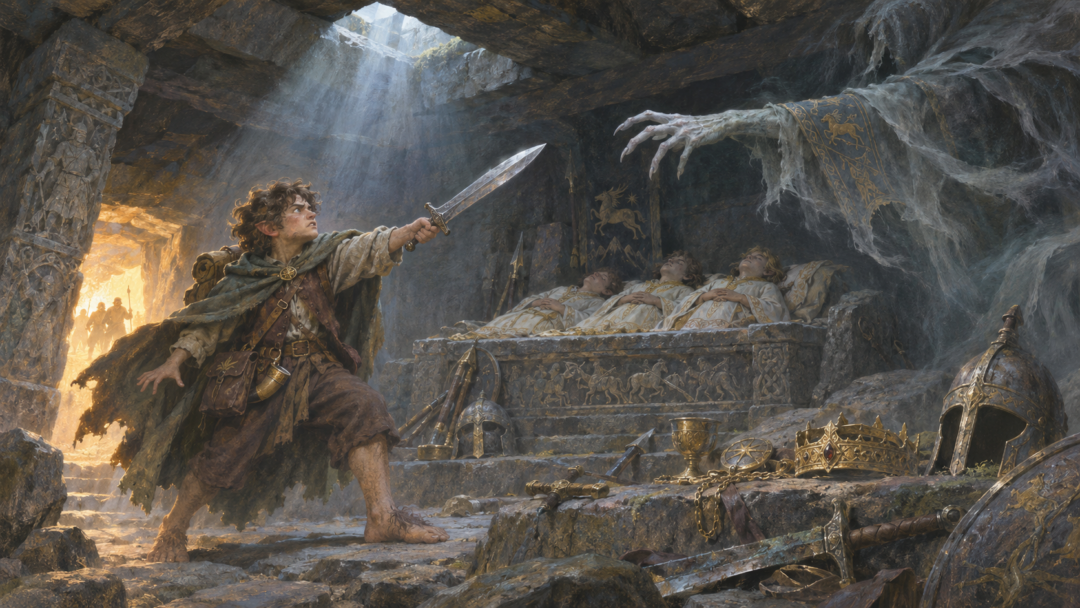
The hobbits lose their way in the fog and fall under the power of a barrow-wight. Frodo eventually awakens inside a burial mound. His companions lie unconscious, dressed in white garments and surrounded by grave treasures.
A sword rests across their necks.
Frodo faces a choice. He considers using the Ring to escape. Instead, he resists that temptation and attacks the threatening arm of the wight with his own sword.
Then he remembers Tom’s song.
He sings, and Bombadil comes.
Tom drives out the wight, opens the barrow, and brings the hobbits back into daylight.
Without the first meeting in the Old Forest, Frodo would not have learned this song. Even if the four hobbits somehow escaped Old Man Willow, they would have entered the Barrow-downs without their established means of obtaining Tom’s help.
They might have avoided the burial mounds altogether. Tom’s guidance helps shape their actual route, and a different journey could have taken them elsewhere.
But if they reached the same barrow and suffered the same attack, their prospects would be poor.
Frodo shows real courage. He is capable of resisting the Ring and striking against the wight. Yet Tolkien does not show that he can defeat the creature unaided, awaken his companions, or escape the tomb.
The likely outcome would be the death or permanent loss of the hobbits.
The Ring would remain in a region already associated with hostile powers.
The swords that would never reach the Witch-king
There is another consequence of the rescue on the Barrow-downs.
After freeing the hobbits, Tom takes ancient blades from the treasure within the barrow and gives them to the travellers.
These are not ordinary short swords.
In Book I, Chapter 8, Tolkien explains their connection with the Men of Westernesse and the old wars against the enemies of Arnor. The blades come from a history that predates the Shire and the present struggle against Sauron.
Their importance is not fully revealed until much later.
In Book V, Chapter 6 of The Return of the King, “The Battle of the Pelennor Fields,” Merry uses his blade against the Witch-king of Angmar.
The Witch-king has confronted Éowyn, who stands between him and the fallen Théoden. Merry strikes him from behind, piercing the sinew of his knee.
Éowyn then delivers the fatal blow.
Tolkien makes the significance of Merry’s weapon unusually clear. He explains that the blade was made long ago by the enemies of Angmar, and that no other blade, even in mightier hands, would have dealt the same wound.
That statement gives the earlier episode in the Barrow-downs a direct bearing on the war’s decisive battle.
Without Tom’s intervention, Merry might never have obtained the weapon.
Without that weapon, Merry might not have been able to injure the Witch-king in the same way.
And without Merry’s intervention, Éowyn might not have had the opportunity to defeat him.
None of this proves that the Witch-king would have survived the entire war. Tolkien does not establish that no other means of defeating him existed.
It does show that the particular victory described on the Pelennor Fields depends upon a weapon acquired during the hobbits’ early journey.
The connection is easy to overlook because the two events occur so far apart.
A rescue in an ancient tomb becomes part of the explanation for the fall of one of Sauron’s greatest servants.
The past has not disappeared from Middle-earth. Its weapons, grievances, and unfinished struggles remain active in the present.
Could the Ring still have reached Rivendell?
The largest uncertainty concerns Frodo himself.
If Merry and Pippin had died in Old Man Willow, Frodo and Sam might conceivably have continued towards Bree. They still possessed the Ring, and their immediate objective remained unchanged.
Yet their position would have been considerably weaker.
Merry knew the country around Buckland. The hobbits also depended upon one another for practical support and companionship. Losing half their party so early would have deprived Frodo of both.
More importantly, they would have lost the encounter with Bombadil and everything that followed from it.
There is no reason to assume that Frodo and Sam would then have travelled safely through the forest, crossed the Barrow-downs, or reached Bree at the necessary time.
At Bree, the hobbits meet Aragorn, who helps them reach Rivendell. Their arrival is already precarious in the actual story.
The Black Riders pursue them across Eriador. Frodo is wounded at Weathertop, and his survival depends upon reaching Elrond’s house.
Any substantial delay before Bree would therefore have mattered.
There is also a wider consequence. Without reaching Rivendell, Frodo could not have participated in the Council of Elrond or volunteered to carry the Ring towards Mordor.
Another Ring-bearer might have been found. Gandalf and Elrond might have attempted a different course.
But Tolkien provides no basis for assuming that an alternative would have succeeded.
The eventual destruction of the Ring depends upon a long succession of choices, encounters, and acts of mercy. Removing the journey’s earliest protections threatens that entire chain.
It is therefore reasonable to conclude that the failure to encounter Bombadil could have prevented the Quest from developing in its familiar form.
It is less reasonable to describe any particular alternative history as certain.
Why Tom could not simply solve the larger problem
Tom’s ability to rescue the hobbits raises an obvious question.
If he possesses such remarkable power, why does he not take responsibility for the Ring?
Tolkien answers this explicitly in Book II, Chapter 2, “The Council of Elrond.”
When the Council considers whether Bombadil might keep the Ring safe, Gandalf explains that Tom’s independence from its influence does not give him authority over its power.
Gandalf says that Tom is “his own master,” but cannot alter the Ring or break its hold over others.
He also doubts that Tom would recognize the need to guard it indefinitely. He might simply forget about it or discard it.
Bombadil’s power is real, but limited in its application.
He can confront Old Man Willow. He can drive a wight from its barrow. He can shelter travellers within his country.
He cannot replace the Ring-bearer’s task.
This distinction prevents the counterfactual from becoming a story in which Tom could simply have carried the Ring to Mordor.
His importance lies elsewhere. He enables the hobbits to continue their journey without taking it over.
That is also why his absence matters so much. Tom provides help at moments when the travellers lack the strength or knowledge to save themselves.
Once they leave his country, they must proceed without him.
What the films leave out
Peter Jackson’s theatrical adaptation of The Fellowship of the Ring removes Tom Bombadil, Goldberry, Old Man Willow, and the Barrow-downs episode.
The film takes the hobbits towards Bree without those encounters.
That change produces a different narrative structure. The ancient blades from the barrow no longer enter the story through Tom’s rescue. Instead, Aragorn supplies weapons to the hobbits at Weathertop.
The films also do not retain the book’s full explanation of Merry’s blade and its particular significance against the Witch-king.
Consequently, the cinematic version does not demonstrate that Bombadil was unnecessary to the events of the novel. It rewrites the circumstances in which the hobbits survive and acquire their weapons.
Within the film’s continuity, the journey can proceed without Tom because other elements of the story have been changed.
Within Tolkien’s text, his absence would leave several immediate dangers unresolved.
The distinction is essential when asking what might have happened to the hobbits. The question concerns the events and conditions established in the book, not the alternative continuity created by the adaptation.
A small cry with consequences far beyond the forest
The most defensible conclusion is that the hobbits’ failure to call for help would have placed Merry and Pippin in immediate mortal danger. If Tom did not intervene, the four travellers would probably have been separated or destroyed before reaching Bree.
Even if they escaped, the loss of their meeting with Bombadil would remove his later rescue on the Barrow-downs. It would also interrupt the chain of events by which Merry acquired the weapon he eventually used against the Witch-king.
Tolkien does not state that Frodo’s original cry summoned Tom through supernatural power. Nor does he establish that Tom would certainly have passed the trapped hobbits without helping them.
The uncertainty is part of the episode.
What the text does establish is the extraordinary significance of a seemingly minor encounter.
At this early stage, the hobbits do not understand the history of the Ring, the full danger of the Nazgûl, or the ancient conflicts represented by the tombs and weapons around them.
They are simply trying to escape a hostile forest.
Yet their survival preserves the possibility of everything that follows.
Tom Bombadil does not defeat Sauron. He does not join the Fellowship or undertake the journey to Mordor. His intervention is brief and geographically limited.
But without that intervention, there might have been no Fellowship to begin with.
That is the real weight of Frodo’s cry beneath Old Man Willow. A small act of desperation helps preserve a much larger hope, long before the hobbits understand what rests upon their survival.
Sources & Notes
This article is based on close reading and interpretation of Tolkien's published works and related source material where relevant.