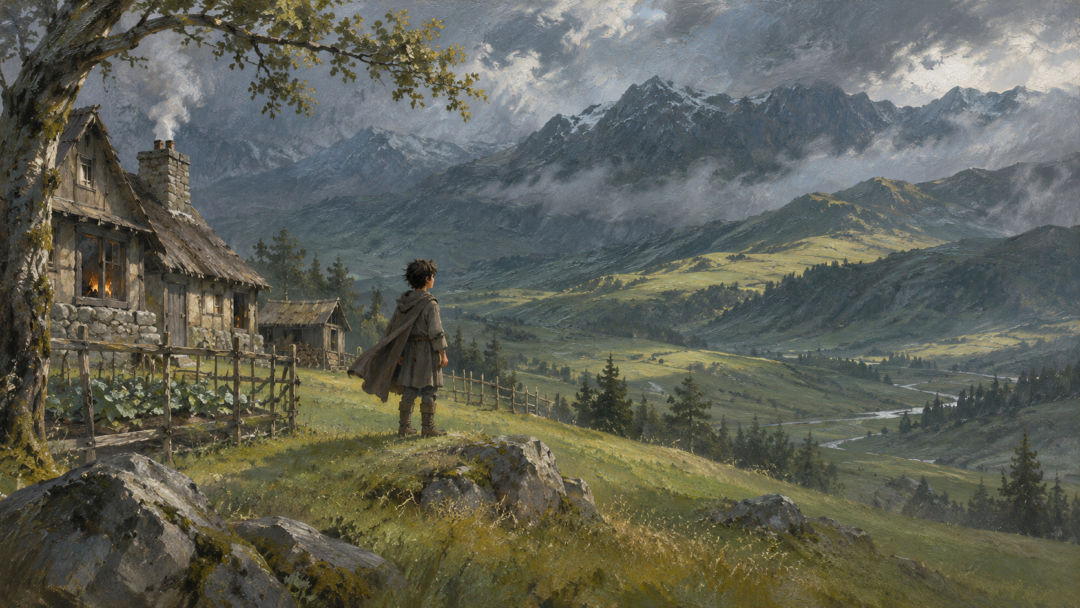
In Dor-lómin, beneath the mountains of Hithlum, a boy named Túrin grows up while war darkens the northern borders of his world. Far away, Elven kingdoms hold their ground against Morgoth, and the rivers and forests of Beleriand still belong to a landscape that will one day disappear. It is a striking place to enter Middle-earth, whether you know the history behind it or not.
So, should you read The Silmarillion before The Children of Húrin? It helps, but you do not have to. The first offers the broad history that gives Túrin’s story its setting; the second lets you remain with one family through a sustained, dark tragedy. If you are returning to the First Age after a long absence, revisiting The Silmarillion offers the fullest preparation. If the family story is what has caught your interest, you can begin there without treating another book as an entrance exam.
What The Silmarillion gives you
The Silmarillion begins far beyond the concerns of a single household. It moves from the creation of the world and the awakening of the Elves to the making of the Silmarils, their theft by Morgoth, and the long struggle against him. By the time the story reaches the Men of the First Age, kingdoms have been founded, alliances tested, and wars fought across Beleriand. That breadth is precisely what makes it useful preparation, even if its many names can seem formidable.
It also explains why Húrin’s family cannot simply escape the war by moving elsewhere. Their homeland, Dor-lómin, lies in the northwestern region of Hithlum, under the shadow of conflict with Morgoth. Húrin belongs to the House of Hador, one of the houses of the Edain, the Men allied with the Elves against the Dark Lord. These affiliations give the family a place within a much older struggle. They are not background trivia: they shape the dangers that surround Túrin from childhood.
The wider book introduces the powers and peoples who would otherwise arrive almost as legends within the family’s own tale. Morgoth is the first Dark Lord, not another name for Sauron; the latter is his servant during this age. The Noldor are Elves whose history is bound to the stolen Silmarils, while other Elven realms have their own rulers and customs. You need not memorize every genealogy to appreciate the difference between the human households of Hithlum and the guarded Elven kingdom of Doriath.
The shorter story is already in The Silmarillion
The overlap is more direct than many reading-order guides suggest. Chapter 21 of the Quenta Silmarillion, “Of Túrin Turambar,” tells the central story in abbreviated form. It does not end just as The Children of Húrin begins. The separate 2007 book returns to much of the same narrative territory, expanding scenes, encounters, conversations, and the sense of time spent in particular places. Think of the two presentations as different distances from the same events, not successive installments.
That makes the spoiler question unusually important. If you read “Of Túrin Turambar” first, you will know major turns in the family’s fate before you encounter them in the continuous telling. The later book can still reward you with closer characterization and a richer movement from scene to scene, but you will not approach its story with the same uncertainty. Anyone who strongly values discovering a tragedy as it unfolds has a good reason to start with The Children of Húrin instead.
One compromise is to read The Silmarillion through the earlier history of Beleriand, then stop before the Túrin chapter. You gain some orientation without the compressed account of his fate, although earlier chapters contain revelations of their own. It is an option, not another assignment.
Why the 2007 book feels different
These books reached readers through different editorial projects. Published in 1977, The Silmarillion presents an extensive mythology in compressed, connected form, selected and arranged by Christopher Tolkien from his father’s writings. Unfinished Tales, published in 1980, includes substantial material from the Narn i Hîn Húrin, a longer telling of Túrin’s story, alongside other writings from different ages of Middle-earth. It preserves a more visibly editorial experience, with interruptions and explanations about texts that survived in varying states.
Christopher’s introduction to Unfinished Tales, [adapted by the Tolkien Estate](https://www.tolkienestate.com/writing/christopher-tolkien-unfinished-tales-of-numenor-and-middle-earth/), explains why “unfinished” means different things. Some narratives break off; others have alternative versions or conflicts the editor has not concealed. The collection invites readers to notice how the writing evolved as well as the history being told. That can be fascinating, but differs from following one dramatic line.
For The Children of Húrin in 2007, Christopher drew on the surviving material to present a coherent, continuous narrative with minimal interruption. The Tolkien Estate calls it a standalone and complete version. This describes the resulting published reading experience, not the discovery of one finished manuscript left untouched or the invention of a new plot by Christopher. The distinction matters because readers can approach the volume as a story while still recognizing the editorial care behind its form.
If you have already read the Narn material in Unfinished Tales, much of the action will be familiar. What changes is the pacing of the reading: instead of turning away from the tale to consider textual gaps and commentary, you can remain inside its sequence of choices and consequences. Conversely, if you enjoy following variants and the decisions involved in assembling a text, Unfinished Tales offers something the 2007 presentation deliberately keeps less prominent. Neither edition makes the other redundant for every reader.
Entering Beleriand without knowing every name
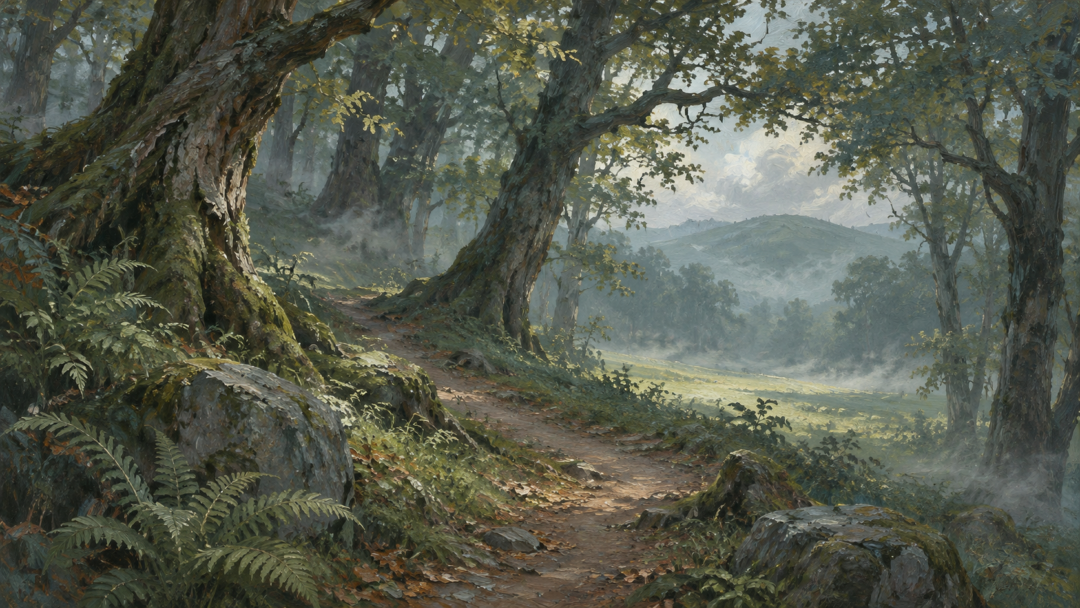
Starting with The Children of Húrin means meeting a world whose history is underway. Dor-lómin is a homeland before it is a point on a map: hills and mountains frame Túrin’s early life, and the war beyond them affects the household. When the tale moves toward Doriath, the change is not merely geographical. The sheltered forest realm of Thingol and Melian has its own court, boundaries, and ways of judging outsiders.
Other names gradually acquire texture. Nargothrond is an Elven stronghold beside the River Narog, a place of hidden halls rather than an ordinary town. Brethil is woodland country inhabited by the People of Haleth. These settings are distinctive enough to follow through their atmosphere and inhabitants. The larger political map adds depth, but the story offers more than unexplained dots to connect.
Beleriand belongs to an older geography than the journeys of Frodo or Bilbo. Much of this western land is lost beneath the sea by the end of the First Age, so its rivers and mountains cannot be placed directly along the routes to Rivendell or Mordor. That vanished quality affects the story’s atmosphere: the places feel vividly inhabited, yet belong to a distant, irrecoverable past.
How to make either route easier
The 2007 volume provides useful companions to the narrative: a Preface, an Introduction, a note on pronunciation, genealogies, a list of names, and a map. Treat them as tools, not homework. If Hithlum and Doriath blur together, consult the map. If two similar Elvish names cause trouble, look one up. The genealogies can clarify how households and kindreds relate, though they need not be studied in advance. None of these aids can promise that every unfamiliar reference will instantly become clear.
Readers who want to preserve as much discovery as possible may prefer to begin with the narrative and consult introductory material selectively. It is unwise to assume that every foreword, chapter heading, or supplementary section is free of revelations. After the story, the editorial appendices “The Evolution of the Great Tales” and “The Composition of the Text” offer a path into how this version came together. Their natural place for a story-first reader is afterward, when discussion of construction cannot interrupt the unfolding events.
If you choose The Silmarillion first, a similarly light touch works well. Keep track of the broad relationship among Morgoth, the Elven kingdoms, and the houses of Men rather than trying to retain every name on first encounter. The narrative’s sweeping, chronicle-like style can make individual episodes seem brief, yet the cumulative history prepares you to recognize the stakes of a seemingly local decision. A return visit to its earlier chapters can be especially satisfying when old names begin to carry more meaning.
Two sound ways to read them
For context first, read The Silmarillion, including “Of Túrin Turambar,” and then take up The Children of Húrin. This favors recognition over surprise. You will know where the family stands in the First Age and why the conflict around it has such weight, while the longer book gives the familiar outline more room to breathe. It is a good route for someone who enjoys returning to an event after learning its place in the history of the world.
For immersion first, open The Children of Húrin now, using its map and name list when needed, and visit The Silmarillion afterward. This favors sustained involvement with Túrin, Húrin, Morwen, and the places they inhabit before placing their lives among the broader wars of the Elder Days. The [Tolkien Estate’s reading guidance](https://www.tolkienestate.com/selected-further-reading/) explicitly rejects any requirement to follow fictional chronology, so neither route needs a certificate of approval. A returning reader who remembers the broad history need not reread an entire volume to begin.
Whichever entrance you choose, expect something darker than a conventional quest of victory and homecoming. The first image worth keeping is small: a child in Dor-lómin, with green hills around him and the northern mountains beyond. One book shows how much history presses against that horizon. The other stays close enough to feel what it is like to live beneath it.
Sources & Notes
This article is based on close reading and interpretation of Tolkien's published works and related source material where relevant.