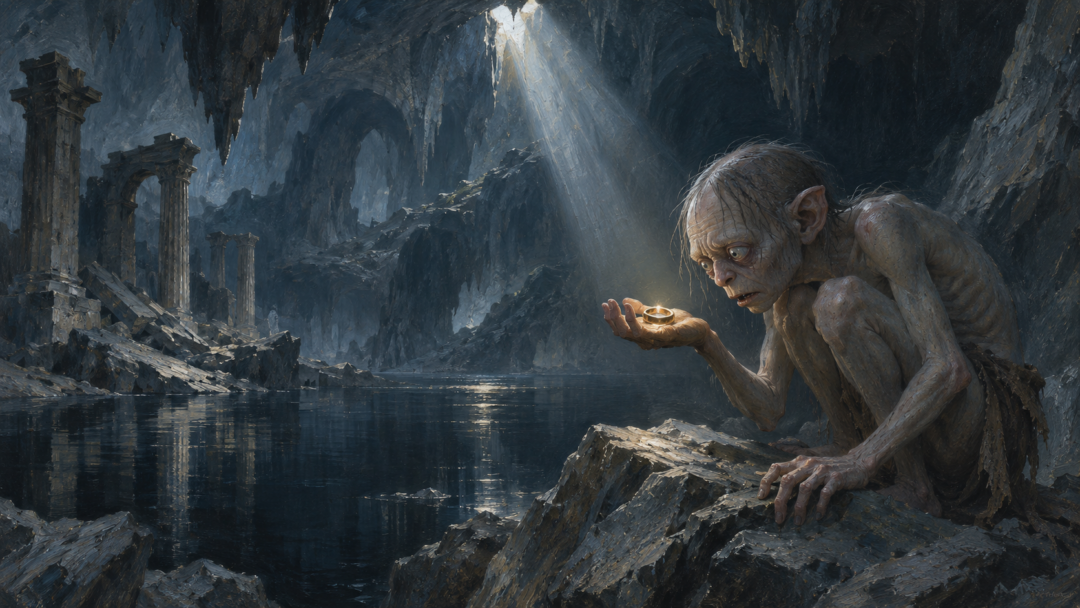
What Is the Point of a Movie Centered on Gollum?
Why does Gollum need his own film?
He is already among the most thoroughly explored characters in Peter Jackson’s Lord of the Rings trilogy. His origins are explained, his divided personality dominates much of The Two Towers, his relationship with Frodo carries enormous emotional weight, and his death brings The Return of the King to its climax.
Yet Tolkien left a substantial part of his life outside the trilogy’s main action. Between Bilbo’s discovery of the Ring and Frodo’s departure from the Shire, Gollum wandered across Middle-earth, approached Mordor, fell into Sauron’s hands, and became the object of a search conducted by Gandalf and Aragorn.
This history provides the foundation for The Lord of the Rings: The Hunt for Gollum, scheduled for December 17, 2027. Andy Serkis returns as Gollum and directs, with Peter Jackson, Fran Walsh, and Philippa Boyens involved in the production. The film extends Jackson’s cinematic Middle-earth rather than beginning a new adaptation of Tolkien’s books.
The commercial appeal is obvious. Gollum is recognizable, Serkis remains closely associated with the character, and the story allows familiar figures to return without remaking the War of the Ring.
The artistic question is harder. Gollum matters not because he leads an exciting life, but because the fate of Middle-earth comes to depend on a creature almost everyone has good reason to despise.
Whether that idea can sustain a film is the interesting question.
A creature who should have died
Tolkien introduces Gollum in Chapter 5 of The Hobbit, “Riddles in the Dark.” Bilbo encounters him beneath the Misty Mountains, where he has lived for centuries with the Ring. Their contest of riddles ends with Bilbo escaping and Gollum discovering that his precious possession has disappeared.
The episode has a complicated textual history.
Tolkien revised the chapter for the second edition of The Hobbit, published in 1951. Originally, Gollum accepted the contest’s outcome and intended to give Bilbo the Ring as a prize. In the revised version, he cannot willingly surrender it.
Tolkien incorporated the discrepancy into his fictional history. In The Fellowship of the Ring, Book I, Chapter 2, “The Shadow of the Past,” Gandalf explains that Bilbo initially gave an inaccurate account of acquiring the Ring. The earlier version of The Hobbit thus becomes a story distorted by the Ring’s influence.
But the decisive event in Bilbo’s encounter is not his acquisition of the Ring. It is his refusal to kill Gollum.
Bilbo recognizes the creature’s danger but imagines his misery: centuries alone in darkness, dependent on the object he has lost. That sudden pity stays his hand.
When Frodo subsequently regrets Bilbo’s decision, Gandalf challenges his certainty. Knowing that someone is dangerous does not confer the wisdom to decide whether that person deserves death. Gandalf suspects Gollum may still have some part to play, though he cannot know what it will be.
Mercy here is neither forgiveness nor confidence in rehabilitation. Bilbo spares Gollum without assurance that anything good will follow.
That distinction creates a problem for a film tempted to turn Gollum’s history into a conventional redemption story.
The making of Gollum
Gandalf reconstructs Gollum’s origins in “The Shadow of the Past,” drawing partly on what he learned from Gollum himself.
Before becoming Gollum, he was Sméagol, a member of a river-dwelling people related to the ancestors of hobbits. His relative Déagol discovered the Ring while fishing. Sméagol immediately coveted it and murdered Déagol when he refused to surrender it.
The Ring did not force that first murder. Sméagol chose to kill.
Its influence subsequently enlarged his existing faults. He used its power to conceal himself, becoming increasingly malicious and isolated. His family expelled him. Eventually he withdrew beneath the Misty Mountains, where his existence narrowed into dependence on the Ring.
Tolkien does not describe an innocent person abruptly transformed by external evil. Sméagol remains responsible for his choices even as the Ring intensifies his corruption.
Nor does that corruption eliminate every other capacity. Gollum remains capable of fear, shame, affection, and occasional tenderness.
Jackson dramatizes this conflict in The Two Towers through Serkis’s performance, giving Sméagol and Gollum distinct voices and physical mannerisms. One scene even allows Sméagol seemingly to banish Gollum.
The novel resists such a clear division.
In The Two Towers, Book IV, Chapter 2, “The Passage of the Marshes,” Gollum argues with himself about the Ring, Frodo, and his promise to serve him. The competing voices express different impulses within one damaged person, not two independent beings.
His struggle concerns whether he can still act without being governed by possession.
This offers a possible dramatic center for the new film: someone repeatedly approaching change but unable to escape the habits that have consumed his life. It also requires leaving him morally uncomfortable. He cannot simply become a misunderstood hero.
What Tolkien wrote about the hunt
After Bilbo’s escape, Gollum eventually leaves the mountains and searches for the thief. He learns enough to associate the Ring with Bilbo Baggins and the Shire. His wandering brings him toward Mordor, where he falls into Sauron’s power.
In “The Shadow of the Past,” Gandalf explains that Sauron learns the names Baggins and Shire from Gollum, helping direct the Dark Lord’s attention toward the Ring’s hiding place.
Meanwhile, Gandalf and Aragorn search for Gollum because he can help establish the Ring’s history. As its previous bearer, he possesses information unavailable from any other living witness.
Aragorn eventually captures him near the Dead Marshes.
In The Fellowship of the Ring, Book II, Chapter 2, “The Council of Elrond,” Aragorn describes the arduous journey north to deliver Gollum to the Elves of the Woodland Realm. His prisoner is dangerous and difficult to control. Aragorn keeps him bound and drives him through hostile country.
The episode reveals Aragorn’s life before the Fellowship. For years he has guarded people unaware of his existence and investigated dangers whose full significance remains hidden.
It also establishes an unusually prolonged encounter between characters who otherwise occupy very different positions in the story.
Tolkien supplied further material in Unfinished Tales, Part Three, Chapter IV, “The Hunt for the Ring,” edited and published by Christopher Tolkien in 1980. These accounts expand the chronology and circumstances of Gollum’s movements, his capture, and the activities of Sauron’s servants.
They do not constitute a completed novel. Christopher Tolkien presents explanatory material and developing accounts, including variations discussed in his editorial notes.
The distinction matters. Tolkien provided a history of the hunt, not a continuous dramatic narrative. A screenplay must invent conversations, encounters, conflicts, and transitions.
An Aragorn-centered pursuit offers an obvious adventure: a dangerous quarry, an arduous search, growing threats, and eventual capture. It could explore his years as a Ranger and his responsibilities before becoming king.
But Gollum would then be the object of the story rather than its subject.
Following Gollum presents the opposite difficulty. His motivations are limited and often repellent. He wants the Ring, resents those who possess it, fears domination, and survives through secrecy, cunning, and occasional cruelty.
The temptation will be to invent a defining betrayal or failed opportunity for redemption that explains the Gollum audiences already know.
Tolkien’s portrayal is more unsettling because no single event explains him. His deterioration is cumulative, and his capacity for change never entirely disappears.
The moment Jackson left out
The most important attempt to reach Gollum occurs after the hunt, during his journey with Frodo and Sam.
Frodo understands something his predecessors cannot. As a Ring-bearer, he knows what it means to desire an object that progressively undermines personal freedom. His pity carries a particular intimacy.
Sam remains suspicious, understandably. Gollum has repeatedly demonstrated his capacity for deception and betrayal.
Yet Sam’s suspicion also has consequences.
In The Two Towers, Book IV, Chapter 8, “The Stairs of Cirith Ungol,” Frodo sleeps while Gollum approaches him. For a moment, the creature appears transformed by affection. He reaches toward Frodo with unexpected tenderness.
Sam wakes and responds with hostility.
The moment disappears.
Tolkien does not assert that Gollum would otherwise have repented. He shows something narrower: tenderness was still possible, and Sam’s intervention helped extinguish it.
The scene is painful because Sam is neither malicious nor foolish. His distrust is justified. Nevertheless, a reasonable judgment produces a tragic result.
Jackson’s films reshape this relationship.
In The Return of the King, Gollum deceives Frodo into believing Sam has betrayed him. Frodo sends Sam away, and Sam returns after discovering the deception.
No equivalent separation occurs in the novel. Frodo never dismisses Sam on the stairs. Gollum’s treachery develops differently, and the loss of his brief tenderness remains almost unnoticed.
Jackson turns mistrust into a visible conflict with a dramatic reversal. Tolkien allows a possible turning point to vanish through an ordinary failure of understanding.
The difference exposes the difficulty facing The Hunt for Gollum.
Cinema often demands that internal conflict become outward action, moral choices produce identifiable consequences, and characters change through legible turning points. Jackson’s trilogy uses these methods successfully.
But Gollum’s tragedy depends partly on the absence of such clarity.
Gandalf can reconstruct his history without predicting his future. Aragorn can restrain him without reforming him. Frodo can offer compassion without securing repentance. Even Gollum cannot consistently understand his own desires.
To explain him too completely would diminish him.
The failure that saves Middle-earth
Gollum’s ultimate significance emerges at Mount Doom.
In The Return of the King, Book VI, Chapter 3, “Mount Doom,” Frodo reaches the place where the Ring must be destroyed. Yet at the decisive moment, he claims it for himself.
The quest fails precisely where success appears possible.
Gollum attacks Frodo, bites off his finger, and recovers the Ring. Celebrating his triumph, he falls into the fire, destroying himself and the object he has pursued.
The ending turns on a terrible irony. Gollum achieves his deepest desire, and that achievement destroys him. The Ring perishes not through Frodo’s final strength of will but through circumstances made possible by earlier acts of mercy.
Jackson changes the physical action. Frodo and Gollum struggle at the precipice and both fall over the edge before Frodo is rescued. This gives Frodo a more immediate role in the Ring’s destruction.
In the novel, Gollum’s victory becomes his annihilation without that final struggle. He has not become virtuous, willingly sacrificed himself, or consciously saved anyone.
Yet Bilbo’s pity, Frodo’s mercy, and the decisions that preserved Gollum’s life have made his presence possible.
His indispensability does not require him to become good. The fate of the world depends on someone whose moral failures remain real and whose life nevertheless proves worth sparing.
A film set before these events cannot reproduce that conclusion without distorting the chronology. Nor should it manufacture an earlier redemption merely to give its protagonist a satisfying arc.
Instead, The Hunt for Gollum could explore the distance between knowing a person’s history and understanding what that person might still become.
Aragorn’s pursuit can supply the physical narrative. Sauron’s interrogation can supply danger and historical consequence. Gollum’s memories, evasions, and conflicting impulses can supply the character drama.
But the film’s meaning will depend on what it refuses to settle.
Gollum must remain dangerous even when pitiable, responsible even when corrupted, and capable of tenderness without becoming trustworthy. His captors have compelling reasons to fear him, but none can know what his survival will mean.
The audience already knows. The characters do not.
That dramatic irony could become the film’s strongest resource. Every opportunity to kill Gollum carries consequences invisible to those making the decision. Every act of restraint preserves a possibility no one can identify.
The danger is that a film ostensibly centered on Gollum will turn him into a conventional protagonist, granting him heroic choices, explanatory traumas, or a redemptive climax that makes his later fate easier to understand.
The better possibility is a pursuit in which the quarry remains more complicated than the hunt itself.
Tolkien made Gollum essential without making him admirable. His life mattered not because anyone could foresee its value, but because mercy preserved him when no such value was apparent.
A film about Gollum has a reason to exist if it can make that uncertainty compelling.
Sources & Notes
This article is based on close reading and interpretation of Tolkien's published works and related source material where relevant.