If I Could Visit One Place in Middle-earth, It Would Be Rivendell
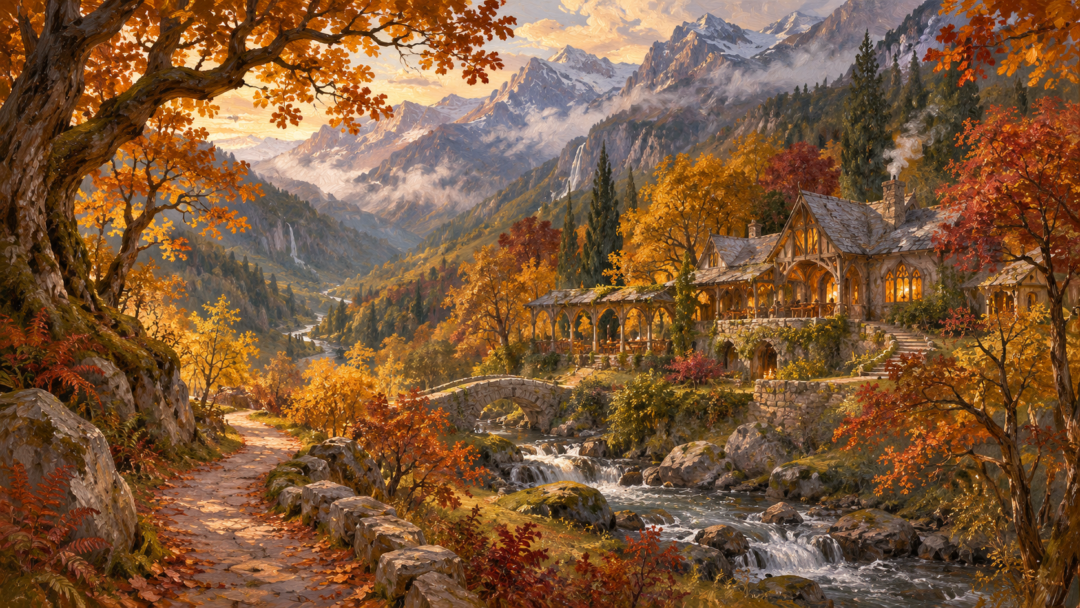
If I could visit one place in Tolkien’s Middle-earth, I would choose Rivendell. Not because it is the grandest or most beautiful destination, but because it offers something rare: a place where thousands of years of history remain alive, yet an ordinary visitor might still find a comfortable chair, a good meal, and someone willing to tell a story.
Minas Tirith has its seven levels and the White Tower of Ecthelion. Lothlórien has the golden trees of Caras Galadhon. The Glittering Caves beneath Helm’s Deep impress even Gimli, who knows something about stonework. The Shire offers the considerable advantage of being somewhere a person might actually enjoy living.
But I would choose a few days in Elrond’s house during the autumn of 3018 of the Third Age.
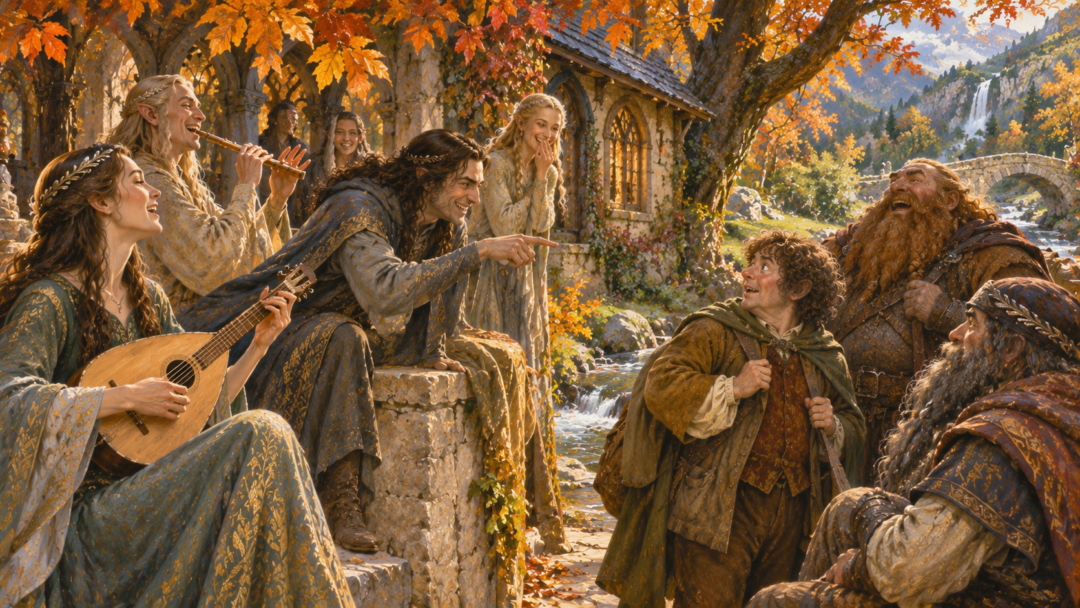
Frodo and his companions are there. Bilbo is there. Gandalf is there. The Elves are singing in the Hall of Fire. The War of the Ring is approaching, but the household still has time for poetry, conversation, and hospitality.
It would be an extraordinary opportunity to encounter Middle-earth’s history before much of its living memory disappears.
The Last Homely House
Tolkien introduces Rivendell in Chapter 3 of The Hobbit, appropriately titled “A Short Rest.”
Bilbo, Gandalf, and Thorin’s company have travelled east toward the Misty Mountains. Exhausted and uncertain about the country ahead, they follow Gandalf down a difficult, winding path into a hidden valley. They hear Elves singing among the trees before reaching Elrond’s house.
Rivendell has no imposing entrance or monumental gate. The valley almost reveals itself to travellers as they descend.
Tolkien calls Elrond’s dwelling the Last Homely House west of the Mountains. For those heading east, it offers the last dependable shelter before the dangerous journey through the mountains and beyond.
Yet its appeal goes far beyond protection.
In “A Short Rest,” Tolkien describes a household suited to eating, sleeping, working, storytelling, singing, and quiet thought. These ordinary pleasures distinguish Rivendell from the more austere sanctuaries one might expect in an ancient Elvish realm.
The Dwarves recover from their journey. Gandalf discusses history and geography. Bilbo enjoys himself without understanding every song.
That last detail matters.
A visitor to Middle-earth would inevitably be ignorant of its languages, customs, and complicated history. Rivendell seems one of the few places where such ignorance would not prevent someone from having a wonderful time.
Bilbo arrives knowing little about the wider world. Nevertheless, he is welcomed, entertained, and given opportunities to learn.
For someone without heroic ambitions, that would be enough.
Where history is still alive
Rivendell’s deeper attraction is its relationship with the past.
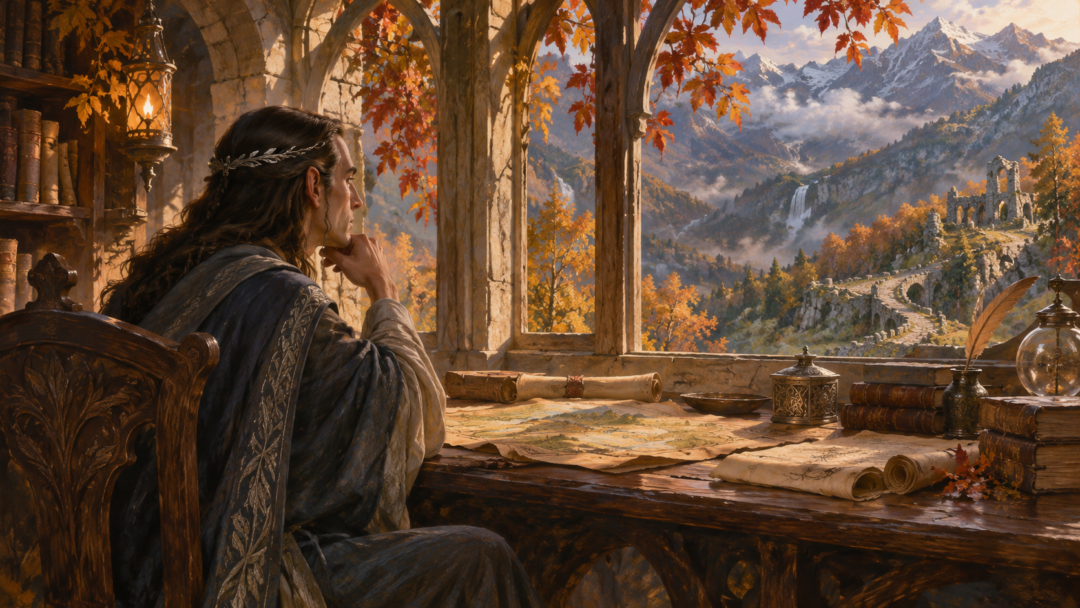
Middle-earth is full of ruins. The Argonath stand above the Anduin. Weathertop preserves the remains of an ancient watchtower. Travellers passing through Hollin encounter a country once inhabited by the Elves of Eregion.
These places testify to vanished kingdoms and forgotten lives.
In Rivendell, however, some of the people who remember those ages are still living.
Elrond was born in the First Age. He witnessed the end of the Second Age and fought alongside Gil-galad in the Last Alliance of Elves and Men. He has watched kingdoms rise and disappear.
When Elrond discusses Isildur and the Ring in The Fellowship of the Ring, Book II, Chapter 2, “The Council of Elrond,” he is not repeating a legend preserved in an ancient manuscript.
He was there.
Imagine speaking with someone who remembers events everyone else considers mythology.
I would want to ask about the great cities before their destruction, the rulers whose reputations changed after their deaths, and the songs that have been altered through centuries of retelling.
But the smaller questions might be more revealing.
What did ordinary Elvish households look like a thousand years earlier? Which customs survived? Which disappeared without anyone thinking to record them?
Tolkien’s history often reaches the reader through fragments: inherited objects, poems, names, and memories. Rivendell is a place where those fragments can still be explained by people who understand their original meaning.
Its importance extends beyond Elvish history.
Appendix A of The Lord of the Rings, in “The North-kingdom and the Dúnedain,” describes how the heirs of Isildur were fostered in Rivendell after the northern kingdom fell. Aragorn himself was brought there as a child and raised under Elrond’s protection.
Rivendell has therefore preserved more than books and songs. It has protected the continuity of cultures whose political power has vanished.
A kingdom can disappear from the map while its memory survives in a household.
An evening in the Hall of Fire
If I could visit only one room in Rivendell, I would choose the Hall of Fire.
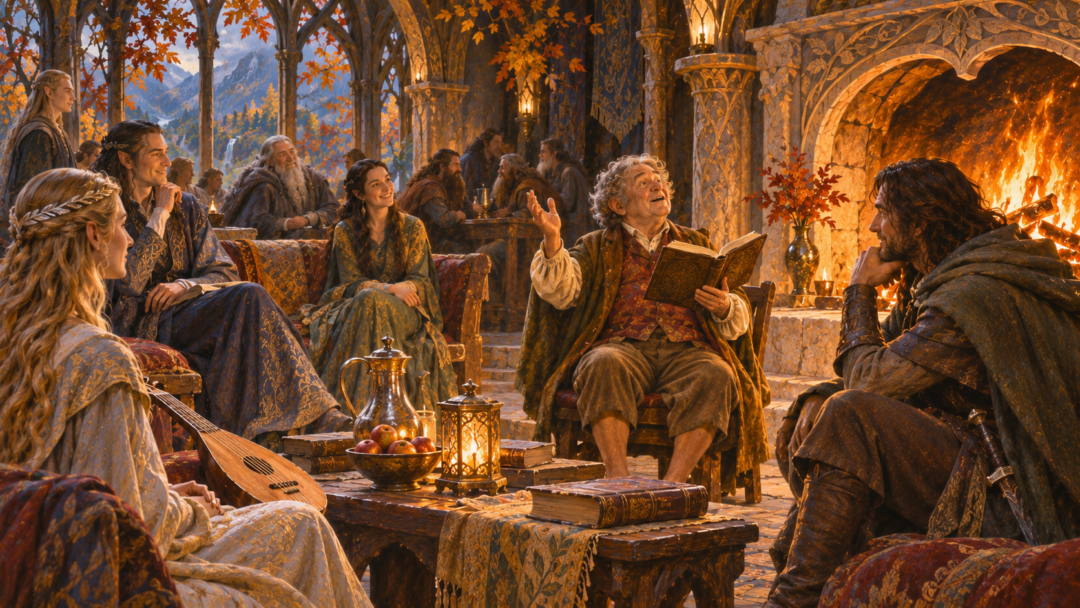
Tolkien describes it in “Many Meetings,” Book II, Chapter 1 of The Fellowship of the Ring. A fire burns continuously in a great hearth between carved pillars. During the day, the hall is generally quiet. At night, it becomes a gathering place for music and stories.
After the feast celebrating Frodo’s recovery, he finds Bilbo there.
Bilbo has been living in Rivendell since leaving the Shire. He has continued writing and translating, and is working on a poem about Eärendil, the great mariner of the First Age.
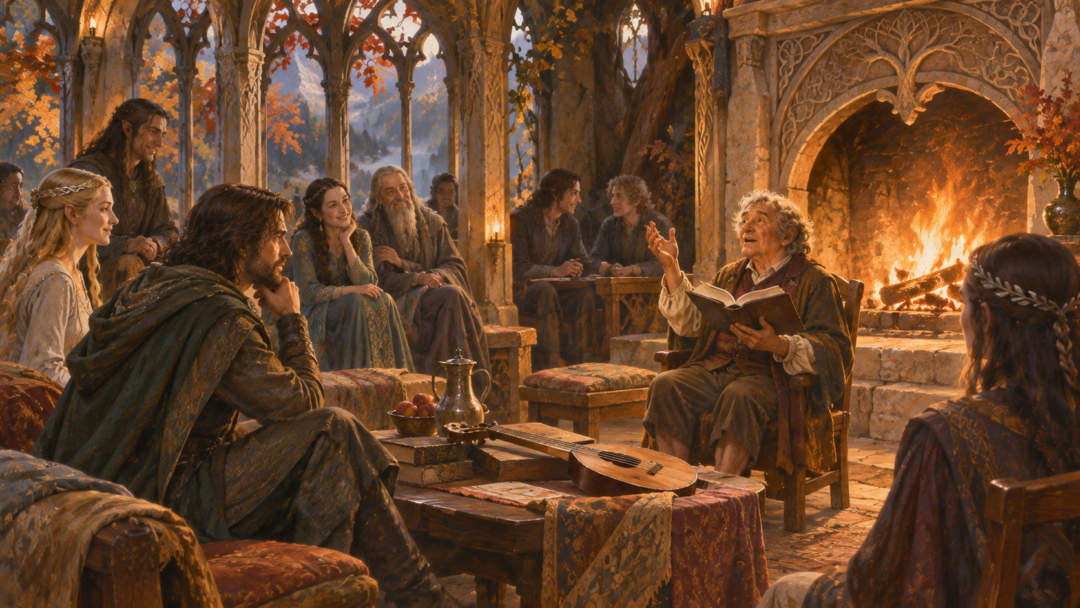
The scene is delightful partly because of its absurdity.
An elderly hobbit recites his interpretation of ancient Elvish history to an audience that includes people whose knowledge of those events vastly exceeds his own. Aragorn has helped him compose the verses. Afterwards, the Elf Lindir cannot distinguish Bilbo’s contributions from Aragorn’s.
Yet the Elves listen.
The scene reveals something important about Tolkien’s treatment of art. Bilbo’s poem does not need an original subject to be worthwhile. He is participating in a tradition far older than himself, retelling a story because he loves it.
The Hall of Fire also gives Elvish beauty an unusually domestic setting.
Elsewhere, Tolkien’s descriptions of the Elves can make their music seem almost beyond mortal understanding. Here, it belongs to an evening indoors. People gather around a fire. Someone sings. Others listen. Conversations begin and end.
The experience is extraordinary without ceasing to be familiar.
Its significance reaches beyond Rivendell. In The Two Towers, Book IV, Chapter 10, “The Choices of Master Samwise,” Sam draws strength from Elvish song and remembrance during his struggle with Shelob.
Music and beauty cannot eliminate danger, but their memory can help someone endure it.
I would love to spend an evening in the Hall of Fire, listening without necessarily understanding everything. There would be no need to interrupt with questions or try to become part of history.
Simply being present would be enough.
The Elves Tolkien actually wrote
Peter Jackson’s films provide a memorable visual interpretation of Rivendell: carved stonework, terraces, waterfalls, and intricate buildings surrounded by autumn foliage.
But Tolkien never supplies a comprehensive architectural plan of Elrond’s house. Much of what audiences now associate with Rivendell’s appearance comes from the filmmakers.
The adaptations also encourage an impression of Elves as solemn, distant beings permanently burdened by ancient knowledge.
Tolkien’s Elves can certainly be solemn. Elrond understands the danger of the Ring, and the approaching end of the Third Age gives their civilisation an unmistakable sadness.
But they can also be funny.
In “A Short Rest,” the Elves sing teasing songs about Bilbo and the Dwarves. They joke about the travellers’ appearance and uncomfortable journey. Thorin’s companions do not always appreciate their humour.
There is mischief in Rivendell, not merely ceremonial dignity.
That makes its inhabitants more interesting. A living culture cannot consist entirely of wisdom and solemn pronouncements. Its people must also have ordinary personalities, habits, disagreements, and pleasures.
Another important difference between book and film concerns Frodo’s arrival.
In Jackson’s The Fellowship of the Ring, Arwen takes Frodo toward the Ford of Bruinen and confronts the pursuing Nazgûl. In Tolkien’s book, Glorfindel comes to the travellers’ aid. Frodo crosses the Ford on Glorfindel’s horse, Asfaloth, while attempting to resist the Riders.
Arwen’s literary role is different.
Her appearance at Elrond’s feast in “Many Meetings” connects Rivendell to Aragorn’s history and to one of the novel’s central questions: the choice between mortality and immortality.
Although she has relatively little dialogue, her presence carries considerable historical weight.
Jackson communicates Rivendell’s significance through striking images and dramatic encounters. Tolkien reveals it more gradually through hospitality, poetry, conversation, and relationships.
For an imagined visit, I would prefer the literary version.
A refuge that cannot escape history
Rivendell offers genuine safety, but Tolkien never presents it as an invulnerable paradise.
When Frodo awakens in Elrond’s house, he is recovering from a Morgul-knife wound that nearly transformed him into a wraith. Elrond has removed the fragment of the blade, allowing Frodo to heal.
The valley provides the protection and care he desperately needs.
Yet Gandalf explains in “Many Meetings” that even powerful refuges like Rivendell would eventually fall if Sauron conquered Middle-earth.
Their safety depends on events beyond their borders.
This becomes clear at the Council of Elrond.
Its participants have arrived with separate concerns. Glóin brings troubling news from the Lonely Mountain. Legolas comes from the Woodland Realm. Boromir has travelled north following a prophetic dream.
As they exchange information, their individual problems reveal a common threat.
The Council is remarkable because nobody possesses a complete solution. Even its wisest and strongest members cannot guarantee success against Sauron.
The film transforms parts of the discussion into open confrontation, including Gimli’s attempt to destroy the Ring with his axe. That episode does not occur in Tolkien’s book.
Instead, the argument against using or keeping the Ring develops through careful consideration of its nature and history.
Finally, after a long silence, Frodo volunteers to carry it.
The decision transforms an adventure imposed upon unwilling travellers into a deliberate moral commitment.
Rivendell provides healing, knowledge, and counsel. It cannot remove the responsibility to act.
That distinction makes it far more interesting than a place completely untouched by the world’s troubles.
The sadness of arriving too late
Timing would matter enormously.
By the end of The Lord of the Rings, the world that sustained Elrond’s household is passing away.
In The Return of the King, Book VI, Chapter 6, “Many Partings,” Frodo returns to Rivendell and finds Bilbo elderly, increasingly absorbed in sleep and his papers.
The household celebrates Bilbo’s 129th birthday. He gives Frodo the three volumes of his Translations from the Elvish.
It is an affectionate scene, but its mood differs from Frodo’s first visit.
Bilbo has completed much of his work. The war is over. Frodo is travelling home to a Shire that has suffered its own damage.
Victory has not restored the world to its previous condition.
Then comes “The Grey Havens.”
Elrond departs Middle-earth with Galadriel, Gandalf, Bilbo, and Frodo. Their departure marks the passing of an age in which ancient Elvish memory remained a living presence in the lands of Middle-earth.
Rivendell does not simply cease to exist, but the extraordinary household I would want to visit belongs to a particular moment in history.
That is why I would choose the autumn of 3018 rather than the peaceful years following Sauron’s defeat.
I would want to hear Bilbo recite a poem while Elves who remember its subject listen nearby. I would want to see Gandalf at ease, hear laughter among the trees, and sit beside the fire while stories older than human kingdoms are told.
I would also want to know that beyond the valley, history is still unfolding, and that the people gathered in Elrond’s house are preparing to meet it.
Most of Middle-earth’s famous places are worth visiting because of what happened there.
Rivendell is different. I would want to visit because of what is still happening there: conversations, songs, acts of hospitality, the preservation of memory, and the passing of knowledge between generations.
For a few days, I would choose the Last Homely House, where the ancient world is still alive and there is room at the table for a stranger.
Sources & Notes
This article is based on close reading and interpretation of Tolkien's published works and related source material where relevant.