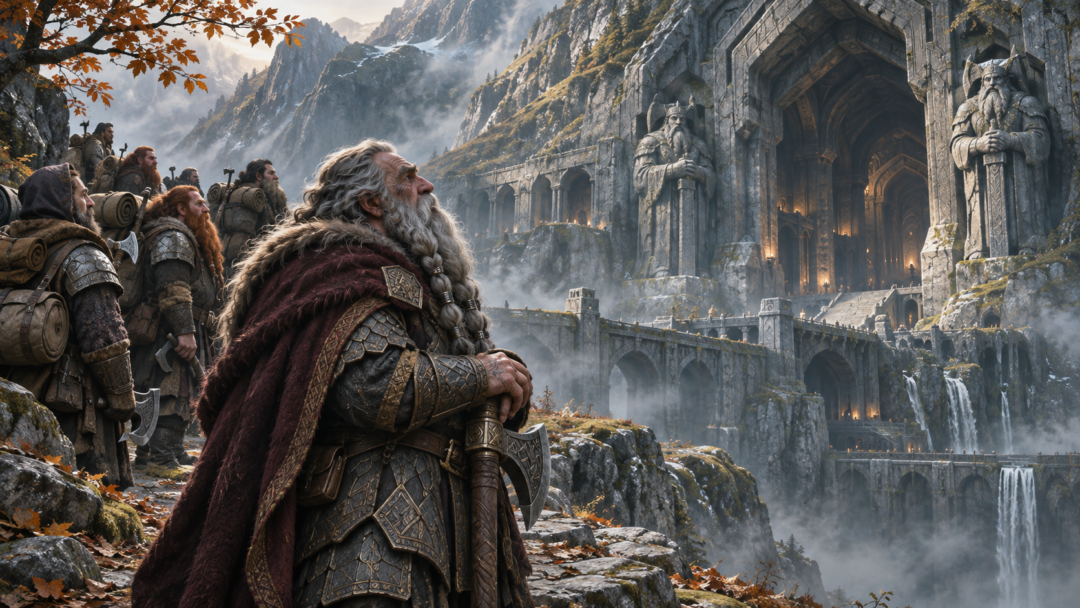
The Hobbit Film We Never Got: Balin’s Lost Kingdom of Moria
Peter Jackson’s Hobbit trilogy spent three films getting thirteen Dwarves back into their ancestral kingdom. Yet one of those Dwarves later led an expedition into a far more dangerous ancestral home, established a colony, and disappeared.
Balin’s attempt to reclaim Moria might have made a more interesting Middle-earth film than much of the material invented to expand The Hobbit. Not because it promises bigger battles or monsters, but because it offers a clear dramatic purpose with consequences that cannot be overcome by winning another fight.
The strongest adaptation would follow a hopeful expedition discovering the difference between reclaiming a kingdom and holding it. Tolkien supplied the essential events. Filmmakers would need to develop the characters and intervening drama without inventing another world-ending conspiracy.
A Familiar Dwarf With an Unfinished Story
Balin is a strong protagonist because audiences already know him. In Jackson’s Hobbit films, Ken Stott portrays him as one of Thorin Oakenshield’s most thoughtful companions. He understands Thorin’s family history, remembers the Dwarves’ suffering, and questions decisions without abandoning his loyalty.
His account of the Battle of Azanulbizar in An Unexpected Journey establishes his connection to Moria’s bloody history. Audiences already have an emotional foundation for another film: Balin has witnessed what happens when his people confront their ancient enemies outside their ancestral home.
Appendix A of The Lord of the Rings provides an important distinction. The War of the Dwarves and Orcs ends with victory at Azanulbizar, but Dain Ironfoot recognizes a terrible danger inside Moria. The Dwarves cannot simply march inside and restore their kingdom. Military success has not solved the underlying problem.
That is the history Balin eventually challenges.
An established actor and character would also eliminate the need for an elaborate introduction. Audiences would recognize Thorin’s older adviser and understand why another lost Dwarven kingdom matters to him.
Yet Balin is not simply Thorin repeated. Experience makes him potentially more measured, while his decision to enter Moria suggests that even sensible people can succumb to ancestral glory.
The Victory That Makes Disaster Possible
Tolkien dates Balin’s departure from Erebor to Third Age 2989, decades after the Quest of Erebor. The Lonely Mountain has been restored as a Dwarven kingdom. Balin is neither fleeing catastrophe nor seeking the only home his people have left.
He leaves an existing kingdom to reclaim a more ancient one.
That creates the film’s central moral tension. A desperate refugee seeking shelter is understandable. An established leader risking lives for a lost inheritance invites harder questions.
At the Council of Elrond in The Fellowship of the Ring, Gloin explains that Balin became determined to return to Moria despite Dain’s reluctance. His expedition includes Oin and Ori, both veterans of Thorin’s company, giving the venture personal history alongside national ambition.
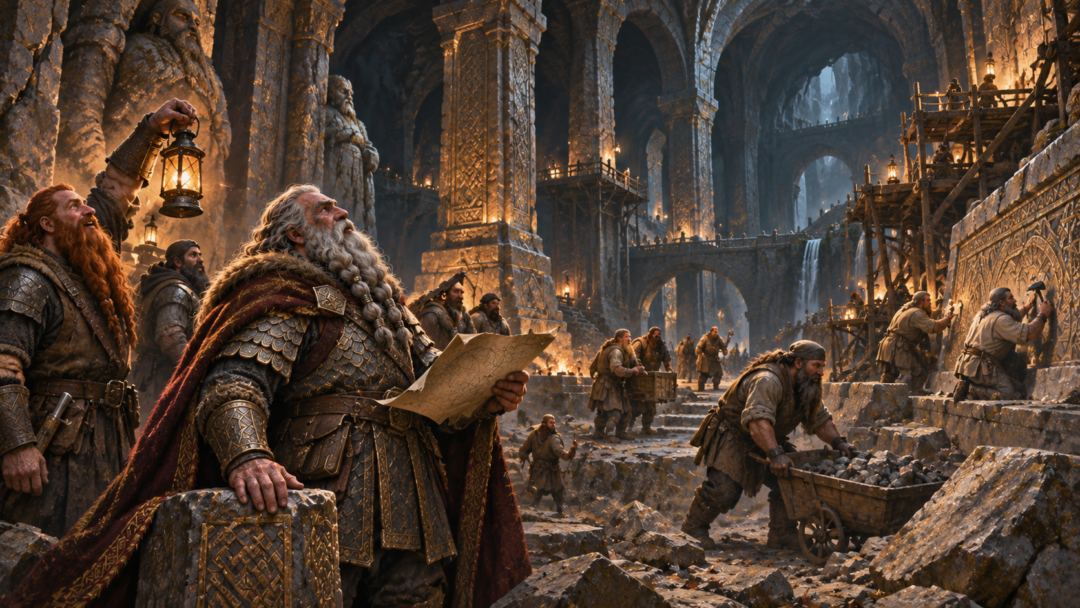
A film could explore this disagreement without making Dain an unreasonable obstacle. His opposition rests on Dwarven history. Balin might reasonably believe a new generation could succeed where earlier attempts failed.
The dramatic question is what evidence Balin considers sufficient to justify the gamble, and how he responds when early success vindicates him. That is richer material than another argument resolved by the arrival of a battle.
Moria Was Not an Immediate Failure
What makes Balin’s expedition particularly suitable for film is that it initially succeeds.
According to the Book of Mazarbul, discovered by the Fellowship in Tolkien’s novel, the colonists enter Moria, defeat enemies, establish themselves, and explore their ancestral halls. They recover treasures, including Durin’s Axe. Balin assumes the title Lord of Moria.
The colony survives approximately five years, from 2989 until its destruction in 2994. This is not an expedition that opens the wrong door and dies before sunset.
Imagine the first occupation of an abandoned hall, the reopening of a passage, or the discovery of surviving Dwarven craftsmanship. These would be invented scenes illustrating Tolkien’s recorded developments, not events explicitly described in his narrative. They could establish the settlement as a functioning community rather than a group awaiting death.
Moria also presents visual opportunities distinct from the Hobbit trilogy. Erebor appears as an immense, treasure-filled mountain fortress. Khazad-dum was an underground civilization of halls, bridges, mines, and passages stretching through the mountains.
Rediscovering that world could initially feel wondrous before revealing the difficulty of defending it. Every reopened passage might unlock valuable chambers while creating another approach for enemies. Expansion itself becomes dangerous, and visible success conceals growing vulnerability.
The story already suggests a natural progression: arrival, consolidation, recovery, overconfidence, isolation, and catastrophe. It needs neither another quest object nor an invented villain pursuing the heroes across Middle-earth.
A War Film Without a Convenient Victory
The surviving accounts of the colony’s destruction describe danger spreading across several locations.
An Orc archer kills Balin near the Mirrormere, outside the eastern entrance. The Dwarves fight to recover his body. Orcs subsequently capture key positions, increasingly restricting the survivors’ escape routes.
The Book of Mazarbul records the loss of the bridge and Second Hall. Oin dies at the West-gate, taken by the Watcher in the Water. The remaining Dwarves retreat into the Chamber of Mazarbul, writing their final entries as enemies close in.
These events form a military tragedy. A leader dies unexpectedly. Defenders lose strategic ground. Escape attempts fail. Survivors become trapped inside the stronghold they thought they had reclaimed.
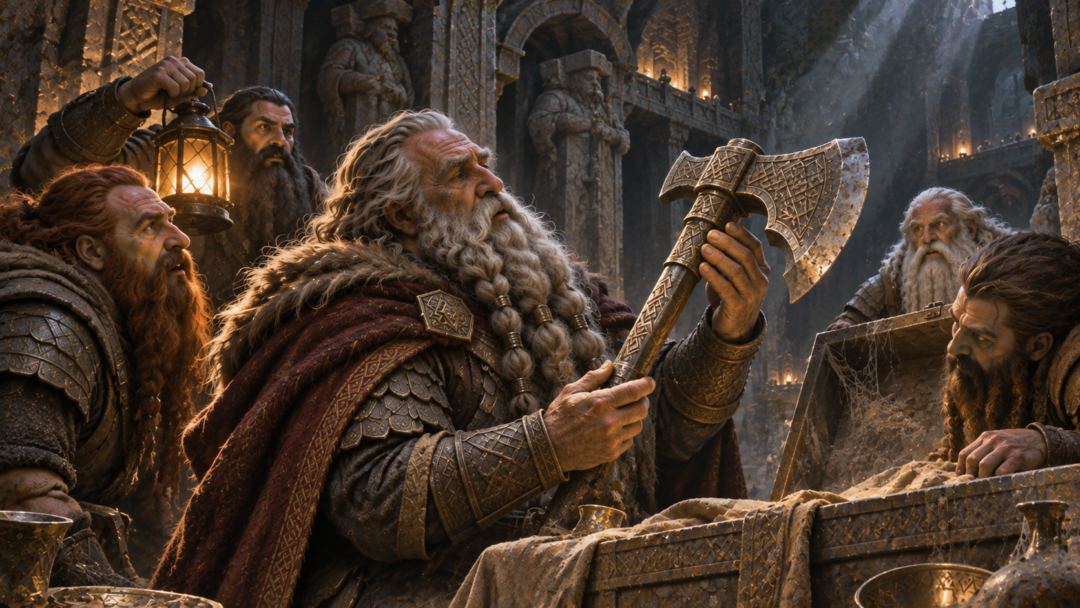
Unlike a conventional fantasy siege, this conflict needs no inspirational charge reversing impossible odds.
The largest battle could depict the bridge’s defense or the retreat through the halls. But a smaller emotional climax would be stronger: the surviving companions realizing there is nowhere left to go.
Ori offers a powerful perspective. He survives long enough to be associated with the final writing in the colony’s record book. The younger Dwarf from The Hobbit could become the expedition’s historian when survival is no longer possible.
His final task would not be defeating the enemy, but preserving evidence that his people lived there and that their attempt mattered.
The Balrog Should Not Become the Main Villain
A tempting adaptation would revolve around Durin’s Bane. Jackson’s Fellowship of the Ring already gave audiences an unforgettable encounter with the creature on the Bridge of Khazad-dum.
But making the Balrog Balin’s principal enemy would weaken the story and distort Tolkien’s account.
The creature drove the Dwarves from Khazad-dum long before Balin’s expedition. Yet the surviving record of the colony’s destruction describes Orc attacks and the Watcher at the western exit. It never establishes that Balin’s people confronted the Balrog during their last stand.
A faithful film should preserve that distinction.
The Balrog could remain an unseen historical terror, explaining Dain’s fear and reminding audiences how little the Dwarves understand beneath their feet. A distant disturbance or unexplained sign might suggest danger, although such scenes would be cinematic inventions rather than documented events.
Balin need not fight the creature or discover its nature. The colony’s destruction becomes more disturbing if its legendary ultimate danger never appears. Ordinary enemies, failed defenses, and severed escape routes are enough.
Moria does not need to reveal its greatest horror to defeat an ambitious expedition.
What the Hobbit Films Tell Us About the Risk
Jackson’s trilogy demonstrates both the promise and danger of expanding Tolkien’s brief material.
Its strongest additions connect spectacle to recognizable motivations. Balin’s recollection of Azanulbizar gives Thorin’s mission historical weight. Lake-town’s devastation makes Smaug’s threat immediate and human. Bilbo surrendering the Arkenstone creates a conflict that swordsmanship cannot resolve.
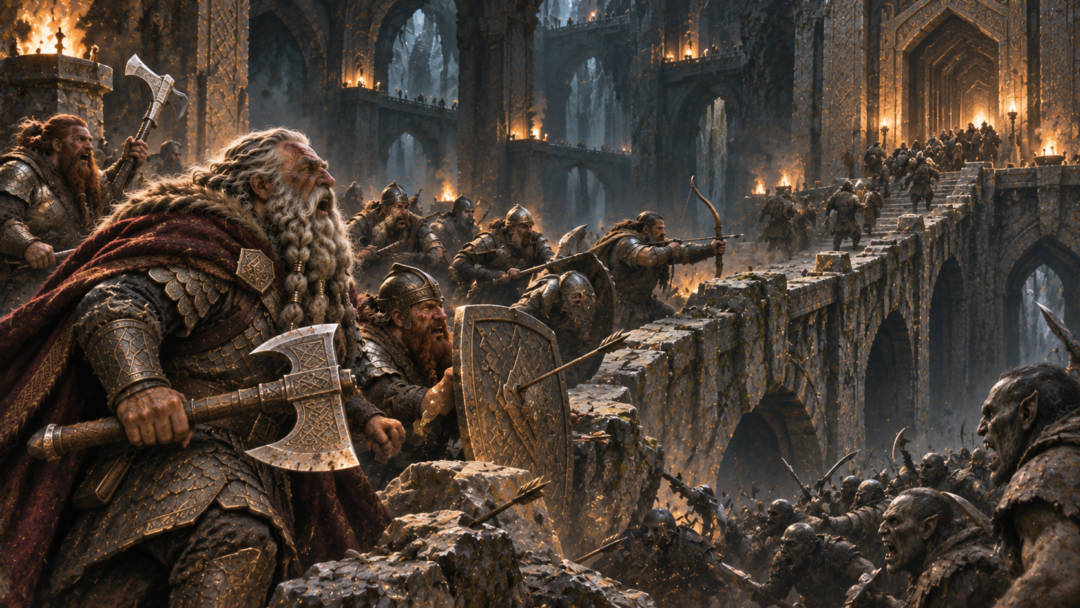
Other expansions work less effectively. Azog’s continuing pursuit, the invented romantic triangle involving Tauriel, Kili, and Legolas, and increasingly elaborate combat sequences compete with Bilbo’s central adventure.
The Battle of the Five Armies is especially revealing. Tolkien’s novel gives Bilbo a limited perspective before unconsciousness removes him from the fighting. Jackson instead stages successive confrontations, including Thorin’s final struggle against Azog on Ravenhill.
The results are spectacular, but accumulating action can diminish the significance of individual decisions.
A Balin film could do the opposite. Its conflict would arise from one consequential choice: entering Moria despite warnings and memories of earlier failure. Each development would test whether Balin was justified, whether he recognizes changing circumstances, and whether he can accept retreat after investing so much in restoration.
The adaptation would face its own risks. The surviving account is short. Sustaining a feature film requires invented dialogue, relationships, daily life, and perhaps disagreements about abandoning the colony.
Such dramatization is not inherently illegitimate. Tolkien adaptations have always needed it. The danger is presenting inventions as established lore or transforming a restrained historical tragedy into another sprawling supernatural war.
The film would need to remain about Balin’s people rather than assembling famous characters for cameos.
The Ending Has Already Been Filmed
The proposed film has a remarkable advantage: audiences have already witnessed its aftermath.
In The Fellowship of the Ring, the company enters the Chamber of Mazarbul and discovers Balin’s tomb. Gandalf reads from the damaged record book. Gimli’s grief makes the discovery personal, while approaching drums transform an archaeological revelation into a fight for survival.
Jackson’s film stages a memorable battle against Orcs and a cave troll inside the chamber. Audiences understand that Balin’s expedition ended badly but learn little about the colony itself.
A prequel would transform that sequence’s emotional meaning.
After spending a film with Balin and Ori, viewers returning to The Fellowship of the Ring would recognize the chamber not merely as a battle location, but as the final refuge of people they watched build a future.
The record book would cease being merely an exposition device. It would become the expedition’s last surviving voice.
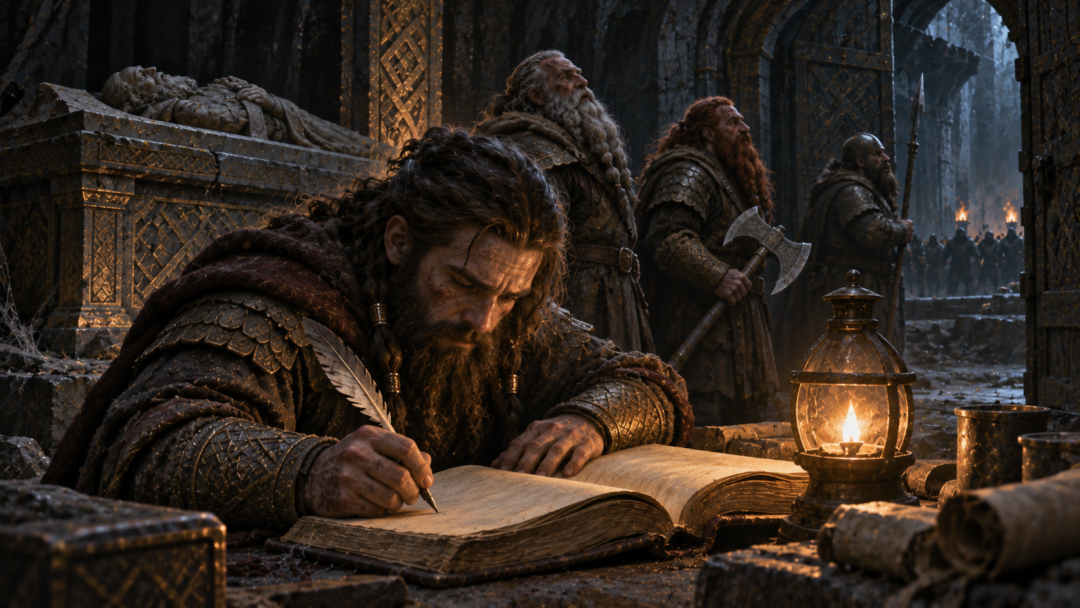
That is why the proposed film should never change the ending. Its strength lies in making an established loss personal.
Knowing Balin dies does not eliminate suspense. Audiences could still care about the settlement’s achievements, the decisions accelerating its collapse, and missed opportunities to withdraw.
Effective tragedy rarely depends entirely on uncertainty about survival. It depends on understanding why people believed a different outcome remained possible.
Would It Actually Have Been the Better Choice?
Balin’s expedition would not have been a straightforward replacement for The Hobbit itself.
Bilbo is that story’s heart. His discovery of courage, relationship with Thorin, and encounter with the Ring provide a distinctive perspective that Balin’s military expedition cannot replicate.
The stronger comparison is with stretching The Hobbit into three increasingly action-heavy films. A focused Hobbit adaptation followed by a separate Balin film could arguably have provided two distinct kinds of Middle-earth storytelling.
One would be an adventure about an unlikely hero discovering his worth. The other, a tragedy about experienced people underestimating the cost of restoring a lost world.
A Balin film would have commercial disadvantages. Its ending is bleak, its cast predominantly Dwarven, and its source material much thinner than a complete novel. Its success would depend heavily on writing rather than the familiar appeal of another quest.
These are legitimate concerns, but not reasons to dismiss it.
A carefully written film could offer something increasingly rare in blockbuster fantasy: an expedition that achieves meaningful progress, earns our admiration, and still fails because success was never synonymous with safety.
The tragedy is not that Balin wanted his people to recover their inheritance. It is that he recovered enough to believe the danger had passed.
That is the Middle-earth film I would rather have seen than another hour of invented battles. Not a bigger adventure, but a more consequential one: a story that makes the silent tomb in The Fellowship of the Ring feel like the end of an entire lost world.
Sources & Notes
This article is based on close reading and interpretation of Tolkien's published works and related source material where relevant.