Was Dagorlad the Largest Battle in Middle-earth History?
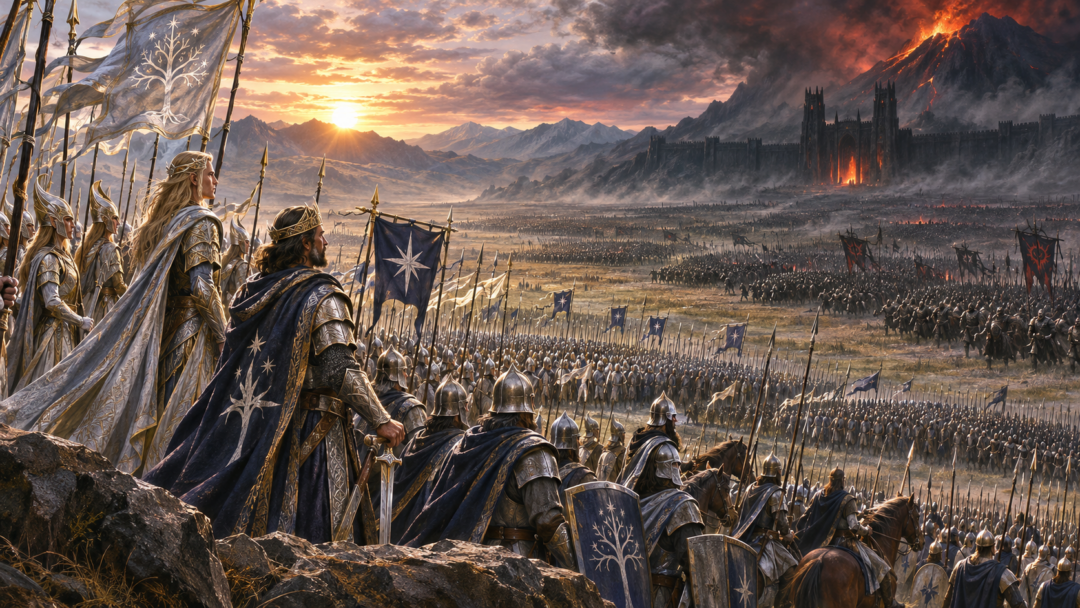
The Battle of Dagorlad was among Middle-earth’s greatest military confrontations. In Second Age 3434, the Last Alliance of Elves and Men defeated Sauron’s army on the plain outside Mordor, opening the way to Barad-dur. Its dead haunted the landscape for thousands of years. But was it the largest battle ever fought?
**Probably not. The War of Wrath at the end of the First Age has the stronger claim, although Tolkien supplies no numbers that settle a ranking of individual battles.** Dagorlad may have been the greatest battlefield confrontation of the Second Age. Distinguishing assembled armies, single engagements, and entire wars is more useful than inventing troop totals.
Why Dagorlad Has Such an Enormous Reputation
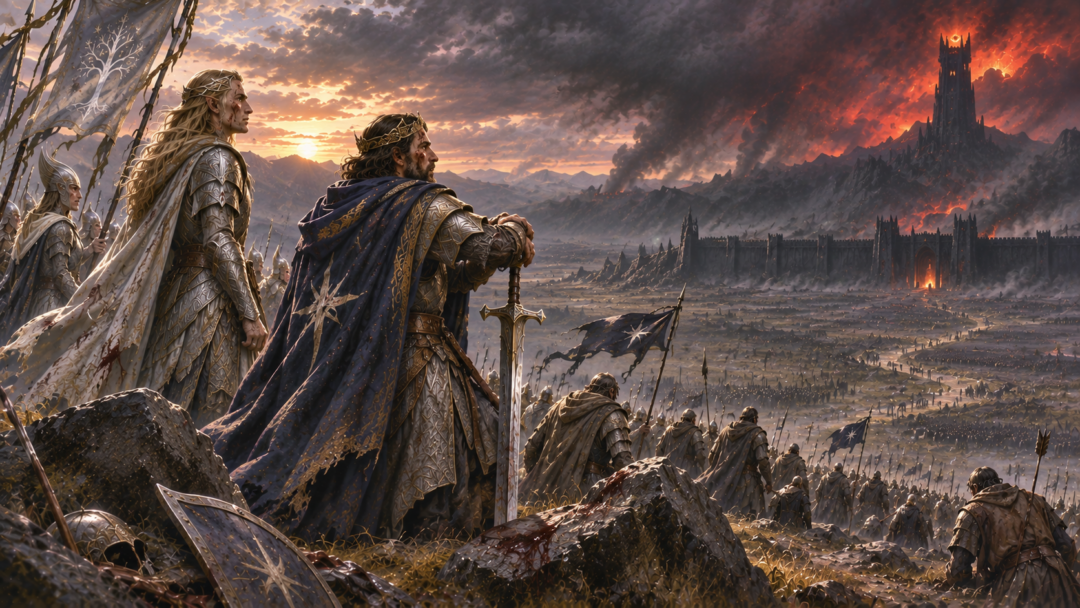
In Second Age 3434, the Last Alliance met Sauron’s forces on Dagorlad, the broad plain before Mordor’s Black Gate. Gil-galad, High King of the Noldor, and Elendil, leader of the surviving Faithful Numenoreans, commanded Elves from Lindon and other realms, Men of Arnor and Gondor, and additional allies. The leading powers of the western lands had united against a common enemy, not merely fought a neighboring kingdom.
In *The Silmarillion*, ‘Of the Rings of Power and the Third Age,’ Tolkien depicts the alliance’s host as surpassing later armies in splendor and strength, while comparing it with the host that fought Morgoth at Thangorodrim. That comparison matters more than any unsourced numerical estimate.
Sauron’s army barred the approach to Mordor. Victory at Dagorlad let the allies enter the Black Land and begin their prolonged siege of Barad-dur. Dagorlad was the campaign’s decisive opening confrontation, not its entirety.
What Elrond Actually Tells Us
Elrond fought in the War of the Last Alliance. At the Council of Elrond in *The Fellowship of the Ring*, he recalls the glory of the armies that marched against Sauron, yet remembers greater hosts in the Elder Days, when Morgoth was overthrown and Thangorodrim broken.
He offers no troop figures, logistical estimates, or measurements of the battlefield; his comparison is not a modern census. Nevertheless, it differentiates the Last Alliance’s extraordinary power from the still greater forces associated with the First Age’s end.
‘Of the Rings of Power and the Third Age’ reinforces that reading by presenting the Last Alliance as the greatest host mustered since the powers of the West went against Morgoth. Tolkien himself thus locates the alliance within a hierarchy of legendary military strength. Importantly, these descriptions concern assembled hosts, not independently counted combatants actually fighting at Dagorlad. Neither side’s precise numbers are known. Moreover, an army assembled for a major war might include troops who never took part in its opening engagement. Tolkien’s emphasis on glory and strength describes the host’s importance, but those qualities are not interchangeable with headcount. That is why Elrond’s firsthand recollection is valuable without resolving the literal question of the largest battle.
The War of Wrath Was on Another Scale
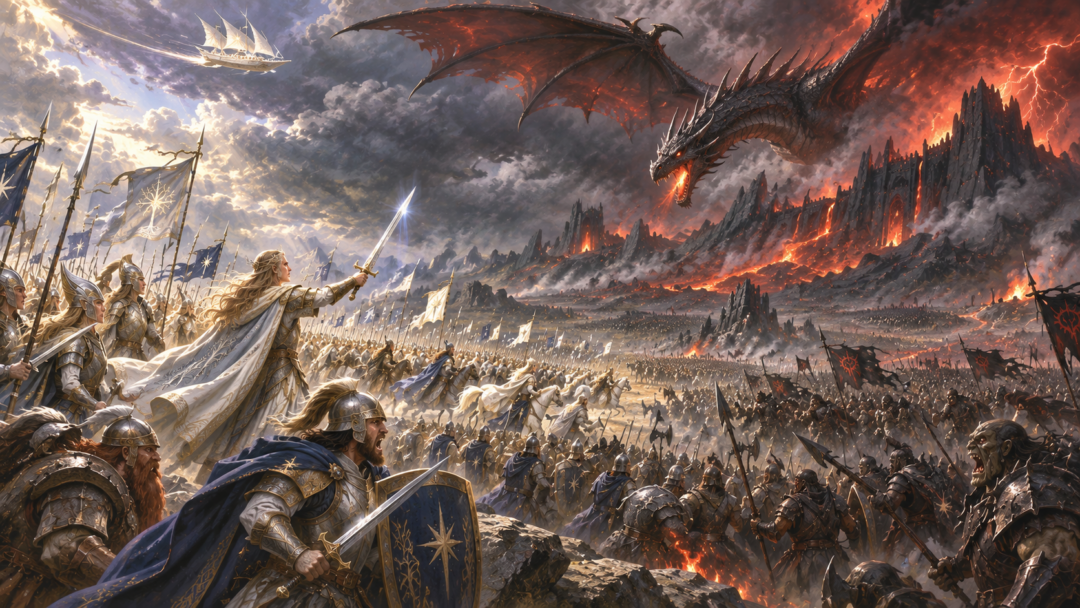
The strongest rival came at the end of the First Age. Following Earendil’s voyage to the Blessed Realm and appeal for help against Morgoth, a host arrived from the West under Eonwe, herald of Manwe. It included the Vanyar and Noldor from Aman. Morgoth defended Angband with his surviving strength, including Orcs, Balrogs, and dragons.
This was more than a larger version of the wars against Sauron. Morgoth was a Vala, whose power and destructive ambitions eclipsed those of his former lieutenant. In *The Silmarillion*, ‘Of the Voyage of Earendil and the War of Wrath,’ the western armies overwhelm Morgoth’s forces and ultimately break his stronghold.
The arrival of winged dragons briefly reversed the western host’s fortunes. Ancalagon the Black led the assault, until Earendil defeated him in the sky; his fall shattered Thangorodrim’s towers. Across the conflict, much of Beleriand was ruined and eventually submerged beneath the sea.
Neither that devastation nor the geographical transformation gives us a casualty count, and the changes should not be assigned to one afternoon’s fighting. They do, however, show a conflict on a scale beyond an ordinary military engagement. Dagorlad opened the road into Mordor; the War of Wrath ended Morgoth’s dominion and altered northwestern Middle-earth itself.
The Problem With Comparing Them
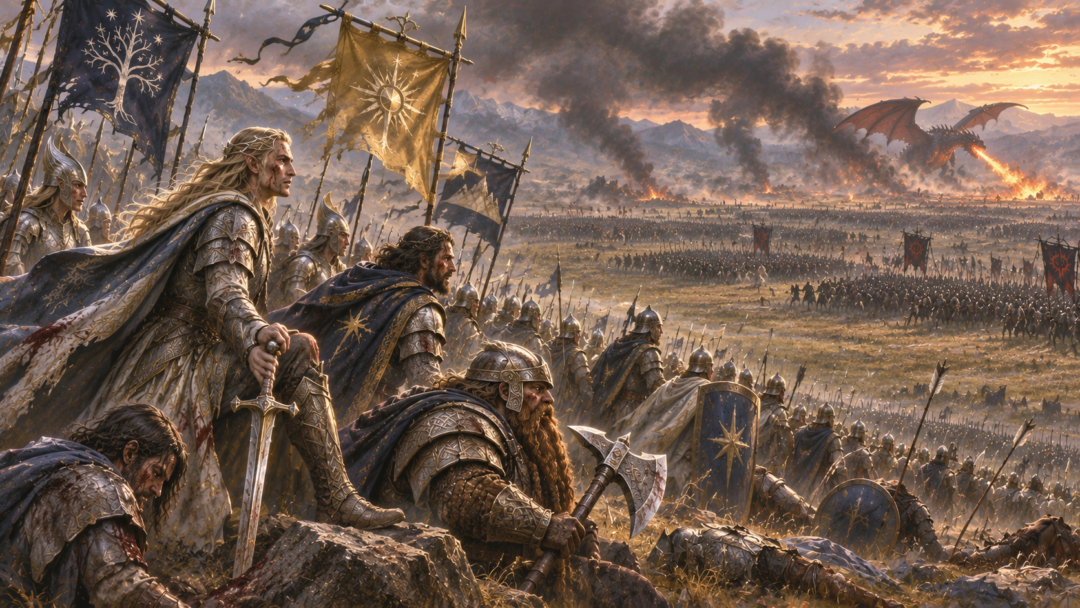
**The War of Wrath was a war, not necessarily one continuous battle on a single field.** Tolkien describes a prolonged campaign with successive phases, reversals, assaults, and Angband’s eventual destruction. Dagorlad, conversely, identifies one encounter within the War of the Last Alliance.
If we ask which *military conflict* was greatest, the First Age has the stronger claim. If we ask how many combatants fought *simultaneously on one identifiable battlefield*, we lack the figures needed to name an undisputed winner.
The western host at the War of Wrath was portrayed as greater than later hosts, making it the leading candidate for the greatest mobilization. But a larger army across a campaign does not mean every engagement in that campaign exceeded Dagorlad. Tolkien’s comparisons support a historical judgment, not a battlefield census. This distinction also prevents a misleading inference from the damage caused: a campaign that reshaped a continent might be more destructive without offering evidence that more warriors stood together on any particular day. The question is not whether the War of Wrath was momentous, which the text plainly establishes, but what kind of size Tolkien allows us to compare.
What About the Battle of Unnumbered Tears?
The Nirnaeth Arnoediad, or Battle of Unnumbered Tears, is another serious contender. In the First Age, Maedhros organized a coalition against Morgoth. The armies of Fingon and Maedhros sought to coordinate an offensive uniting Elven kingdoms, Men, and Dwarves, hoping to break Morgoth’s dominance before their remaining strength disappeared.
Morgoth exploited the allies’ separation, sent reinforcements, and benefited from treachery among some Easterlings serving Maedhros. Glaurung and Angband’s armies helped turn the battle. Fingon died; Hurin’s desperate rearguard let Turgon’s army escape. The defeat effectively destroyed the organized military hopes of much of Beleriand.
‘Of the Fifth Battle: Nirnaeth Arnoediad’ in *The Silmarillion* portrays multiple armies and fronts, with more tactical detail than the War of Wrath narrative. It is therefore one of the strongest candidates for an enormous *single* battle. Yet it provides no dependable numbers for comparison with Dagorlad. The phrase Unnumbered Tears signifies immeasurable grief, not an enumerated troop strength; catastrophic losses do not prove that the battle was larger.
The Last Alliance Was Bigger Than One Battle
Dagorlad and the War of the Last Alliance are not interchangeable. After winning on the plain, the allies entered Mordor and besieged Barad-dur for seven years. Sauron eventually emerged and confronted Gil-galad and Elendil on Orodruin’s slopes. Both leaders died, Sauron was overthrown, and Isildur took the One Ring from the fallen enemy.
That final victory followed several stages of war, with losses accumulated across them. Soldiers killed at Dagorlad cannot simply be added to everyone who died during the later siege and called one battle’s casualties. Nor must the army surviving Dagorlad have equaled the force outside Barad-dur seven years afterward. Tolkien recounts the sequence without supplying full figures for recruitment, reinforcements, desertions, or garrison strengths. Any precise total would be speculative. Even the length of the siege tells us about the endurance and cost of the campaign rather than the size of the opening battle. Treating every participant in a seven-year struggle as if present at Dagorlad would inflate the encounter beyond anything the surviving narrative warrants.
The Dead Marshes Show the Cost, Not the Numbers
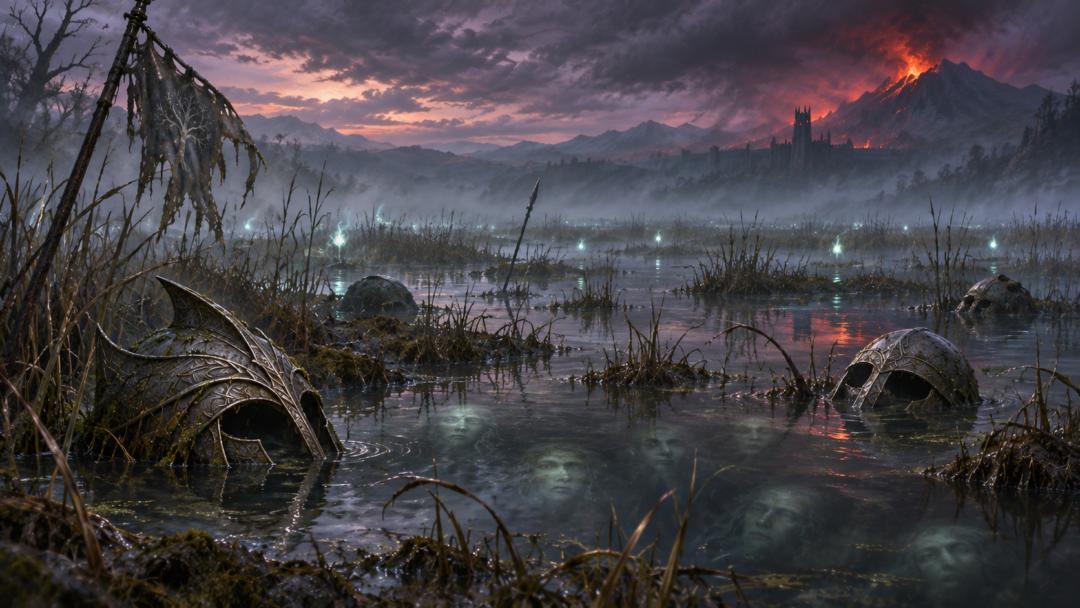
In *The Two Towers*, Frodo, Sam, and Gollum cross the Dead Marshes, encountering eerie lights and faces beneath the water. Gollum connects the area to the ancient battle. The marshes retain a supernatural memory of Elves, Men, and Orcs killed there, making the horrors of Dagorlad palpable thousands of years later.
Peter Jackson’s film adaptation emphasizes this haunting: Frodo sees submerged faces and falls into a terrifying vision of the dead. The sequence ties the ancient kings’ war to Mordor’s enduring corruption. But neither Tolkien’s text nor the movie supplies a body count. The Dead Marshes attest to devastating consequences, not a numerical comparison with First Age battles. The emotional magnitude of a scene cannot establish military size.
Did the Films Make Dagorlad Look Even Larger?
Jackson’s *The Fellowship of the Ring* begins with a spectacular portrayal of the Last Alliance: vast formations of Elves and Men, seemingly countless Orcs, and Sauron personally sweeping aside his enemies. For many viewers, it defines ancient Middle-earth warfare before the main story starts.
The opening also compresses Tolkien’s chronology. In the books, the initial battle at Dagorlad and Sauron’s last confrontation near Mount Doom were separated by years of siege; the film joins them in a more continuous visual account. Effective filmmaking is not an authoritative basis for comparing troop strengths.
Jackson provides no definitive numerical count for Dagorlad, and the original film trilogy offers no comparable full-scale depiction of the War of Wrath. A conflict rendered spectacularly on screen naturally seems greater than one presented mainly through ancient historical narration. Visual prominence is not proof of precedence. The opening prologue also foregrounds Sauron himself, making the scene feel like the war’s climax. In the book chronology, however, his personal defeat comes after the alliance has already fought at Dagorlad and sustained the siege. Confusing those scenes can distort both the dating of events and assessments of what happened on the plain.
Could Numenor Have Fielded an Even Greater Army?
Ar-Pharazon’s expedition against Sauron complicates Second Age rankings. In ‘Akallabeth,’ Tolkien describes Numenor’s last king arriving in Middle-earth with overwhelming military force. Recognizing he could not win a direct confrontation, Sauron submitted without giving battle.
The expedition proves that immense armies could be mobilized before the Last Alliance, but it was no great pitched battle: there was no clash between two deployed armies. Nor does Tolkien supply numbers establishing whether Ar-Pharazon commanded more troops than the later alliance. The coalitions, circumstances, and objectives differed. The episode illustrates why the *largest army assembled*, *largest battle fought*, and *most destructive war* require separate answers. Intimidating an enemy into surrender can demonstrate an army’s power without establishing any battlefield casualties at all. Ar-Pharazon’s success therefore belongs in a discussion of military mobilization, while offering little evidence for a ranking of battles actually fought.
So Was Dagorlad the Largest Battle?
**The best-supported answer is no, though a definitive ranking of individual engagements remains impossible.** Tolkien portrays the Last Alliance as exceptionally mighty but compares its host with the greater precedent of the First Age. The War of Wrath has the strongest claim as Middle-earth’s greatest overall military conflict.
Dagorlad remains a plausible contender among the largest single battles, particularly in the Second Age; the Nirnaeth Arnoediad is another. The texts do not yield reliable comparative troop counts. Claims of hundreds of thousands or millions would be inventions, not evidence.
Dagorlad’s importance never depended on winning a numerical contest. It carried the Last Alliance to Mordor’s gates, enabled the siege of Barad-dur, and left a memory of slaughter that confronted Frodo millennia later. It was a defining battle—but the greatest war had already been fought when Morgoth ruled the North, dragons darkened the sky, and the land itself could not survive the struggle.
Sources & Notes
This article is based on close reading and interpretation of Tolkien's published works and related source material where relevant.