Galadriel Matters Because She Knows What Victory Will Cost
Galadriel is easy to mistake for an impressive detour. The Fellowship enters a golden forest, meets an ancient Elven ruler, receives advice and gifts, and leaves. She does not join the march to Mordor or fight at the Black Gate. In Peter Jackson’s films, her stillness and eerie beauty can make her seem more like a supernatural symbol than a character with choices of her own.
But that is precisely why she matters. Galadriel makes the central conflict of *The Lord of the Rings* more difficult than a contest between good people and a Dark Lord. She has power worth keeping, a realm worth defending, and good reasons to fear what even a successful quest will take away. Her greatness lies not simply in resisting evil. It lies in recognizing that saving Middle-earth may require surrendering the version of Middle-earth she loves.
The safest place in the story is already disappearing
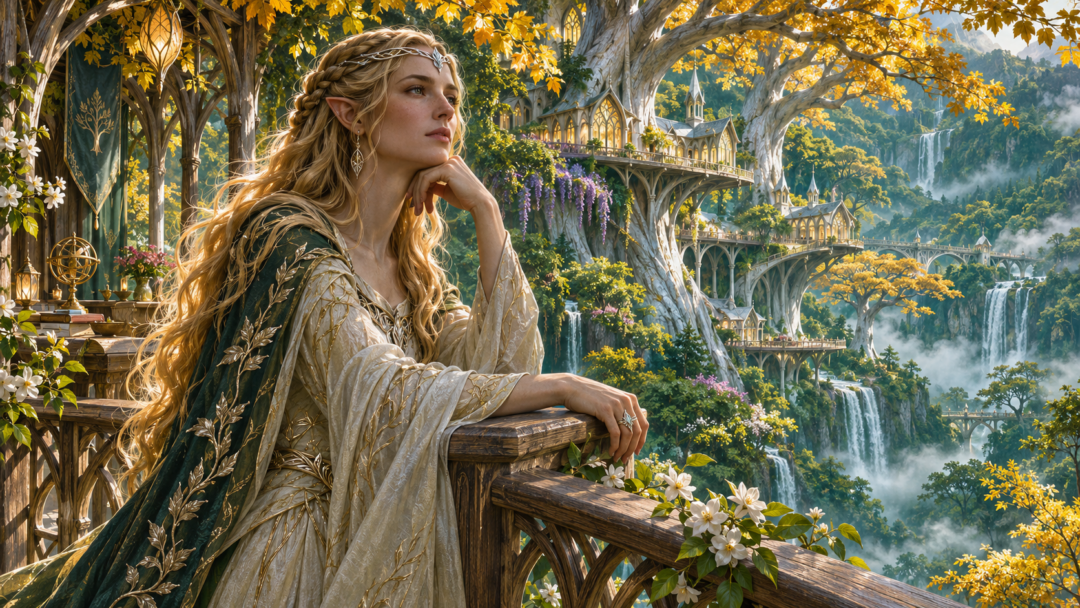
Lothlorien feels like a refuge after Moria. Gandalf has fallen, the Fellowship is frightened, and the woods offer an almost impossible peace. That feeling is not just attractive scenery. Tolkien has made a place that appears to hold loss at bay, a living reminder of an older world that the War of the Ring threatens to erase.
Galadriel is one reason that preservation is possible. She bears Nenya, one of the Three Elven Rings, whose work is associated with preserving and protecting rather than conquering. Sauron did not make the Three himself, but they remain bound to the fate of the One Ring. When the One is destroyed, their power fades. Lothlorien cannot remain what it was forever.
This changes the moral arithmetic. Destroying the Ring will defeat Sauron’s claim to dominion, but it will also end an age in which Galadriel’s arts can hold her cherished world apart from ordinary change. A simpler fantasy might reward every worthy ally by restoring everything they value. Tolkien refuses that bargain. Victory is necessary, but it is not free, even for those on the right side.
Frodo offers her more than a weapon
The Mirror of Galadriel is one of the book’s most important scenes because it turns uncertainty into a temptation. Sam sees alarming images of the Shire, including damage at home. Frodo sees visions he cannot fully sort into past, present, or possible future. Galadriel does not sell the Mirror as a reliable schedule of events. It can show things that may never happen. Seeing a frightening future does not automatically tell you how to prevent it.
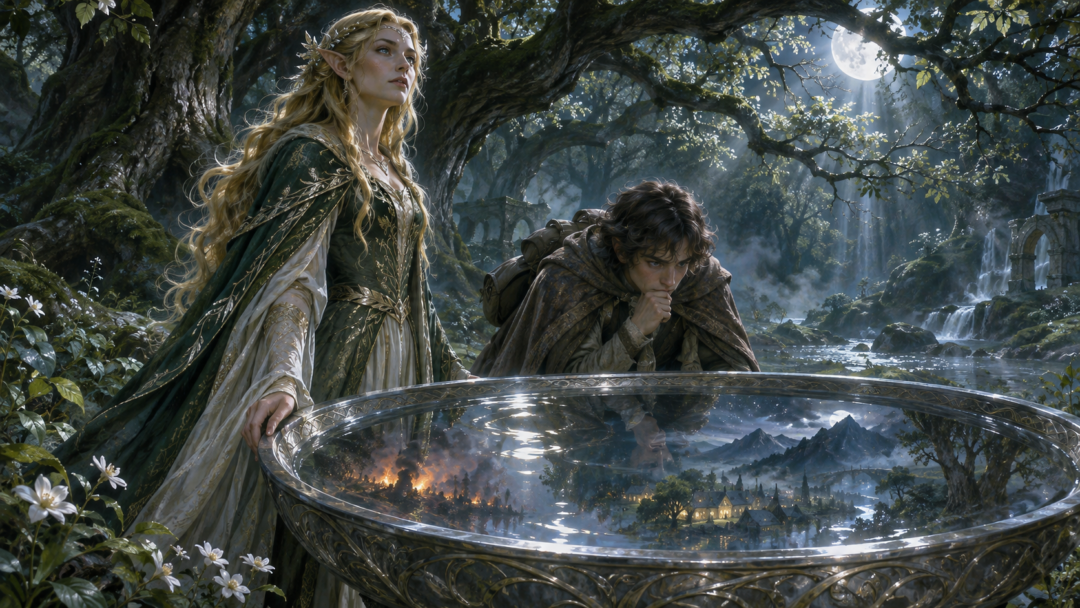
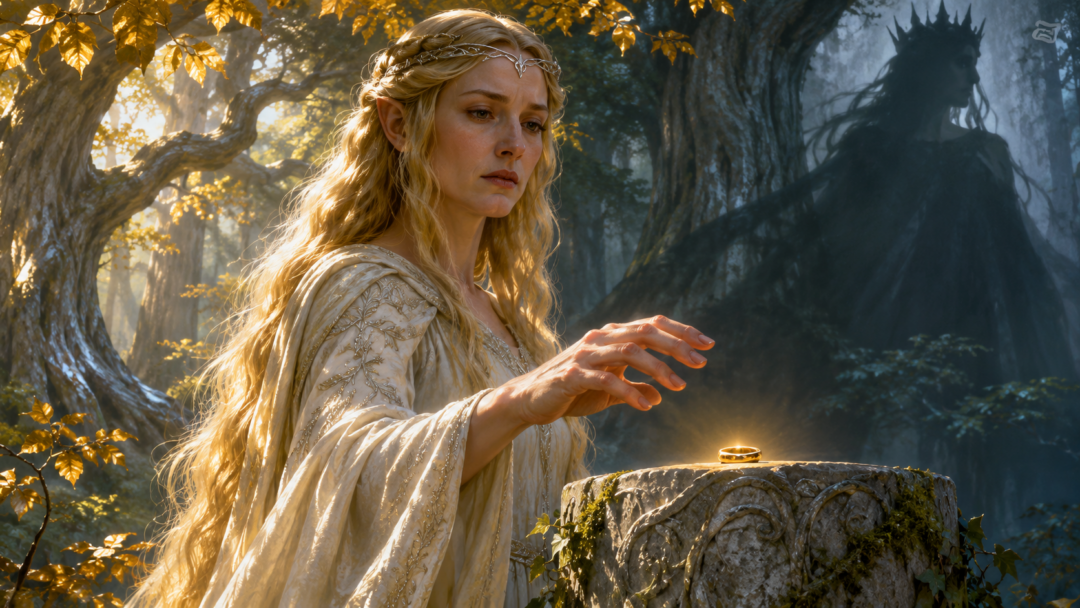
Then Frodo offers her the One Ring. To someone as knowledgeable and formidable as Galadriel, that offer carries an unusual danger. She could imagine using enormous power to oppose Sauron and ordering the world according to her own wisdom. That is the point: the Ring can corrupt noble purposes without first making them ugly.
In the book, she reveals an overwhelming vision of the queen she could become, then lets it pass. Her decision is not merely a dramatic rejection of an evil object. It is a refusal to make her judgment compulsory for everyone else. Tolkien asks whether even a wise protector can remain good while demanding absolute control. Galadriel’s answer is delivered through a choice, not a lecture.
And her choice is unusually costly. Galadriel is not declining a power she has never wanted, or protecting a homeland that will survive untouched either way. She has much to lose and the capacity to picture how she might avoid losing it. That makes her refusal more revealing than an effortless display of purity.
Her most heroic act looks like inaction
Fantasy usually proves greatness through spectacular victories: a monster slain, a city defended, an army defeated. Galadriel’s defining moment works in reverse. The more power she might wield, the more important it becomes that she does not wield it.
This does not make her passive. She understands the danger, confronts it, and chooses not to turn a desperate situation into an excuse for domination. When Gandalf refuses Frodo’s earlier offer of the Ring, the reader learns that even benevolent power can become terrifying. Galadriel gives that principle a second, sharper test. Gandalf has no enduring kingdom like Lothlorien to preserve. She must weigh the fate of the world against something she has spent ages caring for.
Her restraint also challenges an easy reading of the Elves as flawless moral authorities. Tolkien’s Elves can be proud, possessive, stubborn, and reluctant to release the past. Galadriel’s wisdom matters because it is exercised in the presence of desire. That is why the scene remains memorable without a sword drawn. The danger is not a creature attacking from outside the forest. It is the possibility that its guardian could become the thing everyone needs saving from.
The gifts are not decorative souvenirs
After the test, Galadriel’s importance becomes startlingly practical. Her parting gifts do not resemble the prizes handed out after a completed quest. They prepare people for hardships that have not happened yet, while reflecting who those people actually are.
Frodo receives the Phial of Galadriel, holding light associated with Earendil’s star. Later, in the darkness around Shelob, that light becomes more than a symbol. Frodo and Sam use it against a terror that ordinary courage and steel cannot easily answer. Galadriel will not be physically present, but an act of foresight and generosity reaches into Mordor.
Sam receives earth from her garden, with a mallorn seed in the book. The gift may seem almost comically modest beside enchanted light. Yet when Sam returns to a damaged Shire, that small box helps him restore living things. It is a gift suited to the gardener rather than to a warrior. Tolkien quietly connects the fate of a legendary Elven realm with the survival of everyday gardens.
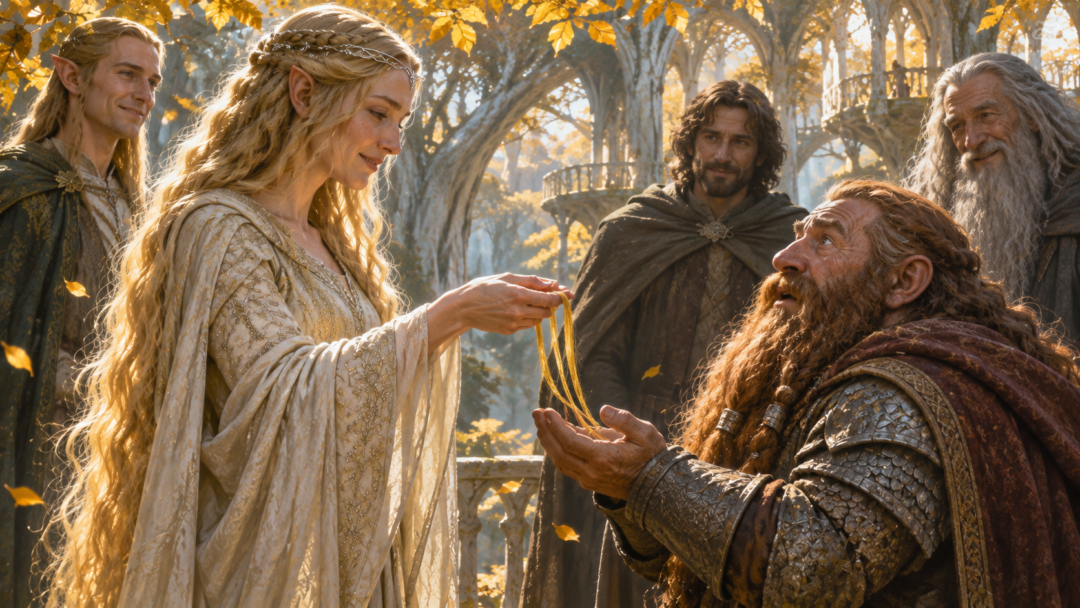
Gimli’s gift reveals another side of her. He asks, with considerable embarrassment, for a single hair, and she gives him three. The exchange matters because Gimli arrives in a place burdened by distrust between Elves and Dwarves. Galadriel recognizes something honorable in his admiration and responds with generosity rather than condescension. A tiny personal gesture accomplishes what proud speeches about reconciliation could not.
She changes how we understand the story’s heroes
Galadriel’s attention to Sam and Gimli is not incidental kindness. It exposes the limits of the usual hierarchy of heroic importance. The Fellowship cannot win by gathering enough superior beings to overwhelm Sauron. Its success depends on people carrying burdens without the certainty of success, often far from anyone who could applaud them. Galadriel recognizes that pattern early. She knows Frodo cannot simply be relieved of his task by someone stronger. Her help matters because it strengthens the quest without taking ownership of it.
There is a quiet contrast here with Boromir. He too wants to save the people he loves, and he imagines using the Ring to do so. His desperation is understandable, but it pushes him toward taking the Ring from Frodo. Galadriel has her own beloved place to protect and a far greater understanding of the Ring. She shows the alternative: love need not give its owner permission to control everyone else.
That contrast makes her compelling in a distinctly adult way. She is not being asked to choose between caring and not caring. She is being asked what caring can justify.
The films turn a private decision into a haunting image
Cate Blanchett’s performance in Jackson’s *The Fellowship of the Ring* makes the character’s distance from ordinary life immediately visible. Her measured speech, watchful presence, and near-motionless authority suggest someone who has seen whole ages come and go. The film intensifies Frodo’s offer of the Ring with a sudden transformation in voice, light, and scale. For a moment, the reassuring Lady of the Wood becomes terrifying.
That spectacle is effective because it externalizes an inward temptation. The audience sees the possible queen rather than merely hearing her described. But it can also distort the scene if treated as proof that Galadriel is secretly evil or becomes possessed for a few seconds. The nightmare is a vision of what domination could make of her, not a hidden identity finally exposed.
The movies also amplify her mysterious influence through voice-over, visual echoes, and the almost sacred quality of Lothlorien. Some details differ between page and screen, including the prominence of particular gifts. The essential argument survives: this is a person whose authority is measured by what she refuses to seize.
Fans find her captivating partly because the films give this conflict an unforgettable face.
Her long history makes the choice harder, not easier
Galadriel is far older than the War of the Ring. Across Tolkien’s wider writings, she is associated with the great Elven histories of the First Age and with a fierce desire for a realm of her own. The precise story of her departure from the West and her possible ban on returning changed in Tolkien’s later accounts. Those versions should not be flattened into a single, perfectly consistent biography.
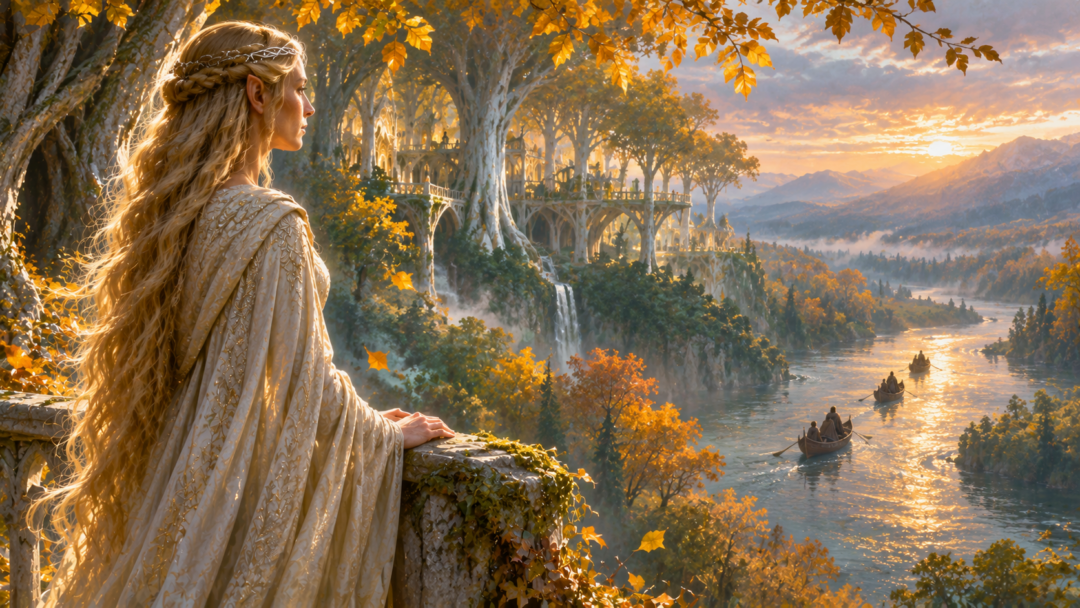
Even with that caution, the larger pattern is useful. Galadriel is not simply an immaculate figure who wanders into the plot to dispense wisdom. Pride, ambition, memory, and attachment belong to her story. The temptation offered by the One Ring reaches those older desires. Her decision in Lothlorien feels like a culmination because she is turning away from more than a momentary impulse.
The published *Lord of the Rings* gives us a ruler whose poise contains a genuine struggle, while the larger legendarium leaves room for debate about the path that brought her there.
Why she stays with us
Galadriel matters to the plot because she protects a refuge, tests the Ring-bearer, rejects the Ring, and provides gifts that continue to shape events far beyond her borders. But the stronger reason is thematic. She makes the victory over Sauron morally complicated without making that victory any less necessary.
She knows that a good end does not permit every means. She knows that preserving beauty can become a form of possessiveness. And she accepts that the future may belong to people who will not preserve her world exactly as she remembers it. Her greatness is therefore neither limitless strength nor spotless innocence. It is the ability to release a claim when holding it would damage what she meant to defend.
Most of the famous heroes in *The Lord of the Rings* move toward an impossible task. Galadriel faces a different impossible demand: she must help bring about a future in which her own power will matter less. It is a rare fantasy story that lets a character be magnificent precisely because she consents not to remain at the center of everything.
That is why the Lady of Lothlorien is more than an atmosphere, a magical benefactor, or a dramatic temptation scene. She embodies one of Tolkien’s hardest ideas: winning can require letting a beloved world pass, and genuine wisdom is knowing when not to stop it.
Sources & Notes
This article is based on close reading and interpretation of Tolkien's published works and related source material where relevant.