1. A surname is not an identification
The most revealing feature of the Black Riders’ pursuit of Frodo is that they repeatedly have to ask for directions. These are the servants of a power that has dominated much of Middle-earth, yet their investigation proceeds through conversations with gardeners, farmers and innkeepers. Their supernatural abilities coexist with a remarkably ordinary dependence on local information. Tolkien makes this discrepancy central to the opening movement of The Fellowship of the Ring.
The distinction that matters is between knowing whom to seek and knowing whom one has found. The Riders possess information connecting the Ring with the name Baggins and the country called the Shire. By the time they reach Hobbiton, they have translated at least part of that information into a practical destination. What the novel does not establish is that they began their expedition knowing Frodo’s personal identity, his relationship to Bilbo, or the circumstances in which he inherited the Ring.
The hunt is consequently neither a pursuit conducted in complete ignorance nor the execution of a fully informed mission. It is an investigation in which the quarry and his pursuers possess different pieces of the same story. Tolkien allows the reader to see this imbalance without supplying a continuous account of how the enemy’s knowledge develops.
2. What Gollum actually gave away
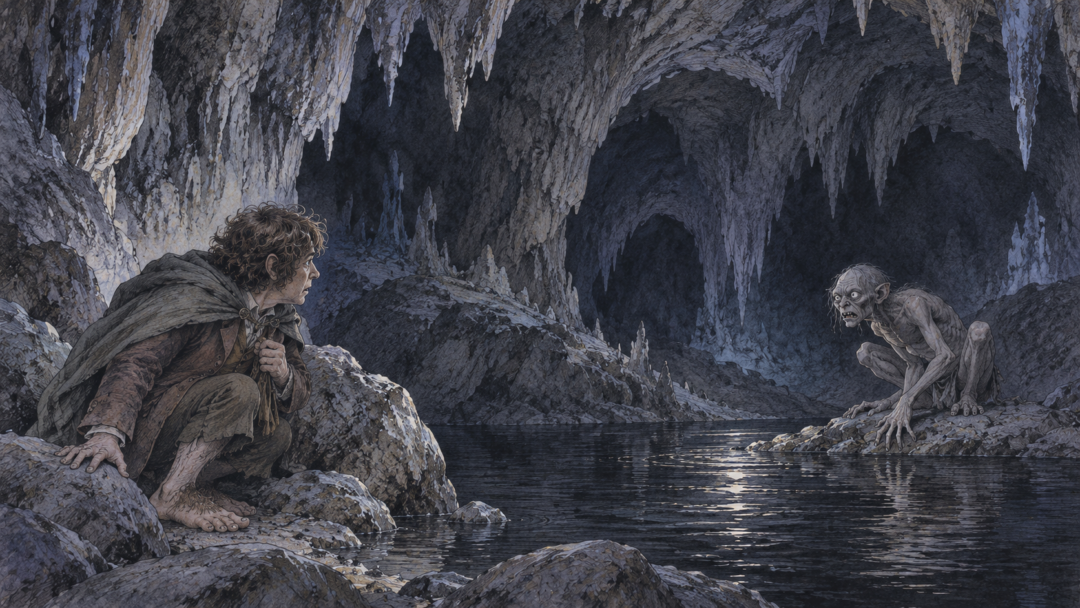
The essential evidence comes from Gandalf’s account in Book I, Chapter 2, ‘The Shadow of the Past’. Gollum’s captivity in Mordor has enabled Sauron to learn about the finding of the Ring and its association with a hobbit. Two names emerge as particularly dangerous: Baggins and Shire.
Their significance is obvious to Gandalf and Frodo, but it is worth remembering how little information they necessarily contain for someone unfamiliar with hobbit society. Baggins is a family name, not a unique personal designation. The Shire is a geographical name, not an address. Neither identifies Frodo as the present bearer.
The Hobbit, Chapter 5, ‘Riddles in the Dark’, establishes that Bilbo supplies Gollum with his surname during their encounter beneath the Misty Mountains. Gollum’s original knowledge of Baggins therefore refers to Bilbo. The subsequent transfer of the Ring, described in ‘A Long-expected Party’, takes place in circumstances that Gollum is not shown witnessing or learning about.
It would be unwarranted to treat Gandalf’s reconstruction of Sauron’s discoveries as proof that Mordor possesses a complete account of the Ring’s passage from Bilbo to Frodo. The novel supplies no transcript of Gollum’s interrogation, no inventory of Sauron’s discoveries and no record of the instructions given individually to the Nine.
Nevertheless, the Riders’ subsequent questions establish that the surname has become operational information. They are acting upon knowledge whose original human—or rather hobbit—referent is Bilbo, but which now directs them towards Frodo. That gap between the original referent and the current bearer is fundamental to understanding the pursuit.
3. Finding the Shire is itself an achievement
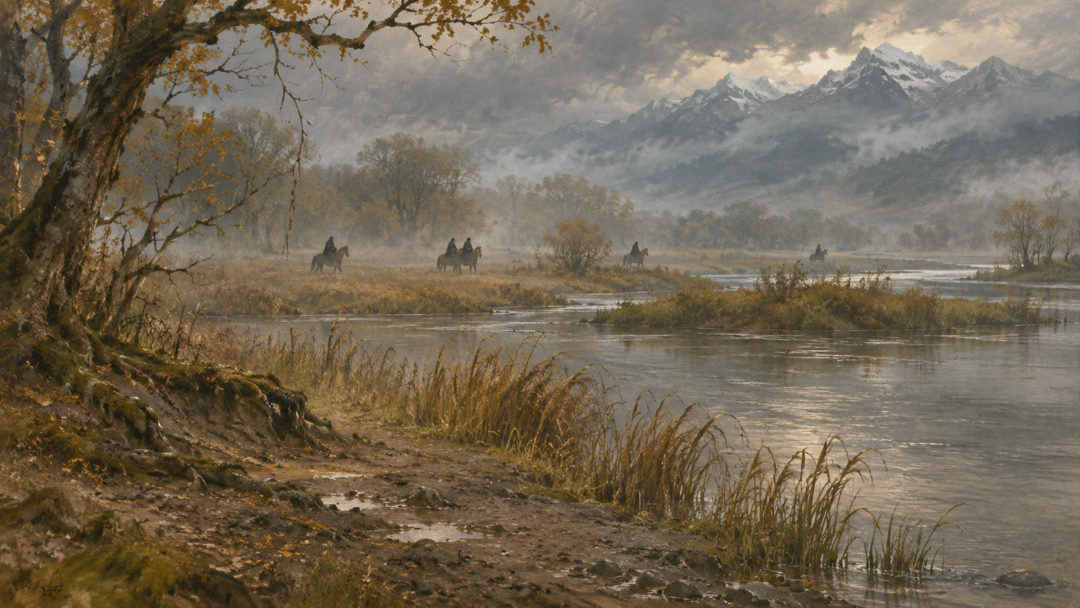
Readers familiar with the map of Eriador can easily underestimate what the word Shire means to the enemy. A name that identifies a clearly bounded region for us does not necessarily provide useful geographical information to a servant of Mordor.
Tolkien gives this problem considerably more attention in the writings published by Christopher Tolkien as ‘The Hunt for the Ring’ in Unfinished Tales, Part Three, Chapter IV. There the search for the land of the Halflings involves substantial uncertainty. Gollum’s information sends the search in a misleading geographical direction, towards the region associated with his own earlier life near the Anduin.
These accounts illuminate an aspect of the hunt largely concealed by the novel: before the Riders can locate a particular Baggins, they must discover where the relevant population lives. Their mission requires geographical intelligence as well as the supernatural powers associated with their condition.
The later writings give Saruman and information originating from his activities important roles in the eventual discovery of the Shire. But Christopher Tolkien presents material from differing accounts, and the reader should not combine every detail into a single definitive chronology. Tolkien’s working narratives do not invariably agree with one another or with the dating of events in Appendix B of The Lord of the Rings.
The secure conclusion is narrower and more interesting than an exhaustive reconstruction. The enemy’s initial information is insufficient to locate the Ring, and the geographical problem has to be solved by investigation. Even after the Riders discover the Shire, they still face the problem of identifying an individual within it.
4. The conversation outside Bag End
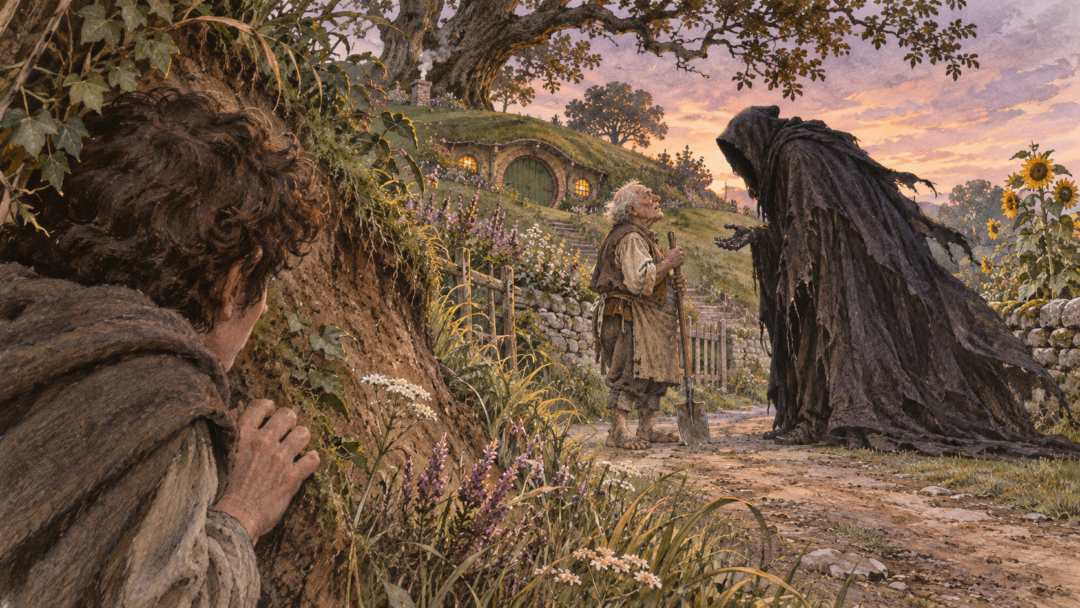
The encounter with the Gaffer in Book I, Chapter 3, ‘Three is Company’, provides the first decisive evidence of how far that investigation has advanced. Frodo overhears part of a conversation near Bagshot Row shortly before his departure. The stranger is asking about Baggins, and the Gaffer explains that his former neighbour has moved towards Bucklebury.
The scene is constructed around an extraordinary limitation: Frodo can hear the answers but cannot distinguish the stranger’s questions. Tolkien therefore gives us the results of the Rider’s inquiries without disclosing their precise formulation.
Sam’s subsequent account supplies additional information. The visitor was interested in Baggins of Bag End. His displeasure at learning that Baggins has moved suggests that the information is unwelcome. The Gaffer’s response has also furnished the stranger with a new destination.
What remains unestablished is whether the Rider knows that the Baggins who has just departed is Frodo rather than Bilbo, and whether that distinction matters to him at this stage. The text does not disclose whether he possesses an accurate account of Bag End’s recent occupants or simply regards the present resident as the most promising connection to the Ring.
There is also a revealing coincidence of timing. Frodo has arranged a public explanation for his departure while concealing its actual purpose. The Gaffer innocently communicates part of that explanation to the enemy. The Rider obtains genuine information about the apparent relocation, but not the secret intention to leave the Shire altogether.
This is the clearest example of the pursuit’s uneven distribution of knowledge. Frodo knows why he is leaving but initially fails to understand the visitor’s importance. The visitor knows enough to investigate Bag End but is not shown learning the true purpose of Frodo’s journey.
5. Can the Riders recognise the Ring-bearer?
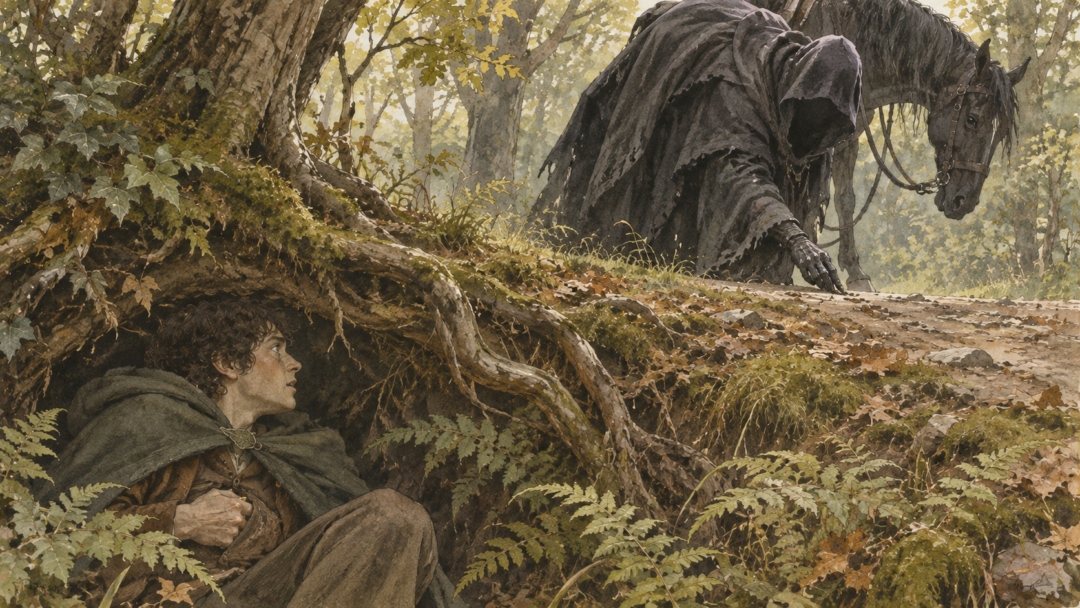
The roadside encounter later in ‘Three is Company’ complicates any account that reduces the hunt to questions and directions. The Rider stops near Frodo’s hiding place, appears to investigate his surroundings by scent, and provokes in Frodo a powerful temptation to put on the Ring.
The juxtaposition makes a supernatural connection an obvious possibility. It does not, however, explain precisely what the Rider perceives. Frodo’s experience cannot be converted without qualification into evidence of the Rider’s knowledge.
The most useful explanation within the novel comes from Aragorn in Book I, Chapter 11, ‘A Knife in the Dark’. He describes the Riders’ unusual relationship to the visible world, the limitations of their ordinary sight and their awareness of living beings through other faculties. His account also distinguishes their perception of the unseen world from ordinary mortal perception.
The later material in ‘The Hunt for the Ring’ gives further substance to these distinctions. Tolkien attributes differing capacities to the individual Ringwraiths, including differences in their ability to perceive the presence of the Ring and their effectiveness in daylight. The hunt should not therefore be understood as though all nine possess identical and infallible means of locating their objective.
The crucial point is that sensitivity does not amount to certain identification. The possibility that a Rider detects something significant nearby does not establish that he knows Frodo’s name, recognises his appearance or can determine his exact position at will.
Frodo’s use of the Ring at Weathertop later makes his relationship to the unseen world unmistakably important to the encounter. But the circumstances of that confrontation cannot simply be projected backwards onto the earlier search. The roadside episode preserves the uncertainty of a near discovery rather than explaining the mechanism by which discovery might have occurred.
6. From Farmer Maggot to the Bucklebury Ferry
In Book I, Chapter 4, ‘A Short Cut to Mushrooms’, Tolkien gives us another report of a Rider questioning a local inhabitant. Farmer Maggot has been approached by a sinister stranger seeking Baggins. The visitor even offers a reward for information about his whereabouts.
Here the supernatural hunter behaves strikingly like an ordinary investigator. He needs a witness, expects that inducement might secure cooperation, and encounters resistance from someone who understands the local country far better than he does.
Maggot’s previous acquaintance with Frodo gives the inquiry particular narrative force. The reader knows that the Rider has approached someone genuinely capable of identifying the intended quarry. Yet the conversation does not reveal whether the Rider himself understands the nature of that acquaintance.
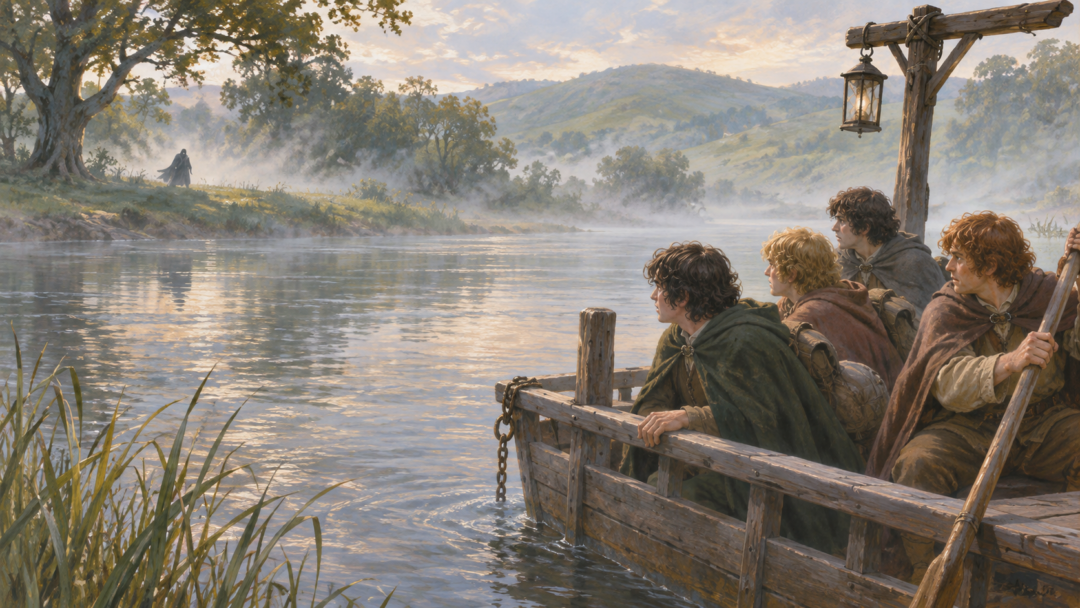
The subsequent appearance of a dark figure on the opposite bank of the Brandywine, in ‘A Conspiracy Unmasked’, continues the pattern. The pursuit has reached a relevant crossing, but the hobbits have already crossed the river. Tolkien supplies the visible evidence of proximity without a corresponding explanation of the pursuer’s reasoning.
The attack on Crickhollow, narrated in the opening of ‘A Knife in the Dark’, ultimately demonstrates that the enemy has acquired knowledge of Frodo’s supposed new residence. Yet the house is empty of its intended occupant. The Riders’ increasingly precise information still lags behind the movements of their quarry.
Taken together, these incidents show an accumulation of practical knowledge rather than the effortless operation of supernatural certainty. The Riders know enough to become terrifyingly close, but their discoveries remain vulnerable to concealment, misleading appearances and changes of plan.
7. Why Tolkien keeps the hunters outside the narrative
It would be misleading to say that The Lord of the Rings never presents events independently of Frodo’s experience. The scene at Crickhollow alone disproves such an absolute claim. What Tolkien generally withholds during this pursuit is something more specific: sustained access to the Riders’ thoughts, deliberations and assessment of their information.
This withholding is particularly effective because the reader already understands facts that the hunters may not know. We have witnessed the transfer of the Ring. We understand Frodo’s preparations and the distinction between his public relocation and his intended journey. We are therefore positioned to recognise both the accuracy and the possible inadequacy of the enemy’s inquiries.
But our advantage over the Riders is limited by our inability to determine exactly how much they have discovered. When a Rider stops near Frodo, we cannot know whether he has detected the Ring itself, sensed something else or merely encountered a promising circumstance. The possibility of discovery is more frightening because its threshold is concealed.
Gildor’s conversation with Frodo at the end of ‘Three is Company’ reinforces this narrative arrangement. Gildor understands that Frodo is in serious danger but expressly disclaims knowledge of the reason for the enemy’s pursuit. His reluctance to explain everything he knows about the Riders leaves Frodo with warnings rather than a comprehensive understanding of his predicament.
The result is not simply an atmosphere of mystery. It is a carefully maintained uncertainty about the relationship between evidence and recognition. The hobbits must act before they can establish what the enemy knows, while the reader must interpret the hunters through their observable conduct.
8. What we can finally say about their knowledge
By the time the Black Riders are operating inside the Shire, they demonstrably know the surname Baggins and have found the country associated with it. Their inquiries connect that surname with Bag End, and their subsequent movements show that information about Buckland and Frodo’s apparent relocation has become available to them. Their mission derives from Sauron’s discovery that the One Ring has survived and is associated with a hobbit.
What cannot be established with comparable confidence is when they first learn the personal name Frodo, when they distinguish him from Bilbo, whether they know the details of his inheritance, or at precisely what moment they become certain that he personally carries the Ring. Nor does the published narrative allow us to reconstruct the knowledge possessed by every individual Rider at every stage of the pursuit.
The supplementary accounts in Unfinished Tales clarify the geographical investigation, the organisation of the hunt and aspects of the Ringwraiths’ powers. They do not eliminate every uncertainty in the novel’s presentation, and their differing versions require interpretive restraint.
The strongest reading is therefore that the Nazgûl enter the Shire with a dangerous but incomplete set of information, which they progressively refine through inquiries and pursuit. Their ignorance is neither total nor reassuring. They do not need to understand Frodo’s entire history in order to capture him; they need only acquire enough information to find him before he escapes.
That is why the Gaffer’s conversation is so important. A creature bound to the power of the One Ring stands outside the home in which that Ring has rested for years, dependent upon the casual remarks of an elderly gardener. The terror of the scene lies in how little the Rider needs to learn, and how narrowly Frodo avoids being there when he learns it.
Sources & Notes
This article is based on close reading and interpretation of Tolkien's published works and related source material where relevant.