
Seventeen years in the life of an immortal
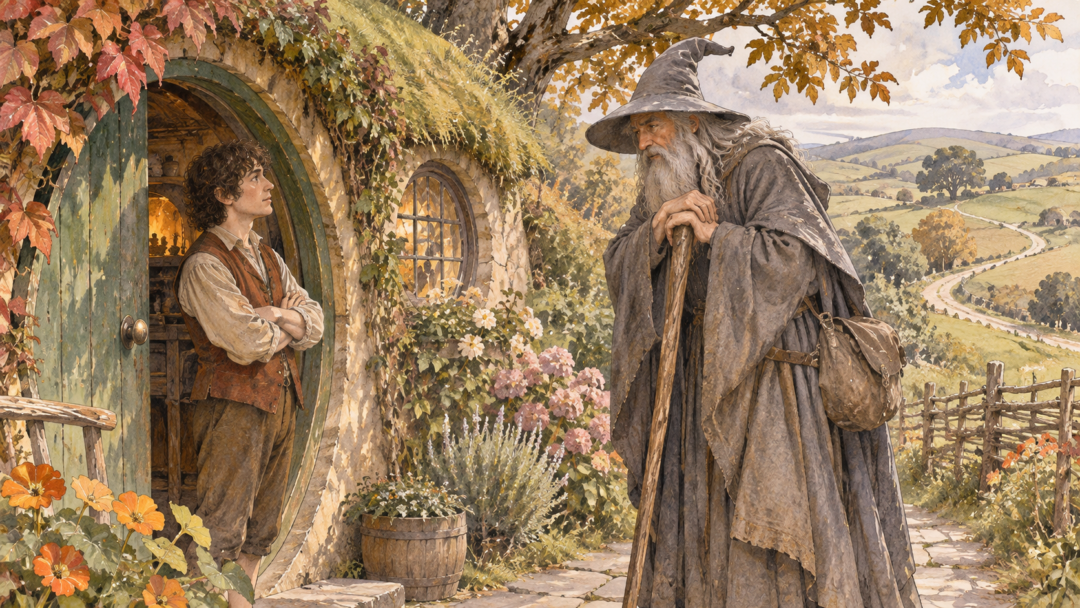
Between Bilbo’s farewell party in September 3001 and Gandalf’s decisive conversation with Frodo in April 3018, seventeen calendar years pass in the reckoning of the Third Age. For Frodo, this encompasses a substantial portion of his adult life. For Gandalf, whose existence predates the physical world, it represents an extraordinarily small fraction of his history. Perhaps, then, Gandalf delayed because seventeen years scarcely registered with him.
Yet Tolkien gives us reason to resist that explanation. Gandalf’s ancient existence provides a context for understanding his patience, but it does not establish that he experiences time more rapidly than mortals or feels less urgency about his responsibilities.
Moreover, the opening chapters of The Fellowship of the Ring and Appendix B establish that these were not seventeen years of uninterrupted absence or inactivity, but a period of visits, investigations, uncertainties and discoveries.
Seventeen years were undoubtedly brief against the scale of Gandalf’s existence. Whether they felt brief is another question, which Tolkien never directly answers. What the narrative establishes is that Gandalf understood the importance of time, even when the knowledge necessary to act decisively remained beyond his reach.
A spirit who entered Time
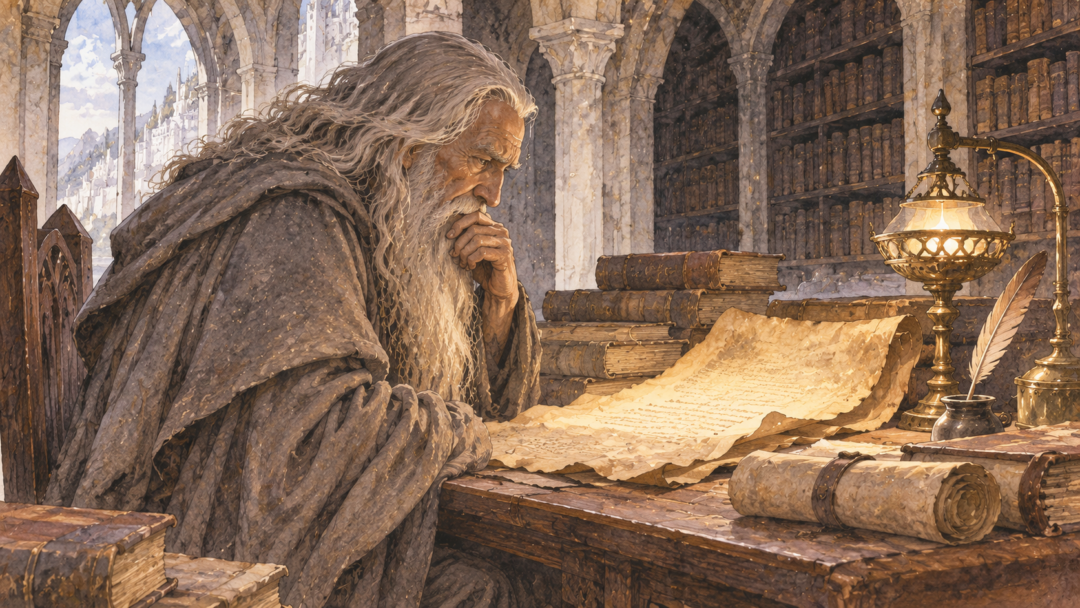
In the cosmology of The Silmarillion, immortality and timelessness are not interchangeable. The Ainulindalë describes the existence of the Ainur before the creation of Eä, the physical universe, and their subsequent entry into it. Those who enter become bound to the world for the duration of its existence.
The Valaquenta identifies Olórin among the Maiar, spirits of the same fundamental order as the Valar, though lesser in stature. His identification with Gandalf is established in Unfinished Tales, in the material concerning the Istari, and is consistent with Gandalf’s account of his names reported by Faramir in The Two Towers, Book IV, Chapter 5, ‘The Window on the West’.
Existence within Eä entails participation in its unfolding history. The Ainur encounter events that have not yet happened, undertake labours requiring completion and contend with changing circumstances. Their existence before the physical world does not make them omniscient or exempt them from temporal succession within it.
Gandalf is therefore an immensely ancient participant in history, not an eternal observer for whom the entire Third Age necessarily exists as a simultaneous present.
Tolkien provides no conversion between the subjective duration experienced by a Maia and that experienced by a Hobbit. Saying that seventeen years felt like seventeen days or hours to Gandalf might illustrate the scale of his existence, but has no textual basis as a description of his psychology.
The limitations of Gandalf’s incarnate existence
Gandalf is not merely a Maia inhabiting Middle-earth under conditions of his choosing. As one of the Istari, his embodiment forms an essential part of his mission.
In Unfinished Tales, Part Four, ‘The Istari’, Tolkien explains that the Wizards received genuine physical bodies, subject to hunger, thirst, fear, suffering and exhaustion. Although they endured far beyond ordinary human lifespans, their appearance gradually reflected the accumulated burden of their work. Letter 156, addressed to Robert Murray in November 1954, likewise describes their incarnation as exposing them to real physical limitations, difficulties and dangers.
Especially relevant is the account in Unfinished Tales of the Istari having to acquire knowledge anew through experience. Their memories of the Blessed Realm were remote rather than immediately available in their original fullness. Gandalf’s ancient identity did not give him unrestricted access to everything he had once known, much less knowledge of everything subsequently occurring in Middle-earth.
This makes the seventeen-year interval more intelligible than an appeal to immortality alone. Gandalf must travel, consult others, examine evidence and pursue leads. Knowledge takes time to acquire under the conditions of his mission.
It would nevertheless be excessive to conclude that Gandalf experiences time exactly as a Man or Hobbit does. Tolkien establishes the reality of his temporal burdens, not the precise character of his subjective perception. An immortal spirit can grow weary during a difficult journey; someone expecting to survive another century can still experience a frustrating afternoon.
The seventeen-year absence that never happened
Gandalf’s departure after the birthday party is not followed by seventeen years without contact with Frodo.
In ‘The Shadow of the Past’, Tolkien describes Gandalf returning after an initial absence of three years. Further visits follow, although the Wizard becomes increasingly preoccupied. Appendix B, ‘The Tale of Years’, places these visits between 3004 and 3008, with the last occurring in the autumn of 3008.
When Gandalf returns to Bag End on 12 April 3018, more than nine years have passed since Frodo last saw or heard from him. That remains a considerable absence, particularly from Frodo’s perspective, but differs substantially from the familiar picture of Gandalf disappearing for seventeen years immediately after Bilbo’s departure.
The earlier visits demonstrate that Gandalf did not simply forget about the Ring or its new keeper. His attention to Frodo continues while his suspicions develop. The changing pattern of visits belongs to the history of his growing investigation, although Tolkien provides no comprehensive account of every intervening journey.
Interpreting the interval as evidence of an immortal’s indifference to passing years therefore overlooks Gandalf’s recorded conduct. He periodically checks on Frodo before the longer separation, remaining concerned without yet resolving the problem.
The seventeen years are best understood as the interval between the Ring’s transfer and its definitive identification in the Shire, not as Gandalf’s uninterrupted absence.
Suspicion was not certainty
At the farewell party, Bilbo’s extraordinary reluctance to surrender the Ring and his possessiveness deepen Gandalf’s longstanding concerns. Nevertheless, ‘A Long-expected Party’ does not present Gandalf as possessing the certainty he demonstrates in the following chapter.
His account at the Council of Elrond, in The Fellowship of the Ring, Book II, Chapter 2, explains why. Gandalf had relied on Saruman’s authority concerning the Rings of Power. Saruman’s assurances encouraged the belief that the One Ring was no longer a practical threat, having been carried down the Anduin toward the Sea.
Gandalf also lacked evidence conclusively distinguishing Bilbo’s ring from other possibilities. His discovery of Isildur’s description in the records of Minas Tirith supplies crucial knowledge of the inscription and the relationship between its markings and heat.
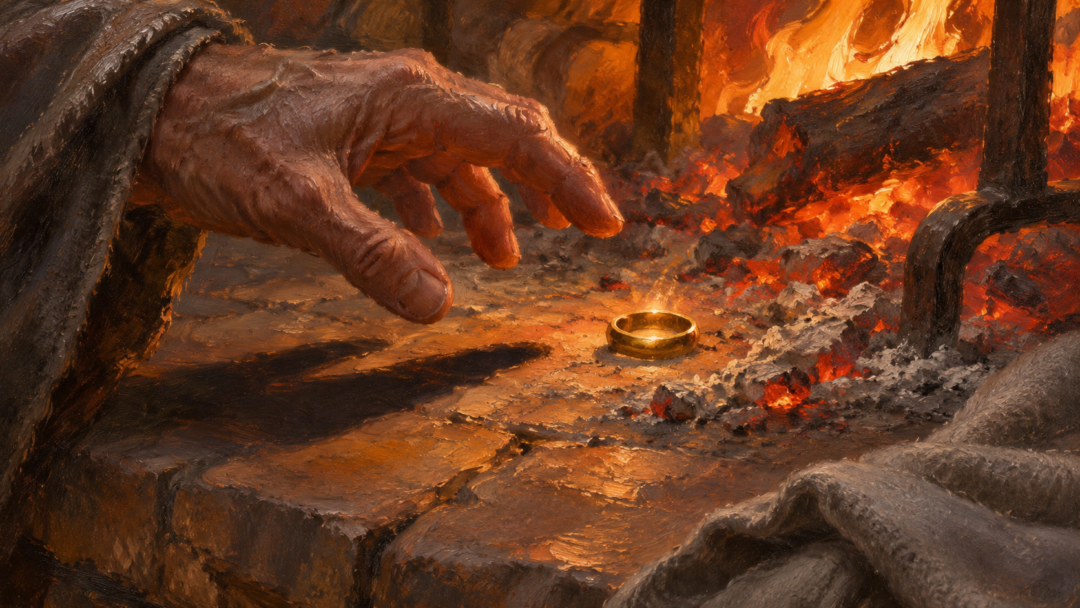
Appendix B places Gandalf’s examination of Isildur’s records in 3017. The following April, the fire at Bag End enables him to establish the Ring’s identity directly.
This progression from suspicion through misleading assurances to new evidence and decisive verification explains the timing of the revelation more convincingly than conjectures about immortal psychology.
That does not mean every year of the delay was unavoidable. Tolkien allows Gandalf to acknowledge errors in his earlier judgement, but these concern incomplete knowledge, misplaced confidence and the difficulty of recognising the truth. Gandalf does not attribute them to a failure to notice how many years had elapsed.
The years were years of pursuit
Both ‘The Shadow of the Past’ and ‘The Council of Elrond’ establish the importance of obtaining information from Gollum, the Ring’s keeper before Bilbo.
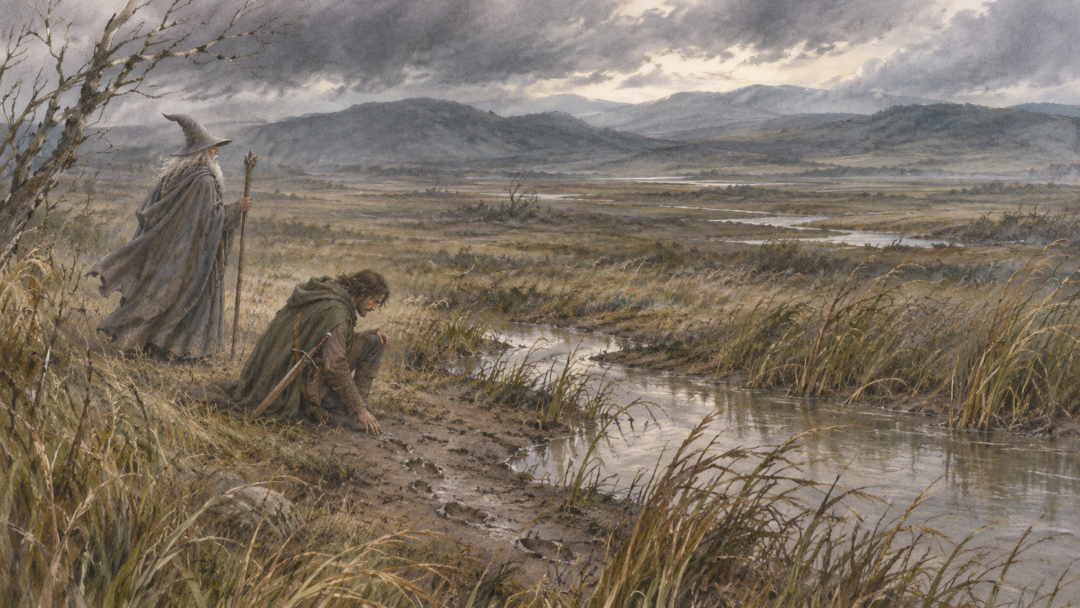
Appendix B records that Gandalf and Aragorn renewed their hunt for Gollum in 3009, searching intermittently over the following eight years. Gollum had meanwhile fallen into Sauron’s hands. After his release from Mordor, Aragorn eventually captured him in 3017, and Gandalf subsequently questioned him in the Woodland Realm.
A significant portion of the apparently empty interval thus belongs to an active, difficult undertaking. These investigations also demonstrate why immortality confers no straightforward advantage over passing time. Gandalf might endure centuries, but the circumstances upon which his investigation depends change independently of him.
Gollum moves beyond his reach, Sauron acquires information, and Aragorn must pursue an elusive quarry across dangerous country. Gandalf cannot simply wait for the truth without consequences, because his adversary is also acting within history. His account in ‘The Shadow of the Past’ establishes that the danger has grown: the Enemy has learned enough from Gollum to threaten the Shire and the Ring’s keeper.
Tolkien provides no continuous itinerary of Gandalf’s activities between 3001 and 3018. We cannot demonstrate that every month was devoted to the Ring or that the chronology vindicates every decision. It does establish that the investigation faced practical obstacles and increasingly serious consequences. The years were not empty merely because they passed outside Frodo’s immediate narrative.
Patience is not indifference to urgency
Gandalf’s great age may nevertheless illuminate his character. The Valaquenta associates Olórin with wisdom, pity and the instruction of Nienna, while Unfinished Tales emphasises the Istari’s responsibility to encourage resistance rather than impose their own rule.
It is reasonable to interpret Gandalf’s willingness to undertake long, uncertain labours against this background. Someone whose responsibilities extend across generations may possess a different historical perspective from a short-lived individual. This remains an interpretation of his disposition, however, not a demonstrated law governing his perception of time.
The later narrative supplies an important corrective. In ‘The White Rider’, ‘The Palantír’ and ‘The Siege of Gondor’, Gandalf responds to rapidly developing events with unmistakable urgency. Hours and days matter because opportunities disappear, armies advance and lives depend upon timely decisions. Immortality does not diminish these deadlines.
In an exceptional passage in ‘The White Rider’, Gandalf describes passing beyond ordinary thought and time following his battle with the Balrog. Letter 156 discusses his death and return as an extraordinary intervention beyond the normal conditions of his mission.
That exceptional experience cannot establish the character of his everyday consciousness during earlier years. Rather, it warns against attributing timeless awareness to Gandalf the Grey during his travels through Middle-earth.
Gandalf’s own survival is not the measure of a consequential delay. He serves beings vulnerable to events that cannot be undone by waiting another century. His concern for them makes their temporal circumstances important, regardless of his own longevity.
What seventeen years meant to Gandalf
The answer requires distinguishing historical scale, subjective experience and practical consequence. Historically, seventeen years are extraordinarily brief beside Gandalf’s existence as Olórin. Even his career as an incarnate Wizard extends approximately two millennia before the farewell party, according to Appendix B.
Concerning subjective experience, Tolkien is silent. We do not know whether Gandalf experienced those years as psychologically shorter than Frodo did, whether accumulated memories altered his perception of their passage, or whether individual days felt different to him.
Concerning practical consequences, the narrative is emphatic. Seventeen years were enough for suspicions to mature, investigations to encounter setbacks, evidence to emerge and the Enemy to draw dangerously close to discovering the Ring.
The contrast between Gandalf and Frodo is therefore more interesting than a difference in the speed of their internal clocks. Frodo experiences the interval principally through the relative tranquillity of the Shire and the increasing mystery of Gandalf’s absence. Gandalf experiences its events as someone engaged in a struggle extending far beyond Hobbiton. They occupy different historical perspectives but inhabit the same endangered world.
Gandalf’s immortality explains how seventeen years might represent a modest chapter in his personal history. It does not make those years negligible, nor is it Tolkien’s stated explanation for the delay. The answer lies in the distinction between possessing ancient wisdom and possessing the particular knowledge necessary to act.
Gandalf had lived through ages of the world. Yet he still needed the evidence of a forgotten record, the testimony of a wretched creature and the revelation of a golden Ring in a Hobbit’s fireplace. Immortality could give him centuries in which to seek the truth; it could not give him the truth before he found it.
Sources & Notes
This article is based on close reading and interpretation of Tolkien's published works and related source material where relevant.