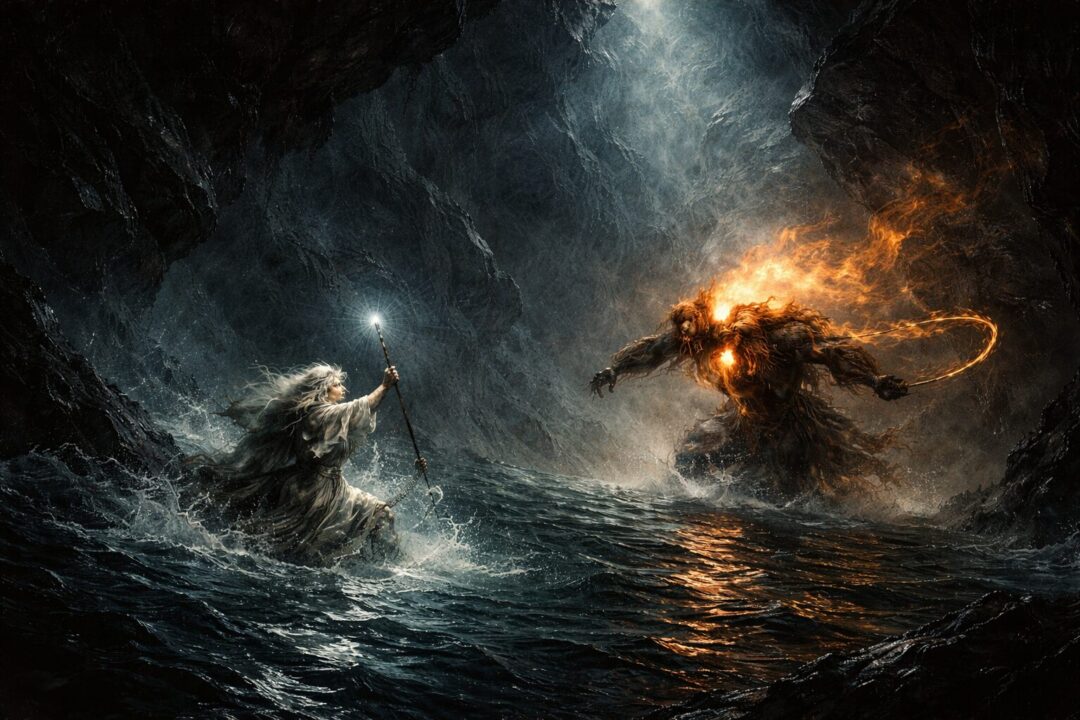
How Gandalf and the Balrog Reached Zirakzigil
When Gandalf falls with the Balrog in Moria, the moment feels final.
The bridge collapses.
The fire-whip coils.
Both figures vanish into the abyss.
The Fellowship does not wait to see what becomes of them. They flee, and rightly so. Everything about the scene tells the reader that Gandalf has fallen beyond recovery. The abyss beneath Khazad-dûm is ancient, bottomless, and hostile to life.
But Gandalf’s later account reveals something far more complex.
“Long I fell, and he fell with me.”
Those few words mark the beginning of a journey that carries both beings from the deepest reaches beneath the Misty Mountains to the very peak of Zirakzigil, also called Celebdil.
The question is simple.
The answer is not.
How did Gandalf and the Balrog reach the summit after falling into the depths of Moria?
What the Text Explicitly Tells Us
Any attempt to answer this question must begin—and largely end—with Gandalf’s own words in The Two Towers. Tolkien gives us a summary, not a full narrative, and it is the only authoritative account of what happened between the fall and Gandalf’s return.
From this passage, several firm points can be established without speculation:
• Gandalf and the Balrog fell a great distance beneath Moria
• They landed in deep subterranean waters
• Gandalf wounded the Balrog, breaking its hold
• The Balrog fled, and Gandalf pursued it
• Their struggle continued through tunnels and stairs, moving “ever upward”
• They emerged onto the mountainside
• Their final battle occurred on the peak of Zirakzigil
These are not interpretations. They are explicitly stated.
What Tolkien does not give us is equally important.
There is no map of their route.
No named stair or tunnel.
No explanation of how long the climb took in miles or days.
Any claim beyond these points must therefore be treated with caution.
The Geography Beneath Moria
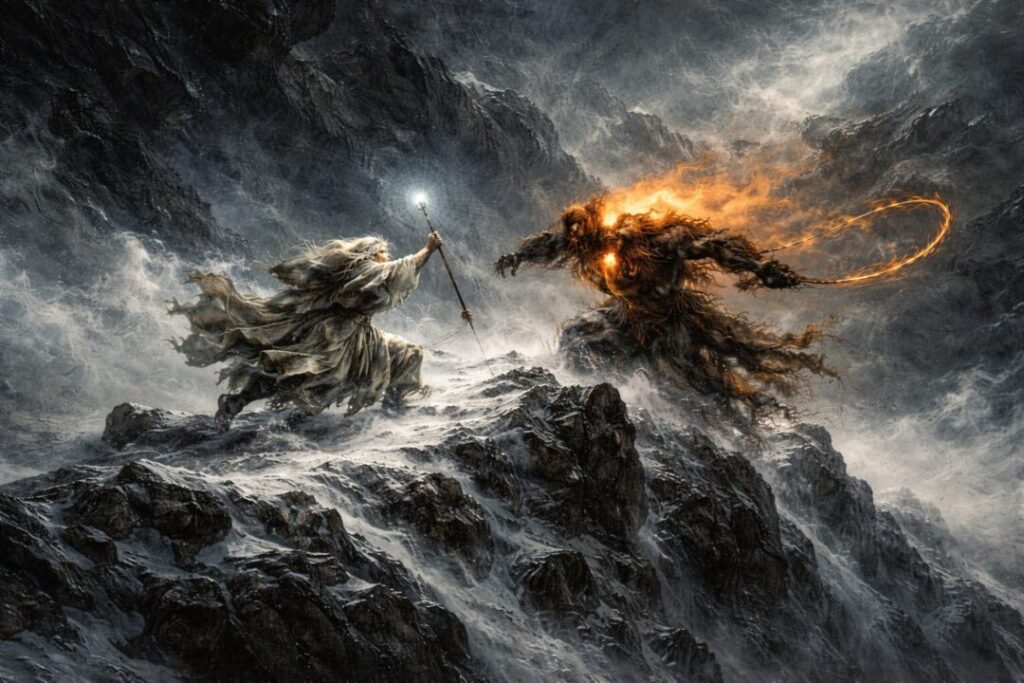
Moria—once Khazad-dûm—was not a shallow city. The Dwarves delved deep beneath the Misty Mountains, following mithril veins downward for generations. By the end of the Third Age, much of this underworld was abandoned, collapsed, or flooded.
Gandalf tells us that he and the Balrog fell into waters fed by “springs far below.” This alone confirms that their fall carried them well beneath the lowest halls encountered by the Fellowship.
From this, the text implies—but does not explicitly describe—a vast vertical underworld beneath the mountains. Natural caverns, fissures, flooded chambers, and ancient shafts likely existed, but Tolkien never inventories them.
It is reasonable to say that paths upward existed.
It is not stated that these were intact staircases, maintained Dwarven roads, or known escape routes.
Tolkien’s language emphasizes darkness, ruin, and exhaustion rather than structure or design. Gandalf does not describe choosing a route. He describes enduring one.
The Nature of Durin’s Bane
The Balrog of Moria—named by Gandalf as Durin’s Bane—is not a mindless beast.
Balrogs are corrupted Maiar, ancient spirits twisted by Morgoth in the First Age. This particular Balrog survived the fall of Morgoth and hid beneath the mountains for thousands of years, awakening only when the Dwarves delved too deeply.
Its long survival suggests a creature that avoids unnecessary exposure.
Once Gandalf breaks its power on the Bridge of Khazad-dûm, the Balrog does not continue the attack in open combat.
It flees.
This is an important detail. The text is clear that Gandalf wounds it, and that the Balrog withdraws rather than presses its advantage.
Why the Balrog Fled Upward
Tolkien never explicitly states why the Balrog fled upward rather than deeper into the earth. Any explanation must therefore be framed as implication, not fact.
That said, the texts allow for several careful observations:
• Balrogs are bound to fire and shadow
• This Balrog survived by hiding, not ruling openly
• It avoided the open world for the entirety of the Second and Third Ages
Moving upward toward the mountain’s peak does not offer strategic advantage. It removes darkness, warmth, and concealment. Each level climbed narrows the Balrog’s options rather than expands them.
The ascent appears not as a plan, but as a retreat with diminishing choices.
Eventually, there is nowhere left to flee.
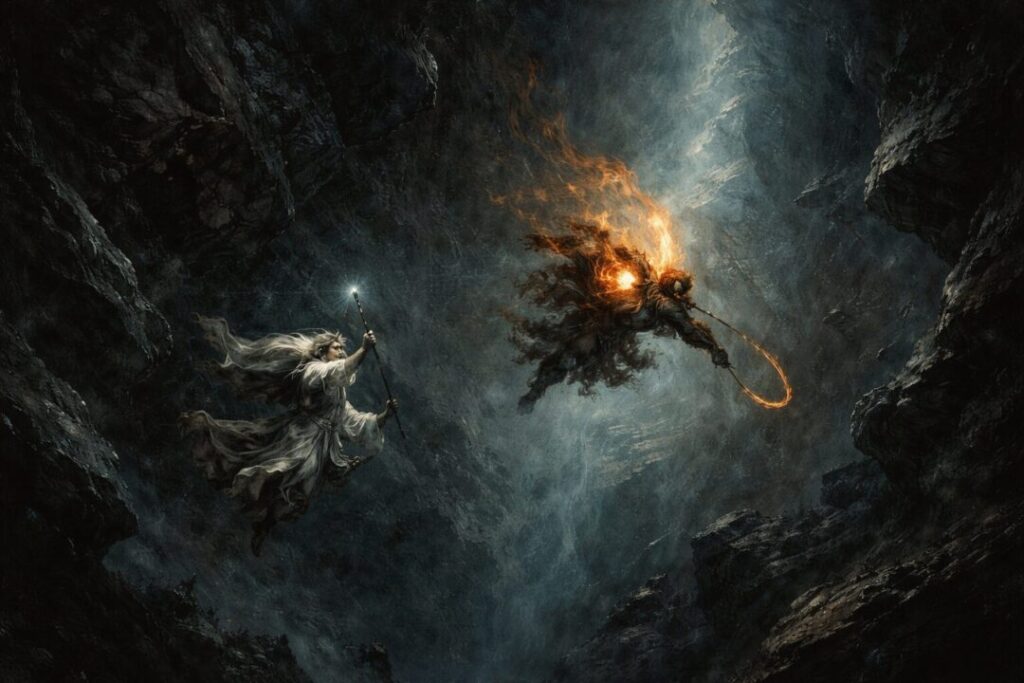
Gandalf’s Pursuit Was Not a Choice
One common misunderstanding is that Gandalf chose to chase the Balrog out of vengeance or duty.
His own words suggest otherwise.
“Ever he clutched me, and ever I hewed him…”
The struggle is continuous. The two are locked together in a conflict that does not allow separation. Gandalf does not describe moments of rest, planning, or decision-making.
The ascent is not heroic pursuit in the traditional sense.
It is a grinding, unavoidable struggle, fought in exhaustion and darkness.
By the time they reach the surface, both are already spent.
Emergence Onto the Mountainside
At some point—how or where Tolkien does not specify—the struggle breaks out of the underworld and onto the mountainside.
This transition matters.
The conflict moves from hidden depths into the open air. From secrecy into exposure. From the roots of the world into the realm of sky, wind, and snow.
From here, the path leads upward to Zirakzigil itself.
Why Zirakzigil Matters
Zirakzigil, or Celebdil, is one of the three great peaks that tower above Moria. It is high, cold, and utterly exposed to the elements.
Narratively, it is the exact opposite of the abyss beneath the mountains.
• Fire meets snow
• Shadow meets open sky
• Darkness meets light
The Balrog does not reach this place because it is powerful there.
It reaches it because there is nowhere else left.
The peak is not a refuge. It is an end.
The Final Battle
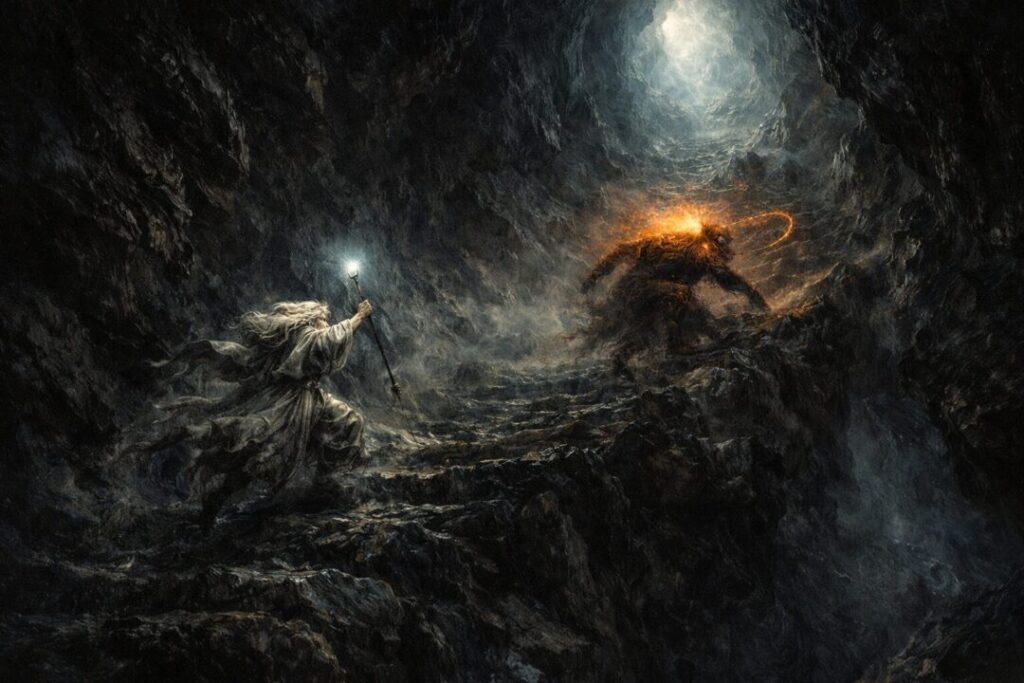
On the summit of Zirakzigil, Gandalf finally overcomes the Balrog.
But the victory is not survivable.
“Then darkness took me, and I strayed out of thought and time…”
Both fall. Both perish.
There is no triumphal survival, no immediate reward. Gandalf’s return comes later, and from beyond the world, through means not fully explained within the narrative.
What matters is that the battle spans the entire vertical range of Middle-earth—from the deepest waters beneath the mountains to their highest crown.
Why Tolkien Leaves the Route Unexplained
Tolkien could have explained the route.
He chose not to.
There is no mechanical description because the story is not about logistics. It is about movement: from concealment to exposure, from ancient terror to final reckoning.
The path is real.
But its meaning matters more than its shape.
The fall in Moria does not end in darkness.
It ends in snow, wind, and silence—
on the crown of the world.
Sources & Notes
- J.R.R. Tolkien, The Lord of the Rings, The Two Towers, Book III, Chapter 5, “The White Rider” — Gandalf’s account of the fall, the deep waters, the Endless Stair, and the battle on Zirakzigil.
- J.R.R. Tolkien, The Lord of the Rings, The Fellowship of the Ring, Book II, Chapter 5, “The Bridge of Khazad-dûm” — the breaking of the bridge and Gandalf’s fall with the Balrog.
- J.R.R. Tolkien, The Lord of the Rings, The Fellowship of the Ring, Book II, Chapter 4, “A Journey in the Dark” — Khazad-dûm beneath Celebdil, Caradhras, and Fanuidhol, and the shadow known as Durin’s Bane.
- J.R.R. Tolkien, The Silmarillion, “Valaquenta: Of the Enemies” — background on Balrogs as ancient spirits of fire and shadow in Morgoth’s service.