Does Doing Nothing Great Rule Out a Vala?
The argument sounds plausible: Tom Bombadil cannot have been a Vala because he accomplished nothing comparable to their great works, and therefore the Elves had no reason to preserve him in their histories. But this reasoning rests on two unsupported assumptions: that spectacular intervention defines membership among the Valar, and that Elvish remembrance requires historically momentous deeds.
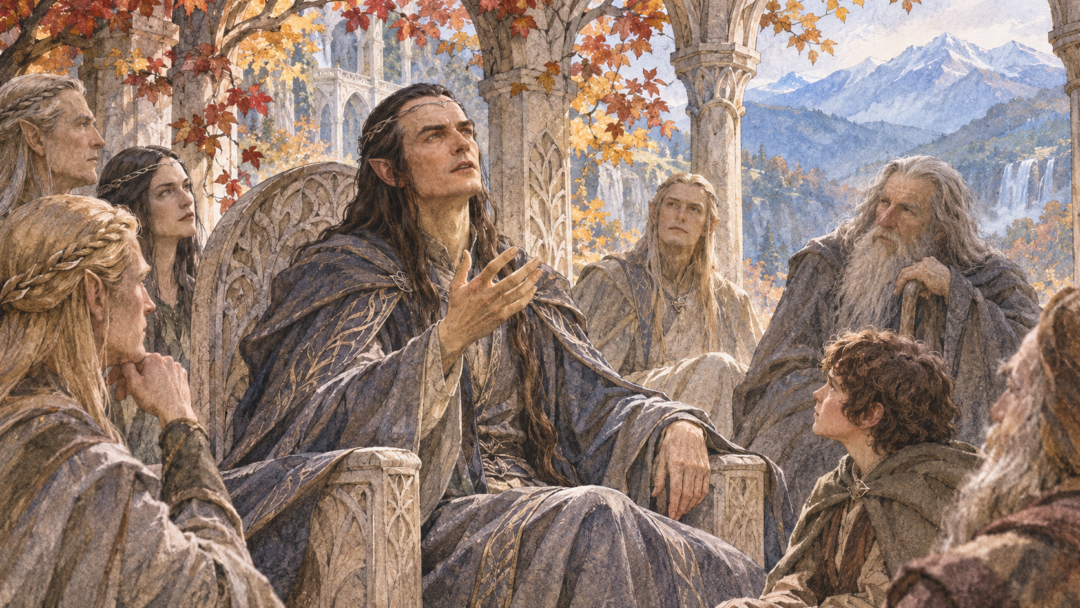
Neither proposition is established by Tolkien’s texts. The second directly conflicts with The Fellowship of the Ring. At the Council of Elrond, Bombadil is no stranger to Elvish tradition. Elrond recalls him from a distant past, supplies an ancient Elvish name, and acknowledges his extraordinary age.
The defensible conclusion is narrower than either identification or exclusion. Bombadil’s conduct differs from the activities normally associated with the Valar, but behavior alone cannot establish his nature. Likewise, Elvish knowledge of him proves remembrance, not understanding.
Tolkien provides evidence about Bombadil’s antiquity, reputation, powers, and attitudes. He does not definitively classify his being. Converting those characteristics into a conclusive identification exceeds what the text allows.

The Council of Elrond Already Refutes the Historical-Obscurity Premise
In The Fellowship of the Ring, Book II, Chapter 2, ‘The Council of Elrond’, Bombadil is proposed as a possible guardian of the One Ring. Elrond recognizes the figure under discussion, admits having forgotten him, and wonders whether he is indeed the ancient wanderer he remembers from long ago. Even then, Bombadil was exceptionally old.
Elrond supplies the name Iarwain Ben-adar, meaning ‘oldest and fatherless’, alongside Forn among the Dwarves and Orald among Northern Men.
These names preserve no celebrated military achievement, kingdom-building enterprise, or intervention against Morgoth. They attest to the remembered existence of a mysterious, extraordinarily ancient inhabitant of Middle-earth.
Elrond’s qualifications matter. Having forgotten Bombadil does not mean all Elves had forgotten him; the Council demonstrates otherwise. Nor does Elrond’s uncertainty about whether this is the same being invalidate the tradition. He recognizes a possible continuity without claiming certainty.
Knowledge also varies among the participants. Galdor knows little of Iarwain beyond his name; Glorfindel considers Bombadil’s likely fate under Sauron’s eventual domination. Elrond contributes ancient recollection, while Gandalf evaluates Tom’s present character.
The Council therefore establishes unevenly distributed Elvish knowledge, not universal ignorance. It does not establish a particular written chronicle about Bombadil. Spoken recollection, inherited names, and formal records remain distinct.
Nevertheless, the claim that Bombadil’s lack of great deeds prevented his entry into Elvish awareness is contradicted by the novel.
What Does ‘Oldest and Fatherless’ Actually Establish?
Iarwain Ben-adar strongly attests to Bombadil’s place in ancient memory, but it is not a classification of his nature. Elrond translates the name without explaining the metaphysical circumstances behind it.
‘Oldest’ suggests extraordinary precedence; ‘fatherless’ suggests existence outside ordinary parentage. Neither identifies Bombadil as a Vala, Maia, incarnate creature, or otherwise unclassified spirit.
In The Silmarillion, ‘Ainulindalë’, the Ainur exist before the physical World, participating in the Music before entering Eä. Their subsequent relationships with the World differ. Bombadil’s antiquity could therefore be compatible with an Ainu interpretation, but cannot establish one or distinguish among orders of being.
Elrond reports an Elvish designation, not a divine revelation of Bombadil’s origin. The tradition may express a profound truth, but Tolkien never specifies exactly how its claims should be understood.
The Dwarvish and Northern Mannish names reinforce evidence of an enduring reputation. They do not establish when the names arose, whether their peoples possessed independent knowledge, or whether their traditions conveyed identical information.
Bombadil was remembered under several names and regarded as exceptionally ancient. Yet no account accompanying Iarwain Ben-adar identifies his creation, entrance into the World, or membership among the Ainur. Those are precisely the missing facts required for classification.
Tom’s Own Testimony Reaches Further Back Than His Recorded Deeds
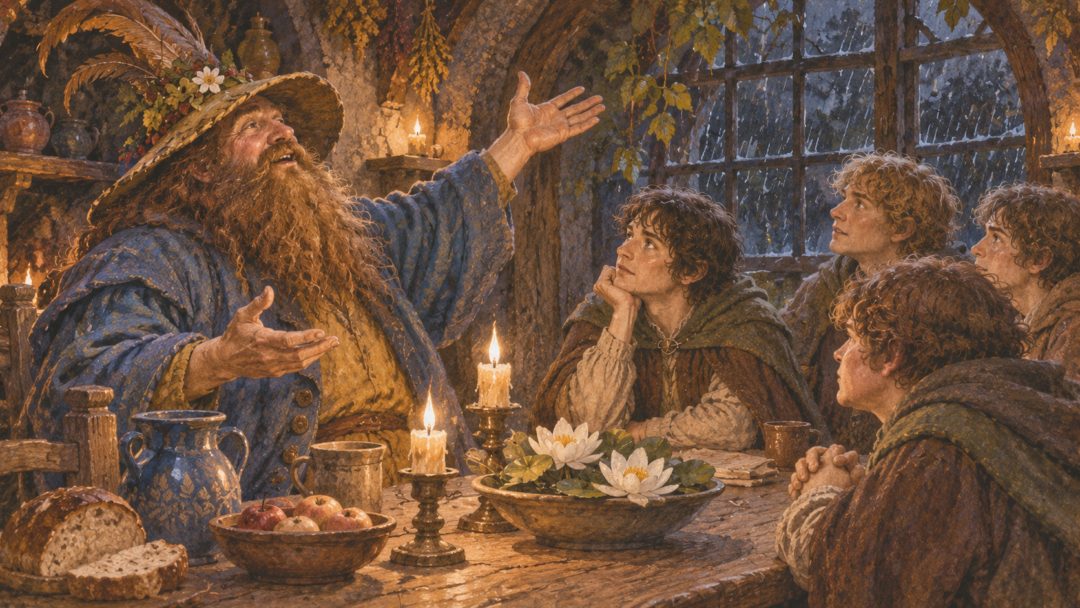
In The Fellowship of the Ring, Book I, Chapter 7, ‘In the House of Tom Bombadil’, Tom answers Frodo’s question about his identity: ‘Eldest, that’s what I am.’
He recalls existence before the local rivers and trees, the first rain and acorn, and the arrival of peoples who later inhabited the region. He remembers the Elves passing westward and an ancient darkness before the Dark Lord came from Outside.
This is poetic testimony, not a chronological table. Bombadil’s speech moves between narrative, song, and riddle. Yet dismissing it as meaningless exaggeration would ignore Elrond’s independent recollection and Glorfindel’s description of Bombadil as the First. Together, these passages reinforce his exceptional antiquity.
The reference to the Dark Lord invites comparison with Melkor, whose entrance into the created World is described in the ‘Ainulindalë’. That interpretation is natural, but Tom does not specify whether he means Melkor’s first entrance into Eä, his arrival in a particular region, or another event in the world’s ancient history.
Assigning the statement to one precise event would impose a chronology the passage does not supply.
Tom claims primordial presence, not responsibility for creation. Existing before familiar landscapes does not establish that he belonged to the Powers shaping them. Remembering ancient events likewise does not prove participation in their causes.
Bombadil presents himself chiefly as a witness. His testimony establishes the extraordinary antiquity attributed to him within the narrative, not an explicit account of his origin.
Do Elvish Records Require World-Changing Achievements?
No textual rule restricts Elvish remembrance to world-changing deeds. Tolkien’s histories emphasize wars, rulers, migrations, oaths, and transformations of the World, but narrative emphasis is not an exclusive criterion for preservation.
The Silmarillion records names, genealogies, journeys, personal loyalties, and local histories. Individuals enter its narrative through kinship, suffering, witness, residence, or association, without necessarily transforming history themselves.
Nor is the published Silmarillion an exhaustive catalogue of everything known to every Elf. Its principal concern is the great conflicts surrounding the Silmarils and the Elder Days. Selection for that narrative cannot establish the limits of Elvish knowledge.
The Council offers a direct comparison. Elrond remembers the former extent of Eriador’s great forest and ancient lands through which he traveled. Such memories concern places and their inhabitants, not merely famous battles.
Bombadil fits that pattern. His antiquity, wandering, unusual character, and enduring local presence might explain why he was remembered without becoming a central actor in the struggle against Morgoth.
That explanation remains an inference. Tolkien does not describe Bombadil’s first encounter with the Elves or the occasion on which Iarwain Ben-adar acquired his name.
The Council proves Elvish remembrance, not an entry in surviving written annals of the First Age. Conversely, Bombadil’s absence from the principal narratives of the Elder Days cannot establish universal Elvish ignorance. A selective historical narrative is not a complete inventory of remembered beings.
Is Inactivity Even a Reliable Test for Membership Among the Valar?
The ‘Ainulindalë’ and ‘Valaquenta’ define the Valar through their origin, relationship to Ilúvatar and the Music, and role in ordering and governing Arda. Their identity does not depend on meeting a minimum requirement of world-changing achievements.
Manwë, Ulmo, Aulë, Yavanna, and the other Powers are nevertheless associated with immense works. Their collective involvement in shaping the World makes Bombadil’s limited geographical sphere and indifference to political domination strikingly different. Those contrasts make a positive Vala identification difficult to support.
But difference is not disproof. Refusing to exercise power beyond a chosen domain does not necessarily establish an inability to do so. Nor can an absence of recorded achievements determine someone’s metaphysical nature.
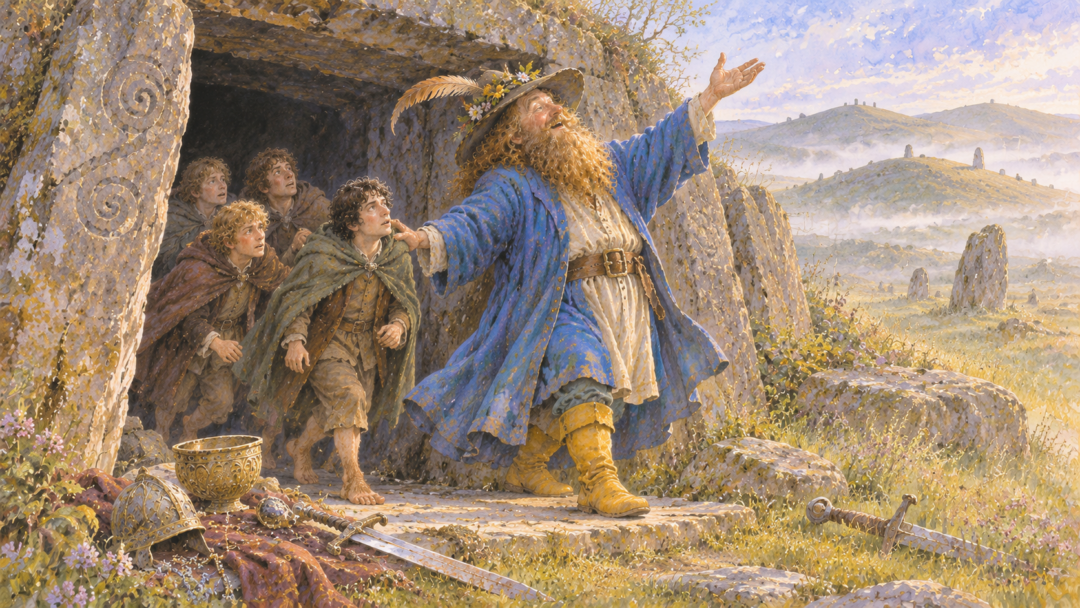
Moreover, Bombadil is not inactive. In The Fellowship of the Ring, he rescues the hobbits from Old Man Willow and overcomes the immediate threat of the Barrow-wight, enabling their escape. These are consequential acts, though not exercises of world government.
A stronger objection to identifying him as a Vala comes from the ‘Valaquenta’ itself. It names the chief Powers and describes their relationships and attributes, without identifying Bombadil among them. No published narrative states that one adopted his identity in Middle-earth.
Thus the Vala hypothesis lacks explicit textual support; inactivity does not independently make it impossible.
Finally, the Valar are not synonymous with all Ainur. The ‘Valaquenta’ identifies the Maiar as Ainur too. Excluding Bombadil from the Valar would not automatically exclude every possible Ainu interpretation.
The Ring Reveals a Limit to Power-Based Identification
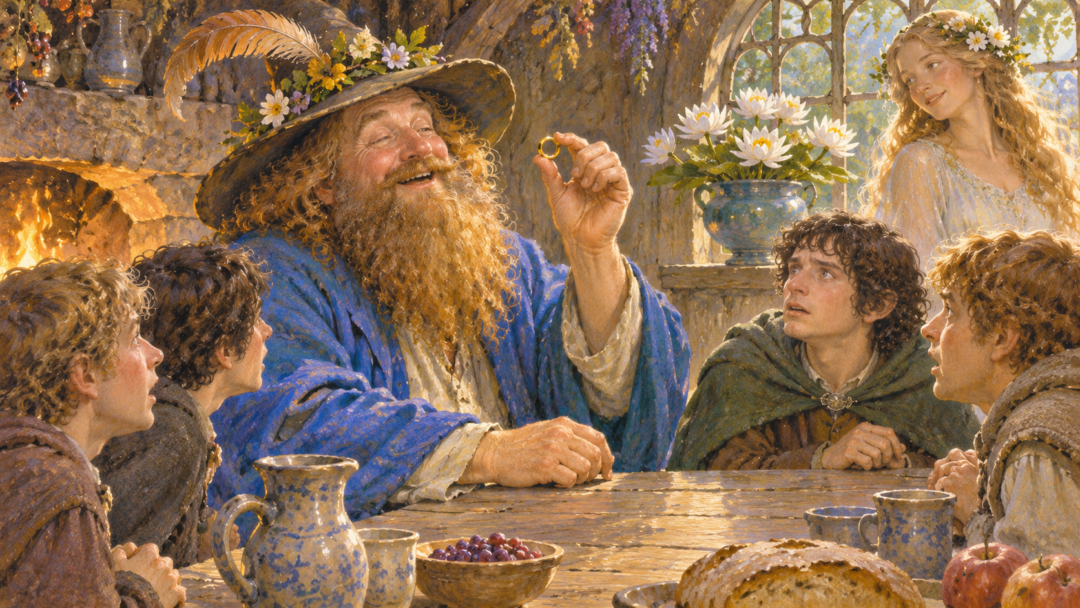
Bombadil’s relationship to the Ring offers firmer evidence than speculation about inactivity. In Book I, Chapter 7, he handles Frodo’s Ring without apparent temptation. In Chapter 8, ‘Fog on the Barrow-downs’, he demonstrates remarkable authority over the immediate supernatural danger.
Yet the Council rejects the inference that these abilities constitute unlimited mastery. Gandalf distinguishes Tom’s immunity to the Ring’s influence from superior power over the Ring itself. Bombadil cannot destroy its power over others, and his indifference cannot simply be deployed against Sauron.
Gandalf doubts Tom would leave his bounded country. The Council also fears that he would not appreciate the responsibility of guarding the Ring and might neglect or lose it.
Glorfindel anticipates Bombadil’s eventual defeat if Sauron conquers everything else. Galdor likewise questions whether he could withstand Sauron indefinitely. Tom is therefore not presented as an omnipotent safeguard, despite his unusual resistance to domination.
In Letter 144 to Naomi Mitchison, Tolkien connects Bombadil with renunciation of control and delight in things independent of the observer. The Ring tempts through domination; Tom does not share that desire.
This explains his behavior without identifying his cosmic rank. His refusal to dominate may be characteristic rather than evidence of insignificance. What he does not seek helps define his narrative role, but does not establish what kind of being he is.
Tolkien’s Letters Preserve the Mystery Rather Than Resolve It
The strongest reason to resist definitive identification is Tolkien’s deliberate preservation of Bombadil’s mystery.
In Letter 144, Tolkien describes him as an intentional enigma. He distinguishes Bombadil’s limited importance to the immediate plot from his broader significance as a comment upon the story’s concerns. Neither observation identifies him as a Vala.
Letter 153, responding to Peter Hastings, develops the philosophical explanation. In draft material printed with the letter, Tolkien presents Bombadil as an exemplar of disinterested knowledge: attention to other things and their histories without a desire to exploit or control them.
That describes a symbolic function, not membership in a particular order of the Ainur. Moreover, a draft explanation in correspondence must be distinguished from an explicit in-world identification in the published novel.
Deliberate mystery does not mean Tolkien necessarily lacked any conception of Bombadil’s nature. Letter 144 defends unexplained elements within a mythical world, including the possibility of explanations withheld from readers.
Consequently, mystery is not an invitation to declare one hypothesis canon through elimination. Tolkien explicitly assigns Bombadil neither to the Valar, the Maiar, the Children of Ilúvatar, nor to another defined order of spirits.
His names, memories, powers, and behavior constrain interpretation without resolving identity. Readers may favor a particular theory, but cannot present it as established revelation.
What Can Finally Be Said About Bombadil and Elvish History?
The argument that Bombadil was not a Vala because he accomplished no world-changing deeds, and therefore could not enter Elvish history, fails on both premises.
Elrond’s testimony establishes ancient Elvish remembrance. The Elves possessed a name for Bombadil and associated him with exceptional antiquity. Tolkien never requires great deeds as a condition of historical knowledge.
The metaphysical inference is equally inadequate. The Valar are defined by their origin and nature as great Ainur, not by a compulsory record of interventions. Bombadil’s limited sphere, detachment, and absence from their established identities justify skepticism about identifying him as one, but inactivity cannot conclusively exclude him.
The Council establishes inherited Elvish knowledge, not a surviving written chronicle of his earliest appearance. Neither his first meeting with the Elves nor the origin of his Elvish name is described.
Tom’s testimony reaches toward the beginnings of the World, while his powers and attitude toward the Ring distinguish him from other figures. None of these facts establishes his nature. Tolkien’s letters confirm that the incompleteness is intentional.
The texts permit doubt about a Vala identification, but not the supposed absence of Bombadil from Elvish memory as evidence against it.
The mystery survives because remembering Bombadil was never the same as explaining him.
Sources & Notes
This article is based on close reading and interpretation of Tolkien's published works and related source material where relevant.