
The Bird Was Going Back Into the Cage
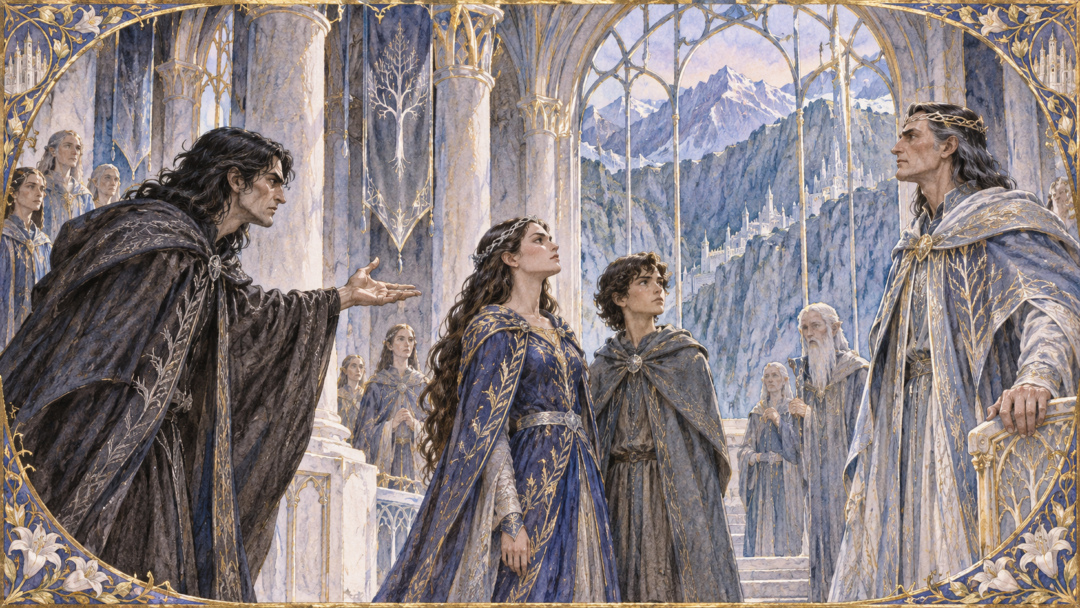
The crucial correction is that Eol does not predict Aredhel will emerge from her cage again. In The Silmarillion, Chapter 16, ‘Of Maeglin’, he predicts she will return to Gondolin and become unhappy there, as before. His accusation challenges Turgon’s guardianship: the magnificent hidden city is also a place whose inhabitants cannot freely depart.
The bird is Aredhel; the cage is Gondolin. Eol’s metaphor recalls her earlier departure and suggests that her restlessness remains unresolved. It offers no promise of another escape.
The speech occurs when Eol confronts Turgon after pursuing Aredhel and Maeglin into Gondolin. Rejecting Turgon’s authority, he claims his wife and son, reluctantly concedes that Aredhel may remain, and compares her return to a bird entering its cage.
The compositional question cannot be answered by assigning this speech and the famous ‘not wholly unwilling’ qualification to one year. Christopher Tolkien’s account of the successive Maeglin texts in The War of the Jewels, Part Three, Chapter III, establishes a story begun in 1951 and substantially revised around 1970. The passages belong to this evolving tradition but have different documentary histories.
The strongest interpretation is that Tolkien increasingly made Aredhel’s desire for freedom central to the tragedy while complicating desire, consent, affection, possessiveness, and captivity. The chronology supports sustained psychological development, not a demonstrably coordinated revision in which both passages originated together.
The Earlier Story Was Much Less Ambiguous
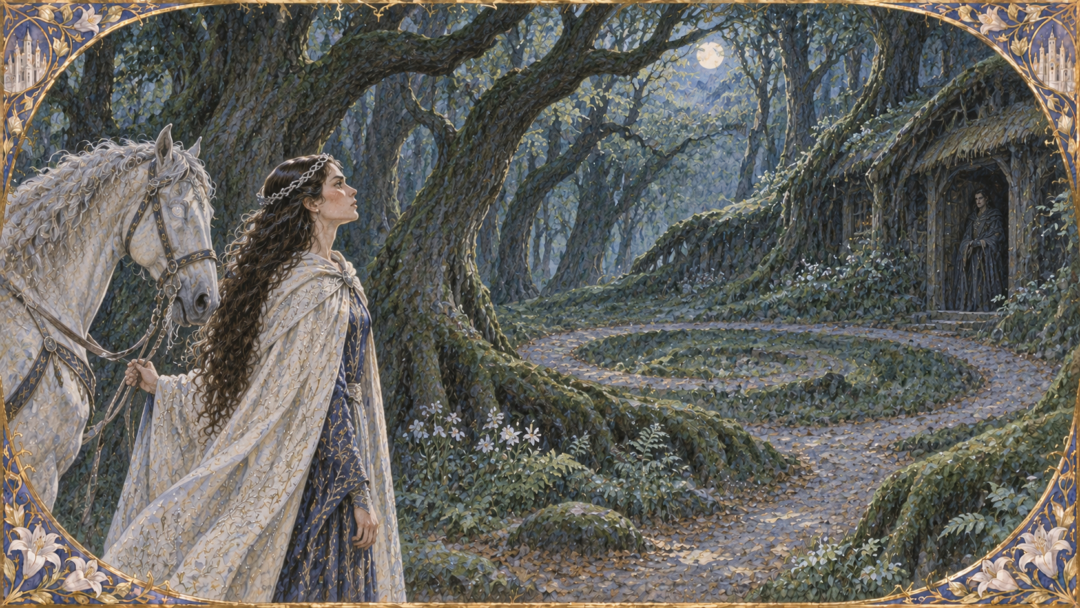
The earliest Gondolin mythology contains the essential family catastrophe, but treats Isfin, Aredhel’s earlier name, more harshly and with less psychological complexity.
In The Book of Lost Tales, Part Two, ‘The Fall of Gondolin’, Eol’s relationship with Isfin is characterized by her suffering and his possessiveness. The narrative shows little interest in emotional ambiguity: her unhappiness helps explain the circumstances bringing Meglin, later Maeglin, into Gondolin.
Successive versions retain the broad structure while changing its details. The Lays of Beleriand, the early Quenta materials in The Shaping of Middle-earth, and the annalistic tradition in The Lost Road and Other Writings document Tolkien’s repeated revisions. In versions where Isfin is trapped or captured by Eol, coercion is much more prominent than any suggestion of affection.
The difference from the mature narrative is not merely greater length. Initially, Isfin primarily serves a genealogical and dramatic purpose, connecting Eol and his son with Turgon’s house. Later, Tolkien increasingly addresses why she left Gondolin, remained in Nan Elmoth, and eventually returned.
These questions transform the tragedy. Aredhel’s dissatisfaction precedes Eol; her marriage imposes further restrictions; her escape returns her to a city whose limitations had already troubled her.
This is an interpretation of successive texts, not a documented declaration of Tolkien’s intentions. The revisions nevertheless show increasing attention to Aredhel’s motives rather than treating her solely as the necessary link between other characters.

The Decisive Starting Point: The 1951 Manuscript
The clearest compositional landmark is 1951. Christopher Tolkien associates the original long Maeglin manuscript, designated manuscript A in his discussion, with his father’s renewed work on the Elder Days that year. The narrative initially bore titles involving Isfin and Meglin before acquiring the familiar names.
More importantly, Aredhel’s dissatisfaction with Gondolin becomes a substantial motive for her departure. She desires the wider lands and forests beyond Turgon’s protected kingdom. Her journey thus expresses individual purpose rather than merely supplying the circumstances of Maeglin’s birth.
The qualification concerning her marriage also belongs to this 1951 stage. Tolkien avoids portraying Aredhel as entirely unwilling or her years in Nan Elmoth as wholly hateful. The recognizable formulation survives in The Silmarillion: ‘It is not said that Aredhel was wholly unwilling’.
That sentence does not establish freely given consent. Its opening concerns what is reported or known about Aredhel’s response, while its negative construction neither wholly condemns her feelings nor positively affirms her willingness.
Such restraint matters because the surrounding narrative still describes Eol’s enchantments and restrictions upon her movements and associations. Aredhel could experience some contentment without having entered the relationship under conditions of unrestricted freedom.
The documentary evidence is firmer than any proposed psychological explanation: this qualification was already present in the manuscript associated with 1951. It need not be assigned to the revision around 1970. Christopher Tolkien’s discussion in The War of the Jewels, ‘Maeglin’, establishes the relevant textual distinction.
Tolkien had therefore complicated Aredhel’s emotional circumstances well before the later version of the Gondolin confrontation. The question becomes how Eol’s caged-bird speech develops that existing complexity.

The Caged-Bird Speech and the Circa-1970 Version
The textual layer most directly associated with the fully developed Gondolin confrontation is the later Of Maeglin typescript, conventionally dated to approximately 1970. Christopher Tolkien discusses its surviving witnesses, their relationship to the 1951 manuscript, and their contribution to the published Silmarillion in The War of the Jewels.
This late compositional period is the appropriate setting for identifying the developed version containing Eol’s caged-bird speech. It represents further work on a narrative begun roughly nineteen years earlier, not a wholly new story.
An essential qualification concerns the published chapter itself. Christopher Tolkien edited together material from different textual stages; the result is not a reproduction of one complete manuscript or typescript. Consequently, a sentence’s appearance in the published narrative does not establish when Tolkien first wrote it.
The 1951 manuscript did not provide the completed Gondolin confrontation in its familiar published form. Its continuation was represented by outline material, subsequently developed in the later textual tradition. The late version is therefore the relevant witness for the speech within the completed dramatic encounter.
But the typescript’s approximate date cannot establish the exact day, month, or independently documented first drafting of the bird metaphor. ‘Circa 1970’ must not become an unqualified assertion that Tolkien composed that specific sentence in 1970. Composition, retyping, and subsequent alterations are distinct events throughout the History of Middle-earth.
The chronological distinction remains significant. The ‘not wholly unwilling’ qualification is attested in the 1951 manuscript; the completed scene containing the bird metaphor belongs to the developed late textual tradition. The passages are thematically and textually connected, but their simultaneous composition is not established.
Why Eol’s Insight Does Not Vindicate Him
Eol’s accusation has force because Aredhel genuinely found Gondolin restrictive. In the published narrative, Turgon resists her departure, while she insists upon following her own wishes. Nan Elmoth subsequently becomes another setting where her freedom conflicts with a male relative’s authority.
Eol consequently identifies a difficulty Turgon cannot easily dismiss. Gondolin offers security, but its secrecy requires restrictions. Aredhel had already departed because she wanted freedoms the hidden kingdom could not provide.
Yet Eol’s perceptiveness grants him no moral authority. He has imposed restrictions of his own, particularly upon Aredhel’s contact with her people. His hostility toward the Noldor shapes both his political accusations and his household. When Aredhel and Maeglin leave, he pursues rather than accepts their decision.
The contradiction becomes unmistakable before Turgon. Eol invokes Aredhel’s confinement while treating Maeglin as his possession. Unable to reclaim his son, he resorts to violence; Aredhel saves Maeglin through her intervention but loses her life.
The metaphor therefore works in two directions. It recognizes Aredhel’s dissatisfaction with Gondolin while exposing Eol’s appropriation of that dissatisfaction to justify his demands. He condemns Turgon’s control without surrendering his own.
This reading follows from the juxtaposition of Eol’s speech and actions in The Silmarillion, ‘Of Maeglin’. Tolkien supplies no separate authorial statement establishing precisely how sincere Eol’s accusation should be considered.
The psychological complexity consequently extends beyond Aredhel to the men competing to determine her circumstances. Neither Turgon’s protectiveness nor Eol’s rhetoric fully answers her desire for an independent life.
The Later Texts Resist a Simple Story of Increasing Consent
Any account of Tolkien progressively softening Aredhel’s marriage must confront ‘Quendi and Eldar’, published in The War of the Jewels, Part Four, particularly note 9.
Generally associated with Tolkien’s linguistic and historical work around 1959–1960, this material preserves an alternative characterization: Eol takes Aredhel as his wife by force, conduct explicitly condemned as wicked according to the standards of the Eldar.
That evidence disrupts a simple progression from early coercion toward increasingly unqualified romantic attachment. After introducing emotional ambiguity in 1951, Tolkien could still characterize the original union in unmistakably coercive terms.
Nor can the discrepancy be resolved automatically by declaring the later account definitive. The texts have different purposes, and Tolkien never reconciled every formulation into one completed, authoritative manuscript.
This alternative witness shows why ambiguity is not exoneration. A relationship might contain companionship or accommodation while its origins remain morally condemnable. The possibility of partial contentment does not retrospectively establish unconstrained consent.
The published Silmarillion provides no explicit retrospective explanation from Aredhel resolving these tensions. Neither does the surviving evidence authorize an invented confession of love, a definitive account of consent, or an undocumented reconciliation.
The safer conclusion is that Tolkien repeatedly confronted the difficulty of representing Aredhel’s life in Nan Elmoth without making her wholly passive. His different formulations address that problem in different, sometimes irreconcilable ways. Psychological elaboration should not be mistaken for an increasingly favourable judgment of Eol.
Tolkien’s Later Attention to Aredhel’s Will
The late Maeglin materials further support a continuing concern with Aredhel’s motives. Christopher Tolkien preserves commentary on Eol’s encounter with Curufin, including explanations of Aredhel’s decision to seek the lands associated with the sons of Feanor.
In this discussion, Tolkien emphasizes that she left Gondolin through her own will and welcomed the comparative freedom beyond Turgon’s authority. The commentary also examines Curufin’s behaviour and the complicated moral and political relationships among the Noldor.
These notes, presented in The War of the Jewels, ‘Maeglin’, move beyond recounting events. They consider what characters know, believe, desire, and intend, alongside judgments of their conduct.
Aredhel’s longing for freedom is thus not simply a modern interpretation imposed upon an indifferent narrative. It is present in the story and in Tolkien’s subsequent explanations of its circumstances.
Eol’s caged-bird image gives that longing a public, political expression. By identifying Aredhel’s restlessness, he challenges Turgon’s authority, even as his own conduct displays comparable domination.
The chronological limitation remains important. Tolkien’s later commentary demonstrates continued attention to Aredhel’s independence, but cannot prove that the ‘not wholly unwilling’ sentence arose in response to the bird metaphor, or that both belonged to a consciously coordinated programme of psychological revision.
Indeed, the 1951 manuscript already contains the central ambiguity concerning her marriage. The stronger interpretation is cumulative: Tolkien first enlarged Aredhel’s motivations and subsequently continued examining the competing claims upon her freedom.
What the Dates Actually Prove
The chronology permits three conclusions, with different degrees of certainty.
First, Tolkien’s psychologically complex treatment of Aredhel was developing by 1951. The manuscript discussed in The War of the Jewels establishes both her longing for freedom and the qualification about her response to Eol. These are documented features of that textual stage.
Second, the developed Of Maeglin narrative associated with approximately 1970 is the relevant late setting for the completed caged-bird confrontation. The exact first composition of the metaphor is less firmly established than the broader manuscript and typescript chronology. No unsupported precision should be attached to its date.
Third, the passages together support an interpretation of sustained interest in Aredhel’s contradictory circumstances. Gondolin protects while restricting her; Nan Elmoth provides an apparent alternative but subjects her to another person’s prohibitions. Her family attachments and her desire for independence need not be mutually exclusive.
The 1959–1960 material describing Eol’s coercion also rules out equating psychological complexity with the progressive rehabilitation of their marriage. Tolkien’s accounts complicate the moral question without finally resolving it.
The central irony lies in Eol’s perceptive but self-serving accusation. He recognizes that Aredhel may again feel imprisoned in Gondolin, yet denies comparable freedom when his own authority is threatened.
Thus Tolkien cannot be shown to have composed both passages together in one securely dated revision. The ‘not wholly unwilling’ qualification reaches back to 1951; the completed caged-bird scene belongs to the late Maeglin tradition associated with around 1970, without a securely established date for the metaphor’s first drafting.
Their common concern with Aredhel’s independence makes a broader reading of psychological deepening persuasive. Their distinct documentary histories indicate a problem Tolkien revisited over many years, not proof of a single, precisely dated authorial intention.
Sources & Notes
This article is based on close reading and interpretation of Tolkien's published works and related source material where relevant.