A Different Sam, or a Different Way of Seeing Him?
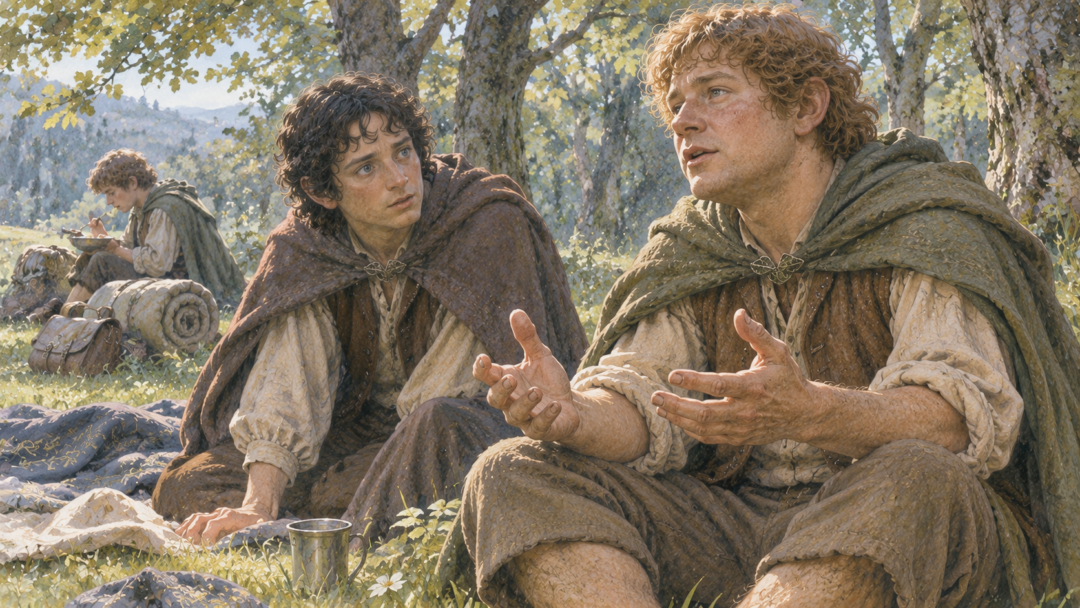
When Sam Gamgee describes the Elves as both old and young, both joyful and sorrowful, Frodo is startled. His gardener has expressed an insight that does not fit Frodo’s familiar picture of him. Has the encounter transformed Sam, or revealed depths Frodo previously overlooked?
The strongest reading allows both possibilities. Meeting Gildor Inglorion’s company genuinely changes Sam’s understanding of his journey. Yet his sensitivity to beauty, history, and sorrow predates Woodhall. The encounter brings existing capacities into clearer expression while giving them fresh direction.
Class complicates the question. Sam’s background helps explain Frodo’s surprise and Sam’s hesitant expression, but does not explain away his insight. Tolkien presents neither the sudden elevation of an ignorant servant nor simply the discovery of an unchanged personality. Frodo’s astonishment tells us something about Frodo’s expectations as well as Sam’s development.
The text establishes change without settling exactly how much is transformation and how much recognition.
What Actually Happens at Woodhall?
The exchange occurs in The Fellowship of the Ring, Book I, Chapter 4, “A Short Cut to Mushrooms,” following the encounter in Chapter 3, “Three is Company.”
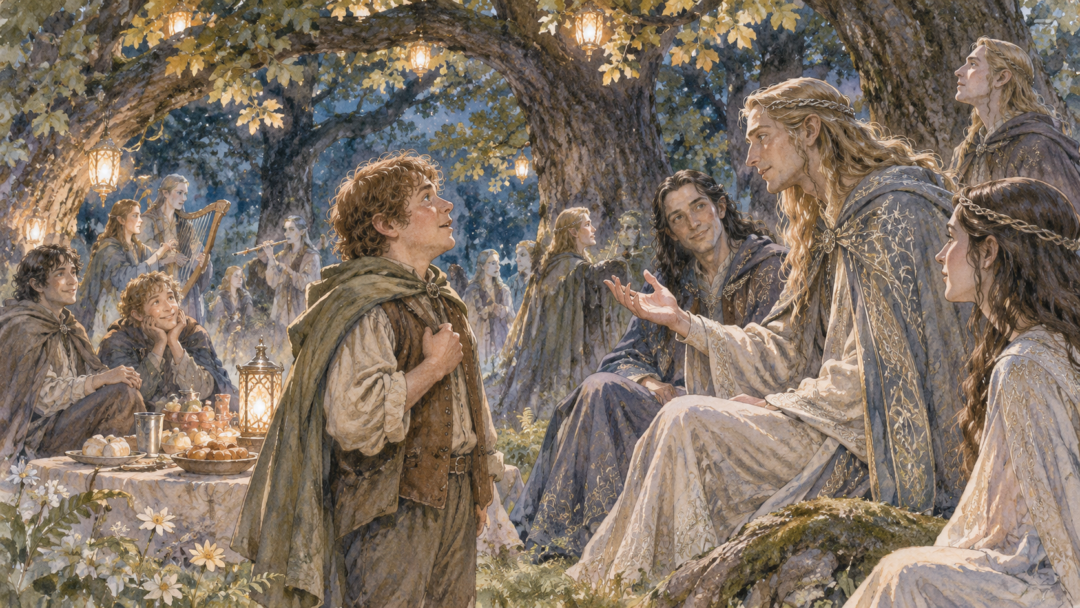
Gildor’s Elves meet the hobbits on the road, protect them from immediate danger, and invite them to spend the night above Woodhall. Gildor counsels Frodo, while Sam encounters beings he has long dreamed of meeting.
Their hospitality, food, music, and presence profoundly affect Sam. Unlike the sleeping Frodo, he remains awake long enough to speak with some of the Elves.
The next morning, asked for his opinion, Sam finds ordinary judgments inadequate. He perceives a union of youth and age, happiness and sadness, and senses that the Elves care more about the world than themselves.
This exceeds simple admiration. Sam distinguishes the actual Elves from his imagined versions, apprehending a wisdom and historical consciousness he cannot adequately define.
Frodo notices an unfamiliar thoughtfulness. Crucially, however, the narration qualifies his previous knowledge: the old Sam is the person Frodo thought he knew.
That qualification matters. We witness Frodo interpreting an apparent change, not an omniscient explanation of its cause. The Elves’ conversations with Sam are not fully reported, and Tolkien describes no explicit spiritual transformation.
Woodhall therefore produces an observable effect without conclusively identifying its source.
The Strongest Evidence That the Elves Really Changed Him
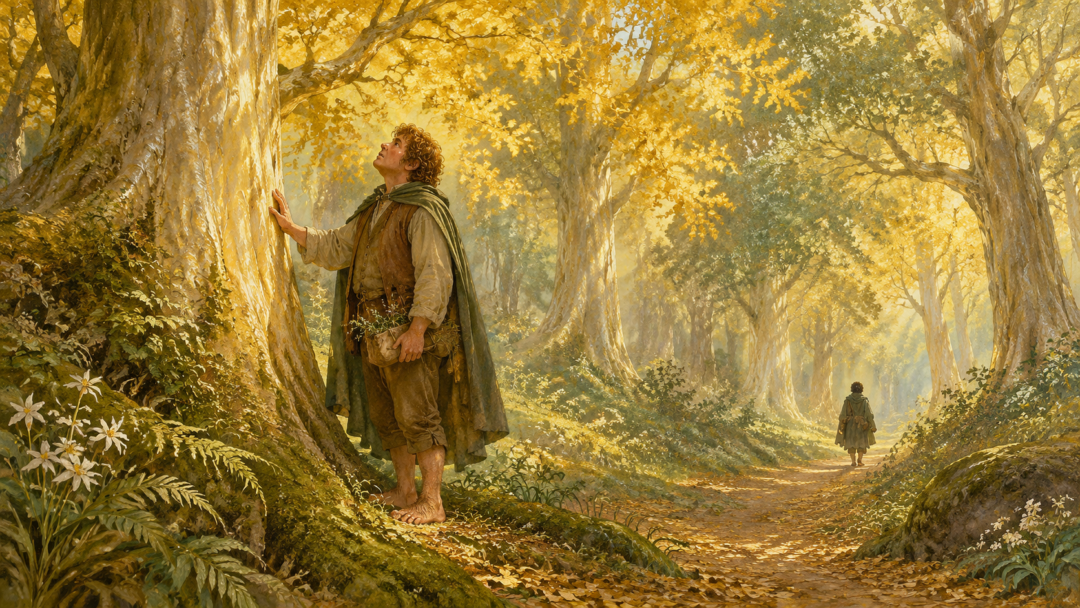
Sam’s own testimony offers the strongest evidence of genuine change. When Frodo asks whether he still wishes to continue after seeing Elves, Sam explains that his reasons for travelling have altered.
Previously, seeing Elves was a major attraction. Now he senses an obligation somewhere beyond the Shire. He cannot identify it, but believes he must continue. His conviction that he has “something to do before the end” expresses purpose without certainty.
Curiosity has become responsibility. An adventure partly motivated by wonder now carries the weight of an unknown task.
Sam also reports that the Elves warned him not to abandon his master. Their injunction reinforces his existing loyalty. Whether they awakened a clearer apprehension of destiny or strengthened a commitment he would have maintained anyway remains uncertain.
His description of Elvish age and youth nevertheless shows more than fascination with glamour. The wider legendarium illuminates his perception.
In The Silmarillion, particularly the Noldor’s struggles against Morgoth, Elvish vitality coexists with accumulated grief, endurance, and memories reaching beyond mortal lifetimes. Joy and sorrow are not contradictory qualities in such beings.
Sam has not acquired detailed knowledge of those histories; Tolkien makes no such claim. His encounter gives him an intuitive glimpse of a condition the larger mythology establishes.
Calling this ennoblement is reasonable if it means enlarged sympathy and purpose. It is unsupported if it implies that Woodhall instantaneously remade Sam’s essential character.

The Sam Who Was Already There
Sam’s imaginative disposition is established before Woodhall.
In Book I, Chapter 2, “The Shadow of the Past,” he already treasures Elvish stories, believes he may once have glimpsed an Elf, and longs for another encounter. His interests distinguish him from the narrower practical expectations surrounding him.
Bilbo has educated Sam and nourished his imagination, but Sam’s fascination is not merely borrowed from Bilbo or Frodo. He has made those stories personally meaningful.
A single night cannot explain a longing already powerful enough to draw him beyond ordinary Shire experience.
Nor should Sam’s plain speech obscure his reflectiveness. He is observant, affectionate, and responsive to values he struggles to articulate. His gardening provides practical familiarity with growth, transience, and care.
Connecting that experience to his sensitivity is an interpretation, not an explanation Tolkien explicitly supplies for the Woodhall conversation.
Later passages suggest continuity. In “Lothlórien” and “The Mirror of Galadriel,” Sam responds to Elvish beauty through practical perceptions of trees, gardens, cultivation, and care. Wonder does not erase his gardener’s understanding.
In The Two Towers, Book IV, Chapter 8, “The Stairs of Cirith Ungol,” his reflections on great stories connect present suffering with larger patterns of courage and endurance. He recognizes that participants in such stories may not understand their significance while events unfold.
These later insights cannot prove he possessed identical understanding before leaving home. Experience teaches him. Yet they reveal a consistent habit of connecting ordinary circumstances with larger meanings.
Woodhall develops this disposition rather than creating it from nothing.
Frodo’s Surprise and the Limits of Class
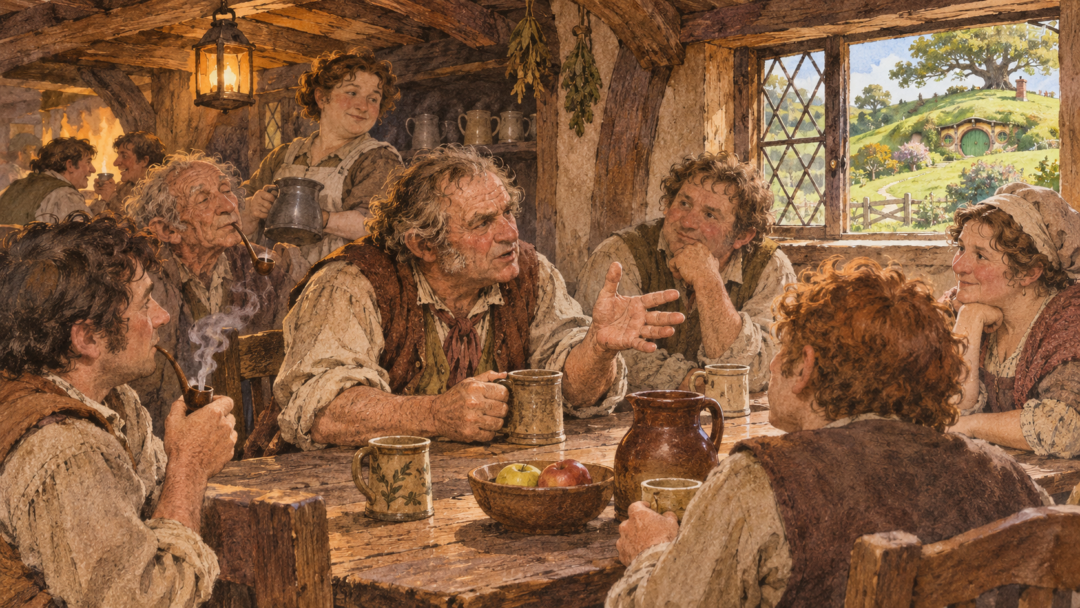
Frodo and Sam inhabit a genuine social hierarchy. Frodo is the prosperous master of Bag End; Sam is his gardener, succeeding his father Hamfast, who served Bilbo. Their affection does not erase differences of employment, education, speech, and deference.
In “A Long-expected Party,” the Gaffer acknowledges Bilbo’s teaching Sam to read while worrying about its consequences. His unease suggests that books and unusual interests might draw a working hobbit beyond accepted expectations.
Sam’s imagination has therefore developed partly against assumptions associated with his position, not because that position inherently grants or denies imaginative capacity.
Frodo’s surprise can reasonably be read through this class framework. Accustomed to Sam’s respectful, rustic manner, he has not expected such perceptive commentary on Elvish existence.
Yet Frodo is not portrayed as deliberately contemptuous. He loves Sam and listens attentively. His limitation may be the subtler mistake of confusing someone’s familiar social manner with the whole person.
Importantly, Sam’s insight arrives in his own hesitant idiom. Tolkien does not make him sound like Bilbo or an Elf-lord to validate his intelligence. His perception remains remarkable without ceasing to be rustic.
The qualification is essential: Tolkien never explicitly says Frodo is surprised because Sam is lower-class, nor does the narrator diagnose social prejudice. The text establishes a class-marked relationship and mistaken expectations. Connecting them is interpretation, not confirmed authorial explanation.
Nor does lower status guarantee superior wisdom. Tolkien’s working characters are not invariably perceptive, or his privileged characters invariably blind.
Sam’s insight belongs to his particular character, not to an idealized category of humble people.
Tolkien’s Letters and the Dignity of the Servant
Tolkien’s correspondence supports taking Sam’s social position seriously.
In his letter to H. Cotton Minchin of 1956, Tolkien associates Sam with ordinary soldiers and military servants he knew during the First World War. He recalls men whose character and endurance he considered superior to his own. The correspondence is associated with Letter 187 in the published collection.
Sam’s service consequently reflects more than narrative convenience. It embodies a relationship in which the socially subordinate companion may possess exceptional courage, practical judgment, and moral strength.
But Tolkien does not make Sam infallible. In Letter 246, he discusses Sam’s limitations toward Gollum and the tragic consequences of his failure to respond sympathetically at a decisive moment.
Extraordinary loyalty can coexist with restricted understanding. Woodhall reveals genuine perception, not comprehensive enlightenment.
Letter 131 also places Sam’s domestic attachments, especially his love for Rosie, alongside the story’s relationship between ordinary life and heroic sacrifice. Tolkien does not treat family affection and Elvish wonder as incompatible.
Sam need not cease being a gardener, lover, or family man to possess an extraordinary imaginative life.
These letters support the dignity concealed beneath apparent social simplicity. They do not establish that the Elves bestowed a particular power or grace upon Sam at Woodhall. Direct textual evidence for that stronger proposition is absent.
What the Later Journey Reveals—and What It Cannot Prove
Sam’s later experiences recall Woodhall without proving it caused everything that followed.
In Lothlórien, Galadriel confronts him with the possibility of returning home to the restored Shire he desires. He feels the temptation but continues beside Frodo. Loyalty becomes a deliberate choice despite an attractive alternative.
In The Return of the King, Book VI, Chapter 2, “The Land of Shadow,” a star glimpsed above Mordor’s darkness briefly restores his hope. He recognizes that surrounding evil does not encompass everything.
Both episodes resemble Woodhall: beauty enlarges his perspective beyond immediate fear or desire.
But Sam’s growing understanding also reflects hardship, danger, friendship, loss, and repeated confrontations with despair. These influences cannot be isolated from the Elvish encounter.
His treatment of Gollum offers a counterexample to any claim of completed moral transformation. Loyalty and certainty sometimes constrict his sympathy even as his courage increases.
His eventual return to the Shire also matters. After the Ring’s destruction, Sam helps restore damaged places, marries Rosie, raises a family, and repeatedly serves as Mayor. Appendix B records these developments and his eventual departure over the Sea.
His extraordinary experiences do not require rejecting ordinary life. Rather, he returns with abilities and responsibilities that his earlier social position scarcely anticipated.
If Woodhall begins his development, it does not complete it.
Why Tolkien Leaves the Change Unresolved
The ambiguity arises from Tolkien’s narrative method.
Frodo observes an apparently altered Sam, but readers cannot directly compare Sam’s complete inner life before and after the encounter. Nor do they hear every conversation between Sam and the Elves.
Sam explicitly acknowledges changed intentions. Frodo unmistakably revises his perception of him. What remains uncertain is the balance between newly awakened understanding and previously overlooked depth.
Sam remains physically the familiar gardener, though unusually thoughtful. The scene suggests possibilities emerging within the same personality rather than one character replacing another.
It is tempting to connect this emergence with broader Elvish themes of preserving and revealing beauty. Yet no published passage explicitly identifies Woodhall as a formal blessing, spiritual initiation, or supernatural ennoblement. Such descriptions remain metaphors, not established facts.
Equally, Sam’s insight cannot be reduced to an allegedly instinctive wisdom of the uneducated. Bilbo’s teaching, treasured stories, and longstanding emotional investment all prepared him for the encounter.
The defensible conclusion is narrower and richer: contact with the Elves clarifies Sam’s purpose while bringing latent qualities into expression. That interpretation respects both the Elves’ influence and Sam’s existing agency.
The Gardener Was Never Merely a Gardener
Sam perceives more than Elvish beauty or power. He senses the coexistence of delight and grief, a vast perspective, and concern for the world’s fate.
The encounter genuinely affects him: he explicitly describes altered motives. Yet his fascination with Elvish stories, imaginative responsiveness, and serious loyalty existed beforehand.
Class helps explain why Frodo has not fully recognized those capacities. He knows Sam’s work, speech, and devotion without necessarily knowing his entire inward life.
Tolkien leaves transformation and recognition intertwined. The Elves may enlarge Sam’s understanding, but enlargement requires something already capable of growth.
Frodo’s discovery is not that an ordinary gardener has suddenly become extraordinary. It is that someone he underestimated has begun revealing what he could become.
Woodhall changes Sam’s direction and Frodo’s sight. The precise balance remains unresolved, and that uncertainty gives the scene its force.
Sources & Notes
This article is based on close reading and interpretation of Tolkien's published works and related source material where relevant.