Forty-Five Years Are Not Nothing to an Elf
Would Legolas experience a meaningful difference between being 2,355 and 2,400 years old? Tolkien’s writings suggest that the numerical difference would probably mean little to him, but the experiences contained within those forty-five years could matter enormously.
Elves do not simply experience human aging over an extended lifespan. They change relatively little while the world around them changes continually. They remember events across centuries, witness the disappearance of beloved things, and endure losses that shorter-lived beings cannot experience in quite the same way.
One factual limitation is essential: Tolkien never establishes Legolas’s exact birth year in the published narrative or principal posthumously published writings. Neither proposed age is canonical. Both are hypothetical, and neither can be presented as a birthday Tolkien recorded.
The question, then, is not whether forty-five years constitute a large fraction of Legolas’s life. It is whether Elves experience years primarily as quantities or through memory, change, and loss. Legolas himself provides the strongest evidence.
Legolas Says the World Moves Both Swiftly and Slowly
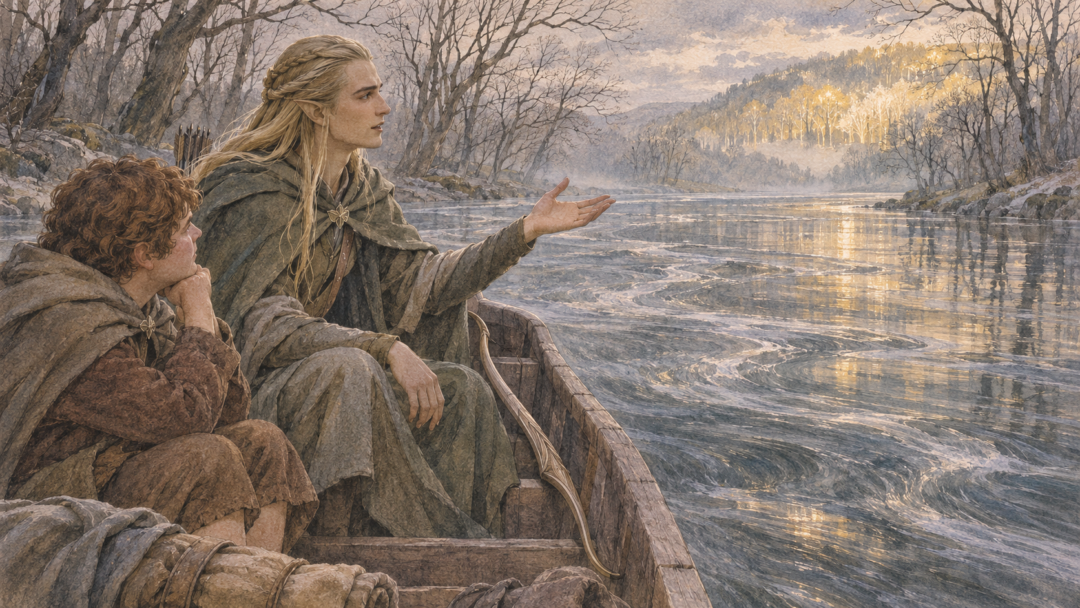
In The Fellowship of the Ring, Book II, Chapter 9, ‘The Great River,’ Sam struggles to understand the passage of time in Lothlórien. Legolas responds that for Elves the world moves ‘both very swift and very slow.’
The contradiction is deliberate. The world moves swiftly because Elves change little while everything around them passes away. It moves slowly because they do not count the running years against themselves as mortals do. Repeated seasons belong to an enduring existence rather than marking successive stages of personal decline.
Legolas is not describing a different physical speed of time. He does not suggest that clocks run differently for Elves or that decades disappear from their awareness. His distinction concerns personal continuity against external change.
For a mortal, forty-five years might separate youth from old age or encompass two generations. An Elf remaining recognizably the same through that interval has less reason to consider it a major stage of aging.
Thus Legolas at 2,400 would not necessarily feel substantially older than at 2,355. Tolkien provides no formula converting Elvish years into human subjective ages.
Yet the other half of his explanation matters equally: an enduring observer must witness things passing away. Forty-five years might scarcely alter an Elf while transforming the world he inhabits. That discrepancy, not numerical age, is central to Elvish sorrow.
Five Hundred Autumns Can Seem a Little While
Legolas offers further evidence in The Two Towers, Book III, Chapter 6, ‘The King of the Golden Hall.’ Approaching Edoras, he remarks that five hundred autumns have passed in his homeland since the period under discussion, yet the interval seems comparatively brief to his people.
Five centuries encompass numerous mortal generations. For Legolas, however, they can belong to a relatively near past. If five hundred years can seem a little while, forty-five are unlikely to represent a dramatic alteration in his ordinary sense of personal age. The difference between 2,355 and 2,400 would presumably feel smaller than that between twenty-five and seventy to a Man.
This remains an interpretation, not a mathematical rule. The passage establishes no universal conversion between Elvish and human perceptions of duration. Nor does it establish Legolas’s birth year or prove that he personally witnessed every historical event being discussed.
Another contrast appears in The Two Towers, Book III, Chapter 5, ‘The White Rider.’ Encountering Fangorn, Legolas recognizes a forest of extraordinary antiquity. His longevity does not make everything else appear young; he can still encounter a past far beyond his familiar frame of reference.
Elves therefore distinguish recent from ancient events. Their longevity changes the scale of that distinction without abolishing it. Forty-five years can be comparatively brief without becoming meaningless.
Lothlórien Shows That Elvish Time Is Not Stopped Time
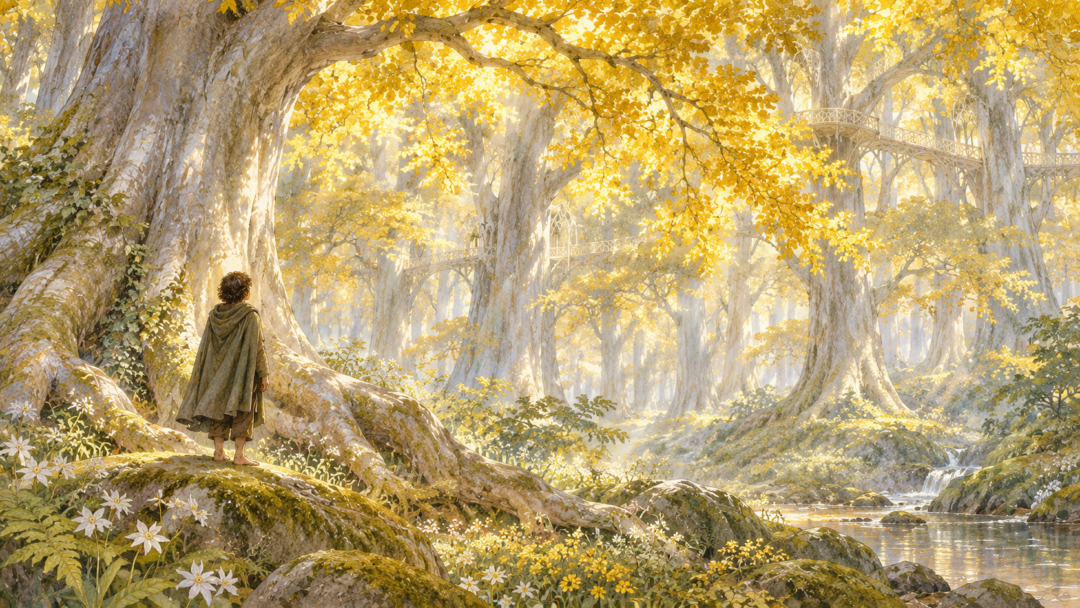
The Fellowship’s stay in Lothlórien further complicates the question. In The Fellowship of the Ring, Book II, Chapters 7–9, the ancient world seems unusually present, and Sam struggles to reconcile his experience with the days indicated by the Moon.
Legolas does not claim that chronology has stopped. Instead, he explains that change and growth proceed differently in different places. Lothlórien is not simply a realm outside time.
Frodo’s perception reinforces this distinction: ancient beauty appears immediately alive rather than confined to distant memory. That atmosphere reflects the Elvish desire to preserve what would otherwise pass away.
Galadriel’s Ring, Nenya, belongs to this struggle against decline. In ‘The Mirror of Galadriel,’ she explains that destroying the One Ring will also end the preserving power upon which her realm depends. Even an enduring Elvish sanctuary cannot escape history indefinitely.
This creates the central irony of Elvish existence. Long life does not guarantee the survival of beloved things; it may make their eventual loss more painful.
Suppose Legolas spent forty-five years amid familiar woodland seasons, with little changing around him. The interval might seem slight in retrospect. But the destruction of a forest, the fall of a kingdom, or a companion’s death could make the same period unforgettable.
Those are hypothetical examples, not recorded incidents from Legolas’s life. They illustrate Tolkien’s distinction between elapsed duration and the consequences of change.
Long Memory Does Not Mean Perfect Memory
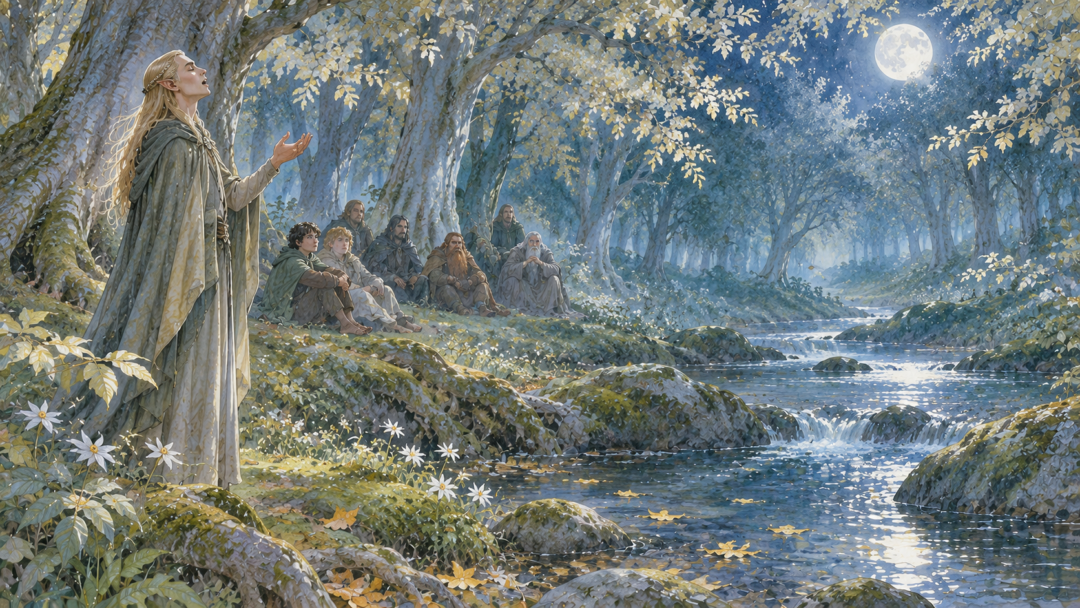
Elvish longevity should not be mistaken for flawless recollection. In The Fellowship of the Ring, Book II, Chapter 6, ‘Lothlórien,’ Legolas sings of Nimrodel but acknowledges having forgotten much of the song.
This does not establish that his memory functions exactly like a human’s. It does establish that Tolkien does not portray him as an infallible archive in which every remembered detail remains accessible.
Nevertheless, memory profoundly shapes Elvish existence. In The Silmarillion, the histories of the Noldor and Sindar are driven by remembered homes, oaths, kinships, injuries, and losses. Events from the Elder Days remain emotionally consequential long afterward.
Morgoth’s Ring develops the underlying philosophical distinction. In ‘Laws and Customs among the Eldar’ and material associated with the ‘Athrabeth Finrod ah Andreth,’ Tolkien examines the relationship between Elvish spirit and body. His account of fading describes the spirit’s increasing dominance over the body during prolonged existence within Arda.
These writings are not direct descriptions of Legolas at 2,400. Nor should every detail of Tolkien’s evolving explanations of Elvish development be treated as one settled biological system.
They nevertheless support the conclusion that Elvish existence is not static. Memory accumulates, and the relationship between spirit, body, and world develops even when outward aging remains slight.
Forty-five years might contribute little to Legolas’s apparent age while becoming part of the remembered experience through which he understands himself.
Immortality Makes Loss Different, Not Insignificant
‘Immortal’ is an imperfect shorthand for Tolkien’s Elves. Their existence is bound to Arda; they can be killed or suffer bodily death. Their ultimate fate differs from that of Men, whose departure from the world remains a central mystery.
This distinction appears in The Silmarillion, particularly ‘Of the Beginning of Days,’ and in Morgoth’s Ring. Elvish immortality means endurance within the world, not immunity from sorrow, danger, or history.
That endurance gives loss a particular character. An Elf may remain while successive mortal generations disappear. Yet knowing that a friendship may end does not make it insignificant.
Legolas’s relationship with Gimli illustrates this. During the War of the Ring, they overcome ancient divisions between Elves and Dwarves. In The Return of the King, Appendix A, the account of Durin’s Folk records their eventual departure together across the Sea, while treating Gimli’s exceptional passage as a matter of tradition.
Their friendship matters because of its character, not because of its duration relative to Legolas’s potentially immense lifespan.
The same applies to any hypothetical forty-five years. An uneventful interval might merge into centuries of remembered continuity. One containing an irreplaceable friendship or devastating bereavement could remain distinctive.
Tolkien establishes no numerical threshold beneath which years lose significance to Elves. His histories repeatedly show choices exerting consequences centuries later.
An Elf Can Change Profoundly Without Becoming Much Older
Legolas’s own story demonstrates how experience can transform an Elf without any corresponding milestone of age.
In the events recounted in The Return of the King, Book V, Chapter 9, ‘The Last Debate,’ he hears seabirds near Pelargir. Their cries awaken the sea-longing foretold in Galadriel’s message, delivered through Gandalf in The Two Towers, Book III, Chapter 5, ‘The White Rider.’
Nothing connects this awakening to a prescribed age or stage of Elvish adulthood. It arises from a particular encounter. Once stirred, the longing changes his relationship with the woods and lands he has loved. They remain important, but a new desire has entered his life.
A brief experience can therefore produce a more substantial transformation than decades of familiar existence. This is an inference from Legolas’s story, not a universal rule about Elvish psychology.
His later choices reinforce the distinction. Appendices A and B of The Lord of the Rings record his association with Ithilien and eventual sailing from Middle-earth after Aragorn’s death. His life consequently crosses the transition from the Third Age into the dominion of Men.
Tolkien does not provide a continuous account of Legolas’s thoughts during the intervening decades. Specific emotional stages cannot responsibly be invented.
Nevertheless, his recorded actions demonstrate that an enduring Elf can develop new loyalties, desires, and purposes. At 2,400, Legolas might differ substantially from himself at 2,355 because of a decisive experience, not because forty-five years had made him older in the human sense.
Forty-Five Years Can Be Brief and Historically Decisive
The War of the Ring demonstrates how little chronological duration reveals about historical importance. Its decisive events unfold across far fewer than forty-five years, with the Fellowship’s principal experiences occupying only a fraction of that period.
Yet those events bring Sauron’s downfall, the One Ring’s destruction, the ending of the Three Rings’ power, and the passing of an age.
For Elves, these consequences are immediate and personal, not merely political. In The Return of the King, Book VI, Chapter 9, ‘The Grey Havens,’ the departure of the Ring-bearers and Keepers of the Three marks the passing of a world in which the greatest remaining Elvish refuges of Middle-earth could be preserved.
A short interval can therefore produce consequences extending across an Elf’s remaining existence.
Imagine two hypothetical histories between Legolas’s proposed ages. In one, familiar woodland life continues relatively undisturbed. In the other, an upheaval comparable in personal importance to the Ring’s destruction transforms everything familiar.
The first interval might seem scarcely remarkable; the second could divide his memories into a before and after. Neither imagined history is canonical. Both illustrate possibilities consistent with Tolkien’s treatment of time.
Elves can recognize gradual change across centuries while also experiencing decisive events within days or months. Their endurance does not make them indifferent to sudden transformation.
So Would Legolas Feel 2,400 Rather Than 2,355?
Probably not in the way a mortal experiences forty-five additional years.
Legolas’s explanation after Lothlórien establishes that Elves do not measure passing years against themselves as Men do. His reference to five hundred autumns suggests that even centuries can seem comparatively brief.
There is no canonical evidence of a psychological or physical milestone between 2,355 and 2,400 years, and Tolkien assigns Legolas neither age. Claims that he would feel exactly the same, or gain a measurable quantity of wisdom, exceed the evidence.
If ‘difference’ means ordinary aging, forty-five years would probably matter little to an Elf already thousands of years old. If it means memory, understanding, attachment, grief, or desire, those years might matter enormously.
Tolkien’s recurring tragedy of the Elves depends upon their capacity to remember and care while the world changes around them. Longevity does not make fleeting things worthless; it allows their passing to remain significant across ages.
The difference between 2,355 and 2,400 would therefore consist less in forty-five additional units of age than in whatever Legolas had witnessed, loved, learned, or lost.
For Tolkien’s Elves, the years themselves may pass lightly. What happens within them need not.
Sources & Notes
This article is based on close reading and interpretation of Tolkien's published works and related source material where relevant.