The East Is Not Described as a Primitive World
There is no sound textual basis for treating Rhûn and the lands farther east as inherently more primitive than Gondor. Tolkien describes eastern peoples as distant, frequently hostile to Gondor, and often subject to Sauron. He does not establish that they possess inferior technology, lack sophisticated institutions, or occupy an earlier stage of civilization. Those are assumptions readers may import, not conclusions the texts demonstrate.
We encounter eastern armies, migrations, alliances, and occasional rulers, but learn almost nothing about their cities, industries, scholarship, agriculture, or domestic life. Gondor, by contrast, receives a detailed history of kingship, architecture, administration, and inherited Númenórean knowledge. Unequal narrative attention can easily be mistaken for unequal development.
Gondor is itself a diminished successor to an older civilization, its achievements measured against what its ancestors possessed. Preservation, inheritance, and loss define much of its history.
The defensible conclusion is therefore limited. Tolkien establishes neither technological equality between Gondor and every eastern society nor a hierarchy placing Gondor above them all. The evidence is insufficient for either comparison. The East remains largely a geographical and political unknown, made threatening through histories told principally from the West.
Rhûn Is a Direction, Not a Single Civilization
Tolkien’s East is not one people or state. Rhûn means East, and its geographical scope varies with context. The lands around the Sea of Rhûn, territories beyond them, and still farther regions cannot be assumed to share a single culture or material condition.
The Lord of the Rings distinguishes several eastern enemies. Appendix A, in its account of Gondor and the heirs of Anárion, records conflicts involving the Wainriders; other passages mention the Balchoth and the Variags of Khand. These are distinct peoples or groupings, not interchangeable representatives of one civilization. Khand itself should not simply be equated with Rhûn.
Gondor’s historical perspective is selective. Easterlings appear chiefly when they invade its territory, threaten allies, or confront its armies. Appendix B’s Third Age chronology likewise records eastern peoples primarily through wars and movements affecting Gondor. Their internal histories remain largely untold.
This reflects the concerns of a political and military chronicle, not necessarily the character of eastern society. Silence about permanent settlements, trade, specialized crafts, or complex government does not establish their absence. Equally, we cannot invent magnificent eastern metropolises and declare them canonical. Tolkien’s silence limits our knowledge; it is not evidence of technological poverty.
The Wainriders Show Organization, Not Technological Helplessness
The Wainriders offer the clearest evidence of eastern military capability. Appendix A of The Lord of the Rings describes their prolonged struggle with Gondor, supplemented by Unfinished Tales, particularly ‘Cirion and Eorl and the Friendship of Gondor and Rohan.’
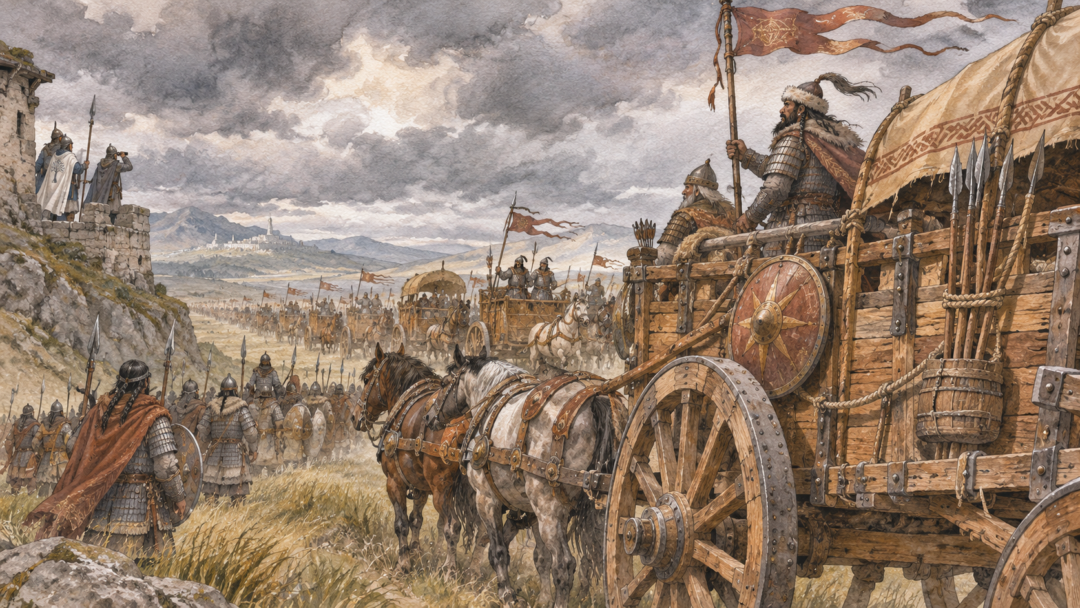
Their characteristic equipment included wagons or wains, and their armies employed war-chariots. Readers might associate these vehicles with an archaic steppe society confronting an advanced settled kingdom. Yet wagons and chariots represent technological choices, not a civilization’s overall developmental level. Building and maintaining them on a military scale requires woodworking, wheel-making, metal fittings, animal husbandry, and logistical expertise.
The Wainriders repeatedly challenged Gondor. In Third Age 1944, their offensive contributed to the deaths of King Ondoher and his sons. Eärnil subsequently defeated them, but Gondor’s inherited military institutions had not guaranteed victory.
Their campaigns involved coordinated movements, alliances, and exploitation of strategic opportunities, not merely numerical pressure. Such forces cannot reasonably be dismissed as disorganized or technologically helpless.
Nevertheless, military competence does not prove equality in architecture, civilian engineering, or production. These sources demonstrate substantial eastern military organization without documenting eastern material culture comprehensively. That distinction is essential: the evidence defeats a simplistic stereotype but cannot establish complete technological parity.
Gondor’s Greatness Is Real, but It Is Not a Universal Measuring Stick
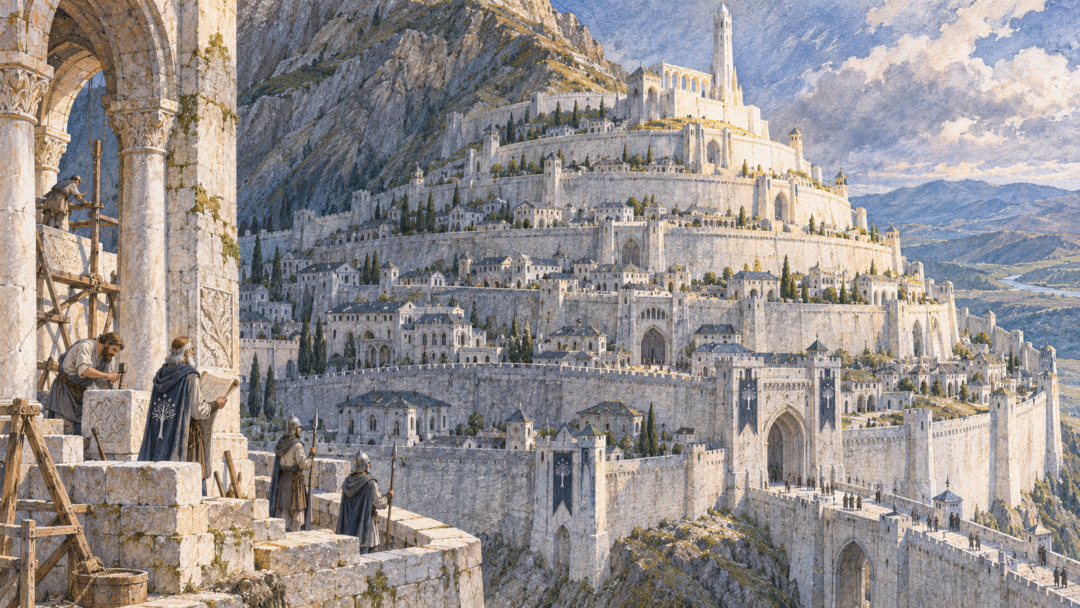
Tolkien presents Gondor as heir to remarkable Númenórean knowledge and craftsmanship. Its founders established settlements distinguished by monumental works, including Minas Anor, Minas Ithil, Orthanc, and other structures of the kingdoms in exile.
The Lord of the Rings, especially ‘Minas Tirith’ and Appendix A, portrays Gondor’s capital as an extraordinary architectural achievement sustained by historical memory. The Silmarillion, in ‘Akallabêth’ and ‘Of the Rings of Power and the Third Age,’ provides the wider Númenórean background.
These passages establish Gondor’s impressive building traditions and institutions. They do not demonstrate that every society east of Gondor was less developed. Evidence for one civilization’s achievements cannot establish another civilization’s deficiencies.
Moreover, Gondor’s greatest structures are frequently legacies of a stronger past. Its history is not a continuous ascent toward technological sophistication but one of population decline, territorial losses, diminished authority, and preservation of earlier works.
Nor does Númenórean descent provide a simple ranking of civilizations. Tolkien associates Númenor with extraordinary gifts and accomplishments, but also with catastrophic moral failure. Technical mastery and political power do not guarantee wisdom.
Gondor therefore demonstrates what western Númenórean civilization achieved, not what eastern civilizations failed to achieve. Confusing these propositions turns a better-documented history into an unsupported universal judgment.
Sauron Loved Order, Machinery, and the Power to Control
Sauron is not merely a destroyer or champion of chaos. His desire for organization and effective control is central to his corruption.
In Morgoth’s Ring, ‘Myths Transformed,’ the essay ‘Notes on motives in the Silmarillion’ explains that Sauron originally valued order, coordination, and the elimination of wasteful confusion. Unlike Morgoth, whose evil became increasingly destructive and nihilistic, Sauron sought to arrange the world according to his will. Tolkien even allows that his earlier ambitions included concern for his subjects’ material well-being, before domination became paramount.
Letter 131, addressed to Milton Waldman, supplies the broader philosophical framework. Tolkien’s concept of the Machine concerns external means of imposing desired results and subordinating the world or other wills to a controlling design. It encompasses coercive systems as well as physical machinery.
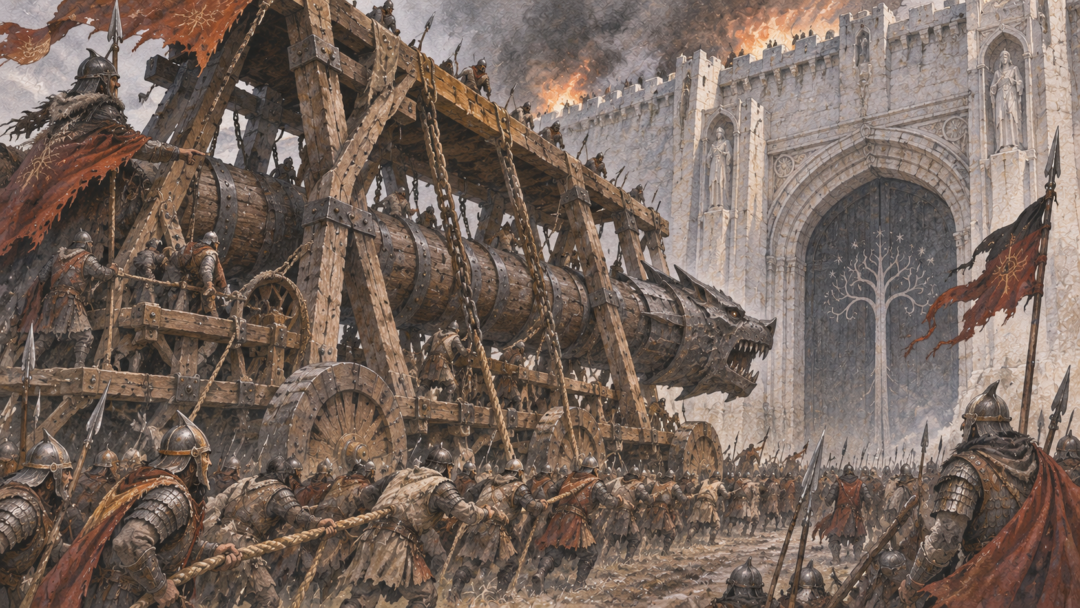
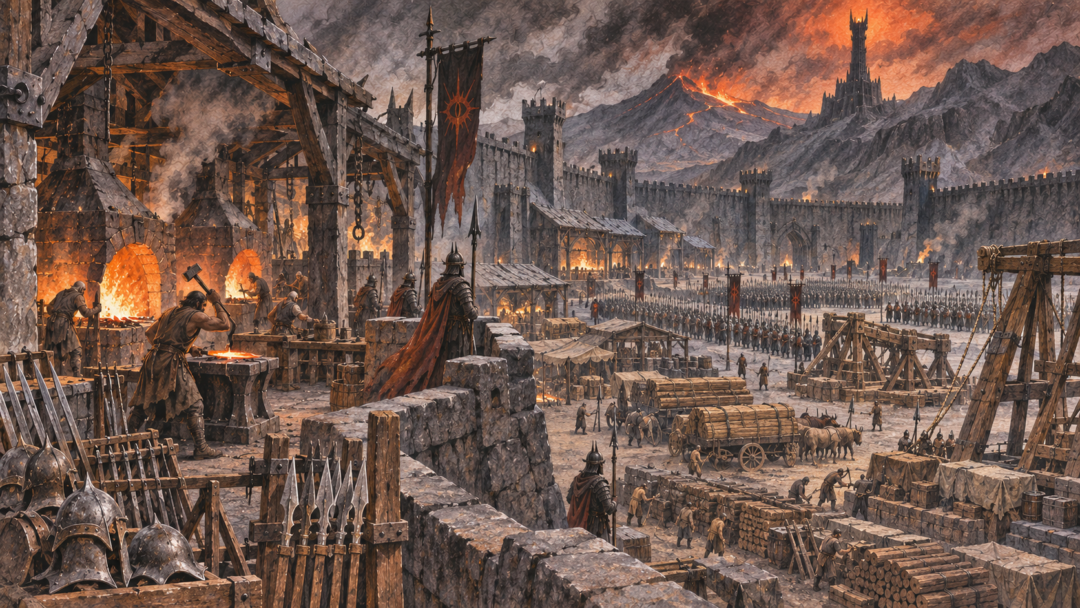
The narrative supplies concrete examples. Mordor maintains fortifications, armies, supplies, workshops, and siege equipment. In ‘The Siege of Gondor,’ Sauron’s forces employ substantial military engineering, notably the enormous battering ram Grond. His command mobilizes resources across great distances.
Saruman offers a smaller-scale parallel. In ‘Treebeard’ and ‘Flotsam and Jetsam,’ his machinery, furnaces, and exploitation of the landscape embody domination through organized production.
Crucially, none of this proves Sauron industrialized Rhûn. Tolkien establishes his organizational and material power but describes no systematic eastern technological development program. Such a program is conceivable, not canonical.
Being Subject to Sauron Does Not Explain Eastern Society
The Silmarillion, in ‘Of the Rings of Power and the Third Age,’ describes Sauron’s efforts to dominate Middle-earth’s peoples. The Lord of the Rings confirms his influence over substantial forces beyond Mordor. Yet political subordination does not determine cultural identity.
Eastern kingdoms might have served Sauron while retaining their own rulers, crafts, institutions, and military customs. Alternatively, he might have exploited populations without substantially improving their infrastructure. Both possibilities fit the limited evidence; Tolkien does not specify which arrangements prevailed.
Neither should we assume Sauron distributed knowledge generously. His objective was mastery rather than independent prosperity. Technical expertise might strengthen servants, while excessive independence might threaten his authority. This is an interpretation consistent with Morgoth’s Ring and Letter 131, not a documented eastern economic policy.
Tolkien also allows for resistance beyond the West. In The Silmarillion, ‘Of the Coming of Men into the West’ shows that early human allegiances were not determined simply by geography. In ‘Of the Fifth Battle,’ Bór and his sons remain faithful to the Elves, whereas Ulfang’s people betray them. These First Age Easterlings belong to a different historical setting from later inhabitants of Rhûn, but demonstrate that eastern origin does not dictate allegiance.
Later accounts preserve similar uncertainty. Unfinished Tales, ‘The Istari,’ acknowledges western ignorance about the two Blue Wizards who travelled east. The later conception in The Peoples of Middle-earth, ‘Last Writings,’ envisages their efforts encouraging resistance to Sauron among eastern peoples. These are developing accounts, not one settled history, but neither supports an East inhabited exclusively by willing servants of evil.
The Historical Analogy Is Tempting but Misleading
The Wainriders invite comparison with horse-using peoples of the Eurasian steppes, while Gondor’s monumental architecture and imperial inheritance recall ancient and medieval states. Such analogies can illuminate contrasting military traditions, but become misleading when turned into rankings of civilization.
Mobility is not inherently primitive. It may reflect deliberate adaptation to geography, subsistence, warfare, or political organization. Chariots likewise do not locate an entire culture on a single technological timeline. Historical societies developed different capabilities according to their circumstances; Tolkien’s fictional peoples should not be reduced to a modern progress chart.
The published texts do not identify Rhûn as the precise equivalent of any historical Asian civilization. Nor do they describe eastern societies sufficiently to compare literacy, metallurgy, urbanization, mathematics, or economic productivity.
Literary perspective nevertheless matters. The Lord of the Rings employs inherited western conventions, including a threatened realm confronting armies from distant lands. Its depictions of foreign enemies sometimes emphasize unfamiliar appearance, martial spectacle, and invasion. These conventions have historical associations worth recognizing.
But recognizing that imagery does not justify assigning fictional peoples deficiencies stereotypically attributed to real-world outsiders. In ‘Of Herbs and Stewed Rabbit,’ Sam wonders whether a fallen Southron was truly evil or had been driven from home by deception or threats. This concerns Harad, not Rhûn, and must not be presented as an eastern episode. It nevertheless shows Tolkien distinguishing an enemy soldier from the cause he serves.
The appropriate response is to recognize the narrative’s western perspective without treating it as a comprehensive description of eastern civilization.
What Can Actually Be Concluded About the East?
Three conclusions follow from the texts. Gondor inherited exceptional Númenórean craftsmanship, architecture, and political traditions. Eastern peoples included formidable military powers capable of sustained campaigns, strategic coordination, and specialized equipment. Yet Tolkien provides no systematic comparison of Gondorian and eastern civilian technology.
Sauron’s devotion to organized power further undermines assumptions that his eastern allies must have been incapable of sophisticated production. His machinery and administrative capacity make uniform technological helplessness an especially doubtful inference. They do not, however, establish that Rhûn possessed factories, advanced cities, or an economy comparable to Gondor’s. Those matters remain unknown.
We may reasonably imagine eastern societies possessing extensive infrastructure, skilled artisans, and distinctive technologies. We may equally imagine political and economic arrangements radically different from Gondor’s. Neither reconstruction becomes Tolkien’s established history without textual support.
Ultimately, the East is not demonstrated to be primitive; it is insufficiently described. Its armies appear because they affect Gondor’s fate, while the societies behind them remain largely outside the narrative. Sauron’s commitment to order complicates assumptions of backwardness without resolving that silence.
Calling Rhûn more primitive than Gondor therefore converts distance, military hostility, and missing information into an imagined hierarchy of civilizations. Tolkien’s published texts do not warrant that conclusion.
Sources & Notes
This article is based on close reading and interpretation of Tolkien's published works and related source material where relevant.