The Choice That Almost Broke Frodo
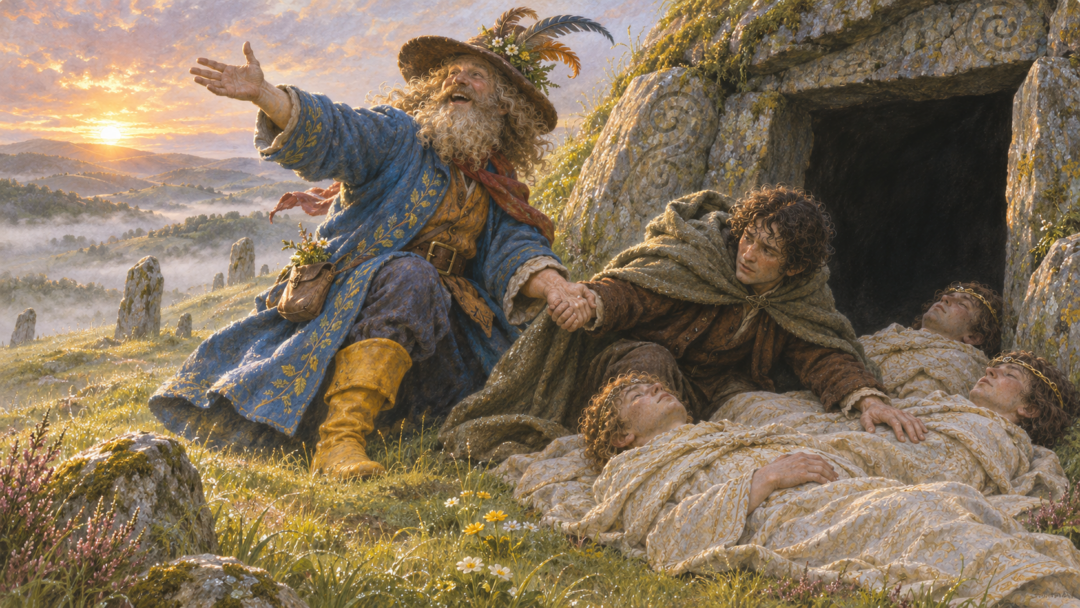
Inside the Barrow-downs, Frodo Baggins faces a temptation that exposes the moral foundations of his journey. His companions lie helpless beneath an ancient sword, a Barrow-wight approaches, and the One Ring offers apparent escape. Frodo imagines slipping away invisibly, abandoning Sam, Merry, and Pippin. Instead, he resists, seizes a sword, and strikes the wight’s advancing hand.
Without his awakening courage, Frodo would plausibly have been more likely to put on the Ring and escape alone. His affection for his friends might have survived, but fear could have overridden his willingness to protect them, endangering both their lives and his subsequent resistance to the Ring.
This conclusion is explicitly hypothetical. Tolkien never establishes what an alternative choice would have produced, although he identifies Frodo’s awakened courage as decisive in overcoming the temptation.
The premise also requires qualification. Tolkien does not depict the hobbits as having completed a separate process of hardening before their capture. Frodo’s resolve develops through earlier experiences and, crucially, inside the barrow. The counterfactual must therefore imagine that this immediate awakening fails. The scene is not merely the exercise of previously acquired bravery: latent courage becomes an active moral force.
Courage Awakens Before the Ring Is Considered
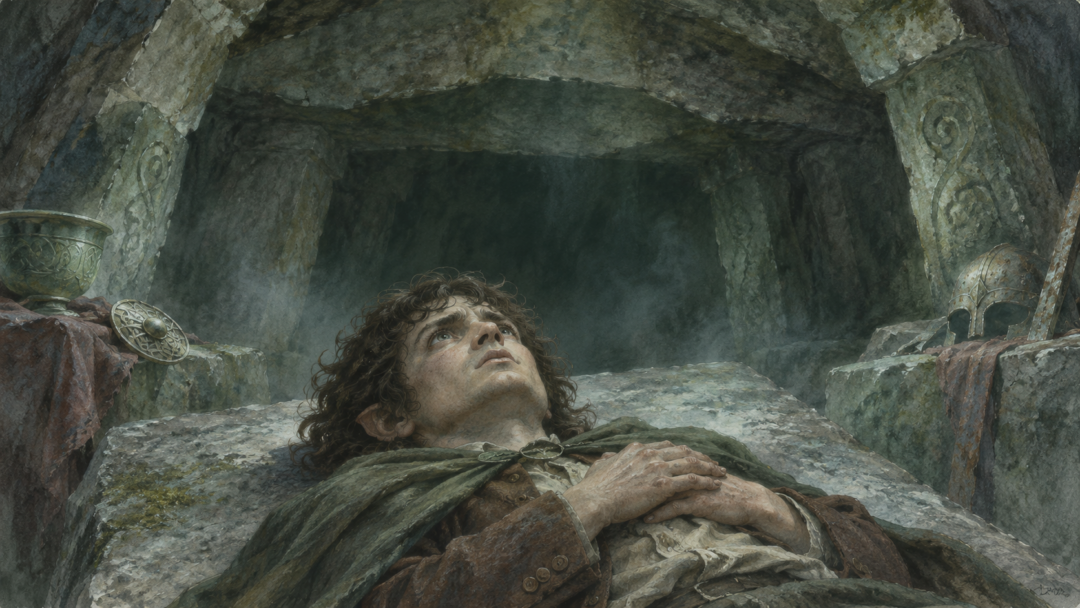
In The Fellowship of the Ring, Book I, Chapter 8, ‘Fog on the Barrow-downs,’ Frodo awakens on cold stone, terrified and apparently imprisoned by supernatural powers. Before seeing his companions or considering the Ring, he remembers Bilbo, their conversations, and stories of adventures. These memories reconnect him with life beyond his fear.
Tolkien invokes the image of a hidden seed of courage within hobbits, capable of growing under desperate circumstances. Bilbo and Gandalf already esteem Frodo highly, though he does not know it. Facing the possibility of death paradoxically strengthens his will: he begins to emerge from helpless terror.
His earlier experiences matter. Frodo has encountered the Black Riders, accepted his friends’ determination to accompany him, endured the Old Forest, and witnessed Tom Bombadil’s intervention against Old Man Willow. Yet Tolkien locates a crucial awakening of courage within the tomb itself. His preparation is both experiential and intrinsic: danger calls forth capacities rather than creating them from nothing.
Had those capacities remained dormant, Frodo might still have loved his companions while interpreting fear as proof that resistance was impossible. The Ring’s apparent promise of escape would then have become considerably harder to refuse.
The Ring Offers Survival at the Price of Loyalty
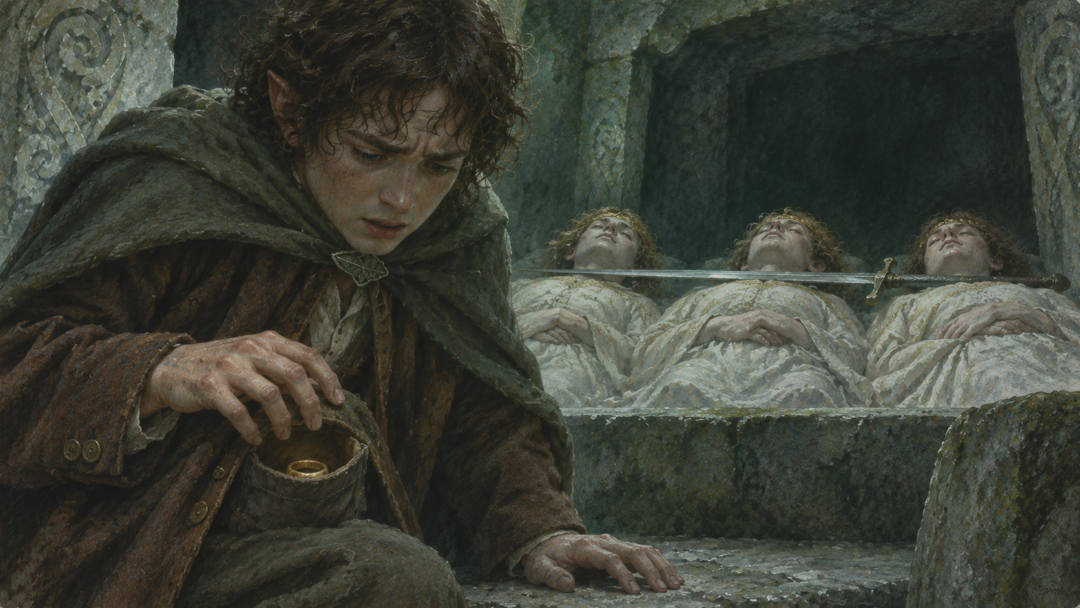
Frodo sees a long arm approaching the sword across his companions’ necks. They cannot defend themselves, and he has no assurance that he can save them.
He considers putting on the Ring, hoping the wight will overlook him and he can find an exit. He imagines surviving, grieving for his abandoned friends, and receiving Gandalf’s understanding that nothing else could have been done.
That imagined justification reveals the temptation’s moral danger. Frodo does not envision becoming indifferent or cruel. He pictures himself sorrowful but reasonable, preserving his self-image while sacrificing his companions. Abandonment becomes a regrettable necessity rather than an acknowledged betrayal.
Tolkien does not explicitly state that the Ring speaks to Frodo, manufactures the thought, or independently controls his imagination. The chapter records an impulse to use it, not a demonstrated act of supernatural persuasion. Describing the episode as temptation associated with the Ring is justified; specifying how Sauron manipulates Frodo’s thoughts would exceed the evidence.
Nevertheless, the Ring presents a seemingly practical way to avoid responsibility. Without awakened courage, Frodo might have reasoned that remaining would simply create another victim, whereas escape would preserve the Ring-bearer.
Such reasoning would not necessarily extinguish his affection. It would allow fear to prevail over his willingness to risk himself. The hypothetical difference is not that Frodo ceases loving Sam, Merry, and Pippin, but that he might stop treating their helplessness as a demand upon his own actions.
The Moment When Resolve Defeats Fear
Tolkien makes Frodo’s actual resistance unusually explicit. His awakened courage prevents him from readily abandoning his friends, although he hesitates, reaches toward his pocket, and struggles again against the impulse. Resistance is neither effortless nor instantaneous.
That hesitation makes the counterfactual credible. A less resolute Frodo would need no new desire for the Ring; he would simply cease opposing an option already under consideration.
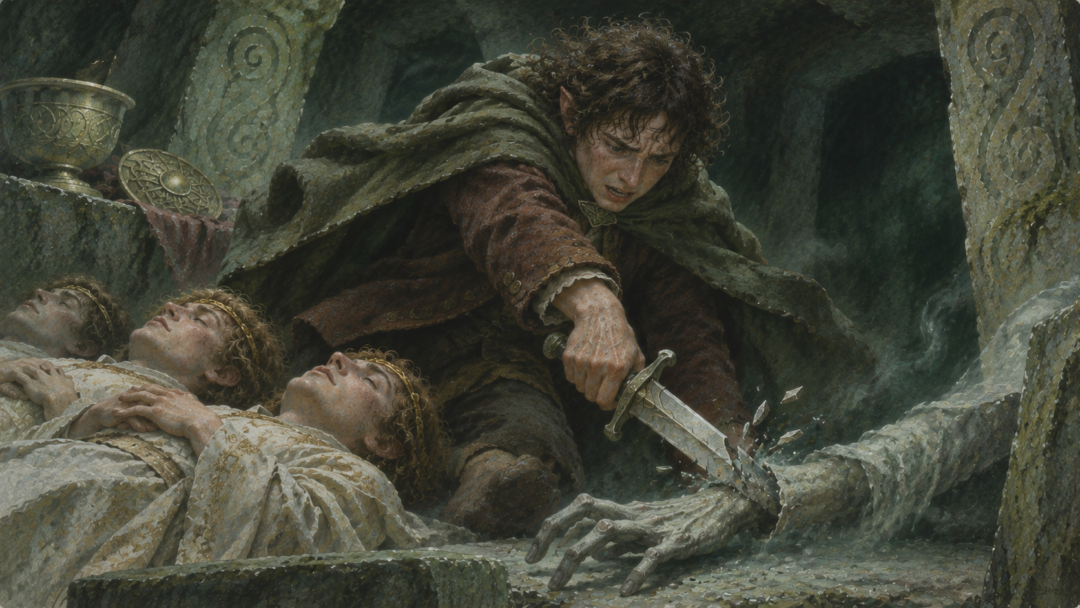
Instead, he seizes a short sword and attacks the approaching arm. His blow severs the hand, but the weapon breaks and the chamber falls into darkness. The danger remains. His bravery consists partly in acting without any guarantee of victory or survival.
Without that resolve, Frodo might have remained frozen, attempted to flee without the Ring, or put it on and sought invisibility. The last possibility has the strongest textual foundation because Tolkien explicitly presents it as Frodo’s contemplated escape.
Even so, abandonment is not inevitable. Frodo might have hesitated until the opportunity vanished, or affection might have awakened resistance through another route. The defensible inference is that removing the force Tolkien identifies as overcoming temptation makes surrender substantially more plausible.
The distinction also clarifies loyalty. In the actual scene, loyalty becomes more than affection: it motivates action despite immediate personal danger. Without courage, Frodo’s attachment might have survived only as grief after abandonment rather than protection before catastrophe.
Would the Ring Actually Have Saved Him?
Frodo’s imagined escape might not have succeeded. The Ring renders its mortal wearer invisible to ordinary sight, as Bilbo demonstrates in The Hobbit, notably ‘Riddles in the Dark,’ and as The Lord of the Rings repeatedly confirms. But invisibility provides neither invulnerability nor guaranteed concealment from supernatural enemies.
In ‘A Knife in the Dark,’ Frodo wears the Ring during the attack at Weathertop. Instead of securing safety, it exposes him to a terrifying perception of the Ringwraiths. The Witch-king wounds him, nearly drawing him into their shadowy condition.
The Barrow-wight is not identified as a Ringwraith, and the two must not be conflated. Nevertheless, Weathertop demonstrates the unreliability of assuming that invisibility guarantees protection.
Tolkien never establishes whether the Barrow-wight could perceive an invisible Frodo or whether Frodo could have found the exit while wearing the Ring. Successful escape is therefore only one possibility. He might have remained within the wight’s reach, lost his bearings, or become trapped.
Gandalf’s explanation in ‘The Shadow of the Past’ also establishes the Ring’s corrupting influence. It cannot safely be regarded as an innocent protective instrument. Using it for an apparently necessary purpose is dangerous precisely because immediate usefulness can obscure longer moral costs.
Had Frodo put it on, he would have surrendered a significant moral choice without securing his survival. He was tempted by the possibility of escape, not a proven means of achieving it. His courage allowed him to refuse that uncertain bargain.
Why His Friends Would Have Been in Greater Danger
Abandonment would probably have exposed Sam, Merry, and Pippin to grave danger, although their precise fate cannot be established.
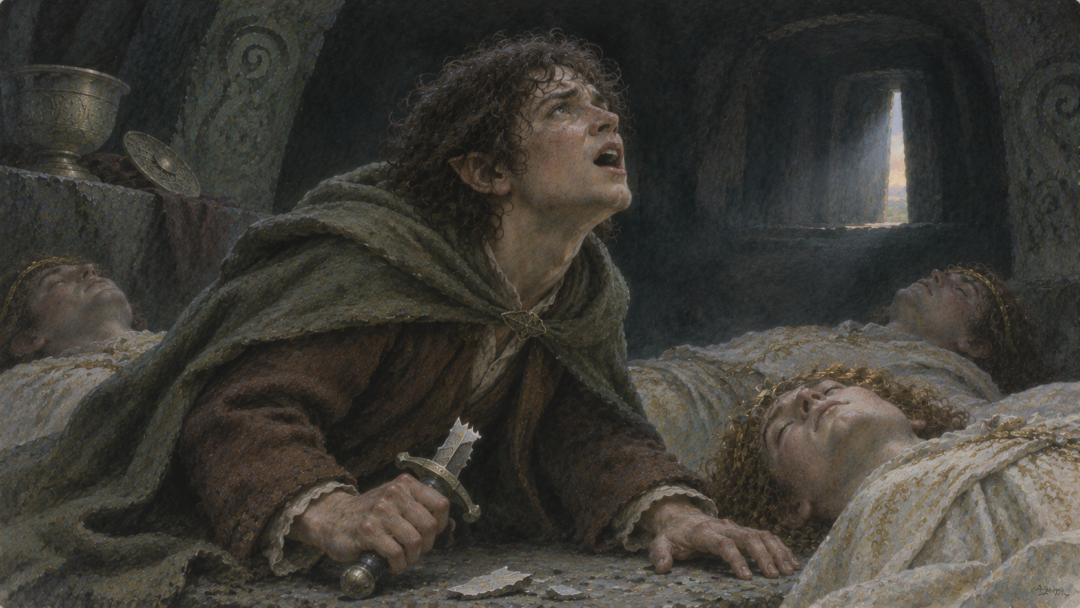
In Tolkien’s account, Frodo interrupts the approaching arm, subsequently remembers Bombadil’s summoning rhyme, and calls for help. Tom arrives, banishes the wight, and helps bring the hobbits into daylight. Their restoration depends upon Bombadil’s intervention, not Frodo defeating the creature alone.
The sequence links courage to rescue. Frodo stays, interrupts the immediate threat, and summons someone demonstrably capable of breaking the wight’s hold. Had he fled, the arm might have reached the sword uninterrupted, leaving his companions exposed to the creature’s intentions.
Their ritual arrangement, the sword across their necks, and the wight’s deathly incantation strongly suggest mortal peril. However, Tolkien does not establish the ritual’s precise nature or its inevitable outcome. Claims that the hobbits certainly would have died or become Barrow-wights would go beyond the narrative.
Bombadil might conceivably have rescued them anyway. Yet the text never shows him discovering their predicament independently of Frodo’s summons. His ability to answer a call does not establish that he would have arrived without one.
Likewise, Frodo might have remembered the rhyme without first attacking the arm. The published sequence places recollection after his resistance and desperate struggle, but does not prove that another sequence was impossible.
The soundest conclusion is therefore limited but important: fleeing would have removed the companions’ only active defender and disrupted the chain of events through which their rescue actually occurred.
Gandalf’s Judgment Reveals the Stakes
In The Fellowship of the Ring, Book II, Chapter 1, ‘Many Meetings,’ Gandalf recalls Frodo’s strength in the barrow and describes the episode as perhaps his most dangerous experience thus far. This is striking because Frodo has subsequently confronted the Nazgûl and suffered the Morgul-knife wound at Weathertop.
Gandalf does not explain every reason for this judgment. His words do not establish that Frodo nearly surrendered the Ring to Sauron or that wearing it would certainly have caused capture. They nevertheless confirm the episode’s exceptional danger.
One plausible interpretation is that Gandalf recognizes several intertwined threats: supernatural captivity, the possible abandonment of companions, and the temptation to seek safety through the Ring.
Had Frodo escaped while leaving his friends exposed to death, he might also have carried the memory of a profound failure of loyalty. Tolkien does not say how that guilt would have shaped him. Repentance, despair, renewed determination, and further rationalization are all conceivable; none is inevitable.
A comparison with Amon Hen clarifies the moral distinction. In ‘The Breaking of the Fellowship,’ Frodo decides to continue toward Mordor without the Company because he believes separation necessary to spare others the Ring’s danger and burden.
That differs fundamentally from abandoning helpless companions for personal survival. Separation in the barrow would represent retreat from responsibility; at Amon Hen, Frodo intends it as protection.
Tolkien therefore does not make physical togetherness the measure of loyalty. Purpose and willingness to sacrifice determine the moral character of a decision. In the barrow, Frodo discovers through action that protecting others may require risking himself.
The First Victory of an Imperfect Ring-bearer
The barrow anticipates Frodo’s wider moral struggle without guaranteeing eventual success. Throughout The Lord of the Rings, exhaustion, fear, and the Ring’s growing influence test his commitment. His resistance is never unlimited.
At the Cracks of Doom, in ‘Mount Doom,’ he ultimately claims the Ring rather than voluntarily destroying it. Tolkien’s Letters, particularly Letter 246, discusses the extraordinary pressure upon Frodo and the limits of his capacity at the end.
That failure prevents us from treating his courage in the barrow as evidence of an invincible will. Resisting one temptation does not guarantee resistance under every circumstance. Moral strength remains vulnerable to suffering and corruption.
The reverse is equally important. A hypothetical failure in the barrow would not prove Frodo incapable of recovering courage. Tolkien supplies no such alternative history, and redemption after wrongdoing is compatible with the legendarium’s broader moral framework.
The strongest inference concerns immediate danger, not an inevitable future. Without awakened resolve, Frodo would have been more susceptible to escaping alone, more likely to mistake self-preservation for necessity, and less capable of translating affection into self-sacrificing action.
His actual achievement is resistance without certainty of success. He cannot know whether his sword will work, whether the wight can be defeated, or whether help will arrive. He knows only that his companions are helpless and that abandoning them would betray their trust.
This is an early expression of Frodo’s heroism as Ring-bearer: not mastery over the Ring, but refusal of its apparent convenience when accepting that convenience would compromise his loyalty.
Had his courage remained dormant, he might have put on the Ring and fled. His companions could have been lost, while his own escape remained uncertain. Tolkien establishes neither outcome as inevitable and offers no definite account of the aftermath.
What the text does establish is the decisive role of Frodo’s awakened resolve. In the barrow, courage enables him to place his friends’ lives before his own immediate safety. His first great victory is not overcoming evil by force, but refusing to let fear persuade him to abandon those he loves.
Sources & Notes
This article is based on close reading and interpretation of Tolkien's published works and related source material where relevant.