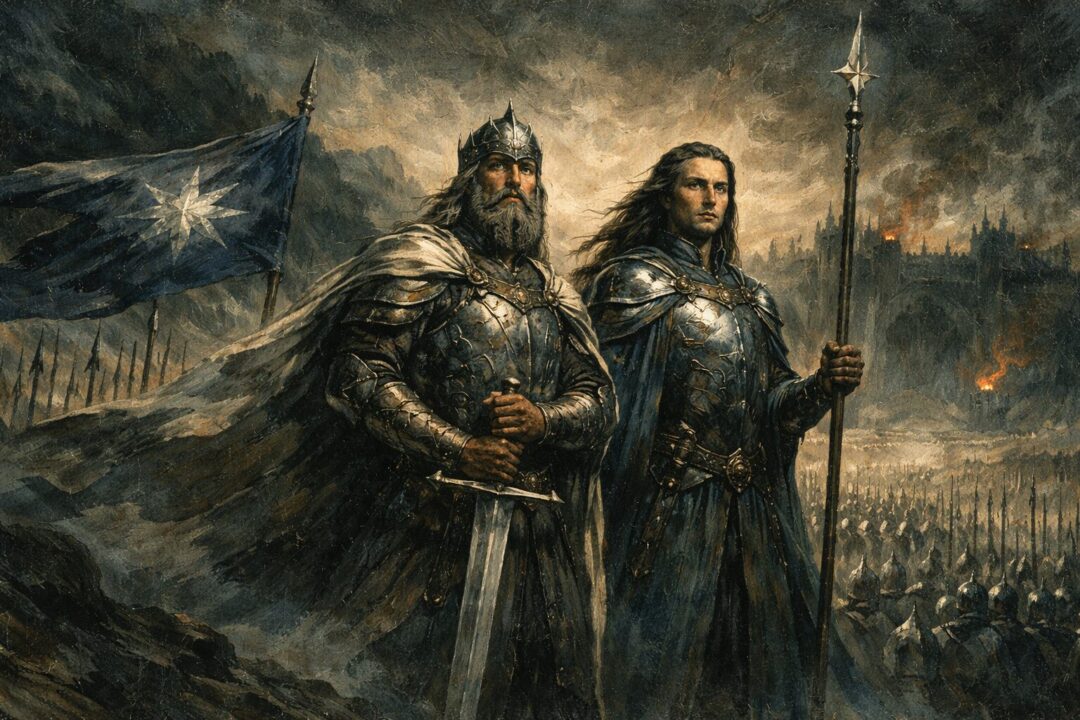
In the long history of Middle-earth, few events are spoken of with as much reverence as the War of the Last Alliance. It is remembered as the moment when Elves and Men finally stood together, united against the Dark Lord, and struck him down at the height of his power.
It is the great heroic climax of the Second Age: banners raised, ancient kings marching east, and the final overthrow of Sauron in open war.
And yet, when the event is examined closely—through its timing, its cost, and its consequences—a quieter and more troubling truth emerges from the texts.
The Last Alliance was not a turning point that saved the world.
It was a response to a catastrophe that had already happened.
The World Before the Alliance
By the time Elendil and Gil-galad marched east with their hosts, Sauron was not a rising threat testing the strength of the Free Peoples.
He was already an established power.
The One Ring had been forged long before, in the heart of the Second Age. Its making was not secret in retrospect; its consequences had already unfolded across centuries. Through it, Sauron had bent much of Middle-earth to his will, even while appearing fair and offering knowledge to the Elves.
Eregion had already been destroyed.
Celebrimbor was dead.
The greatest craftsmen of the Elves were gone.
The Elves had paid the price of deception early—and permanently.
Most devastating of all, Númenor, the mightiest realm of Men, had already fallen beneath the sea.
This matters more than any battlefield victory or defeat.
The Downfall of Númenor is not merely background lore or tragic ornamentation. It is the central wound of the Second Age. Tolkien makes clear that Sauron’s greatest triumph was not achieved through armies or siege engines, but through corruption—spiritual, moral, and political.
By poisoning Númenor from within, Sauron removed the single greatest check on his dominance. The realm that might have overthrown him outright was destroyed by its own pride before it ever marched.
The Last Alliance forms only after this loss.
It is not born from confidence or momentum.
It is born from necessity and desperation.
Why the Alliance Formed So Late
Tolkien never suggests that the Elves and Men were blind to Sauron’s danger. Nor does he portray them as indifferent or foolish. Instead, the texts imply a long period of hesitation, distance, and fractured resistance.
The Elves of the Second Age were not the Elves of the First.
They were fewer.
They were more cautious.
They were already turning inward, guarding what remained rather than reshaping the world.
Men, meanwhile, were deeply divided. Númenor itself had split between the Faithful and the King’s Men long before its destruction. After the Downfall, those who survived did so as refugees, founding Arnor and Gondor in exile rather than dominance.
Centuries of suspicion and distance lay between the races.
Only when Sauron openly declared himself—only when he returned to Mordor in strength and attacked the realms of the Faithful directly—did unity become unavoidable.
The Last Alliance was not delayed because of ignorance.
It was delayed because the world itself was already fractured, wounded, and diminished.
By the time unity was achieved, it was already too late to prevent the greatest losses of the age.
Victory at a Terrible Price
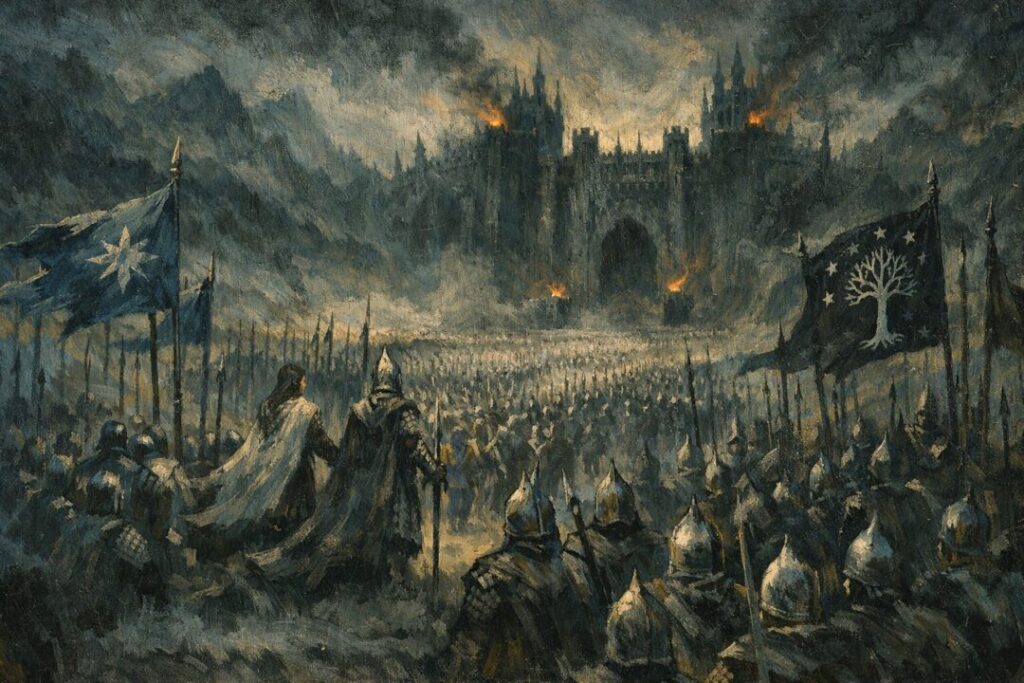
Militarily, the alliance succeeds.
Sauron is defeated in open combat.
His armies are broken.
Barad-dûr is overthrown after a long siege.
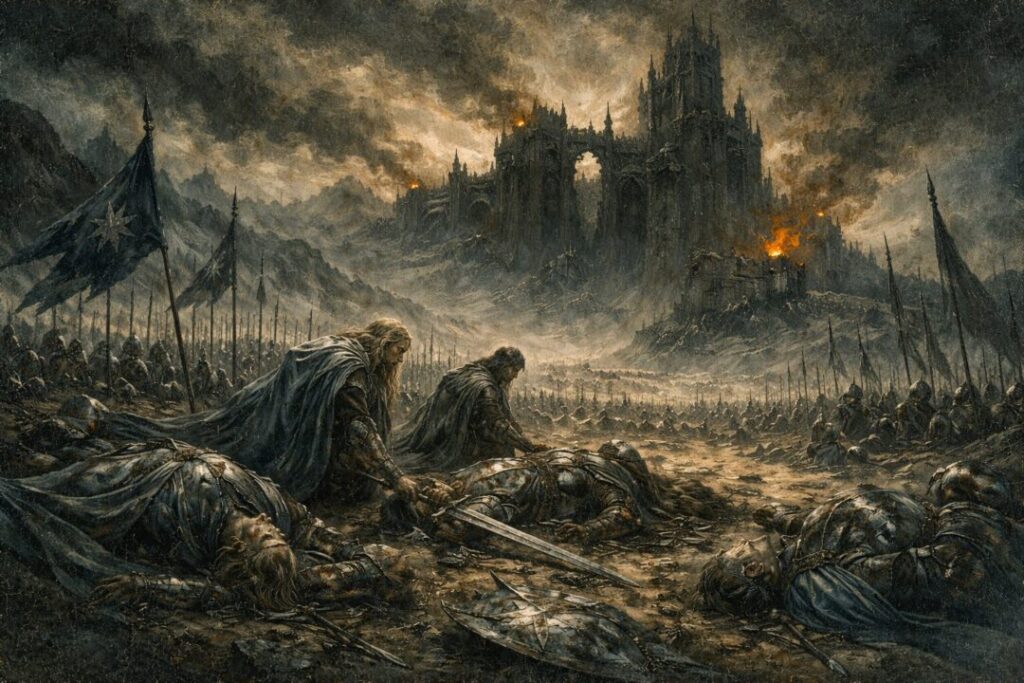
At the climax of the war, Sauron himself comes forth, and he is cast down by Elendil and Gil-galad together—both of whom perish in the act.
This detail is essential.
Tolkien is explicit that the deaths of these two kings mark the true end of an age. Their loss is not merely symbolic or emotional; it is structural. After them, there will be no comparable union of authority, lineage, and power among Elves and Men.
The world that follows is weaker by design.
And even this victory is incomplete.
The One Ring survives.
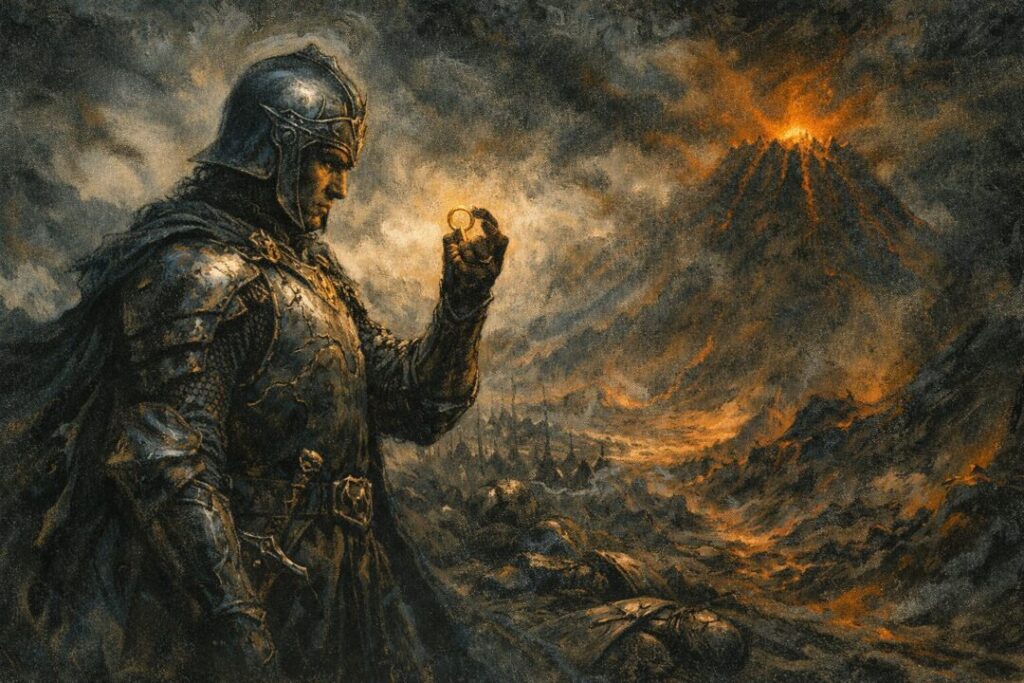
Isildur takes it from Sauron’s hand, but does not destroy it. Tolkien never presents this failure as villainy or simple moral weakness. It is framed as tragedy—an unbearable moral weight placed upon a single survivor at the end of an age of bloodshed.
The texts never suggest that the Ring could easily have been unmade in that moment, nor that Isildur fully understood the scope of what he held.
The alliance removes Sauron’s body.
It does not remove his power.
What the Alliance Could Not Undo
The most important limitation of the Last Alliance is not found on the battlefield.
It is found in what it could not restore.
Númenor remains drowned.
Its culture, wisdom, and unmatched strength are gone forever.
The Elves begin their final fading. Even in victory, they are no longer a people moving toward renewal. Their greatest works lie behind them, not ahead.
Men inherit a broken world rather than a healed one. Their kingdoms rise, but always under the shadow of decline rather than ascent.
This is why Tolkien treats the Second and Third Ages so differently from the First.
The First Age is defined by loss followed by renewal.
The later ages are defined by loss followed only by delay.
The Last Alliance does not begin an era of growth.
It postpones extinction.
Why This Matters for The Lord of the Rings
Understanding the lateness of the Last Alliance clarifies the entire structure of The Lord of the Rings.
By the Third Age, no alliance of comparable power is even possible. The world no longer contains the strength required to repeat such a stand. There are no great kings of the Eldar marching east. No united hosts of unmatched Men. No moment left where victory can be achieved through force alone.
This is why the final struggle against Sauron takes such a different form.
Victory comes not through unity of arms, but through secrecy, endurance, mercy, and moral resistance. The fate of the world rests not on kings and banners, but on a small company—and ultimately on a single hobbit.
The failure of the Last Alliance to finish the war is precisely what makes Frodo’s task necessary.
In that sense, the alliance does matter—but not in the way legends suggest.
It is not the solution.
It is the prelude.
A Victory That Could Only Delay the End
The Last Alliance was heroic.
It was necessary.
It was also late.
Tolkien does not frame this as a mistake or a failure of wisdom. He presents it as the reality of a fallen world—one in which perfect timing is no longer available, and moral action must occur even when it cannot fully heal what has been broken.
History in Middle-earth is not saved by flawless strategy.
It is shaped by courage offered when perfection is no longer possible.
The Last Alliance stands as the final echo of an older world—one last moment when greatness gathered, knowing it could not truly win, but choosing to stand anyway.
And perhaps that is why it still matters at all.
Sources & Notes
- J.R.R. Tolkien, The Silmarillion, ‘Of the Rings of Power and the Third Age’ — for the forging of the One Ring, the ruin of Eregion, Sauron’s war with the Elves, and the later Last Alliance of Elves and Men.
- J.R.R. Tolkien, The Silmarillion, ‘Akallabêth’ — for Sauron’s corruption of Númenor from within and the Downfall that precedes the Last Alliance.
- J.R.R. Tolkien, The Lord of the Rings, Appendix A, ‘Annals of the Kings and Rulers: Númenórean Kings’ — for Elendil’s exile-realms, the war against Sauron, and the deaths of Gil-galad and Elendil.
- J.R.R. Tolkien, The Lord of the Rings, Book II, Chapter 2, ‘The Council of Elrond’ — for Isildur taking the Ring and the later understanding that Sauron’s power endured while the Ring survived.
- J.R.R. Tolkien, The Letters of J.R.R. Tolkien, Letter 131 — for Tolkien’s broader account of Sauron’s will to order, domination, and corruption rather than mere battlefield conquest.