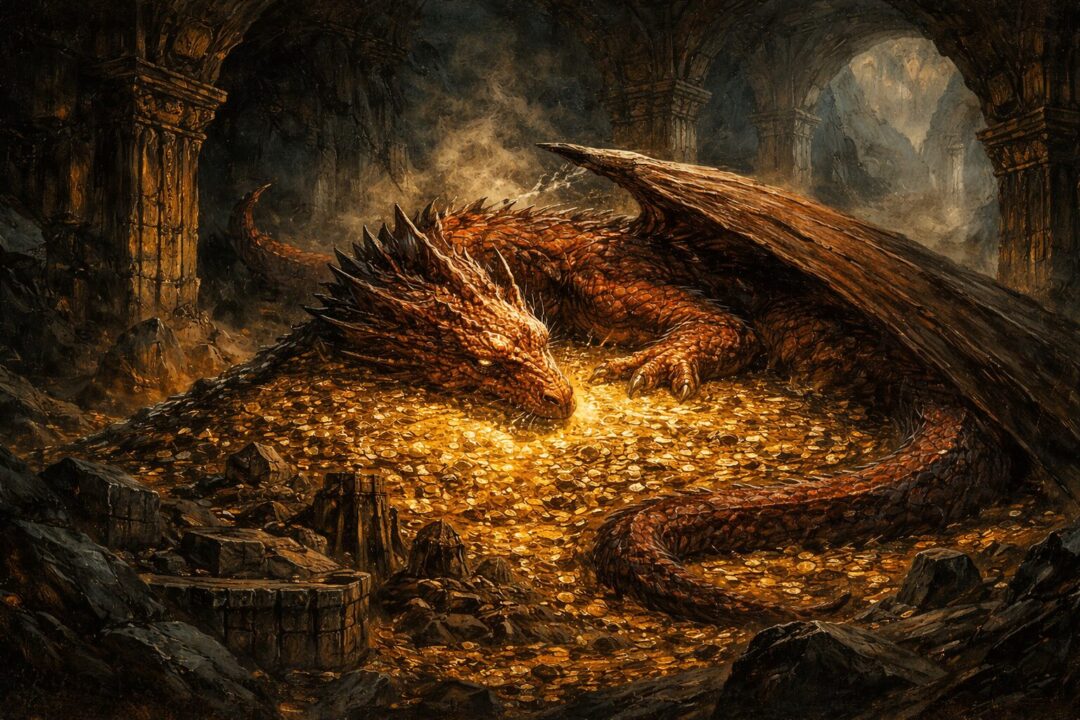
Gandalf’s role in The Hobbit is often misunderstood.
He appears suddenly at Bag End, gathers a band of dispossessed Dwarves, insists on bringing along a quiet Hobbit with no experience of the wider world, and then — just as suddenly — vanishes for long stretches of the journey. To many readers, especially on a first reading, his actions can feel whimsical or even careless, as if he is improvising rather than guiding events.
At times, Gandalf seems almost irresponsible: leaving Bilbo and the Dwarves to face trolls, goblins, spiders, and Elves on their own while he attends to mysterious business elsewhere.
But when The Hobbit is read alongside Tolkien’s wider legendarium, a very different picture emerges.
Gandalf’s involvement in Thorin Oakenshield’s quest is neither accidental nor sentimental. It is deliberate, restrained, and deeply connected to the long struggle against Sauron — even though Sauron never appears directly in The Hobbit at all.
To understand why Gandalf helps the Dwarves, we must first understand that he is already fighting a much larger war.
Gandalf Was Already Fighting a Larger War
By the time of The Hobbit, set in the year 2941 of the Third Age, Gandalf is not wandering Middle-earth without purpose.
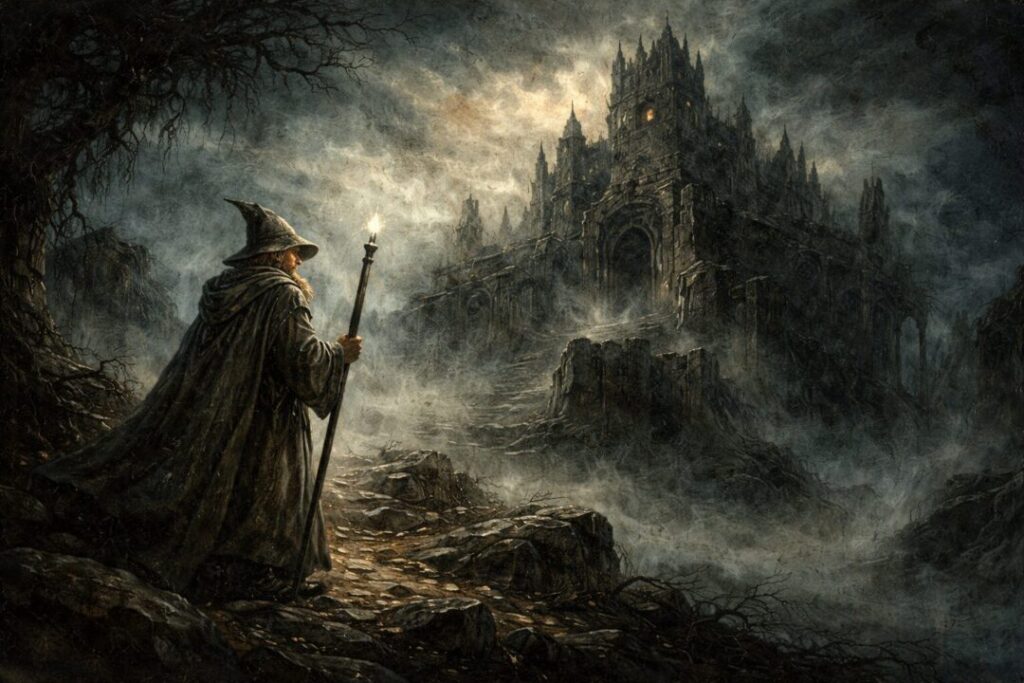
In The Lord of the Rings and in Unfinished Tales, we learn that Gandalf has long been troubled by the growing shadow in southern Mirkwood — the dark power at Dol Guldur. While the true identity of this presence is not yet publicly known, Gandalf strongly suspects that it is connected to the return of Sauron.
This concern is not abstract. Gandalf repeatedly presses the White Council to take action, gathering information, testing the strength of the enemy, and attempting to prevent Sauron from openly re-establishing himself too soon.
This broader context is essential.
Gandalf does not view Middle-earth as a series of disconnected adventures. He understands it as a fragile system, where regional threats can have catastrophic consequences if they align at the wrong moment. Power left unchecked in one place can tip the balance elsewhere.
And in the North, no force is more dangerous — or more unstable — than Smaug.
Smaug as a Strategic Threat
Smaug is not merely a dragon sitting on a pile of gold.
He is intelligent, ancient by the standards of the Third Age, and entirely independent. He dominates the Lonely Mountain, devastates Dale, and forces the Dwarves of Erebor into exile. For decades, he remains unchallenged.
In The Hobbit, Gandalf later explains that Smaug’s continued existence poses a danger not only to nearby lands, but to the Free Peoples as a whole. This danger is not theoretical. Smaug is capable of destroying armies, cities, and entire regions if provoked or directed.
Importantly, Tolkien never states that Smaug served Sauron — and it would be incorrect to claim that he did. Dragons are not servants in the same way Orcs or Nazgûl are. They are willful, greedy, and self-directed.
However, Gandalf explicitly fears what might happen if Sauron were able to use Smaug.
Even without formal allegiance, a dragon unleashed at the right time could devastate Rivendell, threaten Lothlórien, or cripple the North while Sauron advanced elsewhere. Smaug’s independence makes him dangerous; his potential alignment makes him catastrophic.
Removing Smaug, then, is not an act of heroism for its own sake.
It is a preventative strike against a future disaster.
Why Gandalf Couldn’t Act Openly
If Smaug represents such a danger, a natural question arises: why doesn’t Gandalf confront him directly?
The answer lies in the nature of Gandalf himself.
As one of the Istari, Gandalf is not sent to Middle-earth to dominate events by force. His mission is not to overthrow evil through displays of overwhelming power, but to encourage resistance, strengthen resolve, and unite the Free Peoples against the Shadow.
Direct confrontation — especially against a dragon — would violate both the purpose and the method of his role. Gandalf is permitted to advise, to warn, and to guide. He is not meant to replace the choices and courage of others.
This is a pattern repeated throughout Tolkien’s works.
Gandalf does not slay the Witch-king.
He does not claim the Ring.
He does not rule kingdoms.
Instead, he nudges events, placing the right people in the right positions and trusting them to act.
The quest to Erebor follows this same philosophy.
Thorin’s Claim — and Gandalf’s Calculation
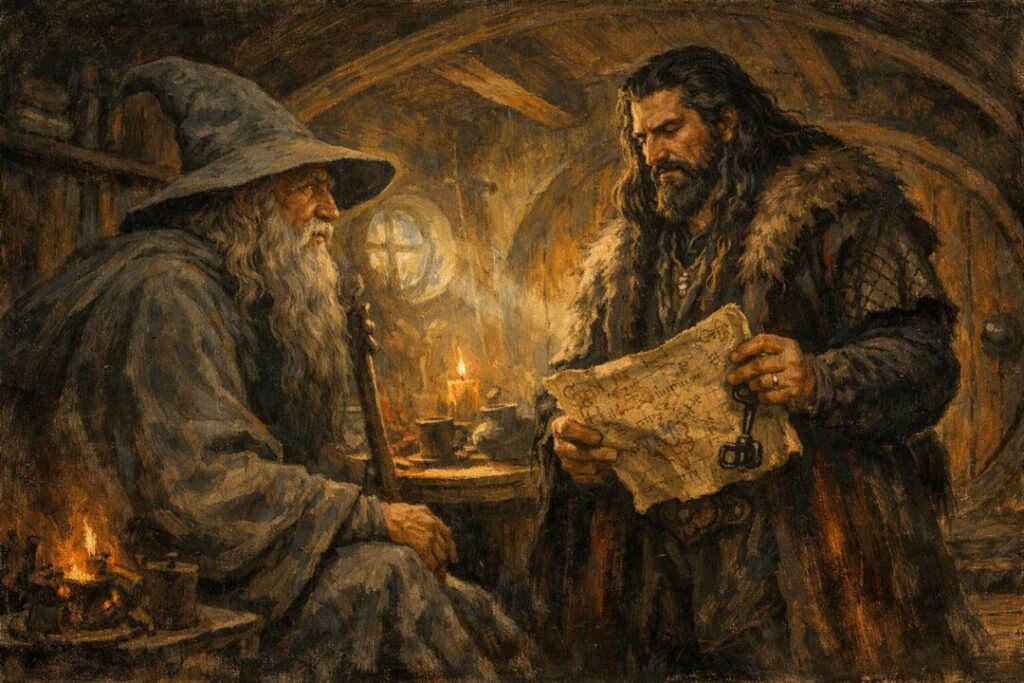
Thorin Oakenshield’s desire to reclaim Erebor provides Gandalf with something crucial: legitimacy.
This is not a Wizard attacking a dragon out of strategy. It is a dispossessed king seeking to reclaim his ancestral home. That distinction matters deeply in Tolkien’s moral framework.
A rightful claim transforms the quest from an act of aggression into an act of restoration. It limits the political fallout and frames the conflict as a matter of justice rather than conquest.
But Thorin alone is not enough.
A large army would alert Smaug.
A public campaign would provoke war across the North.
An open assault would draw attention from powers Gandalf does not want watching.
What Gandalf needs is subtlety.
He needs a plan that avoids spectacle and minimizes collateral damage.
He needs someone small.
Why Bilbo Matters More Than the Dwarves
Bilbo Baggins is not chosen for his strength, skill, or bravery — at least not at first.
He is chosen because he is unexpected.
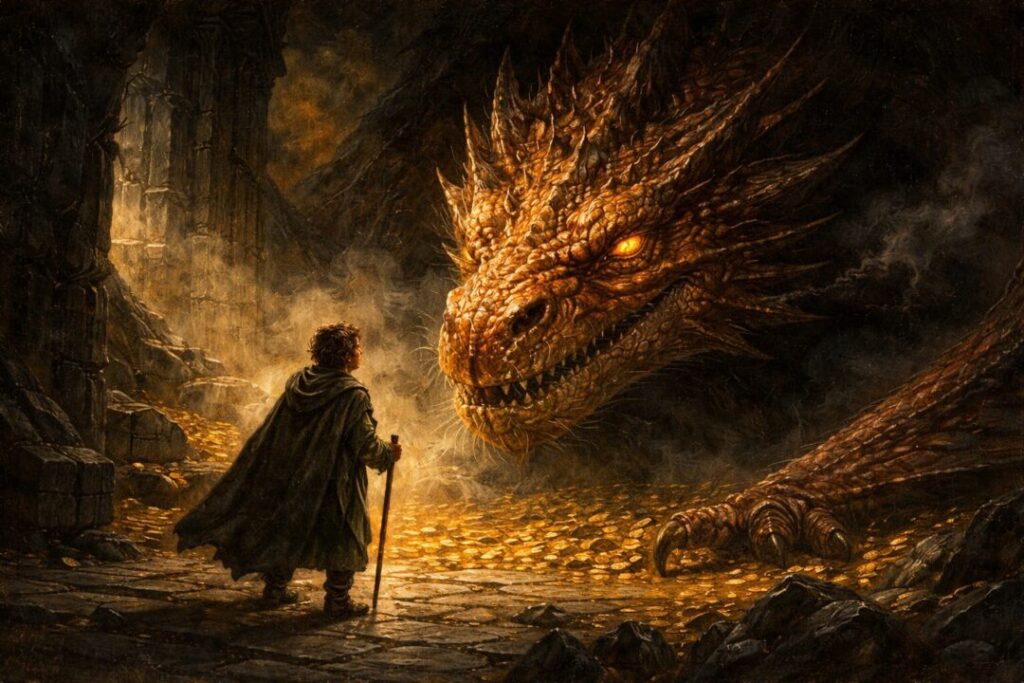
Gandalf explicitly remarks that Hobbits are overlooked by the great powers of the world. They do not register as threats. They inspire neither fear nor suspicion. In a world shaped by pride and power, this makes them uniquely effective.
Bilbo’s role is not to fight Smaug.
It is to speak to him.
Smaug’s greatest weakness is not a missing scale or a vulnerable spot in his armor. It is his pride. He delights in boasting. He enjoys psychological dominance. He assumes superiority — especially over small, seemingly harmless creatures.
Bilbo exploits this perfectly.
In their conversation, Smaug talks.
He reveals information.
He boasts of his invulnerability.
And in doing so, he exposes the weakness that Bard will later exploit.
This chain of events does not happen by accident. It only occurs because Gandalf placed a Hobbit — not a warrior — at the center of the encounter.
Gandalf’s Absence — and the White Council
Gandalf’s long disappearance from the quest is sometimes treated as a narrative convenience.
In reality, it is anything but.
During this time, Gandalf is actively involved with the White Council’s assault on Dol Guldur. This action forces Sauron to abandon the stronghold — temporarily, but at a critical moment.
The timing is not accidental.
Smaug is removed from the board.
Sauron is driven into retreat.
The North is stabilized.
These events occur in parallel, not coincidence.
By eliminating Smaug while pressuring Sauron elsewhere, Gandalf ensures that two major threats cannot converge.
It is not a dramatic victory.
It is a quiet one.
A Quiet Victory, Not a Grand One
Gandalf does not claim credit for the Quest of Erebor.
He does not rule Erebor.
He does not remain to guide Thorin.
He does not attend the rebuilding of Dale.
Because that was never the point.
The true victory of The Hobbit is not the reclaiming of treasure, but the prevention of a far darker future — one in which a dragon and a Dark Lord reshaped the fate of Middle-earth together.
Gandalf helps the Dwarves, yes.
But he is really helping everyone else.
And as always, he does it not through force, but through trust — placing the fate of the world into the smallest, most overlooked hands, and allowing courage to grow where power would only corrupt.
That is not whimsy.
It is strategy.
And it is one of the most quietly profound choices Gandalf ever makes.
Sources & Notes
- J.R.R. Tolkien, Unfinished Tales, “The Quest of Erebor” — Gandalf’s later account of choosing Bilbo and treating Smaug as a strategic danger in the North.
- J.R.R. Tolkien, The Hobbit, Chapter 1, “An Unexpected Party” — Thorin’s claim, Gandalf’s plan, and Bilbo’s unlikely recruitment for the quest.
- J.R.R. Tolkien, The Hobbit, Chapter 12, “Inside Information” — Bilbo’s talk with Smaug reveals both the dragon’s pride and the bare patch in his armour.
- J.R.R. Tolkien, The Hobbit, Chapter 14, “Fire and Water” — Smaug’s attack on Lake-town and Bard’s shot show why a living dragon was a regional catastrophe, not just a hoarder.
- J.R.R. Tolkien, The Lord of the Rings, Appendix B, “The Tale of Years” — places the Quest of Erebor and the White Council’s attack on Dol Guldur in the same year, linking the northern strategy to Sauron’s return.