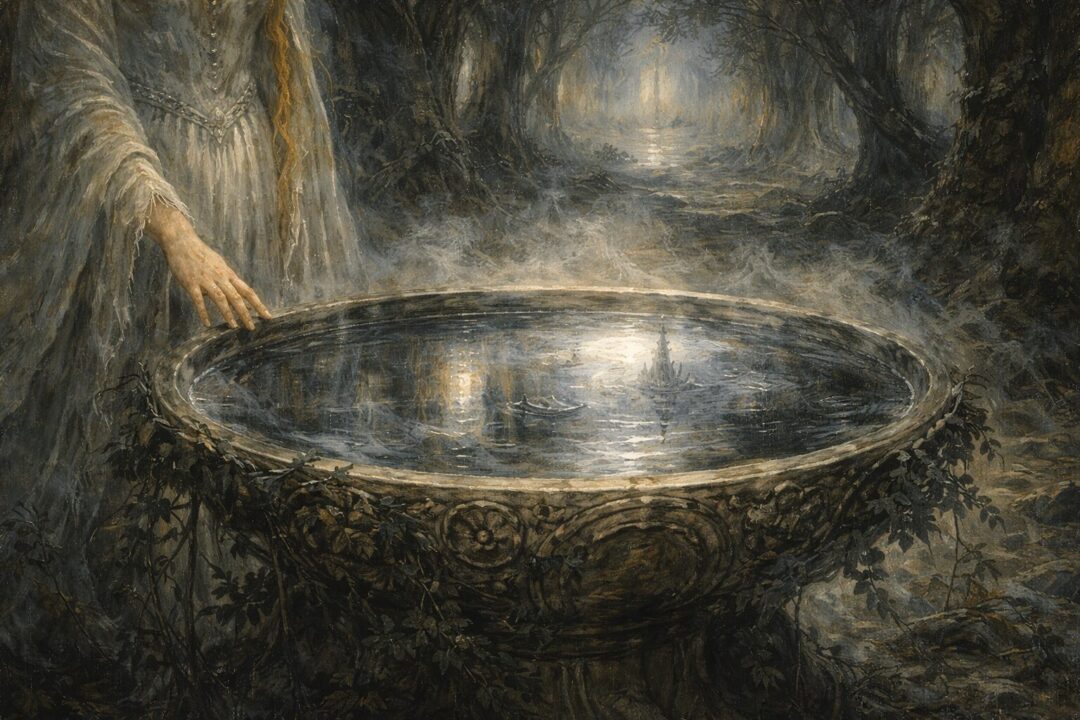
Few scenes in The Fellowship of the Ring unfold with less action—and fewer spoken words—than Frodo’s meeting with Galadriel. Yet few moments carry greater weight.
There is no battle.
No confrontation.
No visible struggle.
And yet, in the quiet heart of Lothlórien, the fate of Middle-earth tilts on a single choice.
Frodo does something unprecedented: he offers the One Ring freely to another.
Not under threat.
Not through deception.
Not by force.
He offers it openly, with full awareness of what it is.
This moment often passes quickly for readers. It is quiet, almost restrained, especially when compared to the violence and terror that surround the Ring elsewhere. But this exchange reveals more about the true nature of the Ring—and about Frodo himself—than many louder scenes.
To understand why Frodo makes this offer, we must first understand where he is in his journey, and what Galadriel represents within the moral structure of Middle-earth.
Frodo’s State of Mind in Lothlórien
By the time the Fellowship reaches Lothlórien, Frodo Baggins is already changed in ways that are easy to overlook.
He has been wounded by the Witch-king at Weathertop—a wound that is not merely physical, but spiritual.
He has crossed into the unseen world while wearing the Ring and survived an experience meant to destroy him.
He has begun to feel the Ring not as an object he carries, but as a presence that presses back.
The text makes clear that Frodo’s burden is no longer abstract. The Ring weighs on his mind. He feels exposed, observed, and increasingly isolated—even among companions who care deeply for him.
Lothlórien, for all its beauty, does not soothe this feeling. It intensifies it.
Time behaves strangely there. Thoughts seem closer to the surface. Memory, desire, and fear feel sharper. Tolkien repeatedly describes the land as one that strips away pretense and reveals truth.
In this environment, Frodo cannot hide from the Ring—or from himself.
Galadriel does not interrogate him. She does not demand explanations. She does not ask to see the Ring.
Instead, she allows Frodo to perceive her thoughts, and—more importantly—to realize that she perceives his.
This mutual awareness is crucial.
For perhaps the first time since leaving the Shire, Frodo is fully understood without having to explain himself. Galadriel knows what the Ring is. She knows what it does. And she knows what it is doing to him.
When Frodo offers her the Ring, he is not acting blindly or impulsively.
He is acting in full knowledge that she understands the cost.

Why Galadriel, Specifically?
Galadriel occupies a singular position in Middle-earth.
She is not a tyrant seeking domination, like Sauron.
She is not a steward clinging desperately to fading authority.
She is not naïve about the Ring’s nature or its danger.
The texts never present Galadriel as ignorant of temptation. On the contrary, they imply—carefully and without explicit exposition—that she understands the Ring’s allure more clearly than almost anyone else still living in Middle-earth.
She has lived through the rebellion of the Noldor.
She has seen the ruin of great realms.
She has witnessed how noble intentions curdle into tyranny.
Tolkien never states outright that Galadriel has personally desired supreme power before this moment—but her own words strongly suggest a long history of renunciation. Her test in Lothlórien is not sudden. It is the culmination of centuries of restraint.
When Frodo offers her the Ring, he is not merely trying to escape responsibility.
He is asking a moral question that lies at the heart of the entire story:
Can absolute power be wielded rightly, if the wielder is good enough?
This is not a childish hope. It is a reasonable question in a world where evil has often been opposed by strength.
Galadriel answers it not with argument, but with revelation.
Galadriel’s Temptation and Refusal
When Galadriel imagines herself as a queen, the text is careful and unsettling.
She is not depicted as monstrous.
She is not shown as cruel.
She is not even shown as false.
She would be beautiful and terrible.
She would overthrow Sauron.
She would bring order.
The text emphasizes that this vision is real. It is not a lie of the Ring. It is a genuine possibility.
This matters.
The Ring’s danger does not lie in offering empty promises. It lies in fulfilling them—at a cost that reshapes the world according to a single will.
Galadriel understands this immediately.
If she takes the Ring, she will defeat evil by becoming something equally absolute. The freedom of others would survive only so long as it aligned with her wisdom.
When she says, “I pass the test,” it is not triumphal.
It is resigned.
With that refusal, she accepts not only the loss of power, but the eventual fading of her realm and her own departure from Middle-earth. The Ring had offered her permanence. She chooses transience instead.
In doing so, she confirms a fundamental rule that governs Tolkien’s world: the Ring cannot be used to achieve good without destroying the moral freedom of the world.

Frodo’s Offer Is Not Failure
It is tempting to read Frodo’s action as weakness—a moment where his courage falters.
But the text does not condemn him.
At this stage in his journey, Frodo does not yet understand that no one can bear the Ring safely. He still believes that somewhere there must exist a wiser hand, a stronger will, a purer heart.
This belief is not foolish. It is human.
Offering the Ring to Galadriel is the moment when that belief finally collapses.
When she refuses, Frodo learns something essential: the burden cannot be delegated. It cannot be solved by finding the “right” person.
From this point forward, Frodo no longer offers the Ring freely. The task becomes fully internal. The Ring is now hisburden, whether he wants it or not.
This marks a psychological turning point.
Frodo does not become stronger in the sense of power. He becomes more isolated, more inward, and more resigned. His heroism begins to resemble endurance rather than hope.
The Larger Pattern in Middle-earth
Frodo’s offer to Galadriel mirrors a broader pattern repeated throughout the story.
Gandalf refuses the Ring.
Elrond does not claim it.
Galadriel rejects it.
Each refusal reinforces the same truth: evil in Middle-earth is not defeated by superior power, but by restraint.
This is why the Ring is entrusted to a Hobbit.
Not because Hobbits are immune.
Not because they are stronger.
But because they desire domination least.
Even so, the Ring nearly breaks Frodo.
This, too, is part of the lesson.

Why This Moment Still Matters
Modern fantasy often treats power as a neutral tool, waiting for the right person to wield it wisely.
Middle-earth does not.
The Ring exposes the flaw in that thinking. Frodo’s offer and Galadriel’s refusal together form one of the clearest moral statements in the entire legendarium: that some victories can only be won by letting go.
Frodo learns this lesson slowly, painfully, and incompletely.
Galadriel already knows it.
And in that quiet exchange beneath the trees of Lothlórien, the fate of the world shifts—not through action, but through refusal.
Sources & Notes
- J.R.R. Tolkien, The Lord of the Rings, Book II, Chapter 7, “The Mirror of Galadriel” — Frodo offers the Ring to Galadriel, and her refusal becomes the explicit “test.”
- J.R.R. Tolkien, The Lord of the Rings, Book I, Chapter 2, “The Shadow of the Past” — Gandalf refuses the Ring because he would try to use it from pity and be corrupted by power.
- J.R.R. Tolkien, The Lord of the Rings, Book II, Chapter 2, “The Council of Elrond” — the Wise reject using the Ruling Ring as a weapon against Sauron.
- J.R.R. Tolkien, Unfinished Tales, “The History of Galadriel and Celeborn” — gives Galadriel’s long Noldorin background, pride, and desire for a realm of her own.
- J.R.R. Tolkien, The Letters of J.R.R. Tolkien, Letter 131 — explains the One Ring as domination of other wills, clarifying why even “good” use would become tyrannical.